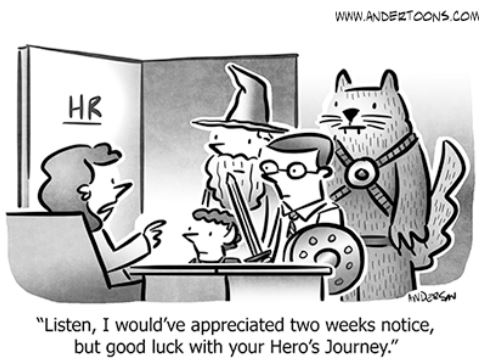
Going on a Hero’s Journey is an epic quest of adventure and excitement. It’s funny to think of the hero stopping, and realizing that it will take so long that they need to take care of mundane things like quitting their job. It’s also funny to think of HR thinking that they should have gotten two weeks notice, when the Hero is facing something as important as the Hero’s Journey. Not ROTFLMAO, but it worked OK for me.
Step one of the Hero’s Journey — the Call to Adventure, in which the hero is called to drop their daily life and become something else. It would have been really nice if he had been given two weeks to prepare, to let HR know that he was going to get a Call to Adventure and have to leave all of that behind, but he wasn’t. And he’s trying to be as responsible as he can, letting them know that, hey, this wizard, elf, and bearcat-wookie-like thing just showed up and are telling me that I’m the chosen one and have to leave.
HR is annoyed, because the Call To Adventure never comes at a convenient time, but they’re trying to be as understanding as they can.
Ah, a scholarly cartoon, exploring one facet of the monomyth described by Joseph Campbell’s classic work of comparative mythology, The Hero with a Thousand Faces. As described in the Wikipedia article: “”The hero’s adventure” begins in the ordinary world. He must depart from the ordinary world, when he receives a call to adventure.” Leaving the quotidian workplace to embark on that journey is a key step.
The cartoonist may never have heard of Campbell, but the analysis still works. Typically those to whom the demands of the humdrum everyday are owed either forgo them freely in the face of the call to adventure, or strongly resist the hero’s attempt to leave. Here, HR has taken a middle path, allowing the departure but expressing annoyance that the adventurers did not more fully comply with their mundane procedures. The contrast between heroic adventures and HR’s attitude gives the cartoon its humor.
Wow, you guys of really analyzing.
I just thought the idea was funny for a person on a hero’s journey to go through the mundane processes of going through HR to leave his office job, and that it was funny for the HR person in seeing a person on a hero’s journey to see it from the mundane HR perspective of wanting two weeks notice.
So I recognize Gandalf and Frodo and I think that’s Chewbacca, but who’s the guy in a white shirt & tie with sword/shield? Is he just “ordinary guy” juxtaposed with the well known heroes?
not_woozy: Isn’t that that same as what others have said?
Willdebeast: The guy in the white shirt is the “ordinary guy” who’s been called on the Hero’s Journey, and who is coming to HR to let them know that he’s quitting. The Hero’s Journey is a quest for a single Hero – the other are just there to help him. (And also just happen to be accompanying him to HR; they presumably don’t also work in this building.)
Wittdebeast — I don’t think it’s even specifically Gandalf, Frodo, or Chewbacca — just “Wizard”, “Hobbit/Elf/Other Short Pointy-Eared Fantasy Type” and “Large Furry Barbarian Nonhuman Type”. Beings of whom Gandalf, Frodo, and Chewbacca are among the most prominent examples, but not actually them in particular.
“Is he just “ordinary guy” juxtaposed with the well known heroes?”
Yes. That’s the entire joke.
Yeah, that looks more like a large cat being. Shirt-and-tie guy (I guess business casual has not penetrated their company yet) has been swept up into the adventure and is turning in his notice.
The way it is drawn it looks as though ALL the characters are employees of this company, as they all seem to be up in front of the HR person and equally at fault. It might have looked better if all but Tie Guy were standing outside the door, or at least to one side, arms folded and faces displaying some impatience: “we have to go on this heroic mission and you two are doing corporate admin?”
Instead it looks as though they are all equally mildly disconcerted at being told off, but aware HR has a point.
I like your idea more than the comic itself.
I just thought it was a twist on the usual reasons for quitting a mundane office job, juxtaposed with HR’s mundane reaction.
I do often think about characters and how they earn a living. Not Hero’s Journey specifically, but a common thing we see in fiction (movies, TV, books) is that protagonist occupations seem to contain a lot of architects, magazine writers/editors, other writers, advertising executives. I think this is because the writers imagine these as jobs that give a great deal of free time for the character to run around and do things other than spend 10 hours/day commuting and working. Not true of course. When I worked at the magazine, I had to keep regular office hours except when out interviewing or going to press conferences. Doctor and cop are also two other common character jobs, but those usually play a central role to the story, rather than being peripheral. Like real life, working gets in the way of the story.
Also, based on my own experience, I can’t help but think that this is also an example of HR failing to recognize the skills and potential of the staff. My experience in the work world is that you need to change companies to get a substantial upgrade in role and pay. HR saw they were cube slaves and assumed that was all they could do.
I thought this same concept was well-executed in a deleted scene from The Blues Brothers, where Elwood quits his job at an aerosol can factory. I can see why it was deleted, it doesn’t move the story much and there is not much reason to think or care that Elwood has a day job, but I found it funny how Elwood’s boss’ attitude changes quickly from annoyed to extremely respectful after Elwood lies and claims he’s quitting to become a priest.
At some point Clark Kent went from being a newspaper reporter to being a television news anchorman. Now as a newspaper reporter he could always say “Sorry, Lois, I have to rush off — there’s a story out there that I have to get” and not come back for a few days. But what can Superman do when he’s trapped on a planet a billion light-years away that has a red sun, so he can’t fly, and he’s surrounded with green Kryptonite and he has to be on the air in two minutes?
 Comics I Don't Understand
Going on a Hero’s Journey is an epic quest of adventure and excitement. It’s funny to think of the hero stopping, and realizing that it will take so long that they need to take care of mundane things like quitting their job. It’s also funny to think of HR thinking that they should have gotten two weeks notice, when the Hero is facing something as important as the Hero’s Journey. Not ROTFLMAO, but it worked OK for me.
Step one of the Hero’s Journey — the Call to Adventure, in which the hero is called to drop their daily life and become something else. It would have been really nice if he had been given two weeks to prepare, to let HR know that he was going to get a Call to Adventure and have to leave all of that behind, but he wasn’t. And he’s trying to be as responsible as he can, letting them know that, hey, this wizard, elf, and bearcat-wookie-like thing just showed up and are telling me that I’m the chosen one and have to leave.
HR is annoyed, because the Call To Adventure never comes at a convenient time, but they’re trying to be as understanding as they can.
Ah, a scholarly cartoon, exploring one facet of the monomyth described by Joseph Campbell’s classic work of comparative mythology, The Hero with a Thousand Faces. As described in the Wikipedia article: “”The hero’s adventure” begins in the ordinary world. He must depart from the ordinary world, when he receives a call to adventure.” Leaving the quotidian workplace to embark on that journey is a key step.
The cartoonist may never have heard of Campbell, but the analysis still works. Typically those to whom the demands of the humdrum everyday are owed either forgo them freely in the face of the call to adventure, or strongly resist the hero’s attempt to leave. Here, HR has taken a middle path, allowing the departure but expressing annoyance that the adventurers did not more fully comply with their mundane procedures. The contrast between heroic adventures and HR’s attitude gives the cartoon its humor.
Wow, you guys of really analyzing.
I just thought the idea was funny for a person on a hero’s journey to go through the mundane processes of going through HR to leave his office job, and that it was funny for the HR person in seeing a person on a hero’s journey to see it from the mundane HR perspective of wanting two weeks notice.
So I recognize Gandalf and Frodo and I think that’s Chewbacca, but who’s the guy in a white shirt & tie with sword/shield? Is he just “ordinary guy” juxtaposed with the well known heroes?
not_woozy: Isn’t that that same as what others have said?
Willdebeast: The guy in the white shirt is the “ordinary guy” who’s been called on the Hero’s Journey, and who is coming to HR to let them know that he’s quitting. The Hero’s Journey is a quest for a single Hero – the other are just there to help him. (And also just happen to be accompanying him to HR; they presumably don’t also work in this building.)
Wittdebeast — I don’t think it’s even specifically Gandalf, Frodo, or Chewbacca — just “Wizard”, “Hobbit/Elf/Other Short Pointy-Eared Fantasy Type” and “Large Furry Barbarian Nonhuman Type”. Beings of whom Gandalf, Frodo, and Chewbacca are among the most prominent examples, but not actually them in particular.
“Is he just “ordinary guy” juxtaposed with the well known heroes?”
Yes. That’s the entire joke.
Yeah, that looks more like a large cat being. Shirt-and-tie guy (I guess business casual has not penetrated their company yet) has been swept up into the adventure and is turning in his notice.
The way it is drawn it looks as though ALL the characters are employees of this company, as they all seem to be up in front of the HR person and equally at fault. It might have looked better if all but Tie Guy were standing outside the door, or at least to one side, arms folded and faces displaying some impatience: “we have to go on this heroic mission and you two are doing corporate admin?”
Instead it looks as though they are all equally mildly disconcerted at being told off, but aware HR has a point.
I like your idea more than the comic itself.
I just thought it was a twist on the usual reasons for quitting a mundane office job, juxtaposed with HR’s mundane reaction.
I do often think about characters and how they earn a living. Not Hero’s Journey specifically, but a common thing we see in fiction (movies, TV, books) is that protagonist occupations seem to contain a lot of architects, magazine writers/editors, other writers, advertising executives. I think this is because the writers imagine these as jobs that give a great deal of free time for the character to run around and do things other than spend 10 hours/day commuting and working. Not true of course. When I worked at the magazine, I had to keep regular office hours except when out interviewing or going to press conferences. Doctor and cop are also two other common character jobs, but those usually play a central role to the story, rather than being peripheral. Like real life, working gets in the way of the story.
Also, based on my own experience, I can’t help but think that this is also an example of HR failing to recognize the skills and potential of the staff. My experience in the work world is that you need to change companies to get a substantial upgrade in role and pay. HR saw they were cube slaves and assumed that was all they could do.
I thought this same concept was well-executed in a deleted scene from The Blues Brothers, where Elwood quits his job at an aerosol can factory. I can see why it was deleted, it doesn’t move the story much and there is not much reason to think or care that Elwood has a day job, but I found it funny how Elwood’s boss’ attitude changes quickly from annoyed to extremely respectful after Elwood lies and claims he’s quitting to become a priest.
*shaking hands*
Elwood: “God bless you, sir.”
Boss: *touched* “Well, thank you!”
At some point Clark Kent went from being a newspaper reporter to being a television news anchorman. Now as a newspaper reporter he could always say “Sorry, Lois, I have to rush off — there’s a story out there that I have to get” and not come back for a few days. But what can Superman do when he’s trapped on a planet a billion light-years away that has a red sun, so he can’t fly, and he’s surrounded with green Kryptonite and he has to be on the air in two minutes?