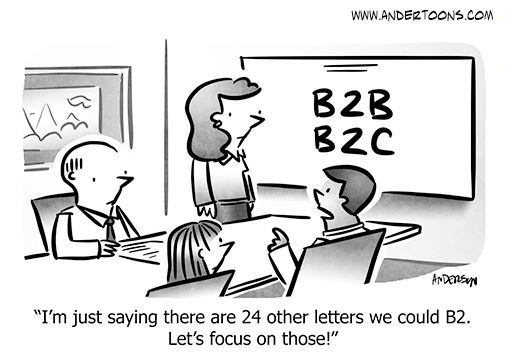
Apparently they’re failing with Business to Business and Business to Consumer. So with 24 other letters to find an acronym for, maybe there’s someone else to sell to.
I really enjoyed seeing that idea elaborated so well in the video!
I think I originally picked it up long ago from a book of riddles and puzzles.
Another I think was from that book:
If the B mt put more :
If the B . putting :
Even though the answer was in the back, my mom (I was somewhere around 6 to 10 y.o.) couldn’t help me understand the answer. Much later I realized it depended on some British names and conventions for punctuation.
“B2G” is a big one in DC (business-to-government), and “B2A” (business to administration) a smaller one.
There’s probably a focus on not-for-profits and NGOs too.
“Do B2B do” is for doing business with Frank Sinatra.
“Do B a do B” is for doing business with Romper Room.
“B2B2B2” is for doing business with minions.
A B C D puppies? L, M N O puppies. O S A R puppies. C M P N?
The B one was this, supposedly posted over a fireplace:
If the B m t put: [ If the great be empty put coal on]
If the B. putting: [If the great be full stop putting coal on]
Don’t put:
-der [Don’t put coal on over a high fender]
U’d b n * it [You’d be an ass to risk it]
Yes! MiB you have the Great B puzzle right, and thanks for the additional lines. Though it may work a little clearer to write “if the grate be” in the explanation part.
Unless you’re strictly limited to alphabetic order, there are 25 other letters, not just 24. Only one of the possible puns on “B2” suggest that limitation.
@ Bob Peters – There are 26 – 2 = 24 letters because the blackboard examples have used both “B” and “C” in the third spot, leaving “B2{A, D, E, F, … X, Y, Z}” as the remaining possibilities. I don’t think alphabetic order enters into this anywhere.
My understanding was that the line was parsed “Abie, see de goldfish?”
William Steig, now known as the creator of Shrek, wrote two books with the titles “C D B.” and “C D C?” Each monologue or dialogue had an accompanying cartoon. One the covers, people point out respectively a bee and the sea. In one of them, a chef exclaims “U 8 D X! 1 NE M?”
Elsewhere, I read about a restaurant patron who was so dissatisfied that he walked out without saying a word, simply leaving the note: I 0 2 O 0 4 I 8 0.
“L, M N O puppies” = Hell, them are no puppies. C M P N will put me in moderation if I spell it out.
The “If the B m t” one is probably 19th-century and British. What we call a period, they call a full stop. “Great B” was how they said “Capital B”.
My dad told me the ABCD puppies one. Another of his favorites: Two men were gazing out to sea when suddenly a submarine surfaced. The first said “Is that a U-Boat?” The second said “No, that’s-a not-a my boat.”
Another of his favorites was to say “How long is a Chinaman” and leave it at that. The victim would give up, but Dad would just say “How long is a Chinaman” again. This would go on like “Who’s on First” for a while. What my Dad was really saying was “How Long is a Chinaman” and he was waiting for the victim to catch on that he was talking about a Chinese man named How Long. I never thought it was all that funny.
Mark in Boston: Homer and Jethro used the “U-boat” pun in their parody of the song “Sink the Bismarck” back around 1960:
Tony, our Italian cook, was sitting on the deck,
And we were peeling ‘taters — we must have peeled a peck.
The captain called, “Hey, Tony, is that a U-boat I see?”
And Tony said “Itsa notta my boat, itsa no belong to me!”
MiB suggests: “L, M N O puppies” = Hell, them are no puppies.
Hmm, you use “are” but there is no ‘R’ in the coded string.
I think I would stick with my previous proposal of “Hell, them ain’t no puppies”. This works if you put ’em for “them” and something like “en’t” for the “ain’t” — that’s the spelling I’ve noticed reading Philip Pullman today.
Apologies, I forgot that the original reading of I 0 2 O 0 4 I 8 0 cheated on the last two zeroes. I’m so used to it that I overlooked the infelicitity of “0” for “nothing”. “I ought to owe nothing, for I ate nothing.”
I agree that Brian’s reading is the best way to split the difference: “I ought to owe zero, for I ate zero.”
 Comics I Don't Understand
Apparently they’re failing with Business to Business and Business to Consumer. So with 24 other letters to find an acronym for, maybe there’s someone else to sell to.
LikeLike
He must be an MBA.
LikeLike
He’s a TLA MBA.
LikeLike
“Apparently they’re failing with Business to Business and Business to Consumer”
Not necessarily, it’s just that those markets are saturated with competitors. They could have the B2X channel all to themselves.
LikeLike
CDB?
S! I C D B. R U OK?
S, I M. Y U S?
LikeLike
f u cn rd this, u cn bcm a sec & gt a gd jb w hi pa
Advertisement for shorthand training in the last century.
LikeLike
F U N E X?
S, V F X
F U N E M?
S, V F M
So, F U N E MNX?
(Sighs) S, S, V F MNX!
LikeLike
The Two Ronnies – “F.U.N.E.X?” (said while ordering breakfast, not rude as it appears at first sight)(though one of the costume choices is very 70s).
LikeLike
Hey, Mitch4’s comment wasn’t there when I typed mine! Only 4 mins apart I C.
LikeLike
I really enjoyed seeing that idea elaborated so well in the video!
I think I originally picked it up long ago from a book of riddles and puzzles.
Another I think was from that book:
If the B mt put more :
If the B . putting :
Even though the answer was in the back, my mom (I was somewhere around 6 to 10 y.o.) couldn’t help me understand the answer. Much later I realized it depended on some British names and conventions for punctuation.
LikeLike
A poem:
1 1 was a racehorse,
1 2 was 1 2;
1 1 1 1 race,
1 2 1 1 2 .
LikeLike
Pinny, I’m working on it, but can’t get past using some awkwardly constructed names :
Wunwun was a racehorse ;
Wuntwo was one too;
Wunwun won one race,
Wuntwo won one, too
LikeLike
Mitch4
It may be easier to read if you think of the horses being given numbers for names by their owners:
Horse 1 was named: “1 1”
Horse 2 was named: “1 2”
“1 1” was a racehorse,
“1 2” was one, too;
“1 1” won one race,
“1 2” won one, too.
No need for awkward spelling. ;)
LikeLike
My mother’s favorite was:
A B! C D goldfish? (or whatever creature we were looking at.)
L, M N O goldfish.
O S A R.
LikeLike
“B2G” is a big one in DC (business-to-government), and “B2A” (business to administration) a smaller one.
There’s probably a focus on not-for-profits and NGOs too.
“Do B2B do” is for doing business with Frank Sinatra.
“Do B a do B” is for doing business with Romper Room.
“B2B2B2” is for doing business with minions.
LikeLike
A B C D puppies? L, M N O puppies. O S A R puppies. C M P N?
The B one was this, supposedly posted over a fireplace:
If the B m t put: [ If the great be empty put coal on]
If the B. putting: [If the great be full stop putting coal on]
Don’t put:
-der [Don’t put coal on over a high fender]
U’d b n * it [You’d be an ass to risk it]
LikeLike
Yes! MiB you have the Great B puzzle right, and thanks for the additional lines. Though it may work a little clearer to write “if the grate be” in the explanation part.
LikeLike
“Hey, Bea! See the puppies?”
“Well, ??? puppies.” (“Hell, ??? puppies.”??)
“Oh yes they are puppies; see them peeing?”
LikeLike
Mark in Boston said (in part) L, M N O puppies and larK was unsure how to render as language the “M N O” part.
I think it’s
’em [for ‘them’] ain’t no
LikeLike
Unless you’re strictly limited to alphabetic order, there are 25 other letters, not just 24. Only one of the possible puns on “B2” suggest that limitation.
LikeLike
@ Bob Peters – There are 26 – 2 = 24 letters because the blackboard examples have used both “B” and “C” in the third spot, leaving “B2{A, D, E, F, … X, Y, Z}” as the remaining possibilities. I don’t think alphabetic order enters into this anywhere.
LikeLike
My understanding was that the line was parsed “Abie, see de goldfish?”
William Steig, now known as the creator of Shrek, wrote two books with the titles “C D B.” and “C D C?” Each monologue or dialogue had an accompanying cartoon. One the covers, people point out respectively a bee and the sea. In one of them, a chef exclaims “U 8 D X! 1 NE M?”
LikeLike
Elsewhere, I read about a restaurant patron who was so dissatisfied that he walked out without saying a word, simply leaving the note: I 0 2 O 0 4 I 8 0.
LikeLike
That last one from Douglas I think may be solved by taking the zero as “aught” or “ought” and then re-understanding that as meaning “should”.
LikeLike
“L, M N O puppies” = Hell, them are no puppies. C M P N will put me in moderation if I spell it out.
The “If the B m t” one is probably 19th-century and British. What we call a period, they call a full stop. “Great B” was how they said “Capital B”.
My dad told me the ABCD puppies one. Another of his favorites: Two men were gazing out to sea when suddenly a submarine surfaced. The first said “Is that a U-Boat?” The second said “No, that’s-a not-a my boat.”
Another of his favorites was to say “How long is a Chinaman” and leave it at that. The victim would give up, but Dad would just say “How long is a Chinaman” again. This would go on like “Who’s on First” for a while. What my Dad was really saying was “How Long is a Chinaman” and he was waiting for the victim to catch on that he was talking about a Chinese man named How Long. I never thought it was all that funny.
LikeLike
That last one from Douglas I think may be solved by taking the zero as “aught” or “ought” and then re-understanding that as meaning “should”.
That makes sense, although only for the first one. You still need to parse the second one as “zero” or “naught”.
LikeLike
Mark in Boston: Homer and Jethro used the “U-boat” pun in their parody of the song “Sink the Bismarck” back around 1960:
Tony, our Italian cook, was sitting on the deck,
And we were peeling ‘taters — we must have peeled a peck.
The captain called, “Hey, Tony, is that a U-boat I see?”
And Tony said “Itsa notta my boat, itsa no belong to me!”
LikeLike
MiB suggests: “L, M N O puppies” = Hell, them are no puppies.
Hmm, you use “are” but there is no ‘R’ in the coded string.
I think I would stick with my previous proposal of “Hell, them ain’t no puppies”. This works if you put ’em for “them” and something like “en’t” for the “ain’t” — that’s the spelling I’ve noticed reading Philip Pullman today.
LikeLike
How Long is a Chinaman… and Wye is the fourth of July.
LikeLike
Apologies, I forgot that the original reading of I 0 2 O 0 4 I 8 0 cheated on the last two zeroes. I’m so used to it that I overlooked the infelicitity of “0” for “nothing”. “I ought to owe nothing, for I ate nothing.”
I agree that Brian’s reading is the best way to split the difference: “I ought to owe zero, for I ate zero.”
LikeLike
I’m from Boston. “Them are no puppies” sounds like “them ah no puppies.”
LikeLike
Boston and Japan, two cultures that have no use for the letter “R”.
LikeLike
Boston DOES have a use for the letter R. You remember how John F. Kennedy would talk about Hahvahd and Havaner, Cuber.
LikeLike
I stand corrected (and also, there’s an R in “Gojira”.)
LikeLike
Here’s one that takes a lot of work, but not actually puzzling.
LikeLike