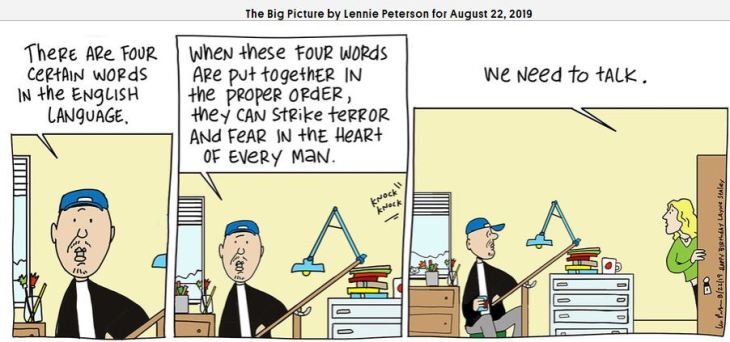
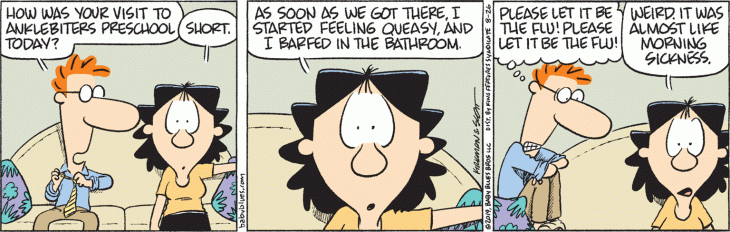
Submitted by Andréa. The Big Picture is off by a few days, but the other two appeared Monday.
No great shock: The Knight Life showed up exactly three weeks after this.
Submitted by Andréa. The Big Picture is off by a few days, but the other two appeared Monday.
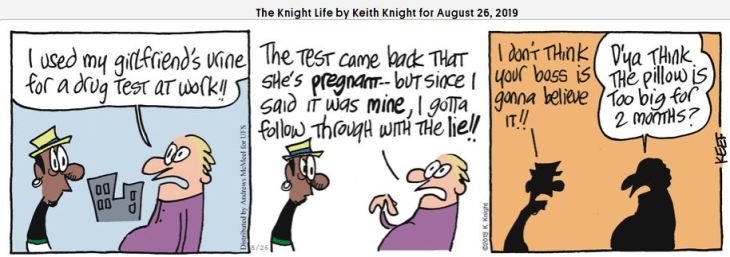
No great shock: The Knight Life showed up exactly three weeks after this.
 Comics I Don't Understand
If what we would call a “man” identifies as a “woman”, then of course he can be pregnant. Who are we to impose our heteronormative stereotypes on her?
Pregnancy is often a shark-jumping moment for TV shows.
“Pregnancy is often a shark-jumping moment for TV shows.”
Well, it certainly won’t be for BABY BLUES, will it?
Mea Culpa . . . you can take down my first two comments, Bill, so I won’t look so stoopid . . .
Of course it will. Adding a new kid into an established dynamic, whether through pregnancy or adoption or taking in a stray, it’s all shark-jumping. Look at cousin Oliver in The Brady Bunch or Jamie in Malcolm in the Middle or Leonardo Di Caprio on Growing Pains
Also, given that nobody ever gets any older in comics (Trixie in Hi and Lois has been a baby for at least 50 years), how is a baby actually going to be born? They’ll be pregnant forever.
In BABY BLUES, the kids ARE getting older, which is why another baby has to be added (Wren is now at the walking stage, I believe). Yes, Wanda will be pregnant again. And again.
To me, adding a baby to a TV show WOULD BE jumping the shark ’cause I wouldn’t like the change in dynamics . . . I’m trying to remember a show in which this happened ’cause I never saw that many. I can’t remember any baby in HOME IMPROVEMENT or MONK, the two shows I did used to watch.
BIG BANG THEORY is, to me, the exception to that ‘rule’ . . . mainly ’cause the baby/babies themselves never became the focus; yes, there was a change in dynamics, but they were pretty funny. I quit watching the show four or five years ago, tho, so I don’t know what’s happened lately, if anything.
WARNING: PROBABLY TMI IN THIS COMMENTARY.
I dream in novel form [using both meanings of the word: book length and “new or unusual in an interesting way”]. On Sunday night/Monday morning, I dreamt I was pregnant. VERY pregnant and so was Hubby’s SIL.
Mind you, I was born loathing the idea of pregnancy and the result thereof. Never been, never wanted to be, never played with dolls in a ‘maternal’ manner, never regretted not having kid(s).
So a friend sent me a dream interpretation of ‘pregnancy dreams’ . . . could mean one is looking for something, obsessed by a quest of some kind, or involved in a project that is not going well. How right that was!
And the next day, the theme for three comics I read is . . . pregnancy.
[for me, theme from TWILIGHT ZONE plays. OR I should start looking for the webcam/microphone/NSA agent in my house.]
With Big Bang Theory, the kids weren’t from the most central characters, although with that show it’s an ensemble so all are important characters. So it was possible to have a show with the pregnancy/kids one week, then not for weeks at a time.
In Baby Blues, Both Hammy and Wren were born during the run. The kids age but slowly. Wikipedia says the the authors claim 3-to-1, but that doesn’t really work. Baby Wren came along in 2002, but is only just in the toddler stage and learning to talk.
In TBBT, was a baby ever shown? I thought – at least for the early episodes I saw – the baby was more like Leonard’s Ma . . . noises off.
@SingaporeBill: “Also, given that nobody ever gets any older in comics ”
There are exceptions. GASOLINE ALLEY for instance was famous initially for aging characters in more or less real time, and even killing some off, but it’s lost its nerve for that some years ago and now main character Walt Wallet has to be around 125 and is still mobile, if fragile. (There was even a story a couple of years ago where rumors that he had found the Fountain of Youth or somesuch casused near-riots in his town.)
Lots of strips have introduced a baby who gets *somewhat* older — and then stops aging. Even in PEANUTS, Linus and Schroeder started out as pre-verbal babies. and Lucy, while older than that, was depicted as a couple of years younger than Charlie Brown. But over the years those distinctions were mostly smooshed out, so that Charlie, Lucy, and Schoreder all seemed to be the same age, with Linus apparently only a year or so younger. Sally Brown also entered the strip as a newborn and grew up into kindergarten or first-grade level, but apparently no older.
Alexander and Cookie Bumsted also started out as babies in BLONDIE. So did Sparkle Plenty, Bonnie Braids, and Honeymoon Tracy in DICK TRACY; the former two are now seemingly in their late twenties, while Honeymoon is about twelve (?). (Since DICK TRACY absobed the LITTLE ORPHAN ANNIE characters when that strip folded, it will be interesting to see how they handle Annie’s agelessness.)
Andréa: “To me, adding a baby to a TV show WOULD BE jumping the shark ’cause I wouldn’t like the change in dynamics.”
The famous Early Days of Television example was Lucy Ricardo going through pregnancy and the eventual birth of Little Ricky on I LOVE LUCY (utilizing Lucille Ball’s real-life pregnancy). Shocking! The show seems to have survived the sharkjump somehow, though. . . .
Before my [TV-watching] time, but didn’t Dick van Dyke and Mary Tyler Moore do the same? Well, not a REAL pregnancy, but on the show . . . or was it real?
Andréa wrote, “In TBBT, was a baby ever shown?”
When I was watching the last episode of The Big Bang Theory with my mom, Howard and Bernadette’s two kids were shown. My mother remarked that this was the first time it happened in the entire run of the show.
I’ll take her word for it.
Me, too.
There was a show with Raymond Someone-or-other in it; I believe there were babies in there. Don’t know if they caused the shark to jump or not.
Hey – ‘sit on it’ Potsie and jumping the shark – two threads are interweaving . . .
I hadn’t seen the article about the basketball player ‘being pregnant’, but obviously, Keith Knight did.
>Also, given that nobody ever gets any older in comics…, how is a baby actually going to be born? They’ll be pregnant forever.
I assume you are being facetious but I can’t figure out why?
I wasn’t aware of the basketball player story. When I saw the Knight Life strip, I thought it was a case of almost-synchronicity with last week’s Mike du Jour, https://www.gocomics.com/mike-du-jour/2019/08/22 .
The story line for the entire week was on the same theme.
Let’s see if I get ’em right this time . . .
https://www.comicskingdom.com/baby-blues/2019-08-27
(I dunno – women do this all the time, since . . . forever . . . )
I like the fact that both Gunther and all of you are ignoring: Gunther’s girlfriend is pregnant and he’s blissfully blase about it.
I assume that sometime this week, he’ll realize it, but he’s too self-absorbed at the moment.
” Adding a new kid into an established dynamic, whether through pregnancy or adoption or taking in a stray, it’s all shark-jumping. Look at cousin Oliver in The Brady Bunch or Jamie in Malcolm in the Middle or Leonardo Di Caprio on Growing Pains”
They were adding Leo because the most popular character was played by Kirk Cameron, who was growing increasingly difficult to work with and kept talking about leaving the show. Eventually, he did. The weird thing about that show was the way the baby jumped 5 years in age while none of the other kids did.
However, I’d like to offer a counterexample where introducing the kids did NOT alter the dynamic of the show… How I Met Your Mother. The kids appear in season 1. Their mother doesn’t show up until season 9. To keep the kids from aging, all their scenes were shot in season 1, including their scenes for the final season.
Isn’t Gunther from LuAnn? Or is one of the characters in one of the strips posted here called Gunther? (Not Baby Blues, that’s Wanda and Darrel, and the other one is Lennie, so it must be — if it is — from the third one?)
How many plots are based around the device of using a girlfriend’s sample for an employer’s drug test, only to find the results to come back as “pregnant” ?
This trope forms a twist in the plotline of one episode of “Venture Brothers”, except it’s actually a bit more complicated: the woman involved is actually the wife of the “boss”, who’s perplexed that the new “employee” appears to be pregnant, though he is male. The wife overhears this and weeps. Therefore she knows she’s pregnant, but her husband is oblivious.
https://venturebrothers.fandom.com/wiki/Ice_Station_-_Impossible!
Oh, and relating to “jumping the shark”,
“Happy Days” really jumped the shark when Fonzie jumped a shark. :-)
(Well, maybe not really. https://www.metv.com/lists/in-defense-of-fonzie-jumping-the-shark-which-is-not-the-jump-the-shark-moment-of-happy-days )
A show that survived and did quite well after a new baby was The Flintstones. Pebbles didn’t arrive until the third season.
I wonder if the times were different vis-a-vis babies; FLINTSTONES begin in 1960, while the shows we’ve mentioned came along quite a few years later.
Okay, I have to admit it… I don’t follow any of these three strips, but now I’m curious how they’ll all play out.
I’ll forward them to you, as I follow them ev’ry day.
“The Big Picture” is probably one of the most intimate strips around. I have followed it from way back when it was running in the papers. Now Lennie is just doing it for fun, and interacts with the commenters on GoComics frequently. When people point out mistakes he will often redo the panel.
Recently he put up some old sketches he had lying around. When people made up captions, he picked the ones he liked and finished the cartoons.
Grawlix, that’s a really weird (and weak) defense of the jump the shark episode. It seems to hinge on the utterly unfounded assumption that ratings will start to drop off once the show gets bad, and that once it gets bad it will last very much longer.
I would think the vast majority of shark jumping occurs in the first third of a shows life or earlier.
I agree with woozy: the whole point of “jump the shark” moments is to define — in retrospect — the point when a show became dead-man-walking — walking, but not dead. It obviously wasn’t apparent at the time, otherwise you wouldn’t have to do it retroactively, and obviously the show doesn’t immediately become unpopular after the event — people didn’t know that the show had reached the tipping point, and kept tuning in in hopes that it would be as good as it used to be, and certainly some episodes might even be, but only in retrospect can they see that, yep, back at that moment was the point when the show crossed the Rubicon of breaking bad.
A sitcom has a predefined situation, and mostly they try to make sure that nothing ever changes from episode to episode, everything gets reset back to zero at the start of a new episode. But that is virtually impossible to do without becoming tedious or boringly repetitive, so some change inevitably must happen. The question then is, is it good change or bad change? Have you done something that so breaks the characters or situation that in retrospect it is clear that it or they cannot survive the insult? Yes, the show will revert to the mean of its situation, but having stretched the envelope too far, it will inevitably continue stretching, and getting ever worse (or at least different) as it does so.
Happy Days was a nostalgia show about the 50s set in a northern US working class city. To have an episode take place in California with 60s surfing culture breaks the situation — yes, it might seem fresh and exciting at the time (might!), but you are breaking what made people like the show in the first place. Yes, they may go back to 50s working class northern city, but now that they’ve shown that they can escape, they will continue to do so so ever more. And even if it might be a better show about surfers in 60s California, it is no longer Happy Days… And that is the point of the phrase “jumping the shark”!
…Though I might as well not bother, in the article the author misuses the phrase “begging the question”, one more phrase they don’t understand, so clearly I’m fighting a lost battle….
I used “begging the question” here once and was set straight, so it’s now out of my vocabulary.
“Begging the question” is actually a stupid, totally counter-intuitive, frozen / fossilized / derived-from-Latin exclusionary expression that I can totally understand succumbing to the forces of folk etymology. In my mind it is linked with a counter-example, also derived from Latin, where a totally unnecessary, complicated, and counter-intuitive folk etymology has been invented, namely “the exception that proves the rule”. I recently had a real life example of a situation where that phrase was wholly appropriate in its intended meaning that I’ve been dying to share…
So the phrase originates from a legal case from the Roman Republic or thereabouts (I’m not going to look it up right now, though it might well be from Cicero), and the point was they needed to prove that a certain rule or law existed and was in effect, even though this law was not written down. So by finding an exception to this law that was written down, or at least commonly accepted as in force, they could prove the existence of the underlying law, (and thus not be accused of begging the question, but I digress… ; – )
So, I recently crossed the border driving into Canada. And I was stuck at a red light, and unsure whether or not it was legal to make a right turn on red in Canada or not. So I was hoping to find the exception that would prove the rule, ie: I was hoping for a sign that said (as pretty much every single traffic light in New Jersey has): “No Turn On Red”. Bam! if you need an exception rule saying that here you cannot turn on red, then the general rule “You can turn right on red” must be true! QED.
@ larK – Given that definition, I can say that the point at which “Star Trek” jumped the shark (at least for me) was when the “Next Generation” scripts started making extensive use of the holodeck, transforming a science fiction series into any sort of soap opera that the writers cared to invent.
One of the definitions of “prove” is “to test”. “The exception proves the rule” means that finding an exception to a rule may show the rule to be invalid.
P.S. @ larK – “pretty much every single traffic light … has ‘No Turn On Red’”
Washington, D.C. was the very last jurisdiction in the US to adopt “right turn on red”, in part because they knew that they would have to forbid the turns at about 2/3rd of the intersections. They considered adopting a “negative” version of the law (illegal unless expressly permitted), which would have saved 50% of the costs for new signs, since they would only need them for 1/3rd of the lights. However, sanity prevailed (nobody wanted the city to become a confusing special case), and they wrote the law the same way it is everywhere else, and put up prohibitions on 2/3rds of the lights.
P.P.S. Germany has a “right turn on red” law that was inherited (after many arguments) from the East German traffic code. It is a “negative” rule: it is permitted only when there is a little green arrow attached to the red section of the traffic light. New lights are more likely to have a “modern” (electric) lamp for the right turn arrow, but the static arrows are still used (more so in the East than in the West), and are occasionally installed for new intersections.
Kilby: it’s still illegal (as far as I know) in NYC to turn right on red. Since I fairly often do drive into NYC, I am more aware of the fact that I need to be aware, and not just blithely assume it, which is probably why I was looking for confirmation rather than just assume it must be so in Canada. Interesting what you say about Germany; I was unaware of that, and the “new” signage — I’ll have to make a point of paying conscious attention for that the next time I’m there…
PS: I can understand DC needing an exception for most of its intersections, what with the radial avenues making intersections six-way, but in NJ, I don’t see the reason for the prohibition on most of the traffic lights that have them (and like I said, it is the exception to find one that doesn’t), and it strikes me as just lazy traffic management. Especially in the case where it is prohibited only during certain times: it is included in the law that you can only turn if it is safe to do so, so revoking my right to judgement during what they think are heavy traffic times just annoys me — yeah, probably I won’t be able to make the turn most of the time during the heavy traffic, but if I can, why prohibit me? Are we really assuming most drivers are so stupid they would somehow impede traffic by unsafely turning right? (Well, it is New Jersey…) Also, those exceptions to the exception are a pain to read and process….
PPS: when we first moved here, there was a particularly vexing case that was fairly common: a lot of traffic lights have a special carved out right turn lane (with raised concrete medians) and its own light. In any sane jurisdiction, they would put a yield sign at the end of that, not a light, and where they did put a light it would be because they meant that you (obviously) must follow the light (otherwise you could just put a yield sign there — $100 vs $100,000…). Not so in NJ! You can “turn” right at these red lights! (I put “turn” in quotes, because once you’ve carved out a special lane that looks like a yield/merge lane, it is no longer really clear that you are “turning” and not just following the road into a merge…) So you have to go totally counter-intuitive, and in this special lane with its own light that could have been equally well served with a yield sign, you can legally turn on red… unless there is a sign prohibiting it :-/
@ larK – New York City has a number of other special rules, such as an increased minimum age (either 18 or 21) for out of state (or possibly even out of city) drivers. I would never consider trying to drive there, Boston was bad enough.
P.S. Washington D.C. has one oddball rule that I know of: it is illegal to make a U-turn at any lighted intersection, unless there is a sign or light that specifically allows it. This is sort of similar to the general philosophy used by German traffic signs: “Everything that is not specifically allowed is forbidden.” (You never see “No Right (or Left) Turn” signs in Germany. Instead, they put up a blue sign with the arrows that show which turns are allowed.)
P.P.S. For a typical “green arrow” on a German traffic light, see the last photo in the “Geschichte” section of this Wikipedia article.
I’m very found of the phrase “begging the question” when used properly. One can even use it as “And that begs the question then quote the question” so long as the question “then quote the question” is truly being beggered (being made empty of content and having it’s essence avoided, evaded, and circularly used to justify its non-demonstrated significance) and not merely being brought up.
Jumping the shark isn’t always about a bad retooling; it’s just a moment when it becomes clear to the viewer that show’s quality is gone and that’s the norm and its not likely to come back. It’s also not always when the show went bad; it’s often just the point when it becomes *apparent* to viewer the show had become bad some time in the past.
Kilby: I had forgotten about the increased NYC driving age. I once drove in NYC when I was below their legal age, but legally licensed in my home jurisdiction, and a friend of mine from NYC and I would have endless arguments about the Full Faith and Credit Clause, and whether what I did was legal or not. Even after law school, I still couldn’t tell you which of us was right — most of the time they end up splitting hairs about what is a judgement, and what is a law, and they keep going back and forth about it. Heck, the recent need for the Supreme Court to step in in what should have been an easy slam dunk for Full Faith and Credit (marriage certificates) shows how unclear the the understanding of full faith and credit is. I do remember one of the cases discussed explicitly used the example of one state’s prohibiting a driver who needed to go through that state from his home state to another state in order to accomplish something being a prime example of why you needed full faith and credit, so to me this was proof that NYC could not prohibit me from driving through it if I were legally licensed in my home state to do so, even if I couldn’t be legally licensed in NYC… Anyway, one thing I can tell you with certainty is that NYC could not impose that restriction only on foreign drivers as you imply: it could only regulate what drivers can and cannot do within its own jurisdiction, and those rules would have to apply equally to everyone (and here I hear my friend arguing why it couldn’t have been legal for me to drive in NYC at that time…)
Semi-old magazine panel: Under the headline “THE DAWN OF SPEECH”, a cavewoman says “We need to talk” and the caveman thinks “uh oh”.
The arrival of a baby in a show isn’t always a shark-jumping moment, especially if it was part of the plan. Say, for example, if it is a show about newlyweds and getting settled into the challenges of married life. A new kid is a shark jump when the child is introduced because the existing children have aged out of being cute and adorable and are awkward tweens or surly teens. New cast members, especially if they are replacing cast that left, can be a shark jump as well. You can argue that the replacement of Trapper John with BJ Hunnicut was shark jumping for MASH. Maclean Stevenson’s departure was not shark jumping, I’d say, as Colonel Potter was a strong character and sufficiently different from Colonel Blake that the wasn’t a pale copy. Cousin Oliver was shark jumping for the Brady Bunch. Suzanne Somers leaving Three’s Company was shark jumping. David Caruso leaving NYPD Blue was not shark jumping because the ensemble was strong enough to carry on without him. Laverne & Shirley moving to California was not a shark jump; it was falling right into the tank with the shark.
As a previous comment said, shark jumping is only apparent in retrospect. The show can carry on for some time afterward and the drop off in quality can be gradual but consistently downward.
Regarding right-turn-on-red laws, as a pedestrian, I hate them. The law is that the red is to be treated as stop sign. One must come to a stop and can turn right if it is save to proceed. My experience is that drivers speed up to them. looking left for traffic and pay no attention to pedestrians, who have the right of way, and just whip around the corner. I’d have been killed a dozen times over if I weren’t cautious. I’d prefer no right on red.
” I’d have been killed a dozen times over if I weren’t cautious. I’d prefer no right on red.”
I’d prefer right-on-red, but with drivers who take their responsibilities seriously.
I had an intersection to cross some 30 years ago, where I’d have been run over AT LEAST once per day from drivers who didn’t bother to look to see if there was a person in the crosswalk, just whether or not a car was coming from the left.
What jumped the shark for the Flintstones was Gazoo.
@ MiB – I agree. I disliked that character as soon as he appeared.
What about Little house on the prairie, then? That was constantly disposing of old, and introducing new, characters.
Kilby- Boston is far worse to drive in than Manhattan – we once made a turn in Boston and were stuck in going around in a circle of streets as all intersecting streets were one way into the street we were on.
Pretty sure the babies were shown several time on Big Bang – even when there was just one.
Baby Blues had a negative pregnancy test
Olivier – and the show was lacking in keeping with the original set of books.
“Pretty sure the babies were shown several time on Big Bang – even when there was just one.”
I was still watching TBBT regularly through the first baby and ’til she was pregnant with the second, and never saw the baby displayed. Hmmmm . . . maybe I’ll have to watch all the first episodes again. NOT.
A little late to the party . . .
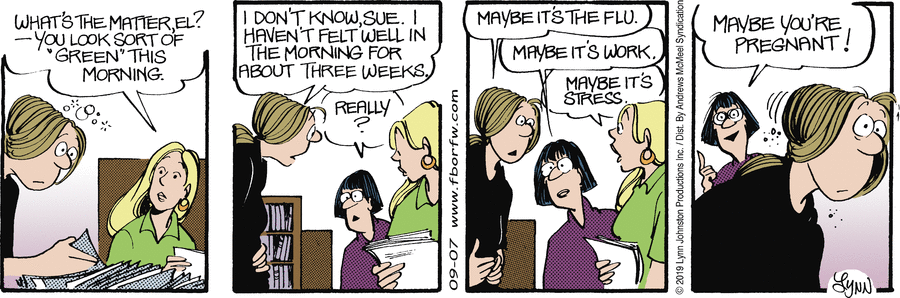
Lynn Patterson writes: I was beginning to regret having the characters age in real time. I was losing the art and sweet comedy of “the baby days.” My young characters were speaking in adult language and having adult concerns. I talked to Cathy Guisewite (“Cathy”), and she suggested that Elly should have another baby. I argued that I only had two kids in real life and didn’t know what it would be like to have three. She said, “Lynn, it’s a comic strip. Make it up!”
Lynn “Patterson”?
@ Andréa – I know someone who went through exactly the same sort of trial and error diagnosis process (over the course of several days) before figuring out that she was pregnant. The amusing part was that it was her fifth kid, so it’s not like anything about it should have been a surprise.
JOHNSTON – sorry!!
It looks like the For Better or for Worse (reruns? redos?) are starting the “Elly’s unexpected pregnancy” arc.
The weird part of this was that my sister-in-law had an unexpected “I thought I was through with this” pregnancy at precisely the same time.
There seems to be a virus goin’ ’round the comics . . .
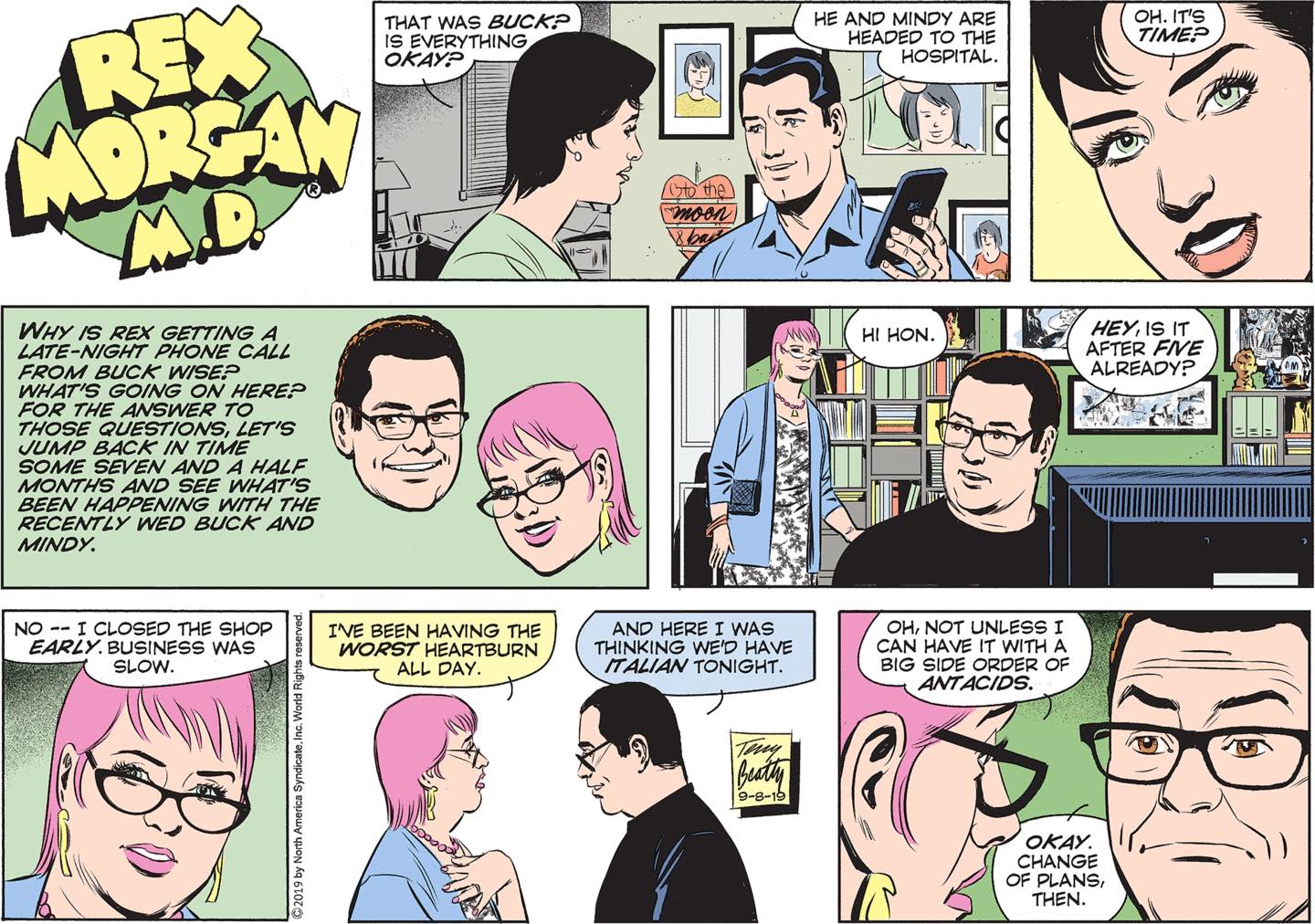
Is everyone in the comics about to have a baby (though this one might yet turn out to be adoption):
@ Arthur – Given their ages and the everpresent “wholesomeness” of Luann, I would bet that the “child” is going to turn out to be a dog (or some other pet).
Arthur, I did not see THIS coming.
That said, anything that gives us more of Al, Leslie, Ann Eiffel and the rest of this bunch can’t be good.