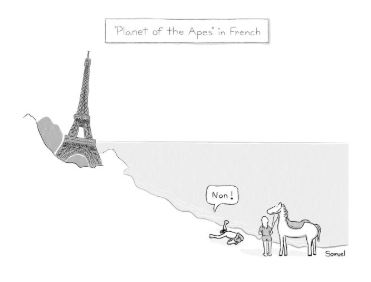
Although the water is a little closer, it’s been buried pretty much none at all. Fake Comics!
Probably a number of fallacies. I’m guessing that the one you’re going for is the fact that the tower is not near any large body of water unlike the statue? Plus I think the artist means “France”, not “French”.
Well, the original novel was in French, but it didn’t include that scene.
No, we don’t all know the fallacy. It’s not the location of the art versus the movie, since neither are near cliffs and Liberty isn’t on an island conducive to horseback riding. I don’t think Liberty was buried, but was broken. Though how a copper-clad sculpture could be broken I haven’t a clue. Interesting, both pieces were built by Gustave Eiffel.
Could we really tell if he’s saying “Non!” and not “No!”?
Yes, I suppose we could.
Ms Liberty is symbolic; the Eiffel Tower is not. Pour moi, c’est tout.
I think Bill just meant that Liberty was already on the coast, whereas the tower is in the middle of France. I don’t think that is a “fallacy”, but it would take a significantly larger rise in sea levels to flood the tower. Ocean levels that would put Liberty under water would just barely moisten the base of the tower. On the other hand, maybe using Paris as the location is a bad idea for this movie, because after all, its slogan is “fluctuat nec mergitur“.
I’m with DemetriosX. The fallacy is that “The Planet of the Apes” was in French to begin with.
“The franchise is based on French author Pierre Boulle’s 1963 novel La Planète des singes, translated into English as Planet of the Apes or Monkey Planet. “
In the novel, the first of the double shock endings has our astronaut hero returning to Earth after an extended and eventful stay on the Planet of the Apes; being a Frenchman, he spots Paris, and sets down next to the Eiffel Tower. A gendarme (presumably with the stereotypical flat hat) comes to meet them; he is an ape. [Musical sting]
I was indeed referring to the fact that the original was French.
That’s true, Carl: Ann Eiffel would probably get the same horrified reaction.
The original novel might have been in French, but the original movie wasn’t. This isn’t a reference to the book.
Anton realised that, once again, he’d missed out on the Strictly Come Dancing finals.
Well, I have to agree with James Pollock about references. A reference to an iconic movie is a reference to an iconic movie no matter what the source material is.
However I have to also say that if the phrase “Three French Planet of the Apes” can be ambiguous and can either refer to The French Planet of the Apes (movie) or The French Planet of the Apes (book) and one of them actually *does* exist, the default really needs to be to the one that actually does exist.
The third referent is La Planète des singes. :-)
Actually: it doesn’t matter, we have both.
Well played, Olivier, well played…
While Eiffel designed the interior structure the [visible part of the] statue was designed by and constructed under the direction of Frédéric Auguste Bartholdi.
I have to admit, I was blown away by the idea that there are people who think the statute was broken, not buried. I took a poll of my coworkers (one person) and they said they thought it was broken. Never occurred to me.
As a side note, I found the link below, which includes a section on who thought of the status as the ending of the movie. It’s probably Rod Serling but the anecdote from Producer Jacobs is pretty great, in which he and Blake Edwards are talking about how to end the movie, see a statue of liberty in the deli they’re in, and say to each other “Rosebud!”
So do we. One because you gave it to us, the other just because it looked cool next to a casino.
They chose the SoL as the icon in the movie because Lady Liberty has a human face, thereby proving that the SoL in the movie didn’t come from the damn dirty apes. A steel tower doesn’t necessarily establish that, no matter how iconic the design.
“I have to admit, I was blown away by the idea that there are people who think the statute was broken, not buried. ”
They’re remembering the end of Spaceballs.
I really never understood how the Statue made it onto the mainland.
Not to mention how it could have gotten buried that deeply.
^^^ I assumed that it got blowed up real good and just the top half is there.
I never understood how in the few hundred years at most that had elapsed, the entire geography of coastal New York had changed to be Californian, with new rock cliffs, even though the statue had hardly aged…
@larK: but it’s true for the other side of the pond as well (if you don’t mind ice-cream trucks, that is)…
Well, it was carried from France to the USA less than two centuries ago; so, ‘in the few hundred years at most that ha[ve] elapsed’, it might have been carried somewhere else and then forgotten (sand builds up fast: see the Sphinx in Egypt).
“Damn, now WHERE did I put that Statue of Liberty? I know if was around here earlier, and then I moved it to dust the sand under it, and now I can’t find it. Tsk; lose my furry ol’ head if it wasn’t firmly attached — oh, well, it will turn up sooner or later. Banana break time!”
A few hundred years at most is a bit of a retcon based on the later films. Within the context of the first movie (and the book, for that matter), it could easily be thousands or tens of thousands of years.
Yes, because what is the speed of evolution?
“what is the speed of evolution? ”
Highly variable. According to the films, the apes were altered by humans (at first intentionally, and then later unintentionally) The evolution wasn’t by natural selection, which is usually a slow process (although it can be quite quick. The introduction of mass-produced antibiotics, for example, hastened the development of antibiotic-resistant germs.)
Fine, I’ll gladly give you an extra order of magnitude or two, and still maintain my point about significant changes in geography…
To be fair, why it looks like California is obvious, and one suspends one’s disbelief (think of the M*A*S*H credits with the Hollywood hills in the background). I realize larK is fussing with their tongue planted in their cheek, though.
But as DemetriosX says, without regard to sequels and reboots, when the movie was made the amount of time passed is unknown, so any sort of buried civilization is not hard to accept.
But even if it was a short few hundred years, the implication made by Serling’s script is that advanced weaponry (which in the 60’s meant nuclear war) was involved, at which point all expectations of the landscape are obliterated.
“still maintain my point about significant changes in geography…”
How many thousands of years did it take to create the Salton Sea?
Note that creating seacoast in Nevada was Luthor’s master plan in the first Superman movie, and Luthor thought it could be done with just one missile. The planet of the apes endured a full nuclear exchange. “Beneath the Planet of the Apes” is set in the year 3955, shortly after the events of the first film.
If the SofL is buried and not broken – I thought it was lying down broken – then the land around it has been built up rather high and Liberty Island, as well as probably Staten Island, Long Island and Manhattan Island might all be joined together with what is currently the mainland USA.
 Comics I Don't Understand
Although the water is a little closer, it’s been buried pretty much none at all. Fake Comics!
Probably a number of fallacies. I’m guessing that the one you’re going for is the fact that the tower is not near any large body of water unlike the statue? Plus I think the artist means “France”, not “French”.
Well, the original novel was in French, but it didn’t include that scene.
No, we don’t all know the fallacy. It’s not the location of the art versus the movie, since neither are near cliffs and Liberty isn’t on an island conducive to horseback riding. I don’t think Liberty was buried, but was broken. Though how a copper-clad sculpture could be broken I haven’t a clue. Interesting, both pieces were built by Gustave Eiffel.
Could we really tell if he’s saying “Non!” and not “No!”?
Yes, I suppose we could.
Ms Liberty is symbolic; the Eiffel Tower is not. Pour moi, c’est tout.
I think Bill just meant that Liberty was already on the coast, whereas the tower is in the middle of France. I don’t think that is a “fallacy”, but it would take a significantly larger rise in sea levels to flood the tower. Ocean levels that would put Liberty under water would just barely moisten the base of the tower. On the other hand, maybe using Paris as the location is a bad idea for this movie, because after all, its slogan is “fluctuat nec mergitur“.
I’m with DemetriosX. The fallacy is that “The Planet of the Apes” was in French to begin with.
“The franchise is based on French author Pierre Boulle’s 1963 novel La Planète des singes, translated into English as Planet of the Apes or Monkey Planet. “
In the novel, the first of the double shock endings has our astronaut hero returning to Earth after an extended and eventful stay on the Planet of the Apes; being a Frenchman, he spots Paris, and sets down next to the Eiffel Tower. A gendarme (presumably with the stereotypical flat hat) comes to meet them; he is an ape. [Musical sting]
I was indeed referring to the fact that the original was French.
There are lots of other Eiffels it could be.
Why is Heston speaking french in Blackpool?
That’s true, Carl: Ann Eiffel would probably get the same horrified reaction.
The original novel might have been in French, but the original movie wasn’t. This isn’t a reference to the book.
Anton realised that, once again, he’d missed out on the Strictly Come Dancing finals.
Well, I have to agree with James Pollock about references. A reference to an iconic movie is a reference to an iconic movie no matter what the source material is.
However I have to also say that if the phrase “Three French Planet of the Apes” can be ambiguous and can either refer to The French Planet of the Apes (movie) or The French Planet of the Apes (book) and one of them actually *does* exist, the default really needs to be to the one that actually does exist.
The third referent is La Planète des singes. :-)
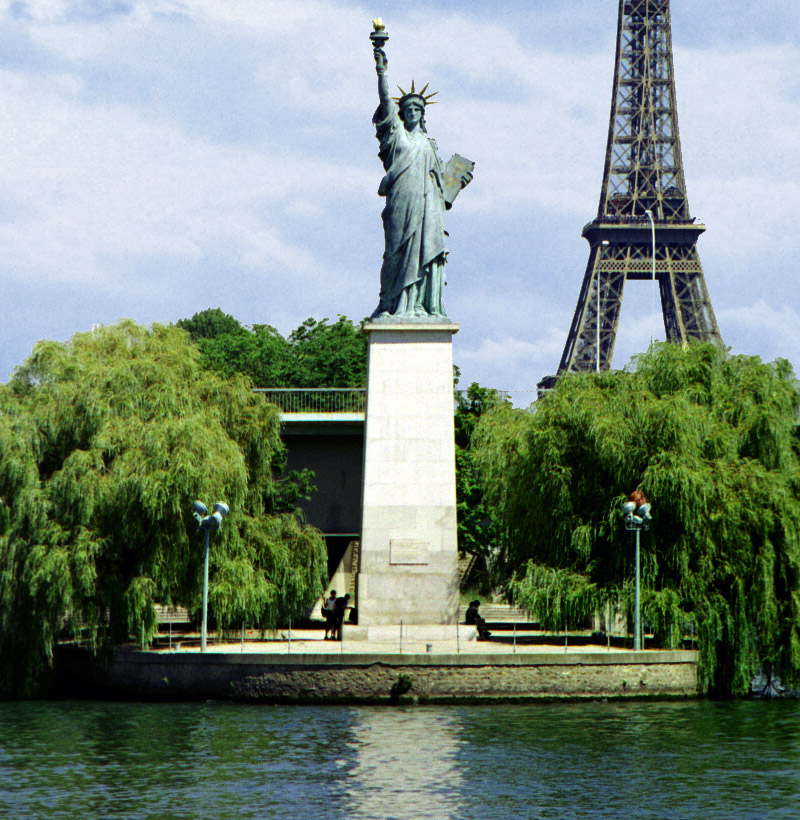
Actually: it doesn’t matter, we have both.
Well played, Olivier, well played…
While Eiffel designed the interior structure the [visible part of the] statue was designed by and constructed under the direction of Frédéric Auguste Bartholdi.
I have to admit, I was blown away by the idea that there are people who think the statute was broken, not buried. I took a poll of my coworkers (one person) and they said they thought it was broken. Never occurred to me.
As a side note, I found the link below, which includes a section on who thought of the status as the ending of the movie. It’s probably Rod Serling but the anecdote from Producer Jacobs is pretty great, in which he and Blake Edwards are talking about how to end the movie, see a statue of liberty in the deli they’re in, and say to each other “Rosebud!”
https://planetoftheapes.fandom.com/wiki/Statue_of_Liberty
“it doesn’t matter, we have both.”
So do we. One because you gave it to us, the other just because it looked cool next to a casino.
They chose the SoL as the icon in the movie because Lady Liberty has a human face, thereby proving that the SoL in the movie didn’t come from the damn dirty apes. A steel tower doesn’t necessarily establish that, no matter how iconic the design.
“I have to admit, I was blown away by the idea that there are people who think the statute was broken, not buried. ”
They’re remembering the end of Spaceballs.
I really never understood how the Statue made it onto the mainland.
Not to mention how it could have gotten buried that deeply.
^^^ I assumed that it got blowed up real good and just the top half is there.
I never understood how in the few hundred years at most that had elapsed, the entire geography of coastal New York had changed to be Californian, with new rock cliffs, even though the statue had hardly aged…
@larK: but it’s true for the other side of the pond as well (if you don’t mind ice-cream trucks, that is)…

Well, it was carried from France to the USA less than two centuries ago; so, ‘in the few hundred years at most that ha[ve] elapsed’, it might have been carried somewhere else and then forgotten (sand builds up fast: see the Sphinx in Egypt).
“Damn, now WHERE did I put that Statue of Liberty? I know if was around here earlier, and then I moved it to dust the sand under it, and now I can’t find it. Tsk; lose my furry ol’ head if it wasn’t firmly attached — oh, well, it will turn up sooner or later. Banana break time!”
A few hundred years at most is a bit of a retcon based on the later films. Within the context of the first movie (and the book, for that matter), it could easily be thousands or tens of thousands of years.
Yes, because what is the speed of evolution?
“what is the speed of evolution? ”
Highly variable. According to the films, the apes were altered by humans (at first intentionally, and then later unintentionally) The evolution wasn’t by natural selection, which is usually a slow process (although it can be quite quick. The introduction of mass-produced antibiotics, for example, hastened the development of antibiotic-resistant germs.)
Fine, I’ll gladly give you an extra order of magnitude or two, and still maintain my point about significant changes in geography…
To be fair, why it looks like California is obvious, and one suspends one’s disbelief (think of the M*A*S*H credits with the Hollywood hills in the background). I realize larK is fussing with their tongue planted in their cheek, though.
But as DemetriosX says, without regard to sequels and reboots, when the movie was made the amount of time passed is unknown, so any sort of buried civilization is not hard to accept.
But even if it was a short few hundred years, the implication made by Serling’s script is that advanced weaponry (which in the 60’s meant nuclear war) was involved, at which point all expectations of the landscape are obliterated.
“still maintain my point about significant changes in geography…”
How many thousands of years did it take to create the Salton Sea?
Note that creating seacoast in Nevada was Luthor’s master plan in the first Superman movie, and Luthor thought it could be done with just one missile. The planet of the apes endured a full nuclear exchange. “Beneath the Planet of the Apes” is set in the year 3955, shortly after the events of the first film.
If the SofL is buried and not broken – I thought it was lying down broken – then the land around it has been built up rather high and Liberty Island, as well as probably Staten Island, Long Island and Manhattan Island might all be joined together with what is currently the mainland USA.