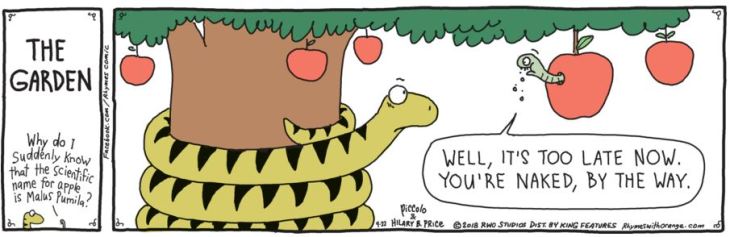
The worm got to the apple of the tree of knowledge before the serpent could give it to Eve, and now the worm knows too much.
The snake came to tempt someone to eat from the Tree of Knowledge of Good and Evil. But it was too late, the worm had already eaten from it without being tempted. The worm now possesses the knowledge of good and evil, and is aware that the snake is naked. (And apparently knows other things, like scientific names for fruit.)
@ Powers – Correcting the spelling doesn’t make them any less frightening. I was never exposed to his books as a kid, but after I saw a few of them as an adult, I found them uniformly irritating, and would never buy any of them for my own kids.
I still have my Richard Scarry’s “Cars And Trucks And Things That Go” (’70s ed.).
It’s a classic.
@Kilby – not scary, but potentially dangerous. I’m thinking of the story in which there’s a power failure all over Busytown on Thanksgiving, and Lowly Worm “saves the day” by distributing charcoal grills so people can cook their turkeys in their living rooms while expiring from carbon monoxide poisoning.
Speaking of Richard Scarry (put me in the pro camp) I assume many but not all of you have seen this Tom the Dancing Bug cartoon:
Could it be ceritificate and secure sites (http: vs. https) that puts some urls into moderation? I wouldn’t have thought
would have been all that long?
I’ve noticed similar stupidity in a few of my children’s German books and story CDs. Perhaps the worst case was when kids in one of the story CDs noticed flashlights in their neighbor’s house, so to prevent the burglar from escaping, they actually went out and poured sugar in the crook’s gas tank. Absolutely insane, and I was careful to tell my kids exactly why as soon as the story was over. This proved to be quite effective: although my kids have never seen a burglar, they certainly have never listened to that CD again.
I forwarded this to Hubby, former elementary school librarian, among other things. Thanks!
Cars and Trucks was my older son’s bible when he was a toddler. He pretty much taught himself to read with it.
I definitely have to send him the Bolling comic.
I think the cartoon has just depicted the *real* origin of the classic1940s Captain Marvel villain, Mr. Mind, the World’s Wickedest Worm. (I went for “real” because I’m pretty sure C.C. Beck explained Mr. Mind’s origin when he was introduced, but I don’t remember what it was and like this one better anyway.)
Kilby, I see you found your own version of the Berenstain Bears.
to prevent the burglar from escaping, they actually went out and poured sugar in the crook’s gas tank. Absolutely insane, and I was careful to tell my kids exactly why as soon as the story was over.
What did you tell them about it?
I vote pro-Scarry, and to supplement woozy’s cartoon:
I’d be curious what Kilby finds irritating about these things (that were actually classics of this geezer’s own childhood– not this geezer’s children but this geezer himself.)
Although the Mark Johnson story has a decent point.
To answer the headline question, there’s no Tyrolean hat on the worm so no credit necessary.
It seems that I owe everyone a few explanations:
1) I liked both of Bolling’s parodies very much (better than the originals that they copy so accurately).
2) My comment about “similar stupidity” was in reply to Mark Jackson’s “potentially dangerous”, and had nothing to do with the “Dancing Bug” comics that woozy posted, which (at the time) were not yet visible.
3) We’ve had several “picture encyclopedia” books for children, and my kids have enjoyed a few of them, but given a choice, I preferred editions with more detailed artwork, and I just never cared for Scarry’s “static” 2-D drawings, even if everyone else does like them.
4) The thing that bothered me about the “gas tank” solution was not the technical question about whether the sugar would stop the engine before the crook got away, but simply the risk of confronting a dangerous individual at night and alone. I pointed out that it would have been better for the kids to call the police, or at least to wake up their parents and ask for advice.
I had not seen those Scarry parody comics, so thanks for posting.
One thing I love now about Mr. Scarry’s artwork is that many of the vehicles in the “Cars And Trucks…” book are fairly accurately drawn, representing recognizable European and American vehicles of the day. On the other hand, his wacky cartoonish cars (fruit-shaped, etc.) sprinkled liberally throughout are a real hoot, along with the situations the book’s drivers find themselves in.
” The thing that bothered me about the “gas tank” solution was not the technical question about whether the sugar would stop the engine before the crook got away, but simply the risk of confronting a dangerous individual at night and alone. I pointed out that it would have been better for the kids to call the police, or at least to wake up their parents and ask for advice.”
Can’t argue with that. I’m a bit taken aback about the idea about jumping to the conclusion that “flashlights in the neighbors” = “burglars” when other options could be, and then to jump that the reasonable reaction would be to sugar the tank of a car you *think* belongs to the burglars and… as you point out why on earth should anyone think children stopping escape is the most prudent action??? (just call the effing police— and if you *think* that is their car take down the license).
“…it would have been better for the kids to call the police, or at least to wake up their parents and ask for advice.”
This is true, of course, but isn’t this a common feature of most kids books? A good story usually requires the main characters to solve the problem on their own; it’s not such a compelling story if they just refer the problem to an authority figure to solve for them. It seems to me I read lots of books where kids are solving murder mysteries and other crimes on their own.
Admittedly, a well-crafted story usually works in some plot device to explain why the problem can’t be referred to an authority figure, but Richard Scarry stories also need to be short and simple.
@ WW – In fairness to Scarry, I need to reiterate that he was not the author of my example (we don’t own any of his books). And while I agree that it is necessary (and good) for kids to take the initiative (both in books and in real life), there are limits, and I would prefer it if children’s stories would also teach a certain amount of common sense.
P.S. In another example (from a different author), the kids discovered that a painting that had been stolen from one neighbor was to be found hanging in the living room of another neighbor, just two or three doors away. They could have reported the discovery, or confronted the neighbor, but the action they actually took was the stupidest possible: they broke into the second neighbor’s house, stole the painting, and gave it back to its owner. It all worked out, of course (the neighbor had just happened to buy the paining from the real thief at a fleamarket), but the route the author took to get there was insane.
 Comics I Don't Understand
The worm got to the apple of the tree of knowledge before the serpent could give it to Eve, and now the worm knows too much.
The snake came to tempt someone to eat from the Tree of Knowledge of Good and Evil. But it was too late, the worm had already eaten from it without being tempted. The worm now possesses the knowledge of good and evil, and is aware that the snake is naked. (And apparently knows other things, like scientific names for fruit.)
Okay, that was simple.
I suppose I should post the back-up comic…
Bill: I actually thought you might have put this one as a shout-out to the discussion we had a few weeks ago about this comic: https://godaddyandthesquirrelmustbothdie.wordpress.com/2019/06/17/and-will-the-animals-start-wearing-clothing-now/
“Scarry”. Two ‘r’s.
Thanks. Changing it now. -Bill
@ Powers – Correcting the spelling doesn’t make them any less frightening. I was never exposed to his books as a kid, but after I saw a few of them as an adult, I found them uniformly irritating, and would never buy any of them for my own kids.
I still have my Richard Scarry’s “Cars And Trucks And Things That Go” (’70s ed.).
It’s a classic.
@Kilby – not scary, but potentially dangerous. I’m thinking of the story in which there’s a power failure all over Busytown on Thanksgiving, and Lowly Worm “saves the day” by distributing charcoal grills so people can cook their turkeys in their living rooms while expiring from carbon monoxide poisoning.
Speaking of Richard Scarry (put me in the pro camp) I assume many but not all of you have seen this Tom the Dancing Bug cartoon:
Could it be ceritificate and secure sites (http: vs. https) that puts some urls into moderation? I wouldn’t have thought
would have been all that long?
I’ve noticed similar stupidity in a few of my children’s German books and story CDs. Perhaps the worst case was when kids in one of the story CDs noticed flashlights in their neighbor’s house, so to prevent the burglar from escaping, they actually went out and poured sugar in the crook’s gas tank. Absolutely insane, and I was careful to tell my kids exactly why as soon as the story was over. This proved to be quite effective: although my kids have never seen a burglar, they certainly have never listened to that CD again.
I forwarded this to Hubby, former elementary school librarian, among other things. Thanks!
Cars and Trucks was my older son’s bible when he was a toddler. He pretty much taught himself to read with it.
I definitely have to send him the Bolling comic.
I think the cartoon has just depicted the *real* origin of the classic1940s Captain Marvel villain, Mr. Mind, the World’s Wickedest Worm. (I went for “real” because I’m pretty sure C.C. Beck explained Mr. Mind’s origin when he was introduced, but I don’t remember what it was and like this one better anyway.)
Kilby, I see you found your own version of the Berenstain Bears.
to prevent the burglar from escaping, they actually went out and poured sugar in the crook’s gas tank. Absolutely insane, and I was careful to tell my kids exactly why as soon as the story was over.
What did you tell them about it?
I vote pro-Scarry, and to supplement woozy’s cartoon:
I’d be curious what Kilby finds irritating about these things (that were actually classics of this geezer’s own childhood– not this geezer’s children but this geezer himself.)
Although the Mark Johnson story has a decent point.
To answer the headline question, there’s no Tyrolean hat on the worm so no credit necessary.
It seems that I owe everyone a few explanations:
1) I liked both of Bolling’s parodies very much (better than the originals that they copy so accurately).
2) My comment about “similar stupidity” was in reply to Mark Jackson’s “potentially dangerous”, and had nothing to do with the “Dancing Bug” comics that woozy posted, which (at the time) were not yet visible.
3) We’ve had several “picture encyclopedia” books for children, and my kids have enjoyed a few of them, but given a choice, I preferred editions with more detailed artwork, and I just never cared for Scarry’s “static” 2-D drawings, even if everyone else does like them.
4) The thing that bothered me about the “gas tank” solution was not the technical question about whether the sugar would stop the engine before the crook got away, but simply the risk of confronting a dangerous individual at night and alone. I pointed out that it would have been better for the kids to call the police, or at least to wake up their parents and ask for advice.
I had not seen those Scarry parody comics, so thanks for posting.
One thing I love now about Mr. Scarry’s artwork is that many of the vehicles in the “Cars And Trucks…” book are fairly accurately drawn, representing recognizable European and American vehicles of the day. On the other hand, his wacky cartoonish cars (fruit-shaped, etc.) sprinkled liberally throughout are a real hoot, along with the situations the book’s drivers find themselves in.
” The thing that bothered me about the “gas tank” solution was not the technical question about whether the sugar would stop the engine before the crook got away, but simply the risk of confronting a dangerous individual at night and alone. I pointed out that it would have been better for the kids to call the police, or at least to wake up their parents and ask for advice.”
Can’t argue with that. I’m a bit taken aback about the idea about jumping to the conclusion that “flashlights in the neighbors” = “burglars” when other options could be, and then to jump that the reasonable reaction would be to sugar the tank of a car you *think* belongs to the burglars and… as you point out why on earth should anyone think children stopping escape is the most prudent action??? (just call the effing police— and if you *think* that is their car take down the license).
“…it would have been better for the kids to call the police, or at least to wake up their parents and ask for advice.”
This is true, of course, but isn’t this a common feature of most kids books? A good story usually requires the main characters to solve the problem on their own; it’s not such a compelling story if they just refer the problem to an authority figure to solve for them. It seems to me I read lots of books where kids are solving murder mysteries and other crimes on their own.
Admittedly, a well-crafted story usually works in some plot device to explain why the problem can’t be referred to an authority figure, but Richard Scarry stories also need to be short and simple.
@ WW – In fairness to Scarry, I need to reiterate that he was not the author of my example (we don’t own any of his books). And while I agree that it is necessary (and good) for kids to take the initiative (both in books and in real life), there are limits, and I would prefer it if children’s stories would also teach a certain amount of common sense.
P.S. In another example (from a different author), the kids discovered that a painting that had been stolen from one neighbor was to be found hanging in the living room of another neighbor, just two or three doors away. They could have reported the discovery, or confronted the neighbor, but the action they actually took was the stupidest possible: they broke into the second neighbor’s house, stole the painting, and gave it back to its owner. It all worked out, of course (the neighbor had just happened to buy the paining from the real thief at a fleamarket), but the route the author took to get there was insane.
Shout-out to Ali Mitgutsch, the children’s illustrator I most remember from my childhood:

He’s still alive!
https://www.stern.de/kultur/buecher/wimmelbuch-autor-ali-mitgutsch-wird-80-6384740.html