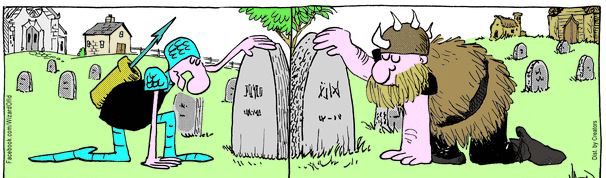
I just read an excellent review about the origins of Memorial Day at The Nib. This comic is effectively the same as having a Union and a Confederate soldier giving homage to their fallen comrades.
I might have mentioned this before here…
Some years ago, I was reading a book about WW1 and had a very good idea whom I considered the “Good Guys” and the “Bad Guys” to be.(notwithstanding the fact that WW1 was possibly the stupidest !@#$ war in the history of war).
I was mid-book when my cousin mentioned to me that our grandfather had fought in that war. On the Hun side. I’d never given this any thought, since I’d long ago done the math and determined he’d been way too young. But, of course, he’d lied about his age.
Suddenly the whole narrative shifted, and “good guys” and “bad guys” stopped being at all clear.
Even in the Civil War, it’s not hard to have some sympathy for the soldiers who fought for the South. The politicians and landowners were largely reprehensible beings fighting to preserve a racist and inhuman social and economic order, but a lot of the soldiers — including many officers — truly felt like they were fighting for their homes and culture against an invading force.
Not to say they weren’t racist. A lot of Northerners were racist too. But racism so suffused the culture of the South it’s difficult to separate it from other possible motivations.
There’s a couple of ways to settle on the “good guys”
One way is to say that OUR guys are always the GOOD guys. Sometimes this doesn’t hold up… current sentiment favors the Injuns a bit, when the old stories had too kinds of Indians… bad ones, and dead ones.
The other way is to say that whoever won was the good guys. This also doesn’t hold up well in historical reflection.
Back when Sir Kenneth Clark’s “Civilisation” series aired on PBS, he noted that Norse gravestones had been unearthed showing Christian symbols on one side and Norse mythological symbols on the other. He referred to it as “hedging your bets.”
“Back when Sir Kenneth Clark’s “Civilisation” series aired on PBS, . . .”
THAT brings back memories! A beautiful book was published, too.
“Speaking of Huns . . .”
Not that it matters, but that cartoon has a huge error in one of the diagrams.
Lindbergh might have been the only person to solo fly over the Atlantic, nonstop. That doesn’t make him the only one to cross.
As I recall, until the US got involved in the “Great War”, many German-Americans supported the old home country. They had fund-raising drives and the like.
Just how old are you, Brian??
“Lindbergh might have been the only person to solo fly over the Atlantic, nonstop. That doesn’t make him the only one to cross.”
Famously, Robert Ripley pegged him as the 67th one:
“The truth about Lindbergh was this: two aviators named Alcock and Brown had flown together from Newfoundland to Ireland in 1919, and that same year, a dirigible carrying 31 men had crossed from Scotland to the United States; five years later, another dirigible had traveled from Germany to Lakehurst, New Jersey, with 33 people aboard. That meant 66 people had crossed the Atlantic nonstop before Lindbergh.”
Well, the comic does specify May, 1927.
Quite a week for huns:
So the headstone inscription on the right-hand side appear to be similar to old Norse runes.
What does the inscription on the left-hand stone resemble? Those don’t look like “regular” (i.e. Latin) letters.
Grawlix, maybe that’s the alphabet used by the Idiots.
BBC History has had over the past several years a wonderful assortment of articles on WWI. In general they have fairly short, but well detailed and informative articles (and not all are British history).
Theodore Roosevelt’s mother was a southern girl. During the American Civil War she would not let TR’s father (also Theodore Roosevelt) fight for the North as he might face her brothers in battle. Part of the reason that TR and his sons were so involved in the several wars in their lifetimes was out of a bit of embarrassment of his father not having fought. His uncles were generals of such standing that after the war they did not sign the papers to allow them to resume their lives and fled to England – where TR’s family went to visit them when he was a boy. (When I needed photos of TR for a a doll I made of him, I took out several books about him and read them in addition to using the photos.)
Just how old are you, Brian??
Old enough that they used to have these books with like stuff that happened in the past in them.
That’s so weird, Meryl: I read that factoid about TR just yesterday.
Well, on one hand “weird,” while on the other hand that always seems to happen.
CIDU BIll – Apparently his father staying out of the US Civil War and the shame or embarrassment of same seems to have affected not only TR’s life, but that of his sons also which is a partial explanation for his Rough Riders unit and his sons’ participation in WWI and II as they considered that they were erasing a stain on the family name.
Did you know that his first wife and his mother both died on the same day, right after is daughter Alice was born. That is how he ended up going out west – he went as diversion to try to get away from his horrible sadness.
Yeah, I’ve read way too much about TR over the past couple of years. Not by any plan, it just worked out that way.
It’s better than reading a lot about Franklin Pierce, I guess.
@ CIDU Bill – Could be worse, you could be reading about William Howard Taft.
I beg to differ, Kilby, Taft was a pretty interesting guy.
I think Kilby meant reading about his presidential administration, although your comeback makes me wonder: was Franklin Pierce really that dull and/or undistinguished a person? I would like to think a hundred years from now, all the presidents that fill my local memory store will have been relegated to as boring as the Tippee Canoes and Mallard Filmores of the 1800s….
@ larK – Actually, the book I cited concentrates on the Taft adminstration’s use of automobiles rather than any political issues.
I find the Taft – Roosevelt relationship one of the most interesting in American history. Actually, I found Taft’s presidential administration reasonably interesting as well. (Dunno how interesting his cars are, though.)
larK: I don’t think any recent presidents who served a full term, or close to a full term, will be as dull a hundred years from now, as Millard Fillmore is to us. (If they only get a short term, like Harrison, that’s perhaps a different matter.) The office of the President is much more closely tied to the functioning of the U.S. than it was 100 years ago. There are lots of interesting U.S. politicians from the early-to-mid 19th century, but many of the best ones – e.g. Clay, Calhoun, Webster – were congressman, not presidents.
Full confession here: I actually totally spaced and for some reason thought Kilby had referenced William Henry Harrison (I guess I read as far as William H…), thinking he was making a joke about his one month presidency. Taft actually was somewhat interesting, in that he is the only person so far to have served as head in both the executive and the judiciary. Still doesn’t make him stand out enough that I don’t confuse him for another president 70 years his predecessor… Like I said, I take comfort from the fact that 100 years from now the current crop will be just as barely remembered as that crop.
Doris Kearns Goodwin wrote a great (though unfortunately overlong, as is her wont) book about their relationship.
Interesting that you mentioned Clay, Calhoun and Webster, because a joint biography of the three of them is next in my reading queue.
The most interesting (and perhaps least admirable) thing about Millard Fillmore occured after his term was up, when accepted (though he apparently had not actually sought) the presidential nomination of the Know Nothing party.
“Like I said, I take comfort from the fact that 100 years from now the current crop will be just as barely remembered as that crop.”
Maybe. Or maybe they’ll be debating whether to keep up all these solid gold statues of the current president. Who knows?
I do a certain small amount of “hate reading” of sources I always disagree with, so I can roughly keep up with what they are saying. Hence the inclusion in one of my comics lists of the astonishingly obtuse and misguided political strip “Mallard Fillmore.”
My other association with that sad president was back in the one year I was a grad student in the English Department at SUNY-Buffalo (which had been the private University of Buffalo, and now, while still part of the public SUNY system brands itself The University At Buffalo). The first year grad students had undergrad teaching responsibilities, with an amazing amount of autonomy. My undergrad students in the required “writing” semester came in large part not from the main SUNY-Buffalo college but from an affiliated 2-year program known as Millard Fillmore College.
@ Mitch4 – I had the misfortune to read that strip in print form even before it was syndicated nationally. Since I have nothing good to say about it (or the rag in which it appeared), I think I’ll leave it at that.
I think this version of the strip, from the Daily Show, pretty well sums up everything about the comic:
Coming in years late, but I remember Taft as the last explicitly non-Christian President of the United States. (He was a non-divine-Jesus-believing [Arian] devotee of Unitarianism.]
@ Carl – No reason not to revive a good discussion. A long time ago, I remember hearing Unitarianism described as a “mathematical” religion. The idea was that Unitarians supposedly believe that “there is at most one (1) god“.
 Comics I Don't Understand
I just read an excellent review about the origins of Memorial Day at The Nib. This comic is effectively the same as having a Union and a Confederate soldier giving homage to their fallen comrades.
I might have mentioned this before here…
Some years ago, I was reading a book about WW1 and had a very good idea whom I considered the “Good Guys” and the “Bad Guys” to be.(notwithstanding the fact that WW1 was possibly the stupidest !@#$ war in the history of war).
I was mid-book when my cousin mentioned to me that our grandfather had fought in that war. On the Hun side. I’d never given this any thought, since I’d long ago done the math and determined he’d been way too young. But, of course, he’d lied about his age.
Suddenly the whole narrative shifted, and “good guys” and “bad guys” stopped being at all clear.
Even in the Civil War, it’s not hard to have some sympathy for the soldiers who fought for the South. The politicians and landowners were largely reprehensible beings fighting to preserve a racist and inhuman social and economic order, but a lot of the soldiers — including many officers — truly felt like they were fighting for their homes and culture against an invading force.
Not to say they weren’t racist. A lot of Northerners were racist too. But racism so suffused the culture of the South it’s difficult to separate it from other possible motivations.
There’s a couple of ways to settle on the “good guys”
One way is to say that OUR guys are always the GOOD guys. Sometimes this doesn’t hold up… current sentiment favors the Injuns a bit, when the old stories had too kinds of Indians… bad ones, and dead ones.
The other way is to say that whoever won was the good guys. This also doesn’t hold up well in historical reflection.
Speaking of Huns . . .
https://www.gocomics.com/wrong-hands/2019/05/28
Back when Sir Kenneth Clark’s “Civilisation” series aired on PBS, he noted that Norse gravestones had been unearthed showing Christian symbols on one side and Norse mythological symbols on the other. He referred to it as “hedging your bets.”
“Back when Sir Kenneth Clark’s “Civilisation” series aired on PBS, . . .”
THAT brings back memories! A beautiful book was published, too.
“Speaking of Huns . . .”
Not that it matters, but that cartoon has a huge error in one of the diagrams.
Lindbergh might have been the only person to solo fly over the Atlantic, nonstop. That doesn’t make him the only one to cross.
As I recall, until the US got involved in the “Great War”, many German-Americans supported the old home country. They had fund-raising drives and the like.
Just how old are you, Brian??
“Lindbergh might have been the only person to solo fly over the Atlantic, nonstop. That doesn’t make him the only one to cross.”
Famously, Robert Ripley pegged him as the 67th one:
https://www.vanityfair.com/culture/2013/05/robert-ripley-believe-it-or-not?verso=true
“The truth about Lindbergh was this: two aviators named Alcock and Brown had flown together from Newfoundland to Ireland in 1919, and that same year, a dirigible carrying 31 men had crossed from Scotland to the United States; five years later, another dirigible had traveled from Germany to Lakehurst, New Jersey, with 33 people aboard. That meant 66 people had crossed the Atlantic nonstop before Lindbergh.”
Well, the comic does specify May, 1927.
Quite a week for huns:

So the headstone inscription on the right-hand side appear to be similar to old Norse runes.
What does the inscription on the left-hand stone resemble? Those don’t look like “regular” (i.e. Latin) letters.
Grawlix, maybe that’s the alphabet used by the Idiots.
BBC History has had over the past several years a wonderful assortment of articles on WWI. In general they have fairly short, but well detailed and informative articles (and not all are British history).
Theodore Roosevelt’s mother was a southern girl. During the American Civil War she would not let TR’s father (also Theodore Roosevelt) fight for the North as he might face her brothers in battle. Part of the reason that TR and his sons were so involved in the several wars in their lifetimes was out of a bit of embarrassment of his father not having fought. His uncles were generals of such standing that after the war they did not sign the papers to allow them to resume their lives and fled to England – where TR’s family went to visit them when he was a boy. (When I needed photos of TR for a a doll I made of him, I took out several books about him and read them in addition to using the photos.)
Just how old are you, Brian??
Old enough that they used to have these books with like stuff that happened in the past in them.
That’s so weird, Meryl: I read that factoid about TR just yesterday.
Well, on one hand “weird,” while on the other hand that always seems to happen.
CIDU BIll – Apparently his father staying out of the US Civil War and the shame or embarrassment of same seems to have affected not only TR’s life, but that of his sons also which is a partial explanation for his Rough Riders unit and his sons’ participation in WWI and II as they considered that they were erasing a stain on the family name.
Did you know that his first wife and his mother both died on the same day, right after is daughter Alice was born. That is how he ended up going out west – he went as diversion to try to get away from his horrible sadness.
Yeah, I’ve read way too much about TR over the past couple of years. Not by any plan, it just worked out that way.
It’s better than reading a lot about Franklin Pierce, I guess.
@ CIDU Bill – Could be worse, you could be reading about William Howard Taft.
I beg to differ, Kilby, Taft was a pretty interesting guy.
I think Kilby meant reading about his presidential administration, although your comeback makes me wonder: was Franklin Pierce really that dull and/or undistinguished a person? I would like to think a hundred years from now, all the presidents that fill my local memory store will have been relegated to as boring as the Tippee Canoes and Mallard Filmores of the 1800s….
@ larK – Actually, the book I cited concentrates on the Taft adminstration’s use of automobiles rather than any political issues.
I find the Taft – Roosevelt relationship one of the most interesting in American history. Actually, I found Taft’s presidential administration reasonably interesting as well. (Dunno how interesting his cars are, though.)
larK: I don’t think any recent presidents who served a full term, or close to a full term, will be as dull a hundred years from now, as Millard Fillmore is to us. (If they only get a short term, like Harrison, that’s perhaps a different matter.) The office of the President is much more closely tied to the functioning of the U.S. than it was 100 years ago. There are lots of interesting U.S. politicians from the early-to-mid 19th century, but many of the best ones – e.g. Clay, Calhoun, Webster – were congressman, not presidents.
Full confession here: I actually totally spaced and for some reason thought Kilby had referenced William Henry Harrison (I guess I read as far as William H…), thinking he was making a joke about his one month presidency. Taft actually was somewhat interesting, in that he is the only person so far to have served as head in both the executive and the judiciary. Still doesn’t make him stand out enough that I don’t confuse him for another president 70 years his predecessor… Like I said, I take comfort from the fact that 100 years from now the current crop will be just as barely remembered as that crop.
Doris Kearns Goodwin wrote a great (though unfortunately overlong, as is her wont) book about their relationship.
Interesting that you mentioned Clay, Calhoun and Webster, because a joint biography of the three of them is next in my reading queue.
The most interesting (and perhaps least admirable) thing about Millard Fillmore occured after his term was up, when accepted (though he apparently had not actually sought) the presidential nomination of the Know Nothing party.
“Like I said, I take comfort from the fact that 100 years from now the current crop will be just as barely remembered as that crop.”
Maybe. Or maybe they’ll be debating whether to keep up all these solid gold statues of the current president. Who knows?
I do a certain small amount of “hate reading” of sources I always disagree with, so I can roughly keep up with what they are saying. Hence the inclusion in one of my comics lists of the astonishingly obtuse and misguided political strip “Mallard Fillmore.”
My other association with that sad president was back in the one year I was a grad student in the English Department at SUNY-Buffalo (which had been the private University of Buffalo, and now, while still part of the public SUNY system brands itself The University At Buffalo). The first year grad students had undergrad teaching responsibilities, with an amazing amount of autonomy. My undergrad students in the required “writing” semester came in large part not from the main SUNY-Buffalo college but from an affiliated 2-year program known as Millard Fillmore College.
@ Mitch4 – I had the misfortune to read that strip in print form even before it was syndicated nationally. Since I have nothing good to say about it (or the rag in which it appeared), I think I’ll leave it at that.
I think this version of the strip, from the Daily Show, pretty well sums up everything about the comic:
Coming in years late, but I remember Taft as the last explicitly non-Christian President of the United States. (He was a non-divine-Jesus-believing [Arian] devotee of Unitarianism.]
@ Carl – No reason not to revive a good discussion. A long time ago, I remember hearing Unitarianism described as a “mathematical” religion. The idea was that Unitarians supposedly believe that “there is at most one (1) god“.