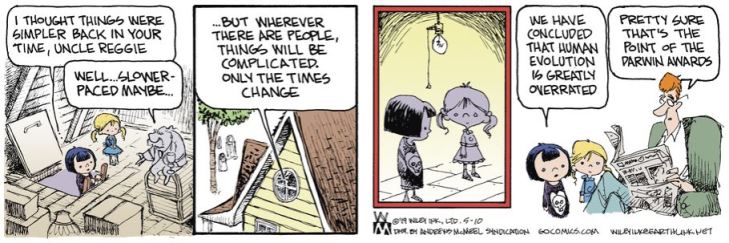
Despite many years of evolution, people (supposedly improved over that time) still find spectacularly stupid ways to get themselves killed. Therefore, evolution isn’t doing it’s job of improving the race. It’s overrated.
I am always a bit suspicious of the “things were simpler back then” idea… After all, designing, building and operating a fleet of Greek triremes or a mediaeval cathedral were fabulously complex things to undertake, and negotiating the subtleties and brutalities of social hierarchies are probably pretty equally complicated in Roman Rome and 21stC White House and indeed pre-historic China. There are vastly more people now, and of course more people you can look at through TV and the internet. But still.
Evolution doesn’t “improve” creatures, especially. It changes them in such a way that they do better than their competitors at reproducing their genes. That’s it.
The funny thing is, narmitaj, a future generation of old people will look back at today as their “good old days”, as a time when life was simpler and care free.
Nostalgia isn’t a logical thing.
But it’s not always illogical, either. For a large segment of American society, the two decades following World War II were pretty good overall. The economy was humming along, a social safety net was being implemented, the middle class was expanding, higher education became more accessible, and the country invested heavily in infrastructure. For whites in particular, it very well might have been a simpler, less fraught time than today.
That doesn’t mean it was better for everyone of course.
I thought everyone was terrified of the Reds – both out in the wide world and under the bed – and annihilation by nuclear weapons ’45-’65 and beyond. Korea, Berlin, Cuba, Sputnik, the start of Vietnam and all that.
But children of the ’50s or ’60s would probably be unaware of the negative things of the era, thus skewing their memories. Happens in every era, I think.
Just the fact of being younger makes the ‘good old days’ so much better.
Well, Andréa, being younger is a separate matter: I don’t think I’d want to be the age I am now in the 1950s.
Perhaps folks want to be today’s age, but live in the 50s. A case of ‘if only I knew then what I know now’, aka wishful thinking.
Bill: what are you, Carnac the Magnificent?
How much easier and better was it then? We don’t really think about how hard and how long it took to do things “in the olden days” and how much labor was involved in running a household “back then”
Even running a household used to be a lot harder than it is now. If one goes back to before the inventions in the late 1800s and 1900s for doing housework, it was an exhausting job and not one easily done by one person. Servants were needed by all but the lowest of households. Like everything else that was determined by wealth – one might have “a girl”” to help in the house or a staff of servants. 18th century enslaved people are not referred to as slaves, but as servants, black servants, or “our people” Houses of the upper middling and the gentry could not be run without a staff of servants – whether enslaved, indentured or hired just do to the amount of work that had to be done. (If you have watched Downton Abbey the start of these inventions is coming in – there was (I think) an electric mixer or such in the kitchen. The show “1900s House” showed how impossible it was a for the mother to do all the work for a family of 4 and she needed to hire “a girl” When the first Mary Poppins movie was made PL Travers was upset that the father was a bank executive – he was a teller in the books and even a “just’ a teller would be able to afford and needed a staff of several employees to run his household.)
Laundry used to be a multi-day task – bringing the water from the well, spring or stream, etc , heating it on the fire or wood stove, boiling the white clothes then washing by hand, washing in hot water by hand the color clothing (and before the introduction of aniline dyes around the middle of the 1800s they would lose their dye easily – imagine the red coats in pink coats), spreading them out to dry – not always on a line, often on the grass and/or bushes, then ironing all of them with an iron that either was heated on fire/stove or had an insert similarly heated, then folding them and putting them away.
Cooking food in the 18th century – pre stove – involved making a fire, taking the charcoal that resulted from the fire and making burners on the hearth to cook on. This was done for dinner, the main meal of the day at 2:00 (for some reason for Germans 3:00). The food left over from dinner would be set aside and the main cooking cleanup done – again the water had to be schlepped from the well or such and heated on the fire and then everything washed, dried and stored. Then the leftovers from dinner would be served at night for supper – and again water had to brought and heated to clean the dishes and the like used for supper. In the morning the leftovers from supper would served for breakfast (food had less time to go bad as it was generally used up within 24 hours and one did not have to do a large amount of cooking or clean up in the dark – additional food could be cooked if needed or head of the household wanted) and again the water brought, heated and dishes washed & dried and then it all started over for 2:00 dinner again.
People talk about people smelling as they did not bath in these earlier times. Again, the water would have to be schlepped and heated for use – and one did not want to be undressed in a cold house in winter and get ill so immersion bathing was not regularly done – but washing from a bowl or pitcher was – less water, less heating, less chance of catching cold.
Big change timesaving was at the end of the 1800s when water could be piped into the house and run through the stove to provide running hot water. The 1800s stove was also in general a huge improvement on cooking on the hearth.
As we progressed in the early 1900s machines to do the work come along – (not sure of the order) telephones, washing machines, dryers, vacuum cleaners, gas stoves – followed by electric stoves, furnaces which progressed from coal which needed to have the coal shoveled into it for use to gas, oil and electric furnaces, even the ice box – insulated box that one had a huge piece of ice delivered and put in to keep food cold so it did not go bad as quickly – followed by the refrigerator and later the “deep” freezer, dishwasher, etc.
All of this allows me to sit at my home computer and “talk” to all of you while our laundry is washed and dried automatically after I cooked a dinner (okay, tonight we had a cold dinner) that started with the turn of a knob to get almost instant heat to cook with and while I have never replaced the dishwasher after it died, the water for me to wash the dishes was almost instantly hot for me to use and came right to my kitchen sink. Our house is kept at the temperature needed automatically by either the thermostat for our furnace or same on our room air conditioners. All without my needing to leave my laptop and without the need of servants to help me get it all done.
We traveled 26 miles to and again back from a meeting of our reenactment unit this evening (which is why we had a cold dinner on our return) in a matter of half an hour each way. Before the car and modern roads – it would have taken several hours each way – and a horse pulling a carriage might not have been able to make the return trip the same day.
 Comics I Don't Understand
Despite many years of evolution, people (supposedly improved over that time) still find spectacularly stupid ways to get themselves killed. Therefore, evolution isn’t doing it’s job of improving the race. It’s overrated.
In a bit of email synchronicity, this review of the book, ‘Evolving Ourselves: How Unnatural Selection and Nonrandom Mutation are Changing Life on Earth’ just came in . . .
https://mailchi.mp/delanceyplace.com/cavemen-did-not-have-cavities-83018-gdrq3s7j65-1146949?e=0f3d9bcdb8
I am always a bit suspicious of the “things were simpler back then” idea… After all, designing, building and operating a fleet of Greek triremes or a mediaeval cathedral were fabulously complex things to undertake, and negotiating the subtleties and brutalities of social hierarchies are probably pretty equally complicated in Roman Rome and 21stC White House and indeed pre-historic China. There are vastly more people now, and of course more people you can look at through TV and the internet. But still.
Evolution doesn’t “improve” creatures, especially. It changes them in such a way that they do better than their competitors at reproducing their genes. That’s it.
The funny thing is, narmitaj, a future generation of old people will look back at today as their “good old days”, as a time when life was simpler and care free.
Nostalgia isn’t a logical thing.
But it’s not always illogical, either. For a large segment of American society, the two decades following World War II were pretty good overall. The economy was humming along, a social safety net was being implemented, the middle class was expanding, higher education became more accessible, and the country invested heavily in infrastructure. For whites in particular, it very well might have been a simpler, less fraught time than today.
That doesn’t mean it was better for everyone of course.
I thought everyone was terrified of the Reds – both out in the wide world and under the bed – and annihilation by nuclear weapons ’45-’65 and beyond. Korea, Berlin, Cuba, Sputnik, the start of Vietnam and all that.
But children of the ’50s or ’60s would probably be unaware of the negative things of the era, thus skewing their memories. Happens in every era, I think.
Just the fact of being younger makes the ‘good old days’ so much better.
Well, Andréa, being younger is a separate matter: I don’t think I’d want to be the age I am now in the 1950s.
Perhaps folks want to be today’s age, but live in the 50s. A case of ‘if only I knew then what I know now’, aka wishful thinking.
Bill: what are you, Carnac the Magnificent?
How much easier and better was it then? We don’t really think about how hard and how long it took to do things “in the olden days” and how much labor was involved in running a household “back then”
Even running a household used to be a lot harder than it is now. If one goes back to before the inventions in the late 1800s and 1900s for doing housework, it was an exhausting job and not one easily done by one person. Servants were needed by all but the lowest of households. Like everything else that was determined by wealth – one might have “a girl”” to help in the house or a staff of servants. 18th century enslaved people are not referred to as slaves, but as servants, black servants, or “our people” Houses of the upper middling and the gentry could not be run without a staff of servants – whether enslaved, indentured or hired just do to the amount of work that had to be done. (If you have watched Downton Abbey the start of these inventions is coming in – there was (I think) an electric mixer or such in the kitchen. The show “1900s House” showed how impossible it was a for the mother to do all the work for a family of 4 and she needed to hire “a girl” When the first Mary Poppins movie was made PL Travers was upset that the father was a bank executive – he was a teller in the books and even a “just’ a teller would be able to afford and needed a staff of several employees to run his household.)
Laundry used to be a multi-day task – bringing the water from the well, spring or stream, etc , heating it on the fire or wood stove, boiling the white clothes then washing by hand, washing in hot water by hand the color clothing (and before the introduction of aniline dyes around the middle of the 1800s they would lose their dye easily – imagine the red coats in pink coats), spreading them out to dry – not always on a line, often on the grass and/or bushes, then ironing all of them with an iron that either was heated on fire/stove or had an insert similarly heated, then folding them and putting them away.
Cooking food in the 18th century – pre stove – involved making a fire, taking the charcoal that resulted from the fire and making burners on the hearth to cook on. This was done for dinner, the main meal of the day at 2:00 (for some reason for Germans 3:00). The food left over from dinner would be set aside and the main cooking cleanup done – again the water had to be schlepped from the well or such and heated on the fire and then everything washed, dried and stored. Then the leftovers from dinner would be served at night for supper – and again water had to brought and heated to clean the dishes and the like used for supper. In the morning the leftovers from supper would served for breakfast (food had less time to go bad as it was generally used up within 24 hours and one did not have to do a large amount of cooking or clean up in the dark – additional food could be cooked if needed or head of the household wanted) and again the water brought, heated and dishes washed & dried and then it all started over for 2:00 dinner again.
People talk about people smelling as they did not bath in these earlier times. Again, the water would have to be schlepped and heated for use – and one did not want to be undressed in a cold house in winter and get ill so immersion bathing was not regularly done – but washing from a bowl or pitcher was – less water, less heating, less chance of catching cold.
Big change timesaving was at the end of the 1800s when water could be piped into the house and run through the stove to provide running hot water. The 1800s stove was also in general a huge improvement on cooking on the hearth.
As we progressed in the early 1900s machines to do the work come along – (not sure of the order) telephones, washing machines, dryers, vacuum cleaners, gas stoves – followed by electric stoves, furnaces which progressed from coal which needed to have the coal shoveled into it for use to gas, oil and electric furnaces, even the ice box – insulated box that one had a huge piece of ice delivered and put in to keep food cold so it did not go bad as quickly – followed by the refrigerator and later the “deep” freezer, dishwasher, etc.
All of this allows me to sit at my home computer and “talk” to all of you while our laundry is washed and dried automatically after I cooked a dinner (okay, tonight we had a cold dinner) that started with the turn of a knob to get almost instant heat to cook with and while I have never replaced the dishwasher after it died, the water for me to wash the dishes was almost instantly hot for me to use and came right to my kitchen sink. Our house is kept at the temperature needed automatically by either the thermostat for our furnace or same on our room air conditioners. All without my needing to leave my laptop and without the need of servants to help me get it all done.
We traveled 26 miles to and again back from a meeting of our reenactment unit this evening (which is why we had a cold dinner on our return) in a matter of half an hour each way. Before the car and modern roads – it would have taken several hours each way – and a horse pulling a carriage might not have been able to make the return trip the same day.