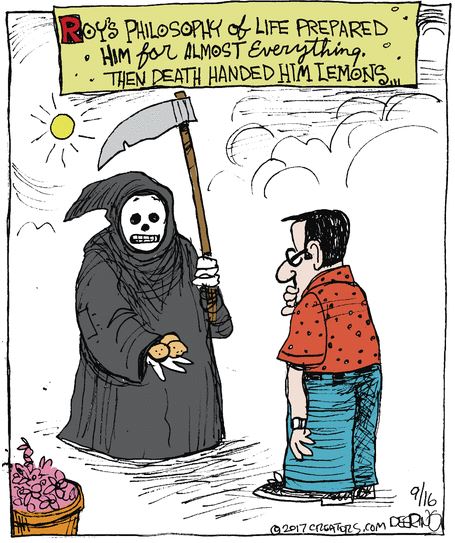
He knew what to do when *life* handed him lemons, but he never considered this possibility.
Roy’s philosophy: When LIFE gave him lemons, he made lemonade. He had a clear path, as still being alive, he could do that.
When Death did the same thing, he was a little confused as to what to do next. He’d have some trouble following protocol being dead and everything.
When Death gives you lemons take them. Inside each lemon are seeds to new life after all.
I think I’m with Slippers on this one. When Death gives you lemons, plant the seeds and grow lemon trees. Life’s gifts are meant to be used in the here and now, Death’s gifts are for the future.
While I like the optimism of Slippers, I think Arthur had it in one.
Arthur of course has the main joke. There’s also a secondary dig at people whose ‘philosophy of life’ is based on trite sayings. It doesn’t seem to prepare them for much.
Having a philosophy of life doesn’t mean you have a philosophy of death: of course, the guy is stumped.
I had forgotten that phrase was about when LIFE gives you lemons which, if I had remembered, would have made this a clearer substitution joke. I thought this was more about when you are alive and given lemons you make the best out of it (i.e. lemonade) but if death gives you lemons there is nothing good that can come out of it. Death is permanent and unchangeable.
Death’s lemons are probably seedless, like the ones on the grafted part of my lemon tree.
I like FBS’s answer. And CaroZ makes a good point.
“There’s also a secondary dig at people whose ‘philosophy of life’ is based on trite sayings. It doesn’t seem to prepare them for much.”
To be fair, I don’t know if anyone’s philosophy, trite or not, prepares them for being dead. OTOH, what do I know? I’ve never been dead.
As Yogi Berra might have said, “When Death hands you a lemon, take it.”
The guy who coined the phrase “When life hands you lemons, make lemonade” died in the sinking of the Lusitania.
I guess life didn’t hand him enough lemons to keep him afloat.
@ Winter Wallaby – I like to tell people I have been dead before – for about 13 billion years from the formation of the (or anyway this) universe until some time in 1957 when a bunch of atoms came together and got to the final stage of becoming me. Not sure they buy it though. In about another 30 years something like the opposite will take place and I will once again be dead, this time for trillions of years – but it will pass in a flash.
“The sparrow, flying in at one door and immediately out at another, whilst he is within, is safe from the wintry tempest, but after a short space of fair weather, he immediately vanishes out of your sight, passing from winter to winter again. So this life of man appears for a little while, but of what is to follow or what went before we know nothing at all.”
Exactly! Well, sort of. I have actually read his book, in the Penguin Classics translation. Bought it 16th September 1978 in Bristol.
narmitaj – Great link, I love little punny jokes like that. However, I’ll say it before anyone else does: Apparently Holmes never said, “Elementary, my dear Watson” in the original canon. If anyone cares.
Stan: An interesting book I once saw: The Public Life of Sherlock Holmes.https://www.amazon.com/Public-Life-Sherlock-Holmes/dp/0715367498/ This book catalogs all of the non-canonical Sherlock Holmes material, starting with the William Gillette play and continuing with Holmes fighting the Nazis in the Basil Rathbone movies. The deerstalker cap and the calabash pipe have bit parts in the canon but Gillette made them permanent fixtures. (Sartorial note: Doyle’s Holmes was always fashionably dressed and would NEVER wear a deerstalker cap while in London.) The amount of non-canonical material has probably doubled since the book was written. The canonical Holmes could truthfully say, as Yogi Berra did, “I never said half the things I said!”
And the Holmes books did not have this constant use of Prof Moriarty, but did have the Baker Street Irregulars who are rarely mentioned.
“The amount of non-canonical material has probably doubled since the book was written.”
Here’s a list of such (novels only) up through about 2012:
Another, including short fiction etc. also, and more or less up to date, organized around which canonical characters appear in which non-canonical items:
“And the Holmes books did not have this constant use of Prof Moriarty”
Very true. Technically he appears “live and onstage” in only “The Final Problem,” though Holmes retrospectively corrects the interpretation of that story at some length in “The Empty House.” Morarity is also the offstage mastermind in THE VALLEY OF FEAR, but he doesn’t appear onstage”there. And he’s mentioned in passing in one or two later stories, as Holmes muses that the later crop of criminals isn’t up to the old Morarity standard.
https://en.wikipedia.org/wiki/William_S._Baring-Gould Baring-Gould was a Holmes fan and expert, and among other things wrote a fictional biography of Holmes. I forget the specifics, but I think he acknowledged the existence of Doyle but explained him away as editor.
I actually first read his similar work about Rex Stout’s detective Nero Wolfe. That book propounded the theories that Archie Goodwin (Wolfe’s Watson, if you will) might have been Wolfe’s offspring; and that Wolfe himself might be Holmes’s son!
I’ve been reading – but not making much progress in a slow-moving story – Son of Holmes by John Lescroart (labeled “Auguste Lupa Mystery #1”), a fiction which incorporates that theory in its underpinnings. The mysterious stranger in town (occupied France) is Auguste Lupa, and we are supposed to figure out he is Nero Wolfe during his international secret agent phase. The formation of the name is meant to be a giveaway. I don’t know yet whether more than the title tells us he may be the son of Holmes.
 Comics I Don't Understand
He knew what to do when *life* handed him lemons, but he never considered this possibility.
Roy’s philosophy: When LIFE gave him lemons, he made lemonade. He had a clear path, as still being alive, he could do that.
When Death did the same thing, he was a little confused as to what to do next. He’d have some trouble following protocol being dead and everything.
When Death gives you lemons take them. Inside each lemon are seeds to new life after all.
I think I’m with Slippers on this one. When Death gives you lemons, plant the seeds and grow lemon trees. Life’s gifts are meant to be used in the here and now, Death’s gifts are for the future.
While I like the optimism of Slippers, I think Arthur had it in one.
Arthur of course has the main joke. There’s also a secondary dig at people whose ‘philosophy of life’ is based on trite sayings. It doesn’t seem to prepare them for much.
Having a philosophy of life doesn’t mean you have a philosophy of death: of course, the guy is stumped.
I had forgotten that phrase was about when LIFE gives you lemons which, if I had remembered, would have made this a clearer substitution joke. I thought this was more about when you are alive and given lemons you make the best out of it (i.e. lemonade) but if death gives you lemons there is nothing good that can come out of it. Death is permanent and unchangeable.
Death’s lemons are probably seedless, like the ones on the grafted part of my lemon tree.
I like FBS’s answer. And CaroZ makes a good point.
“There’s also a secondary dig at people whose ‘philosophy of life’ is based on trite sayings. It doesn’t seem to prepare them for much.”
To be fair, I don’t know if anyone’s philosophy, trite or not, prepares them for being dead. OTOH, what do I know? I’ve never been dead.
As Yogi Berra might have said, “When Death hands you a lemon, take it.”
The guy who coined the phrase “When life hands you lemons, make lemonade” died in the sinking of the Lusitania.
I guess life didn’t hand him enough lemons to keep him afloat.
@ Winter Wallaby – I like to tell people I have been dead before – for about 13 billion years from the formation of the (or anyway this) universe until some time in 1957 when a bunch of atoms came together and got to the final stage of becoming me. Not sure they buy it though. In about another 30 years something like the opposite will take place and I will once again be dead, this time for trillions of years – but it will pass in a flash.
As for the cartoon – A lemon tree, my dear Watson.
@narmitaj: You and the Venerable Bede, eh?
“The sparrow, flying in at one door and immediately out at another, whilst he is within, is safe from the wintry tempest, but after a short space of fair weather, he immediately vanishes out of your sight, passing from winter to winter again. So this life of man appears for a little while, but of what is to follow or what went before we know nothing at all.”
Exactly! Well, sort of. I have actually read his book, in the Penguin Classics translation. Bought it 16th September 1978 in Bristol.
narmitaj – Great link, I love little punny jokes like that. However, I’ll say it before anyone else does: Apparently Holmes never said, “Elementary, my dear Watson” in the original canon. If anyone cares.
Stan: An interesting book I once saw: The Public Life of Sherlock Holmes.https://www.amazon.com/Public-Life-Sherlock-Holmes/dp/0715367498/ This book catalogs all of the non-canonical Sherlock Holmes material, starting with the William Gillette play and continuing with Holmes fighting the Nazis in the Basil Rathbone movies. The deerstalker cap and the calabash pipe have bit parts in the canon but Gillette made them permanent fixtures. (Sartorial note: Doyle’s Holmes was always fashionably dressed and would NEVER wear a deerstalker cap while in London.) The amount of non-canonical material has probably doubled since the book was written. The canonical Holmes could truthfully say, as Yogi Berra did, “I never said half the things I said!”
And the Holmes books did not have this constant use of Prof Moriarty, but did have the Baker Street Irregulars who are rarely mentioned.
“The amount of non-canonical material has probably doubled since the book was written.”
Here’s a list of such (novels only) up through about 2012:
http://home.earthlink.net/~glennbranca/unclubables/id12.html
Another, including short fiction etc. also, and more or less up to date, organized around which canonical characters appear in which non-canonical items:
http://www.schoolandholmes.com/index.html
“And the Holmes books did not have this constant use of Prof Moriarty”
Very true. Technically he appears “live and onstage” in only “The Final Problem,” though Holmes retrospectively corrects the interpretation of that story at some length in “The Empty House.” Morarity is also the offstage mastermind in THE VALLEY OF FEAR, but he doesn’t appear onstage”there. And he’s mentioned in passing in one or two later stories, as Holmes muses that the later crop of criminals isn’t up to the old Morarity standard.
https://en.wikipedia.org/wiki/William_S._Baring-Gould Baring-Gould was a Holmes fan and expert, and among other things wrote a fictional biography of Holmes. I forget the specifics, but I think he acknowledged the existence of Doyle but explained him away as editor.
I actually first read his similar work about Rex Stout’s detective Nero Wolfe. That book propounded the theories that Archie Goodwin (Wolfe’s Watson, if you will) might have been Wolfe’s offspring; and that Wolfe himself might be Holmes’s son!
I’ve been reading – but not making much progress in a slow-moving story – Son of Holmes by John Lescroart (labeled “Auguste Lupa Mystery #1”), a fiction which incorporates that theory in its underpinnings. The mysterious stranger in town (occupied France) is Auguste Lupa, and we are supposed to figure out he is Nero Wolfe during his international secret agent phase. The formation of the name is meant to be a giveaway. I don’t know yet whether more than the title tells us he may be the son of Holmes.