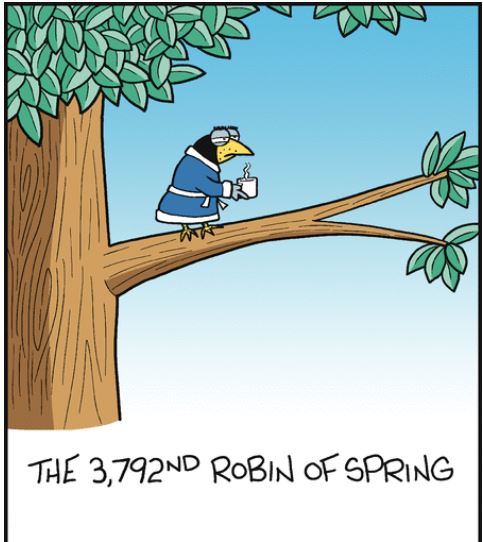
I totally agree with what’s been said so far, but I also thought that maybe there was an element of the metaphorical here.
When you see the 1st robin, you’re all excited as it’s a clear sign of winter packing it’s bags and spring being around the corner. By the time you get around to seeing the 3972nd robin, it’s not such a big deal anymore…a ‘meh’ moment. Perhaps the underwhelming robin in the comic is emblematic of that emotion.
@ Stan – I don’t think you are overthinking it at all: that’s exactly what is going on in this comic. However, as Watterson showed exactly 29 years ago today, it’s not necessary to wait for the 3792nd robin to get the effect, the 2nd one has similar potential:
Round here in Engla-La-La-Land, robins are mostly associated with being the bird that most visibly hangs about in the garden during winter, snow and Christmas. Though they could be a different sort of robin.
One January in WI, I heard robins as I was shoveling snow. A conflicting sensation of winter/spring/summer.
Here in FL, I hear them in winter, but only a solitary one, never flocks. Our ‘flocking’ birds are Ibis; usually 20 or 30 on the lawn at one time. We once had a flock of wild turkeys on our front porch.
Yes, the American robin (Turdus migratorius) is an entirely different bird.than the European robin (Erithacus rubecula). The American robin is much larger, and is reddish-orange from its breast through its belly, while the European robin does not have a red belly, but its red extends up from the breast into the throat and cheeks,
As the scientific name indicates, the American bird is migratory. (And for the record, “Turdus” is Latin for “thrush” and has nothing to do with the bird’s tendency to defecate on automobile windshields.) In the Great Lakes region of the United States, robins are still harbingers of spring: where I live, they are typically gone from late October to mid March.
When I would turn the soil for the Neighbor-Shocking Front Yard Garden, it would attract robins because worms. Once there were a couple in the area. Suddenly the larger one swooped down on the other. “Hmm, they’re fighting,” thought I. A moment later, “Oh, they’re not fighting. They’re not fighting at all.”
 Comics I Don't Understand
I think it’s just a variation of the late bird who doesn’t get the worm.
LikeLike
I’m sure we’ve already seen a similar “Nth robin” comic, but I like the way that this one is dressed.
LikeLike
I totally agree with what’s been said so far, but I also thought that maybe there was an element of the metaphorical here.
When you see the 1st robin, you’re all excited as it’s a clear sign of winter packing it’s bags and spring being around the corner. By the time you get around to seeing the 3972nd robin, it’s not such a big deal anymore…a ‘meh’ moment. Perhaps the underwhelming robin in the comic is emblematic of that emotion.
I’m probably overthinking this.
LikeLike
“Perhaps the underwhelming robin in the comic is emblematic of that emotion.”
The 3792nd robin isn’t that interested, any more, either.
LikeLike
@ Stan – I don’t think you are overthinking it at all: that’s exactly what is going on in this comic. However, as Watterson showed exactly 29 years ago today, it’s not necessary to wait for the 3792nd robin to get the effect, the 2nd one has similar potential:
LikeLike
Robins are year round now, at least as far north as Massachusetts. I don’t expect comics to catch up.
LikeLike
Call me when you see the 3792nd passenger pigeon.
LikeLike
Round here in Engla-La-La-Land, robins are mostly associated with being the bird that most visibly hangs about in the garden during winter, snow and Christmas. Though they could be a different sort of robin.
LikeLike
The early bird gets the worm, but it’s the second mouse that gets the cheese.
LikeLike
…and I like the way the bird is drawn with stubble on his beak.
LikeLike
One January in WI, I heard robins as I was shoveling snow. A conflicting sensation of winter/spring/summer.
Here in FL, I hear them in winter, but only a solitary one, never flocks. Our ‘flocking’ birds are Ibis; usually 20 or 30 on the lawn at one time. We once had a flock of wild turkeys on our front porch.
LikeLike
>>Though they could be a different sort of robin.
Yes, the American robin (Turdus migratorius) is an entirely different bird.than the European robin (Erithacus rubecula). The American robin is much larger, and is reddish-orange from its breast through its belly, while the European robin does not have a red belly, but its red extends up from the breast into the throat and cheeks,
As the scientific name indicates, the American bird is migratory. (And for the record, “Turdus” is Latin for “thrush” and has nothing to do with the bird’s tendency to defecate on automobile windshields.) In the Great Lakes region of the United States, robins are still harbingers of spring: where I live, they are typically gone from late October to mid March.
LikeLike
‘Cause this is what happens when you’re the First Robin of Spring . . .
http://comicskingdom.com/mutts/2019-03-21
LikeLike
And, on a related theme:

LikeLike
When I would turn the soil for the Neighbor-Shocking Front Yard Garden, it would attract robins because worms. Once there were a couple in the area. Suddenly the larger one swooped down on the other. “Hmm, they’re fighting,” thought I. A moment later, “Oh, they’re not fighting. They’re not fighting at all.”
LikeLike
@arthur for once I’m in complete agreement with the preachy philosophy of Frazz. That is precisely how I feel.
LikeLike
The robin slept in. Now that I’m retired, this is pretty much what I look like at 8 am.
LikeLike
Husband saw a robin several days ago.
LikeLike