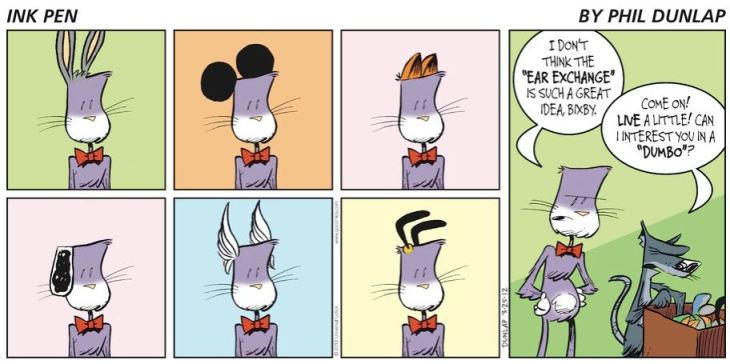
Panel I Don’t Understand, really: that sixth set of ears?
Related
22 Comments
odie from Garfield
Number 6 doesn’t look like Odie to me. His ears are rounder. And who is number 5?
Hats.
Steamboat Bill, Jr.
I think the fifth panel is “Astérix” (by Goscinny & Uderzo).
Snoopy?
#6 is likely Pluto, who often but not always has his ears up like that. A quick Google image search confirms.
Thanks to MinorAnnoyance for resolving the riddle.
P.S. @ Meryl A – Snoopy is the fourth panel, not the sixth.
@Kilby-
I was thinking Thor for the fifth panel, but I believe your answer is correct, although I wonder how many American readers would get the reference?
I thought panel 6 was Odie — but early Odie, when he had smaller black ears and not the larger brown ones of today. But the little orange mound does make me think Pluto may be correct.
@ Blinky – Actually, Thor is another good candidate. The “Ink Pen” strip (and presumably its author) is steeped in comic book nerdism, so either hero is an equally acceptable candidate.
P.S. The reason I think that “Astérix” is unknown in America is that the English translations are incredibly stilted. The text sounds simply unnatural. There’s also a lot of racial humor that presumably was acceptable in France in the 1960s and 70s, but is just not marketable in the current American era. In comparison, the German translations are excellent, coming extremely close to the original French versions.
My problem with 5 being Asterix, or Thor, is that it would be part of their helmet, not ears. I’ll grant it does look very Asterix-like, though. (And BTW, even my kids know Asterix, so I’d say known in Canada.)
@ chemgal – Your kids have a better chance of reading (or at least obtaining) the original French versions than anyone living in the US.
P.S. I own only one Astérix album in French (“Asterix in Britain”). I can puzzle out 90% of the meaning, but that’s mostly because I’ve read the German version. All the rest of my collection is in German.
In my far-off youth, the school library had some Asterix (in English) volumes. I agree that the language appeared stilted. I’m not sure who the (American) publisher was… I’d guess Scholastic… but AFAIK, nobody much cared for them (in these parts… obviously they were popular elsewhere).
The English translations of Asterix that were around in the 70s were pretty good. The humor really worked to a kid, which a more faithful translation from the French might not have. Some of the character names were even better than the original (the doctor/druid Getafix, for one).
#6 could pass for mid-period Snoopy. He started out as a puppy, then grew into a gangly, skinny-eared figure that Schulz could make flexible (dancing, a vulture, and earliest sleeping atop the doghouse). In time Snoopy became compact and maybe a little puppylike in build, concurrent with his preference for walking on two legs.
I got into Asterix in my teens; my father was big on historical novels and enjoyed them. This was in the 70s, and I never found the translations stilted. I did wonder what the English-language punning replaced. The puzzlement is more often the satiric references. It turns out the hapless pirates were parodying a straight adventure comic; even in France Asterix’s pirates are far more famous than their inspirations.
Sometimes the parody lasts far beyond the original. I can’t name even one of the romances of chivalry that Don Quixote is a parody of.
I grew up with Asterix – loved it. I still enjoy it now and then, though I only have a few of the comics now. In English, most of them – look, I was reading Rosemary Sutcliff and Walter Scott and half a dozen versions of Robin Hood from Pyle to Gilbert at the time. The language was well within the range of understandable, and the puns were great. I have a couple in other languages – Portuguese, one, and I think a Spanish one as well – but I can’t really read them, I just pick up a few words here and there. So basically none of the puns, but I can follow the action.
Now I’m a Foreign Service brat, and picked up Asterix while we were still living overseas, in the 70s. Not exactly normal American upbringing, so I can’t speak for how familiar normal Americans are with Asterix. I note, however, that my local library has quite a few in their children’s collection.
@ CaroZ – My objection to the English “Asterix” translations that I have seen so far had nothing to do with “faithfulness to the original version”, but simply that the English text did not seem even close to “native”. In contrast, the German versions are perfectly fluent. However, it seems that there may have been multiple English versions. As I recall, the ones I saw were done by an “agency” (without individual author credit). There may have been a different edition prepared for the American market. I’ll have to check the library the next time I’m in Washington.
@kilby – you are correct about being able to get the French versions in Canada, and one of my kids is capable of reading them in French, but I’ve only read them in English.
The ones I currently have, in the Asterix Omnibus editions (three stories per softbound volume), credit translation to Anthea Bell and Derek Hockridge; I’m pretty sure those were the same names in the older editions.
I remember there were some animated versions of the books that turned up on American VHS in the 80s. Some characters had different names than in the Bell-Hockridge editions. In recent years there have been a bunch of live-action movies, but they haven’t made it to American video. Most recently there was a CGI version of “Mansions of the Gods”, which struck me as odd because it feels like a very specific satire (The Romans build a huge apartment complex near the Gaulish village with the intention of assimilating the Gauls by proximity.). There’s also a prominent Asterix theme park in France; some of the attractions are explicitly set in Asterix’s world.
“Sometimes the parody lasts far beyond the original. I can’t name even one of the romances of chivalry that Don Quixote is a parody of.”
I remember more about some movies from their Mad Magazine versions than from the real version…..
Kilby, I meant the bottom right of the small ones – the one next to the large ones, that to me is the 6th – top 3 are the first 3, then the bottom 3 are the next 3, making the last of the bottom 3 (next to the large drawing) the 6th.
How am I counting wrong – they look like Snoopy’s long thin ears when they up they are sometimes up in the air (in surprise or such)
 Comics I Don't Understand
odie from Garfield
Number 6 doesn’t look like Odie to me. His ears are rounder. And who is number 5?
Hats.
Steamboat Bill, Jr.
I think the fifth panel is “Astérix” (by Goscinny & Uderzo).
Snoopy?
#6 is likely Pluto, who often but not always has his ears up like that. A quick Google image search confirms.
Thanks to MinorAnnoyance for resolving the riddle.
P.S. @ Meryl A – Snoopy is the fourth panel, not the sixth.
@Kilby-
I was thinking Thor for the fifth panel, but I believe your answer is correct, although I wonder how many American readers would get the reference?
I thought panel 6 was Odie — but early Odie, when he had smaller black ears and not the larger brown ones of today. But the little orange mound does make me think Pluto may be correct.
@ Blinky – Actually, Thor is another good candidate. The “Ink Pen” strip (and presumably its author) is steeped in comic book nerdism, so either hero is an equally acceptable candidate.
P.S. The reason I think that “Astérix” is unknown in America is that the English translations are incredibly stilted. The text sounds simply unnatural. There’s also a lot of racial humor that presumably was acceptable in France in the 1960s and 70s, but is just not marketable in the current American era. In comparison, the German translations are excellent, coming extremely close to the original French versions.
My problem with 5 being Asterix, or Thor, is that it would be part of their helmet, not ears. I’ll grant it does look very Asterix-like, though. (And BTW, even my kids know Asterix, so I’d say known in Canada.)
@ chemgal – Your kids have a better chance of reading (or at least obtaining) the original French versions than anyone living in the US.
P.S. I own only one Astérix album in French (“Asterix in Britain”). I can puzzle out 90% of the meaning, but that’s mostly because I’ve read the German version. All the rest of my collection is in German.
In my far-off youth, the school library had some Asterix (in English) volumes. I agree that the language appeared stilted. I’m not sure who the (American) publisher was… I’d guess Scholastic… but AFAIK, nobody much cared for them (in these parts… obviously they were popular elsewhere).
The English translations of Asterix that were around in the 70s were pretty good. The humor really worked to a kid, which a more faithful translation from the French might not have. Some of the character names were even better than the original (the doctor/druid Getafix, for one).
#6 could pass for mid-period Snoopy. He started out as a puppy, then grew into a gangly, skinny-eared figure that Schulz could make flexible (dancing, a vulture, and earliest sleeping atop the doghouse). In time Snoopy became compact and maybe a little puppylike in build, concurrent with his preference for walking on two legs.
I got into Asterix in my teens; my father was big on historical novels and enjoyed them. This was in the 70s, and I never found the translations stilted. I did wonder what the English-language punning replaced. The puzzlement is more often the satiric references. It turns out the hapless pirates were parodying a straight adventure comic; even in France Asterix’s pirates are far more famous than their inspirations.
Sometimes the parody lasts far beyond the original. I can’t name even one of the romances of chivalry that Don Quixote is a parody of.
I grew up with Asterix – loved it. I still enjoy it now and then, though I only have a few of the comics now. In English, most of them – look, I was reading Rosemary Sutcliff and Walter Scott and half a dozen versions of Robin Hood from Pyle to Gilbert at the time. The language was well within the range of understandable, and the puns were great. I have a couple in other languages – Portuguese, one, and I think a Spanish one as well – but I can’t really read them, I just pick up a few words here and there. So basically none of the puns, but I can follow the action.
Now I’m a Foreign Service brat, and picked up Asterix while we were still living overseas, in the 70s. Not exactly normal American upbringing, so I can’t speak for how familiar normal Americans are with Asterix. I note, however, that my local library has quite a few in their children’s collection.
@ CaroZ – My objection to the English “Asterix” translations that I have seen so far had nothing to do with “faithfulness to the original version”, but simply that the English text did not seem even close to “native”. In contrast, the German versions are perfectly fluent. However, it seems that there may have been multiple English versions. As I recall, the ones I saw were done by an “agency” (without individual author credit). There may have been a different edition prepared for the American market. I’ll have to check the library the next time I’m in Washington.
@kilby – you are correct about being able to get the French versions in Canada, and one of my kids is capable of reading them in French, but I’ve only read them in English.
The ones I currently have, in the Asterix Omnibus editions (three stories per softbound volume), credit translation to Anthea Bell and Derek Hockridge; I’m pretty sure those were the same names in the older editions.
I remember there were some animated versions of the books that turned up on American VHS in the 80s. Some characters had different names than in the Bell-Hockridge editions. In recent years there have been a bunch of live-action movies, but they haven’t made it to American video. Most recently there was a CGI version of “Mansions of the Gods”, which struck me as odd because it feels like a very specific satire (The Romans build a huge apartment complex near the Gaulish village with the intention of assimilating the Gauls by proximity.). There’s also a prominent Asterix theme park in France; some of the attractions are explicitly set in Asterix’s world.
“Sometimes the parody lasts far beyond the original. I can’t name even one of the romances of chivalry that Don Quixote is a parody of.”
I remember more about some movies from their Mad Magazine versions than from the real version…..
Kilby, I meant the bottom right of the small ones – the one next to the large ones, that to me is the 6th – top 3 are the first 3, then the bottom 3 are the next 3, making the last of the bottom 3 (next to the large drawing) the 6th.
How am I counting wrong – they look like Snoopy’s long thin ears when they up they are sometimes up in the air (in surprise or such)