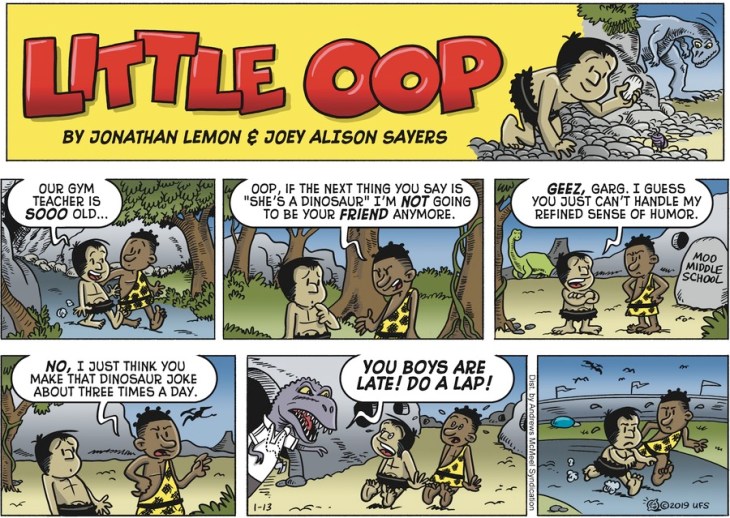
Okay, but… if his gym teacher is a dinosaur, what’s the joke?
Related
19 Comments
When did this strip even appear? I learned to read back in the 50s, on the floor with the Sunday comics and Alley and Oona and the gang. Lemon and Sayers couldn’t come up with their own idea for a strip?
“Lemon and Sayers couldn’t come up with their own idea for a strip?”
Have you noticed that a lot of times, Hollywood movies have “sequels” that are pretty severe departures from the previous films? This isn’t because the new filmmakers aren’t familiar with the previous film. Rather, it’s because they wanted to make a completely DIFFERENT film, but the producer decided it would make more money as a sequel to a popular movie that already existed.
The reason they keep doing this is because it’s hard to convince people to spend $X on a movie. To counter that resistance, they have a number of different ways to market it… look, we used this actor, who was in movies you liked before! Look, we used this director, who made movies you liked before! And sequels, which draw on the fact that you liked the earlier movie, with the characters, settings, or plotline, are easy to market. So Hollywood makes a LOT of sequels, including some that, really, aren’t sequels by original design. This is ALSO why Hollywood makes movies out of old TV shows (Dragnet), toys (Transformers), and even theme park rides (Pirates of the Caribbean)… because you have a positive feeling about those things, and the movie-maker wants to take your $X and will use whatever psychological factor they can to get that $X.
So, looping back, if a syndicate owns an intellectual property, and it has a positive marketing effect, there’s a tendency to shoehorn in a new project into the old intellectual property rather than try to get people to buy a completely new one they aren’t already familiar with. Look at the multiple iterations of Popeye across media, or the Scooby-Doo family of shows. Hollywood does it because it works, and other media follow suit, because Hollywood shows how well it works.
And then there’s The Spirit, when they bought the rights to a character only three people remembered in order to get the film financed, then made a film so far removed from the character that those three people were guaranteed to hate it.
I don’t think making a good film was ever a consideration: just getting the film financed, which meant everybody got a paycheck.
I’m enjoying the new Alley Oop. I dislike bad reboots/remakes, and zombie strips that linger past their time, but there’s nothing wrong with good “reboots.”
I’m _not_ enjoying the new Oop; in fact, I’ve stopped following it. The art is no worse, though different, from old Oop, but it’s not drawing me in enough to make it worth my while to follow the slow storyline (it’s no faster than the old one, and so far less interesting). This Sunday strip was the last straw, for me. Stupid gag strips within a continuity strip will turn me off even faster than recaps, which is what Sunday used to be.
Kind of a flimsy excuse for a “reboot”. Everything that happened in the past did happen but somehow we ending in an alternate universe which explains why suddenly we’ve turned into a strip gag.
I never liked the concept of “reboots” and in some sense it might make sense too do zombie strips. After all a reboot means: we’re erasing everything that happens and everything you read for the last 70 years and think of as “it happened” didn’t. That’s kind of …. mean.
” After all a reboot means: we’re erasing everything that happens and everything you read for the last 70 years and think of as “it happened” didn’t.”
On the other hand, sometimes the creator(s) don’t want to have to keep track of all that stuff that went before, because the nerds will revolt if you say one thing once, and then something else twenty-three years later. Second, if you need 20 years of backstory to keep up with what’s happening today, you aren’t going to pick up many new followers.
So, the comics have to reboot every twenty years or so, because the current writers haven’t read every darn story you ever published, and neither have a substantial portion of your current audience. Movie superhero stories have to reboot after every third movie, because if you try to do a fourth movie without a reboot you get “Batman and Robin” or “Superman IV”… and that’s optimistic, since to even get to 4 you have to make 3 good ones, and “Spiderman 3”, “X-Men 3”, “Batman Forever”, “Superman III”… all are less awesome. Nolan made it ALMOST to the end of his third Batman movie before he screwed it up.
We had to get rid of 40 years of collected Star Wars material so JJ could “fix” Star Wars, and you should have known what you were going to get after Star (lens flare) Trek.
Starting over together means that newbies can get on the bus. That’s good for creators, and ultimately good for fandom, too, even if the newbies don’t know all those secret little details about the old AwesomeMan continuity.
Have you ever noticed how many comics creators launch or try to launch additional strips about ten years in? It’s because they’ve explored all the depths the characters have, and they either have to start contradicting themselves or re-using old stories and gags.
Related to theory that one reason for longer and longer novels wedged into longer and longer series (trilogies, tetraologies, lotsavolumesaies), especially in the science fiction/fantasy field, is that when someone who isn’t really *that* much into reading makes an effort to get into a new plot/world/characterset, s/he doesn’t want to have to just “do it all again” for a long, long time. So standalone novels are too much mental “work,” and short standalone novels are even “worse,” and the very concept of “short stories” causes such readers to have vapors.
you don’t have to reboot to keep the authors of keeping track of every storyline. You can just ignore it and risk being inconsistent or zombie.
There’s no reason we should find “dragging on” to be any worse a crime then quitting and starting over every few years, nor any reason to think that if dragging on is a problem that “rebooting” in any way is actually a legitimate solution.
Just recently I heard part of a radio piece talking about why there’s a new version of Robin Hood every few years. Then on Saturday, I happened to see a DVD of the newest Robin Hood movie at a local store. When I picked it up to read the back, I was surprised to find another Robin Hood DVD underneath it: a version that I had never heard of before. This in addition to any number of other versions that I would recognize immediately.
Shrug: I could believe that effect exists, but I find it hard to think it’s a significant market driver compared to the perceived value of a recognizable franchise. (That and noob writers with delusions of grandeur that publishers are willing to try in case they turn out big — these are the ones where you find a 700 page book by someone you’ve never heard of before boldly emblazoned with “Book 1 of the Chronicles of Ar’de’ar’arr Laph”.)
The decline of editing is definitely also a factor in the increasing girth of books.
 Comics I Don't Understand
When did this strip even appear? I learned to read back in the 50s, on the floor with the Sunday comics and Alley and Oona and the gang. Lemon and Sayers couldn’t come up with their own idea for a strip?
LikeLike
It’s the old “no, I mean she’s LITERALLY a….” (dragon/storm trooper/evil Jedi) joke.
LikeLike
BillR, all I can say is we live in the age where everything old reboots again. And again. And again.
LikeLike
As does the song itself (from one of my five top fave movies, ‘All That Jazz’) . . .
LikeLike
The strip was taken over by a new creative team last week. They’re calling it a reboot, but I don’t think “reboot” means what they think it means.
Little Oop was yesterday’s offering.
LikeLike
“Lemon and Sayers couldn’t come up with their own idea for a strip?”
Have you noticed that a lot of times, Hollywood movies have “sequels” that are pretty severe departures from the previous films? This isn’t because the new filmmakers aren’t familiar with the previous film. Rather, it’s because they wanted to make a completely DIFFERENT film, but the producer decided it would make more money as a sequel to a popular movie that already existed.
The reason they keep doing this is because it’s hard to convince people to spend $X on a movie. To counter that resistance, they have a number of different ways to market it… look, we used this actor, who was in movies you liked before! Look, we used this director, who made movies you liked before! And sequels, which draw on the fact that you liked the earlier movie, with the characters, settings, or plotline, are easy to market. So Hollywood makes a LOT of sequels, including some that, really, aren’t sequels by original design. This is ALSO why Hollywood makes movies out of old TV shows (Dragnet), toys (Transformers), and even theme park rides (Pirates of the Caribbean)… because you have a positive feeling about those things, and the movie-maker wants to take your $X and will use whatever psychological factor they can to get that $X.
So, looping back, if a syndicate owns an intellectual property, and it has a positive marketing effect, there’s a tendency to shoehorn in a new project into the old intellectual property rather than try to get people to buy a completely new one they aren’t already familiar with. Look at the multiple iterations of Popeye across media, or the Scooby-Doo family of shows. Hollywood does it because it works, and other media follow suit, because Hollywood shows how well it works.
LikeLike
And then there’s The Spirit, when they bought the rights to a character only three people remembered in order to get the film financed, then made a film so far removed from the character that those three people were guaranteed to hate it.
I don’t think making a good film was ever a consideration: just getting the film financed, which meant everybody got a paycheck.
LikeLike
I’m enjoying the new Alley Oop. I dislike bad reboots/remakes, and zombie strips that linger past their time, but there’s nothing wrong with good “reboots.”
In defense of remakes: http://www.secretsofstory.com/2010/07/storytellers-rulebook-38-how-do-you.html
LikeLike
I’m _not_ enjoying the new Oop; in fact, I’ve stopped following it. The art is no worse, though different, from old Oop, but it’s not drawing me in enough to make it worth my while to follow the slow storyline (it’s no faster than the old one, and so far less interesting). This Sunday strip was the last straw, for me. Stupid gag strips within a continuity strip will turn me off even faster than recaps, which is what Sunday used to be.
LikeLike
“I’m _not_ enjoying the new Oop”
Ditto. If you are going to turn a continuity strip into a gag strip…. the gags really should be more than Alley Oop likes tacos and pizza.
LikeLike
And two identical taco references in the first week alone.
LikeLike
Kind of a flimsy excuse for a “reboot”. Everything that happened in the past did happen but somehow we ending in an alternate universe which explains why suddenly we’ve turned into a strip gag.
I never liked the concept of “reboots” and in some sense it might make sense too do zombie strips. After all a reboot means: we’re erasing everything that happens and everything you read for the last 70 years and think of as “it happened” didn’t. That’s kind of …. mean.
LikeLike
” After all a reboot means: we’re erasing everything that happens and everything you read for the last 70 years and think of as “it happened” didn’t.”
On the other hand, sometimes the creator(s) don’t want to have to keep track of all that stuff that went before, because the nerds will revolt if you say one thing once, and then something else twenty-three years later. Second, if you need 20 years of backstory to keep up with what’s happening today, you aren’t going to pick up many new followers.
So, the comics have to reboot every twenty years or so, because the current writers haven’t read every darn story you ever published, and neither have a substantial portion of your current audience. Movie superhero stories have to reboot after every third movie, because if you try to do a fourth movie without a reboot you get “Batman and Robin” or “Superman IV”… and that’s optimistic, since to even get to 4 you have to make 3 good ones, and “Spiderman 3”, “X-Men 3”, “Batman Forever”, “Superman III”… all are less awesome. Nolan made it ALMOST to the end of his third Batman movie before he screwed it up.
We had to get rid of 40 years of collected Star Wars material so JJ could “fix” Star Wars, and you should have known what you were going to get after Star (lens flare) Trek.
Starting over together means that newbies can get on the bus. That’s good for creators, and ultimately good for fandom, too, even if the newbies don’t know all those secret little details about the old AwesomeMan continuity.
Have you ever noticed how many comics creators launch or try to launch additional strips about ten years in? It’s because they’ve explored all the depths the characters have, and they either have to start contradicting themselves or re-using old stories and gags.
LikeLike
Here’s Watterson’s take on the “creativity” issue:
LikeLike
Related to theory that one reason for longer and longer novels wedged into longer and longer series (trilogies, tetraologies, lotsavolumesaies), especially in the science fiction/fantasy field, is that when someone who isn’t really *that* much into reading makes an effort to get into a new plot/world/characterset, s/he doesn’t want to have to just “do it all again” for a long, long time. So standalone novels are too much mental “work,” and short standalone novels are even “worse,” and the very concept of “short stories” causes such readers to have vapors.
LikeLike
you don’t have to reboot to keep the authors of keeping track of every storyline. You can just ignore it and risk being inconsistent or zombie.
There’s no reason we should find “dragging on” to be any worse a crime then quitting and starting over every few years, nor any reason to think that if dragging on is a problem that “rebooting” in any way is actually a legitimate solution.
LikeLike
Just recently I heard part of a radio piece talking about why there’s a new version of Robin Hood every few years. Then on Saturday, I happened to see a DVD of the newest Robin Hood movie at a local store. When I picked it up to read the back, I was surprised to find another Robin Hood DVD underneath it: a version that I had never heard of before. This in addition to any number of other versions that I would recognize immediately.
LikeLike
Shrug: I could believe that effect exists, but I find it hard to think it’s a significant market driver compared to the perceived value of a recognizable franchise. (That and noob writers with delusions of grandeur that publishers are willing to try in case they turn out big — these are the ones where you find a 700 page book by someone you’ve never heard of before boldly emblazoned with “Book 1 of the Chronicles of Ar’de’ar’arr Laph”.)
The decline of editing is definitely also a factor in the increasing girth of books.
LikeLike
MPAA Adds New Rating To Warn Audiences Of Films Not Based On Existing Works
LikeLike