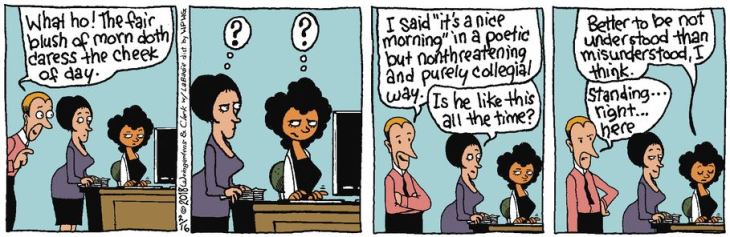
If you can’t be understood, people can’t impute a bad meaning to what you said. If you can be understood, you can also probably be misunderstood, which could be bad.
If you can’t be understood, people will try to figure out what you meant, and I imagine the best result will generally be that they think you’re being a wiseass. Because otherwise you’d just say what you meant, dammit. At worst, particularly if they don’t much like you, they could misunderstand you badly.
… if I understand what you’re saying, I feel offended!
Part of the issue the women have is that Mr. Pillsbury’s assistant is a borderline poster child for the “#MeToo” movement.
Kilby, I guess you mean Duane, who is some kind of junior executive, maybe designated “assistant”. Ms. Foxx is “administrative assistant” so I thought you might mean her, and be saying “poster child” in a secondary sense of “(publicized) supporter”.
The “What ho”! would be enough to get him into trouble.
@ Mitch4 – He’s the one I meant. I wasn’t sure about the spelling of his name (I would have guessed “Dwayne”), but I couldn’t confirm it anywhere, and I didn’t want to derail the thread by mentioning his last name, which happens to be “Butkis”.
And you know how much we hate derailed threads around here.
@John Kowalkowski – LOL!
@B.A. I come for the derailments. :)
@Treesong: I’d say he is saying exactly what he meant. The beauty of language is that it can be crafted to express the subtlest nuances or shades of meaning. While I denounce over-inflated verbiage, often attempts at self-aggrandizement or obfuscation and support the plain speech movement, there is a limit. Diminishing language and losing the poetry of life is sad thought.
Singapore Bill, yes, he’s saying what he meant, but that’s orthogonal to the question of whether it was understood, not understood, or misunderstood (and which is worst). A bit of flowery language may go over people’s heads in a situation where people expect something like ‘good morning’. And given what Kilby said, his greeting people with talk of cheek-caressing may be asking for trouble.
 Comics I Don't Understand
If you can’t be understood, people can’t impute a bad meaning to what you said. If you can be understood, you can also probably be misunderstood, which could be bad.
If you can’t be understood, people will try to figure out what you meant, and I imagine the best result will generally be that they think you’re being a wiseass. Because otherwise you’d just say what you meant, dammit. At worst, particularly if they don’t much like you, they could misunderstand you badly.
… if I understand what you’re saying, I feel offended!
Part of the issue the women have is that Mr. Pillsbury’s assistant is a borderline poster child for the “#MeToo” movement.
Kilby, I guess you mean Duane, who is some kind of junior executive, maybe designated “assistant”. Ms. Foxx is “administrative assistant” so I thought you might mean her, and be saying “poster child” in a secondary sense of “(publicized) supporter”.
The “What ho”! would be enough to get him into trouble.
@ Mitch4 – He’s the one I meant. I wasn’t sure about the spelling of his name (I would have guessed “Dwayne”), but I couldn’t confirm it anywhere, and I didn’t want to derail the thread by mentioning his last name, which happens to be “Butkis”.
And you know how much we hate derailed threads around here.
@John Kowalkowski – LOL!
@B.A. I come for the derailments. :)
@Treesong: I’d say he is saying exactly what he meant. The beauty of language is that it can be crafted to express the subtlest nuances or shades of meaning. While I denounce over-inflated verbiage, often attempts at self-aggrandizement or obfuscation and support the plain speech movement, there is a limit. Diminishing language and losing the poetry of life is sad thought.
Singapore Bill, yes, he’s saying what he meant, but that’s orthogonal to the question of whether it was understood, not understood, or misunderstood (and which is worst). A bit of flowery language may go over people’s heads in a situation where people expect something like ‘good morning’. And given what Kilby said, his greeting people with talk of cheek-caressing may be asking for trouble.