Still, it doesn’t really make sense because the guy is clearly not going ‘on-line’ in this situation, and I imagine that even with Wi-Fi, people still have to hook themselves up like this for certain medical tests.
It seems to me the artist is conflating two things that aren’t really connected and hoping a joke emerges.
Another reason it doesn’t make sense it that people did do online before Wi-Fi, and they still do. I’m wondering if the author thinks “Wi-Fi” is synonymous with “internet.”
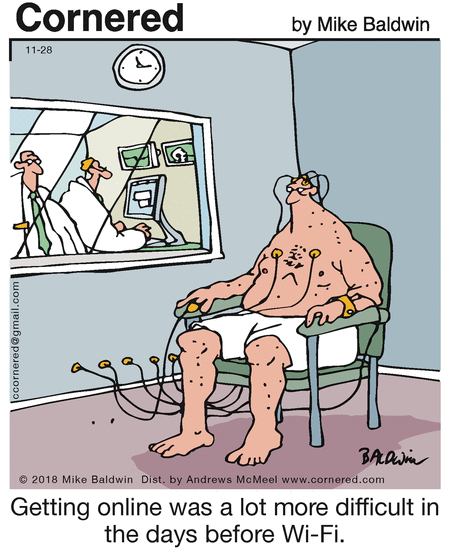
Before Wi-Fi, you had to have actual cords connecting you to a thing in order to get online. Here’s a picture of a guy with lots of cords connecting him to a thing! Ha ha, it’s just like trying to get online before Wi-Fi!
There is one bit of nuance we’ve been ignoring. He’s not using a computer which is going online; he, himself, is going online. It explains why there are wires going to him, but, IMNSHO, doesn’t help the joke.
My father, an airline pilot with Kuwait Airways, filed an incident report in 1959 when the aircraft he was captain of suffered a power failure after take-off from Bombay at night. Eventually “all electrical instruments, lights and radio were out of action”; with no radio they had to fly low over the airport to announce their presence. In those days – he was flying a 4-engine turboprop Viscount – control was through mechanical linkages, not electronically-mediated computer commands, so they could land. Also there were few aircraft movements so the sky was empty enough for them to pootle about in with no lights on. In fact, I remember him saying (it is not in the report) that theirs was the last take-off of the night and the runway lights had been turned off, meaning a blacked-out aircraft buzzing the airfield was how they alerted the ground to switch them back on!
The relevance for this comic is that his report says “the generators were not on line”, “all attempts to get the generators on line failed”, and “the F/O [first officer] states that the generators were on line as we taxied out for takeoff”. So on line – albeit not spelt on-line or online – had an electrical-connection meaning long before any internet-related meaning, whether wired or wireless. So the cartoon chappy is kind of on line in the old pre-internet sense, as Arthur said.
You can read my father’s typewritten one-page report here. 1705 Z is the time, Z standing for Zulu time, ie GMT (or UTC). 17:05 is 5:05pm; currently Mumbai time is five and a half hours ahead of GMT, so 1705 Z was presumably about 22:35 or 10:35 at night.
GAPOW (G-APOW) was the aircraft registration – G (for the UK) as Kuwait was not independent for another two years. It was in another incident in 1960, during a test flight over Beirut: https://aviation-safety.net/database/record.php?id=19600825-0 Completists interested in pics of the plane can google “G-APOW Viscount” and see more info!
“Before Wi-Fi, you had to have actual cords connecting you to a thing in order to get online”
Actually, you didn’t… there were wireless networks before there was Wi-Fi.
“Problem is that just wasn’t true. “on-line” has meant going onto the internet of even a forum or a BBS since the late 80s long before wifi.”
It meant something else before that. Before there were microcomputers, mainframes roamed the Earth. To use a mainframe, you had to be connected to it, and the way was through a “terminal”. Where does a terminal get it’s name? Well, it was at the end of a cable that connected to the mainframe. A terminal by itself was useless except as a doorstop (too big to be a paperweight), but a terminal that was “on-line”… connected to a computer… could do all sorts of cool things.
 Comics I Don't Understand
I think this is a picture from the past when there was no Wi-Fi. The guy in the comic is ‘on-line’, literally. Har, har.
LikeLike
Still, it doesn’t really make sense because the guy is clearly not going ‘on-line’ in this situation, and I imagine that even with Wi-Fi, people still have to hook themselves up like this for certain medical tests.
It seems to me the artist is conflating two things that aren’t really connected and hoping a joke emerges.
It didn’t.
LikeLike
Stan said what I was trying to put into words. Thanks, Stan.
LikeLike
Another reason it doesn’t make sense it that people did do online before Wi-Fi, and they still do. I’m wondering if the author thinks “Wi-Fi” is synonymous with “internet.”
LikeLike
Before Wi-Fi, you had to have actual cords connecting you to a thing in order to get online. Here’s a picture of a guy with lots of cords connecting him to a thing! Ha ha, it’s just like trying to get online before Wi-Fi!
Or, what Stan said.
LikeLike
There is one bit of nuance we’ve been ignoring. He’s not using a computer which is going online; he, himself, is going online. It explains why there are wires going to him, but, IMNSHO, doesn’t help the joke.
LikeLike
I think the idea is that the term “on-line” had a different meaning. And this was its old meaning.
Problem is that just wasn’t true. “on-line” has meant going onto the internet of even a forum or a BBS since the late 80s long before wifi.
LikeLike
I agree with our local marsupial: he thinks “wifi” means “internet” and vice-versa. Which is very stupid, but there you go.
LikeLike
If you’re directly connected to a network, you’re said to be “wired”. This guy is literally wired.
LikeLike
My father, an airline pilot with Kuwait Airways, filed an incident report in 1959 when the aircraft he was captain of suffered a power failure after take-off from Bombay at night. Eventually “all electrical instruments, lights and radio were out of action”; with no radio they had to fly low over the airport to announce their presence. In those days – he was flying a 4-engine turboprop Viscount – control was through mechanical linkages, not electronically-mediated computer commands, so they could land. Also there were few aircraft movements so the sky was empty enough for them to pootle about in with no lights on. In fact, I remember him saying (it is not in the report) that theirs was the last take-off of the night and the runway lights had been turned off, meaning a blacked-out aircraft buzzing the airfield was how they alerted the ground to switch them back on!
The relevance for this comic is that his report says “the generators were not on line”, “all attempts to get the generators on line failed”, and “the F/O [first officer] states that the generators were on line as we taxied out for takeoff”. So on line – albeit not spelt on-line or online – had an electrical-connection meaning long before any internet-related meaning, whether wired or wireless. So the cartoon chappy is kind of on line in the old pre-internet sense, as Arthur said.
You can read my father’s typewritten one-page report here. 1705 Z is the time, Z standing for Zulu time, ie GMT (or UTC). 17:05 is 5:05pm; currently Mumbai time is five and a half hours ahead of GMT, so 1705 Z was presumably about 22:35 or 10:35 at night.
GAPOW (G-APOW) was the aircraft registration – G (for the UK) as Kuwait was not independent for another two years. It was in another incident in 1960, during a test flight over Beirut: https://aviation-safety.net/database/record.php?id=19600825-0 Completists interested in pics of the plane can google “G-APOW Viscount” and see more info!
LikeLike
“Before Wi-Fi, you had to have actual cords connecting you to a thing in order to get online”
Actually, you didn’t… there were wireless networks before there was Wi-Fi.
“Problem is that just wasn’t true. “on-line” has meant going onto the internet of even a forum or a BBS since the late 80s long before wifi.”
It meant something else before that. Before there were microcomputers, mainframes roamed the Earth. To use a mainframe, you had to be connected to it, and the way was through a “terminal”. Where does a terminal get it’s name? Well, it was at the end of a cable that connected to the mainframe. A terminal by itself was useless except as a doorstop (too big to be a paperweight), but a terminal that was “on-line”… connected to a computer… could do all sorts of cool things.
LikeLike
My FIRST thought was . . . electric chair. Where IS my mind this a.m.?
LikeLike
Electric chair… go online now to go offline permanently.
LikeLike