There are memes for dogs and cats talking (adding funny captions to pictures of dogs and cats). Each species has a different way of talking, I think the dog is pretty much spot on – “wow wow” and no verbs is pretty typical, but the cat seems off. Of course, what the cat says is supposed to be funny, and this isn’t…
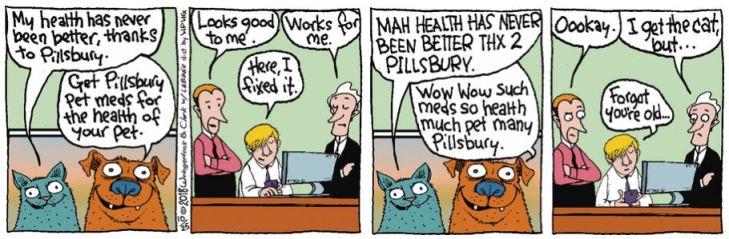
The young man (sitting at his desk) is adding some finishing touches to a pet food/medication commercial advertisement. The first version of the ad is shown in panel 1, and the second version is shown in panel 3.
The old people (the ones standing) voice their approval for the first version in the second panel. What isn’t so clear is that the young person isn’t satisfied with the first version, and so makes a certain change to make it much better in his opinion (“Here, I fixed it.”).
The second version is so bizarre to the old guys that they’re not even sure how to react. Is the young man serious? How can anyone even think that the new version could be better?
To the young man, it is obvious that the new version is better, and attributes the difference in taste to the older men being, well, “old” (and possibly senile).
The humor in the cartoon is supposed to be that the difference in taste actually comes from the young guy being part of the Facebook generation, who can (inexplicably) be endlessly entertained by pictures of cats with badly-spelled captions.
Presumably, the cat is supposed to be speaking LOLspeak, but this nothing like that. The dog is replicating Doge (https://knowyourmeme.com/memes/doge), fairly well, although there is a lack of punctuation.
That’s all. Talking animals which speak proper and comprehensible english make sense to old people. But to catch the attention of young people you should speak the language of internet memes. Which old people don’t get.
They’re supposed to be meme-speak, but they both fall flat. There are actual rules to lolcat and dogespeak — the podcast Lingthusiasm has had some episodes on the linguistics of memes: https://lingthusiasm.com/
The problem is that the Weingartens are also old. (Well, Gene is; his son, probably not so much.) So the Internet memes they chose to imitate are years out of date, and they still didn’t do it right.
“Doge” is a meme of a derpy looking dog, with floating words around mentioning whatever the topic of the meme is; included are “wow” “so *whatever*” and “much *whatever*”


Way over my head.
LikeLike
The youngster has converted normal (old person) language to what he thinks is standard (new-fangled) language?
LikeLike
. . . forgetting how many ‘old’ people have cats or dogs these days.
LikeLike
Wow. Such Internet. So Doge.
https://knowyourmeme.com/memes/doge
https://en.wikipedia.org/wiki/Doge_(meme)
LikeLike
Well, the cat’s revised lines could be taken as exemplifying the “lol cats” style.
LikeLike
There are memes for dogs and cats talking (adding funny captions to pictures of dogs and cats). Each species has a different way of talking, I think the dog is pretty much spot on – “wow wow” and no verbs is pretty typical, but the cat seems off. Of course, what the cat says is supposed to be funny, and this isn’t…
LikeLike
The young man (sitting at his desk) is adding some finishing touches to a pet food/medication commercial advertisement. The first version of the ad is shown in panel 1, and the second version is shown in panel 3.
The old people (the ones standing) voice their approval for the first version in the second panel. What isn’t so clear is that the young person isn’t satisfied with the first version, and so makes a certain change to make it much better in his opinion (“Here, I fixed it.”).
The second version is so bizarre to the old guys that they’re not even sure how to react. Is the young man serious? How can anyone even think that the new version could be better?
To the young man, it is obvious that the new version is better, and attributes the difference in taste to the older men being, well, “old” (and possibly senile).
The humor in the cartoon is supposed to be that the difference in taste actually comes from the young guy being part of the Facebook generation, who can (inexplicably) be endlessly entertained by pictures of cats with badly-spelled captions.
LikeLike
Young people are mentally defective?
LikeLike
Presumably, the cat is supposed to be speaking LOLspeak, but this nothing like that. The dog is replicating Doge (https://knowyourmeme.com/memes/doge), fairly well, although there is a lack of punctuation.
LikeLike
Demetrios X is correct.
LikeLike
Young people and their Internet….
That’s all. Talking animals which speak proper and comprehensible english make sense to old people. But to catch the attention of young people you should speak the language of internet memes. Which old people don’t get.
LikeLike
“There, I fixed it” is an internet genre as well, eg. https://failblog.cheezburger.com/thereifixedit
(Yes, white shirt says “Here,…”, that’s still close enough for a cookie, I think.)
LikeLike
“I am aware of all Internet traditions” is also, of course, a meme.
LikeLike
Such geezer. Many oldness. Wow.
LikeLike
They’re supposed to be meme-speak, but they both fall flat. There are actual rules to lolcat and dogespeak — the podcast Lingthusiasm has had some episodes on the linguistics of memes: https://lingthusiasm.com/
LikeLike
Kids these days, amirite?
LikeLike
The problem is that the Weingartens are also old. (Well, Gene is; his son, probably not so much.) So the Internet memes they chose to imitate are years out of date, and they still didn’t do it right.
LikeLike
My reaction was “Wow, that’s terrible Lolspeak.” And as mentioned above, these are actually old, tired memes.
LikeLike
Wow. So 215. Much doge.
“Doge” is a meme of a derpy looking dog, with floating words around mentioning whatever the topic of the meme is; included are “wow” “so *whatever*” and “much *whatever*”
LikeLike
The “improved” versions read like standard spam emails for questionable prescription meds.
LikeLike