I’ve always said that the difference between France, England and the USA lies in the dryness of biscuits: almost raw in the US, dry as a bone in UK, perfect in France :p ;)
Here, “clothing” has simply been replaced with “biscuits”: some dryers don’t handle very well too wet clothes.
Putting biscuits in the dryer looks like something kids would experiment with: maybe the cartoonist made the best of his personal experience.
@ Olivier – As silly as putting biscuits in a dryer would be (they would be reduced to crumbs in a matter of minutes), it’s better than some other childish experiements, such as the neighbor’s cat, or a kid. My brother and one of his friends took rides in our dryer (one idiot kid activating the door sensor, while the other idiot kid took a spin, then they traded positions). As I recall, it broke the dryer, but my parents and I didn’t find out about the cause until years later.
I thought it was about cooking (baking) biscuits in a clothes dryer. Like other eccentric cooking stunts (automobile engine pot roast).
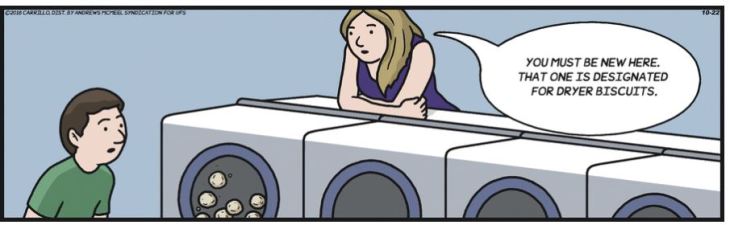
But what I didn’t understand about this was why the woman is giving that advice at this moment. If that dryer is reserved for cooking biscuits, you might warn away someone trying to use it for drying clothes. But the guy here does seem to be cooking, and doesn’t need to be warned off.
Mitch4 – I was a bit confused too at first but I think that the guy is not doing the baking and wants to use the dryer for its intended purpose. The lady is telling the guy not to use it for clothes.
“’ve always said that the difference between France, England and the USA lies in the dryness of biscuits: almost raw in the US, dry as a bone in UK, perfect in France ”
Biscuits in the US are a very different thing than ones in the UK. In the latter, the word refers to what we call crackers or cookies. I don’t know if France has something called that, or what you’re referring to specifically.
BA / Meryl A: “dryer biscuit”= more dry biscuit, I think. What I’m not sure about is if “designated for dryer biscuits” means “you don’t want to put too wet biscuits in there” or “your biscuits will be dryer in this specific dryer, compared to the other appliances in the place”.
Brian: in France, “biscuit”, as in the UK, covers US crackers (“biscuits salés”), and US cookies (simply “biscuits” as “biscuits sucrés” would sound silly). The fact that US and UK biscuits are different is what makes the joke work. Same with French’s mustard ;) .
I have to disagree — it seems unlikely they are using the comparative adjective form of “dry”. For one thing, the standard spelling of that is “drier” rather than “dryer” as here. That’s not determinative, of course, since the comic might not be following standard spelling. But beyond that, the drawing shows a bunch of the devices called “dryer” so we might expect them to have something to do with it.
I had the same question Meryl did, though I was asking whether “these are a thing” already — are people around the Internet talking about “dryer biscuits”? Apparently not. My tentative theory along those lines was going to be that it meant the clumped fibres you scrape off the lint filters, which might seem to be biscuity in shape at least. But that doesn’t seem to be the case.
So we are left with the meaning you get from just combining the words, which has been used in some of the above discussion. That is, biscuits (in the U.S. sense) which are to be prepared in the clothes-dryer.
I say “prepared” to allow for “heated up” if they are already cooked; but my preferred understanding is that they would be prepared in the sense of “cooked” or baked.
It’s nice to hear the different national senses of the word laid out. But I don’t think that has anything at all to do with *this* cartoon.
When Olivier says “The fact that US and UK biscuits are different is what makes the joke work,” I have to suppose you’re referring to some joke made by one of the CIDUers along the way, as it doesn’t have much to do with the joke of this cartoon.
 Comics I Don't Understand
It’s F-.
That’s its explanation. That’s the only explanation F- ever needs.
LikeLike
People like their biscuits warm.
LikeLike
I’ve always said that the difference between France, England and the USA lies in the dryness of biscuits: almost raw in the US, dry as a bone in UK, perfect in France :p ;)
Here, “clothing” has simply been replaced with “biscuits”: some dryers don’t handle very well too wet clothes.
Putting biscuits in the dryer looks like something kids would experiment with: maybe the cartoonist made the best of his personal experience.
LikeLike
@ Olivier – As silly as putting biscuits in a dryer would be (they would be reduced to crumbs in a matter of minutes), it’s better than some other childish experiements, such as the neighbor’s cat, or a kid. My brother and one of his friends took rides in our dryer (one idiot kid activating the door sensor, while the other idiot kid took a spin, then they traded positions). As I recall, it broke the dryer, but my parents and I didn’t find out about the cause until years later.
LikeLiked by 1 person
I think it’s just a play on a currently popular appliance color – biscuit on biscuit.
LikeLike
I thought it was about cooking (baking) biscuits in a clothes dryer. Like other eccentric cooking stunts (automobile engine pot roast).
But what I didn’t understand about this was why the woman is giving that advice at this moment. If that dryer is reserved for cooking biscuits, you might warn away someone trying to use it for drying clothes. But the guy here does seem to be cooking, and doesn’t need to be warned off.
LikeLike
Mitch4 – I was a bit confused too at first but I think that the guy is not doing the baking and wants to use the dryer for its intended purpose. The lady is telling the guy not to use it for clothes.
LikeLike
What’s a “dryer biscuit”?
LikeLike
“’ve always said that the difference between France, England and the USA lies in the dryness of biscuits: almost raw in the US, dry as a bone in UK, perfect in France ”
Biscuits in the US are a very different thing than ones in the UK. In the latter, the word refers to what we call crackers or cookies. I don’t know if France has something called that, or what you’re referring to specifically.
LikeLike
I second BA’s question.
LikeLike
BA / Meryl A: “dryer biscuit”= more dry biscuit, I think. What I’m not sure about is if “designated for dryer biscuits” means “you don’t want to put too wet biscuits in there” or “your biscuits will be dryer in this specific dryer, compared to the other appliances in the place”.
Brian: in France, “biscuit”, as in the UK, covers US crackers (“biscuits salés”), and US cookies (simply “biscuits” as “biscuits sucrés” would sound silly). The fact that US and UK biscuits are different is what makes the joke work. Same with French’s mustard ;) .
LikeLike
I have to disagree — it seems unlikely they are using the comparative adjective form of “dry”. For one thing, the standard spelling of that is “drier” rather than “dryer” as here. That’s not determinative, of course, since the comic might not be following standard spelling. But beyond that, the drawing shows a bunch of the devices called “dryer” so we might expect them to have something to do with it.
I had the same question Meryl did, though I was asking whether “these are a thing” already — are people around the Internet talking about “dryer biscuits”? Apparently not. My tentative theory along those lines was going to be that it meant the clumped fibres you scrape off the lint filters, which might seem to be biscuity in shape at least. But that doesn’t seem to be the case.
So we are left with the meaning you get from just combining the words, which has been used in some of the above discussion. That is, biscuits (in the U.S. sense) which are to be prepared in the clothes-dryer.
I say “prepared” to allow for “heated up” if they are already cooked; but my preferred understanding is that they would be prepared in the sense of “cooked” or baked.
It’s nice to hear the different national senses of the word laid out. But I don’t think that has anything at all to do with *this* cartoon.
When Olivier says “The fact that US and UK biscuits are different is what makes the joke work,” I have to suppose you’re referring to some joke made by one of the CIDUers along the way, as it doesn’t have much to do with the joke of this cartoon.
LikeLike
“you’re referring to some joke made by one of the CIDUers along the way”: yes: mine, responding to Brian’s explanations.
LikeLike
I guess I’l go with “Carrillo doesn’t know that ‘drier’ and ‘dryer’ are different words and spelled differently”.
LikeLike
The word “biscuit” originally referred to twice-baked products, as does the similar Italian word “biscotti”.
LikeLike
I don’t know guys. it just seems to me to just be a patently absurd setup, and that’s it.
Note that I’m not saying it’s particularly funny in itself.
I think Monty Python did absurd setups better…
LikeLike