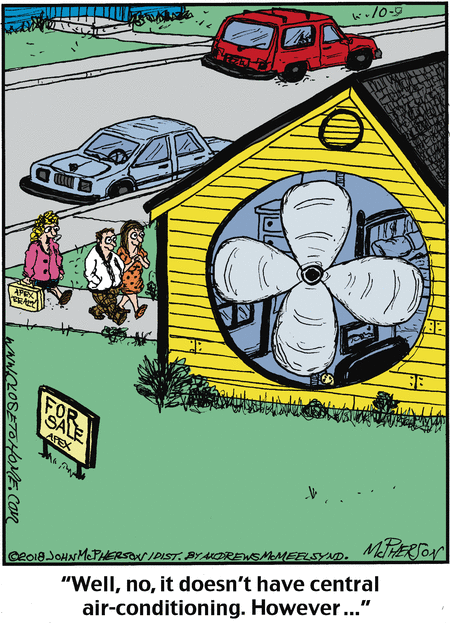
Actually…
This might not be as far-fetched as Mr. McPherson thinks: when we were house-hunting some years back we came across a house whose fan, while not quite as large as this one, was powerful enough that it literally knocked my wife off her feet. The sort of thing you’d expect in a factory or something.
I don’t want to think about what the electric bill must have been for that house, but I’m pretty sure they never had to dust anything.
 Comics I Don't Understand
My house has a large exhaust fan into the attic, so that when it’s not too hot or humid outside, and not pollen season (so about 3 days a year), we can create a wind tunnel in the house . Sliding doors and windows need to be strategically opened for best effect, and stuff can get blown all over the place. Uses less electricity than AC, though.
CIDU BILL: I thought ‘meh’ about the comic, but ‘LOL’d’ at your comment. Thanks for the uplift, much needed these days!
You had me at “never had to dust anything”.
Is that fan facing the right direction?
@ Divad – German houses with central air conditioning are extremely rare, because forced-air heating is never used in private homes. During the hottest weeks in summer, I sometimes open the roof windows on our top floor, and then open the doors at ground level, producing a similar (but unpowered) “chimney” effect. This works best very early in the morning, when the incoming air is as cool as it will be all day.
P.S. @ tygalilee – It depends on what you consider the “correct” direction. It looks like it’s set to blow “out”, which is probably safer, rather than impelling pollen, birds, and insects into the house.
In my childhood home, my Mother used to spend a lot of time (it seemed to me), changing window fan positions (blow in or draw out; this window or that window; upstairs or downstairs). One burden that was lifted from her shoulders when a/c was installed.
The house across the street from us has a whole-house fan. Not, of course, a fan the size of the whole house, but a very large one at the top of the house, designed to pull hot air from the ground floor all the way to the roof. It’s supposedly more energy efficient than traditional systems alone.
I can just imagine a little squirrel in the bottom right corner saying “That sucks!”
(And as I was hitting ” post”, I realized I’d earned myself a trip to Moderation Hell)
Many old Victorian houses have large cupolas on the center top of the roof. Most people don’t realize that the cupolas were early air conditioning. You’d open windows an inch or two throughout the house, close the drapes, and open the attic door and the trap door to the cupola, and there’d be a breeze throughout the house. It really worked! No fans needed.
Silk – earlier a cupola was only on a public building and was for the same reason.
We thought of putting in attic fan when we moved in. It would need to be in the center of our attic.. Unfortunately that only access to the attic is in a closet in the bedroom which serves as our office. Almost everything in the closet needs to be taken out and a folding ladder (which we bought) has to be opened from the small square it stores as, to the full size and then somehow maneuvered into place plus when one enters the attic one is coming in close to the bottom of the roof angle and has to crawl immediately.
We had thought about having a pull down ladder installed in the ceiling more centered so that one could actually use the attic – let alone have a fan put it in – but that would involve having the ladder come down over the open area of the staircase coming upstairs to the second floor – a pretty scary place for it.
This comic made me think of our RV. RV is a polite name for it – it is a Chevy Express Van converted into an RV – very tight quarters. Apparently the smallest BTU air conditioner made to put into an RV (even though it runs on AC, it has to be special for this RV for mounting) is much too large.
If we run the fan or the AC functions it sounds like there is an airplane in the RV and if it runs too long on ac it develops frost.
Traditional houses of Jeddah were constructed to create passive beneficent airflow, among other architectural means such as proper materials selection to ameliorate heat stress for the occupants. Here’s a Saudi chap’s 1990 thesis on the matter:
Click to access 12813354.pdf
I got to it by googling: traditional jeddah housing
narmitaj – Thank you for the link. At almost 400 pages, I didn’t read it all, but I skimmed some sections. I was impressed at the urban planning that ensured streets and alleys got maximum shade and directed breezes, and the houses had planned “chimney” effects in their design.