Is the random Capitalization of Nouns making a comeback after 200-some years, or is this just part of our trend toward functional illiteracy?
- Comment
-
Subscribe
Subscribed
Already have a WordPress.com account? Log in now.
 Comics I Don't Understand
yES
I call false dilemma.
Vat do you mean? Zey neva left to be makink a komeback from…
Zorry, I meant of kourse, “You”…
Meaning what exactly, WW,
I sometimes do that when trying to chunk an idea together, the way I might otherwise do with quotation marks. Or, somewhat similarly, to indicate a word is being used in a specialized sense, as though a technical term, even if not part of a recognized semantic set like that.
I see Superfluous Capitalization very frequently, but it’s generally text that has been preliminarily translated into English by a German colleague. For them it is quite difficult to break the habit of capitalizing every noun (they usually get most of it right, but there’s always a few cases that need to be lowercased).
P.S. There is one author who was an absolute master of judicious capitalization: A.A. Milne. In both of the Winne the Pooh books, Milne carefully used capital letters to give special meaning to particular words, turning ordinary nouns into special titles.The primary reason it works is because he didn’t overdo it.
Cidu Bill: Meaning that you’ve presented an either-or question without providing a reason to think that those are the only two choices. What is your evidence that random capitalization of nouns is increasing?
I do a lot of capitalization thinking Title Case for semi-quotes and fake titles. Another thing is dropping the . from abbreviations. There are a lot of cases where using it isn’t allowed in addresses, or using it makes Word capitalize the next word.
Big Milne fan too, obvs.
Observation, WW.
And of course it doesn’t help that an example is being set by He Who Will Not Be Named.
But the overall trend seems to be that rules of grammar, spelling and punctuation are increasingly seen as mere suggestions.
Milne knew how to write properly and chose to make exceptions for specific reasons. Likewise e.e. cummings, I’m sure, knew where his Cap key was. Neither of them can be accused of sloppiness or ignorance.
. . . as are the ten commandments . . .
The observation that people today don’t know stuff good like we did back in the good old days is a few thousand years old, so I tend to treat it with some skepticism.
Andrea: Since almost half of the Ten Commandments are religious in nature, and I’m not religious, I don’t even treat them as mere suggestions. (Not that I was inclined to worship “other” gods anyway.)
My son recently learned about the “thou shalt not covet” one, and his response was “What? How is that even possible?”
However… I’m old enough that I could have made this observation in any number of time periods.
But didn’t.
it was to be a joke . . . one I’ve heard so many times.
I think there is a difference between ‘knowing’ and ‘using’ . . . We might know the correct usage, but not always use it, esp. online.
Some of it probably down to the not yet entirely ergonomic design of the devices most people type on these days. Autocorrect and all the rest of it.
@Downpuppy: Some of the dropping of periods from abbreviations is British. UK English has the rule that an abbreviation that ends in the letter that the word ends with doesn’t take a period. Mr is a good example of that.
I gotta go with illiteracy in many cases. I’m getting tired of writing “Das ist nicht Deutsch” on things I’m marking up.
E E Cummings actually signed his name that way — not e.e. cummings — and his poems are published with a properly capitalized author. See, e.g., Poems 1923-1954 (Harcourt Brace & World).
Or HITTING THE #$%^ caps lock key wHEN YOU DON”t realize it
Have you looked anything up at https://www.merriam-webster.com/ lately? It’s horrifying what they’ve done to the format.
Merriam Webster is worse than Google. Instead of providing any kind of usable opt-out, the following claim appears: “Look, cookies make everything better. Including websites. By using them, we’re able to make your time on our site a lot less crummy and a much richer experience.”
The idiots who wrote that claim to be an authority capable of writing a dictionary? Sorry, no.
How odd is that, Phil? I also got tired of writing “Das ist nicht Deutsch,” and I was teaching math in New Jersey.
DemetriosX, I’m a real fan of dropping that period: it makes the sentence so much easier to read.
I’m afraid this is something I rant way too often about: even our best magazines seem to have gotten rid of most of their editors. Or else their editors just aren’t very good. Either way, they don’t see this as a real problem.
And they don’t see it as a real problem because apparently not enough of their readers do.
Possibly because their readers have just become accustomed to sloppiness, BECAUSE magazines aren’t taking it seriously enough.
Easy to see how this becomes self-perpetuating.
Kilby: Ha, ha, that’s what you get for trying to have privacy!
Come back to America, where we’ve given up on the idea!OK. That’s not what I mean to happen. But at least I know that I can’t do [sarcasm] tags here, as they become strikeout.
Kilby, in all seriousness we’d love to have you in America. Also in all seriousness, we do seem to have given up on the idea of digital privacy here. On the plus side, you can use YouTube and m-w in peace. ;)
I wonder if it’s a magazine thing? I read lots of books and I’m often irritated by bad proofing there, but I can’t recall the last time I saw Gratuitous Capitalization. The only magazines I read are Skeptical Inquirer and New Yorker, and I never see it there either.
Treesong, I wasn’t referring to Gratuitous Capitalization in the magazines, but rather sloppy sentences, pronoun mismatches, fallacious uses of statistics, that sort of thing. Including in the New Yorker.
Yes, the New Yorker.
Re: fallacious uses of statistics.
India’s BJP recently touted how low the price of gas has been under their government with one of the most egregious bad graphs I’ve ever seen.
https://cms.qz.com/wp-content/uploads/2018/09/Modi_Chart.jpg?quality=75&strip=all&w=1100&h=619
https://cms.qz.com/wp-content/uploads/2018/09/Modi_Chart.jpg?quality=75&strip=all&w=1100&h=619
Hm, don’t know why it doesn’t embed.
As a guess, it has to end with something that WP thinks is an image, such as

Arthur: Beautiful picture!
@ WW – It probably did not embed because of the tokens following the file extension.
The problem is not that people in general are less careful or aware of grammatical rules. The problem is that more people are having their writing distributed for public consumption.
There have *always* been citizens who had trouble with spelling and grammar. But in the past they were largely farm workers and laborers who probably stopped schooling around eighth grade, and on the rare occasions when they wrote something, it was never made public without going through an editor first.
As the country’s workforce has shifted away from manufacturing and basic labor to service and information, and as technology allows “anyone to be an author”, so to speak, we see more written text from people of limited writing skill.
I can’t resist . . . not that I tried to do so . . .
https://www.gocomics.com/realitycheck/2018/09/28
Shakespeare did it, and that should be good enough for anyone. Of course, he frequently uses what we would think of as bad grammar – “most unkindest cut,” and things like that.
A gentleman I know believes that Shakespeare capitalized words as a signal to the actors to emphasize them.
If you see this mostly from He Who Shall Not Be Named, I’m going to assume you’re referring to tweets? Tweets that are typed from his smartphone, of course. When I text, sometimes random words are capitalized. Usually because I’ve added more to the beginning of a sentence, and have to go back and edit the starter word to lowercase. Or voice to text makes some sort of error I have to fix it. I’m pretty sure HWSNBN puts the same intellectual effort into editing his tweets as he does into composing them.
Ignatzz, in Shakespeare’s day, the language wasn’t really standardized yet: he spelled his own name several different ways.
So he wasn’t breaking rules, because there weren’t any.
I haven’t noticed this “trend” at all either
But I don’t hang out on twitter, maybe that is the culprit. If so, I blame (like some people above mentioned) phone text autocorrect
@Arthur, it embedded all right for me, but what the yell kind of graphic is that? Is 80 now less than 71?
As to the capitalization, when I learned to code, we defined variables like ‘FirstNumber’ or ‘ThisIsCrap’, since names weren’t allowed spaces.
Re Andréa’s link: @^#%ing squirrel doesn’t even say something like, “I’ll drink too… that!” or “I’ll drink two thats”
WW’s link: WOW! It took me a long time to even parse what that was trying to say. At first I thought it was just outright new order alternate facts, ie: 80.73 is now less than 71.41, don’t look behind the curtain! But they even have calculated the percentage rises, and 13% is not negative, and if they were outright making up new facts, they could have made it negative. So I finally got that they wanted to show that the rate of increase is down — it’s still going up, but not nearly as much. And this is a terrible way to show that. Graph the percent changes as the bars, drop reference to the actual cost, geez, it’s not even that hard…
larK: I think you’re giving them too much credit by thinking that they’re trying to show that the rate of increase is going down, but doing a bad job at it. I think, rather, they’re trying to lie and show that the price is going down, but without actually putting any false numbers on the graph.
Looking back at my first sentence, I’m not sure if that should be “too much credit” or “too little credit.”
The line between bad grammar and accepted is very fine, as you know, and when used often enough, bad goes to accepted. But when it happens, it drives me nuts until I get used to it. Some things I still can’t put up with, like “different than” (should be “different from”) or “graduated high school” (“graduated from HS”). Some of you have probably used these all your life, but I never heard them until I was grown, and they grate on me. Of course, the older I get, the more I make mistakes I don’t catch, and the more I forget the rules I learned so many years ago.
no reference to archy
the poetic cockroach
created by don marquis
he asked
archy would leap from the
top of the typewriter
and land
headfirst on a key
to slowly versify
unable to work the shift key
and eschewing punctuation
because life is short enough
for a vers libre poet
already handicapped
by reincarnation
Bookworm, in 50-year old usage books they were complaining about “graduated from” because it’s the school who graduates its students, not the students who graduate from the school.
I find it mildly amusing that we’ve gotten far enough in the Internet Age to have language shifts and debates over what IMHO means. ( https://www.theatlantic.com/technology/archive/2018/05/the-h-in-imho-does-not-mean-humble-or-honest/559514/ )
When I accidentally became a magazine editor, became very aware of the difference between right/wrong and preferred/not preferred.
I remember a long discussion I had with the outgoing editor in which she listed the magazine’s preferred usages. Midway through, I realized I was here and she was gone and the magazine’s preferences were now MY preferences. Le magazine, c’est moi!
But wrong was still wrong.
Interesting, Arthur. Hadn’t thought of it that way.
Bill: I was recently dragooned into doing some last minute copy-editing for a friend’s company that was doing a critical presentation, like, yesterday. They had made up a style sheet for preferred usages, and as I quietly digested it, I had a similar reaction (though less justified) to you when I came across that apparently they didn’t use the Oxford comma; they might not use it, but I do, and if I’m doing last minute copy editing for cohesion and coherence, then this document will be using the Oxford comma!
(Turns out they had had a debate about it and the consensus was to use the Oxford comma after all, they just hadn’t updated the style sheet, so it didn’t even end up being a problem.)
@ WW & larK – I remember reading about a statement made by someone in the White House (decades ago), to the effect that “the increase in the inflation rate was starting to slow down”. The comment was that this was the first time a mathematical “3rd derivative” had made it into a political discussion.
Kilby, it had probably happened earlier as well: it’s a rare politician who won’t take advantage of the opportunity to mislead while not technically lying.
If I were doing this for somebody else’s company, I would condescend to adhere to their Oxford policy.
But if I’m the boss, I don’t have to care what the old boss liked.
And likewise, of course, my writers got Oxforded.
Bill: had I been there for the long haul, then yes, I would either have to gird myself for the we-should-use-the-Oxford-comma-and-here’s-why debate, or quietly acquiesce, but since I was there to put the finishing touches for one thing, and one thing only, I felt more along the lines of, “and how are you going to stop me?”
When it comes to judicious emphasis, there is one artist who misfires surprisingly often (in my opinion). I still like “Mutts”, although I was a little disappointed when I discovered that all the text is in a computer font. This is especially obvious when McDonnel decides to put words in bold. Almost every time he does this, the word (or words) he chooses to emphasize don’t seem to be the ones that really need it to make the sentence work.
I can’t say I’ve noticed Mutts in particular, but the misuse of bold in comics is so endemic that I long ago (I mean like at age 8 or something) gave up trying to ascribe any meaning to the randomly bolded words in comics (ie: Marvel and DC) or even Mad Magazine. As far as I can tell, they are merely random decorations. I have tried to read them for emphasis, for irony, for ^%#ing squirrel type punch-line broadcasting, and quickly resolved they were meaningless, and just learned to ignore them. Just like the fact that in comics (eg Uncle Scrooge) every sentence ends in an exclamation point!
@ larK – I first learned about wall-to-wall exclamation points from MAD Magazine. At one point I went through an entire issue, meticulously searching for a line of text that did not end in one.
I’d heard that comic books tend to use exclamation points rather than periods to end sentences because, with the rather fuzzy registration in old-time (at least) comics, a period might get overlooked by a reader, causing some confusion where a sentence ended and a new one began. (Problems of frequent ink bleed, combined with all-capital-letter text, also, famously being why use of the words “flick” and “clint” were supposedly highly discouraged.)
Yeah, that makes perfect sense — try explaining that to 8 year old me, who’s still proud at learning the differences in meaning among the various punctuation marks.
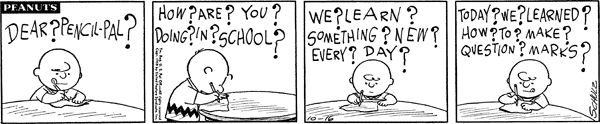
But now explain the random use of bold…
Last try sorry about the repeats of the small unreadable one):

Shrug, I’ve read the same thing, plus the fact that sometimes periods just physically weren’t visible.
Are they even teaching grandma, err, grammar any longer in schools? I think today if people spell the words as intended it is a miracle. Even I find myself using cell phone word abbreviations when sending a text to Robert “R U coming down soon?”
I also know that my grammar has gotten much worse than before (although it was never good according to the grammar check in (not on) the computer. I will leave a lot of participles dangling as writing them correctly can seem a bit “Downton Abbey” in casual postings and writings.