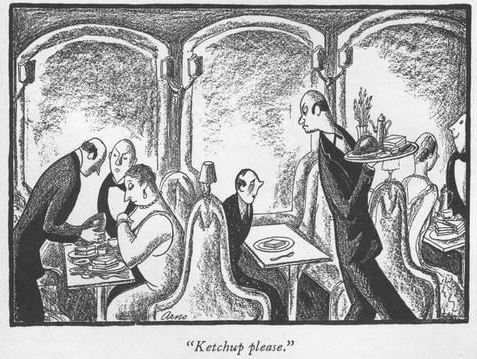
So presumably the joke is that he’s asking for ketchup in a fancy restaurant. Or something.
But is there some significance to the fact that everybody else has been given large meals while he seems to have just a small sandwich?
(Or a square of tofu, but that’s unlikely)
 Comics I Don't Understand
I believe that is a train that they’re on.
Supplementing his small order, I guess. Is he crying?
Synchronicity – https://www.gocomics.com/frazz/2018/09/10
Is that Peter Arno? I seem remember there was another Arno who did cartoons (or “drawings” as they prefer) for the New Yorker.
He has a small meal and is asking for free ketchup in an expensive restaurant. Looks like he may be embarrassed (red-faced), so maybe he’s unexpectedly broke. Still, not very funny.
He looks embarrassed not sad. It appears that he is eating in a restaurant out of his social class (all the other male patrons are wearing tuxedos) and he can only afford a meager sandwich as opposed to the opulent meals being served around him. To top it off, only a Philistine (or a beefwit) asks for catsup at a fine dining establishment, hence the waiter’s sneer.
Still not funny, though.
Agreeing with some previous comments, such as Bookworm — it’s sort of a “One Meat Ball” situation. https://youtu.be/li0qPwn4U8Y
There was a panel I saw just the other day and can’t place now, in which a character that is really a foodstuff (maybe a hot dog) sees a victim on the ground and reacts with “Blood all over! Phew, I was worried it was ketchup.”
The reason that this panel looks a bit “different” is that it is an extremely early example of Peter Arno’s work. At first I thought it was going to be a depression era joke, but it turned out to be even older than that (5-Dec-1925).
@ Mitch4 – The panel you misplaced was last Tuesday’s Rubes (4-Sep-2018):
Yes, that was it!
Not quite a synchro though.
If it had a later date, I’d think it was Jack Benny.
Ketchup is free, hot water is free, salt is free – why pay for tomato soup?
Everyone else is delighted by their stacks of four slices of plain sliced bread, served with tea and on fancy placemats. He is embarrassed to ask for ketchup for his tasteless and measly single slice of bread, and he can’t even afford anything to drink with it. Totally hilarious.
@ billybob – The weird thing in Germany is that ketchup is usually not free (*), but mustard is. There are a number of theories about how this custom developed, but the most likely theory is that mustard has a much longer tradition, whereas ketchup is a relatively “recent” additive.
P.S. This even applies to the golden arches, etc. All the major chains in Germany charge a nominal fee for those little ketchup packets.
If you have to pay for it, you’re less likely to let your kids squirt it at each other. Mustard, being thicker, isn’t as much fun to squirt. And doesn’t make good ‘soup’, either.
When I was in Berlin last year ketchup packets at von Donald’s were definitely free.
I suppose that it may depend on the location. Downtown they may want to avoid negative feedback from tourists not used to “These Strange German Ways“.
P.S. Or maybe McD’s has changed their policy. It’s been a while since I went to one.
This was the one attached to the Friedrichstraße Station, an area where it seemed English was the primary language — so the rules might have been different.
If you think about New York City in comparison with any other city or town in the United States, you won’t be surprised to find that customs in Berlin, London and Paris are somewhat different from those in the other cities and towns in their respective countries.
Catsup (Ketchup is I believe a trademark of Heinz) used to be eaten as soup. In the movie “Meet me in St. Louis” the family has it at dinner one night. Perhaps this is why it is charged for?
I don’t know how many people actually made themselves free “tomato soup” with ketchup and hot water back in the days of the Automat, but it’s certainly an honored cliche.
I don’t know if Ketchup is anyone’s trademark, but Mr. and Mrs. Micawber liked to eat mutton with mushroom ketchup on it. “Ketchup” is either a Chinese or Malay word, I forget which, and was used for different sauces including walnut ketchup.
Earliest OED hit with that spelling:
1682 Nat. Hist. Coffee, Thee, Chocolate, Tobacco 18 Your Soys, your Ketchups and Caveares, your Cantharides, and your Whites of Eggs, are not to be compared to our rude Indian.
as Catsup
1696 J. Floyer Preternatural State Animal Humours iv. 45 By Artificial Sauces we imitate the natural foetid and sub-acid Slime of the Stomach, as in Catchup mango Plumbs, Mushrooms, and some Indian Liquors or Sauces of Garlic.
notes include
Origin: Apparently a borrowing from Chinese. Etymons: Chinese kê-chiap, kôe-tsap, kôe-chiap.
Etymology: Apparently < Chinese (Hokkien: Zhangzhou) kê-chiap, (Hokkien: Qanzhou) kôe-tsap…
The word ketchup first appears in English in the 17th cent. with reference to a type of sauce encountered by British travellers, traders, and colonists in southeast Asia and introduced to Britain by them. Similar sauces referred to as ketchups appear from the 18th cent. using a variety of ingredients, anchovies, mushrooms, walnuts, and oysters being particularly popular. From the late 19th cent. tomato ketchup became the most popular form.
Perhaps as a result of influence from major commercial brands of sauce, ketchup seems to have become the dominant term from around the middle of the 20th cent., although catsup is still well attested in North America.
@ Meryl A – The short version of Shrug’s answer is “No, neither spelling is trademarked by anyone“.
P.S. Wikipedia has a good discussion about the etymology, including other possible sources of the word(s).
Shrug’s answer reminded me – Worcestershire sauce is called mushroom ketchup in the 18th century.
We call it the Wha’s-this-here sauce.
Why ketchup packets aren’t always given away free –
https://www.gocomics.com/foxtrotclassics/2018/09/20
Just remembered I that in THE MORTAL NUTS by Pete Hautman there’s a character who works every year at a colleague’s taco stand at the Minnesota State Fair. One year she has a bright idea, and every time she goes to a fast food place with free taco sauce packets and the like, she takes a few extra and saves them. When the Fair opens she presents them to the stand owner, expecting to make big bucks by selling them to him for use at the stand. However, he computes the value as something like eight or nine dollars — so, no early retirment for her after all.