Mitch4: I didn’t know until an advanced age that “measly” was connected with the disease measles! (Nor the connection between “lousy” and lice!)
Related
10 Comments
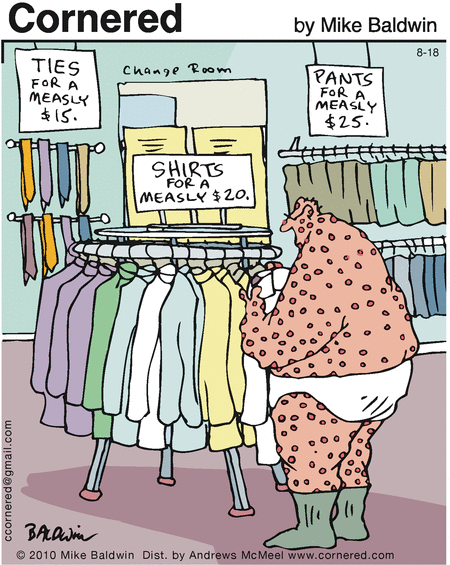
“Welcome to the Pastel Shop, where you can have whatever color clothing you like, as long as it’s a pastel color.”
What’s unclear here is why the dude is walking around undressed when the dressing rooms are so clearly marked.
Because we wouldn’t notice his measles if he had all his clothes on.
OK, the adjective on the signs is related to his condition, but that doesn’t explain what is happening in the panel, and it doesn’t make any of this funny, either.
Mark in Boston, he could have been wearing a short-sleeve shirt, letting us see the measles on his face and arms. That would have done the trick.
Kilby, I assumed the “measly” on the signs was intended (by the store) to mean “mere, paltry”. This customer is coincidentally/opportunistically infected, so anything about him will be measle-ly. He may think he qualifies for the low prices more than another customer would, … but he won’t.
I’ve long known the origin of lousy be measly never occured to me. Perhaps he’s in pain and and doesn’t want to be covered. Although then why is he doing the shopping then and not staying in bed recuperating? This doesn’t really make any sense and it’s not that funny but it’s clear that measly and measle-ly is meant to be the joke and for what its worth its funny enough to warrant not needing to think further. (Which is good because one can’t.)
I was similarly shocked to find out a shambles was a slaughterhouse. A little less disturbing but still a surprise was “mangle” in the sense of a large clothing press.
(I think all of these have been discussed on CIDU before!)
Mitch4: and a “diaper” was a diamond-shaped pattern (as in baseball diamond) that you sometimes see on wallpaper. Which reminds me, did you ever hear the “put the baby on the pitcher’s mound” baby diapering instructions?
 Comics I Don't Understand
“Welcome to the Pastel Shop, where you can have whatever color clothing you like, as long as it’s a pastel color.”
What’s unclear here is why the dude is walking around undressed when the dressing rooms are so clearly marked.
Because we wouldn’t notice his measles if he had all his clothes on.
OK, the adjective on the signs is related to his condition, but that doesn’t explain what is happening in the panel, and it doesn’t make any of this funny, either.
Mark in Boston, he could have been wearing a short-sleeve shirt, letting us see the measles on his face and arms. That would have done the trick.
Kilby, I assumed the “measly” on the signs was intended (by the store) to mean “mere, paltry”. This customer is coincidentally/opportunistically infected, so anything about him will be measle-ly. He may think he qualifies for the low prices more than another customer would, … but he won’t.
I’ve long known the origin of lousy be measly never occured to me. Perhaps he’s in pain and and doesn’t want to be covered. Although then why is he doing the shopping then and not staying in bed recuperating? This doesn’t really make any sense and it’s not that funny but it’s clear that measly and measle-ly is meant to be the joke and for what its worth its funny enough to warrant not needing to think further. (Which is good because one can’t.)
I was similarly shocked to find out a shambles was a slaughterhouse. A little less disturbing but still a surprise was “mangle” in the sense of a large clothing press.
(I think all of these have been discussed on CIDU before!)
Mitch4: and a “diaper” was a diamond-shaped pattern (as in baseball diamond) that you sometimes see on wallpaper. Which reminds me, did you ever hear the “put the baby on the pitcher’s mound” baby diapering instructions?
I’ve just notice “reply” capability.