Well, yeah, but you gotta feel guilty about *something*.
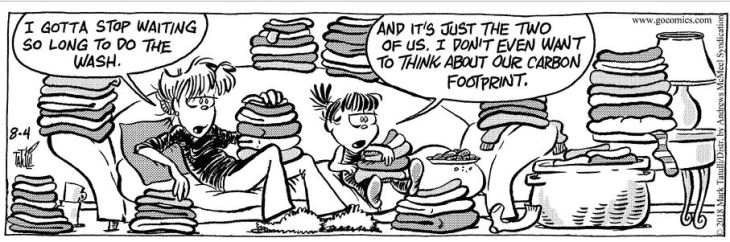
They generate too much laundry for a single adult and one child. Given that factoid, Heart doesn’t even want to consider the broader picture, ie: that they must similarly use disproportionate amounts of other resources; given how much simple laundry they generate, don’t even think about how much total resources they must therefore use.
Laundry procrastination does not increase their carbon footprint and, as Bill says, may even somewhat reduce it. But it is a visible reminder of the amount of laundry, and therefore carbon, that they go through.
I remember fellow college student who provoked a lot of laughter by saying, “I don’t feel like doing laundry. I’m going out to buy some new clothes.” Knowing him, it’s entirely possible that he did it, too.
@ Kilby. I was just going to touch on that. Doing laundry must have a smaller environmental impact than buying new clothes. It’s be interesting to see how growing/harvesting/manufacturing new textiles, making new garments, and shipping them compares to the cost of washing and drying. I wonder about the environmental impact of dry-cleaning vs washing as well. I know there are new solvents that aren’t as bad as perc, but it still must be bad.
I question the assumption that they generate too much laundry: for all we know, dirty laundry might have been accumulating since Fourth of July weekend.
Kilby, when my son was in high school, he had a (slightly spoiled) friend whose parents didn’t want her to be burdened by doing laundry when they sent her to camp for a month, so they shipped up a month’s worth of clothing.
I’m guessing this included multiple changes of clothing for each day, but that’s not something he’d think to ask.
Bill, that does not strike me as “slightly” spoiled. Tone of voice being absent, you might not have meant that entirely literally, of course.
Carlfink, I might have been a wee bit sarcastic in describing the little princess.
Aren’t you supposed to learn useful things at camp? And learning how to do your own laundry is certainly a useful life skill.
My impression of the laundry stock (admittedly, hard to be sure) is that, aside from a couple of socks, it appears to consist solely of towels. I’m not sure what sort of lifestyle results in two people generating a laundry load of six dozen or so towels, and no clothes other than two mismatched single-socks, but it’s not one I want to think about too hard.
I suppose they’re just really, really neat folders (which seems to go against the “avoid laundry as long as possible” mindset, however).
“I question the assumption that they generate too much laundry”
Whether they do or not is moot to an unsophisticated but trendily “aware” thinker like a nine year old girl — she sees a lot of laundry in front of her, therefore they must generate too much of it, and second order thinking like what is the rate of laundry accumulation doesn’t enter into it.
But, if you have this much clothing that you could accumulate laundry for this long without doing laundry, that could actually be a valid measure that you have way too much stuff, at least clothing-wise.
larK, the trendy word is “woke” now. Learn it, memorize it, don’t bother using it because it’ll be history in no time.
Bill: My wife also knew someone in college who was “slightly” spoiled, and rather than figure out how to do her own laundry, just kept buying new clothes, and letting the old clothes pile up. She eventually had to drop out.
Whenever I buy new clothes, which isn’t often, I always wash them first before wearing.
If you wear lots and lots of changes of clothes in the same day, you’ll build up a big pile of laundry plenty fast. This is true no matter how often you actually wash them.
Kilby – when we were first married we had 2 sets of bed linens -one set on the bed, the other to be washed and then ready to go on the bed. I did the laundry back then at a public laundry up the block from our apartment on the weekend. One weekend Robert had other plans and my reaction was “if we go out and do this today, we also have to buy a third set of bed linens today.” (We did.)
Bill – I went to girl scout camp for 2 weeks. Anything anyone in my cabin needed, I had. My dad sent me with 3 blankets (in the summer of course). I had shoe polish. I had enough rope to tie it along one side of the cabin and use it as a cabin closet for everyone to hang things such as our girl scout uniforms from – and yes, I had the hangers also. (The extra 2 blankets were put on the extra 2 beds in the cabin and we had 2 sofas as a result.
Brian – I always wash any fabric items – clothing or household before using. For the past 10 years they are also heated in a suitcase heater (as one puts one suitcase in it on returning home, but it is also a large suitcase shaped bag) to make sure that there are no bed bugs.
James Pollock has a point – they could have so much laundry because they’re wearing things for half a day and throwing them in the wash.
It doesn’t make sense (although Heart might be saying it) to say that their carbon footprint is really large just because they own a lot of clothes. It would require that they buy a lot of new clothes. And who buys new clothes for a kid? I mean, we do a few, but most of them are second hand.
Christine – I never had anything second hand when I was a child. I was the first grandchild on one side and the first girl on the other. My sister would get hand me downs from me, then they would go to a cousin, and then to that cousin’s cousin… By the time my younger sister came along – 12 years younger than me and 7 years younger than the middle sister – it was back to buying new clothes as there was no one to hand down to her.
I know that Robert and his sister only had new clothes also, ditto our nieces and nephews.
Like Brian in StL, we always wash all new clothes before wearing. This is especially important for shirts, because the fabric is usually treated with an additive (called “sizing”) to facilitate sewing. Treated fabric on bare skin often produces an uncomfortable itch.
 Comics I Don't Understand
Or is would at least be a wash!
it, not is….oops.
Well, yeah, but you gotta feel guilty about *something*.
They generate too much laundry for a single adult and one child. Given that factoid, Heart doesn’t even want to consider the broader picture, ie: that they must similarly use disproportionate amounts of other resources; given how much simple laundry they generate, don’t even think about how much total resources they must therefore use.
Laundry procrastination does not increase their carbon footprint and, as Bill says, may even somewhat reduce it. But it is a visible reminder of the amount of laundry, and therefore carbon, that they go through.
I remember fellow college student who provoked a lot of laughter by saying, “I don’t feel like doing laundry. I’m going out to buy some new clothes.” Knowing him, it’s entirely possible that he did it, too.
@ Kilby. I was just going to touch on that. Doing laundry must have a smaller environmental impact than buying new clothes. It’s be interesting to see how growing/harvesting/manufacturing new textiles, making new garments, and shipping them compares to the cost of washing and drying. I wonder about the environmental impact of dry-cleaning vs washing as well. I know there are new solvents that aren’t as bad as perc, but it still must be bad.
I question the assumption that they generate too much laundry: for all we know, dirty laundry might have been accumulating since Fourth of July weekend.
Kilby, when my son was in high school, he had a (slightly spoiled) friend whose parents didn’t want her to be burdened by doing laundry when they sent her to camp for a month, so they shipped up a month’s worth of clothing.
I’m guessing this included multiple changes of clothing for each day, but that’s not something he’d think to ask.
Bill, that does not strike me as “slightly” spoiled. Tone of voice being absent, you might not have meant that entirely literally, of course.
Carlfink, I might have been a wee bit sarcastic in describing the little princess.
Aren’t you supposed to learn useful things at camp? And learning how to do your own laundry is certainly a useful life skill.
My impression of the laundry stock (admittedly, hard to be sure) is that, aside from a couple of socks, it appears to consist solely of towels. I’m not sure what sort of lifestyle results in two people generating a laundry load of six dozen or so towels, and no clothes other than two mismatched single-socks, but it’s not one I want to think about too hard.
I suppose they’re just really, really neat folders (which seems to go against the “avoid laundry as long as possible” mindset, however).
“I question the assumption that they generate too much laundry”
Whether they do or not is moot to an unsophisticated but trendily “aware” thinker like a nine year old girl — she sees a lot of laundry in front of her, therefore they must generate too much of it, and second order thinking like what is the rate of laundry accumulation doesn’t enter into it.
But, if you have this much clothing that you could accumulate laundry for this long without doing laundry, that could actually be a valid measure that you have way too much stuff, at least clothing-wise.
larK, the trendy word is “woke” now. Learn it, memorize it, don’t bother using it because it’ll be history in no time.
Bill: My wife also knew someone in college who was “slightly” spoiled, and rather than figure out how to do her own laundry, just kept buying new clothes, and letting the old clothes pile up. She eventually had to drop out.
Whenever I buy new clothes, which isn’t often, I always wash them first before wearing.
If you wear lots and lots of changes of clothes in the same day, you’ll build up a big pile of laundry plenty fast. This is true no matter how often you actually wash them.
Kilby – when we were first married we had 2 sets of bed linens -one set on the bed, the other to be washed and then ready to go on the bed. I did the laundry back then at a public laundry up the block from our apartment on the weekend. One weekend Robert had other plans and my reaction was “if we go out and do this today, we also have to buy a third set of bed linens today.” (We did.)
Bill – I went to girl scout camp for 2 weeks. Anything anyone in my cabin needed, I had. My dad sent me with 3 blankets (in the summer of course). I had shoe polish. I had enough rope to tie it along one side of the cabin and use it as a cabin closet for everyone to hang things such as our girl scout uniforms from – and yes, I had the hangers also. (The extra 2 blankets were put on the extra 2 beds in the cabin and we had 2 sofas as a result.
Brian – I always wash any fabric items – clothing or household before using. For the past 10 years they are also heated in a suitcase heater (as one puts one suitcase in it on returning home, but it is also a large suitcase shaped bag) to make sure that there are no bed bugs.
James Pollock has a point – they could have so much laundry because they’re wearing things for half a day and throwing them in the wash.
It doesn’t make sense (although Heart might be saying it) to say that their carbon footprint is really large just because they own a lot of clothes. It would require that they buy a lot of new clothes. And who buys new clothes for a kid? I mean, we do a few, but most of them are second hand.
Christine – I never had anything second hand when I was a child. I was the first grandchild on one side and the first girl on the other. My sister would get hand me downs from me, then they would go to a cousin, and then to that cousin’s cousin… By the time my younger sister came along – 12 years younger than me and 7 years younger than the middle sister – it was back to buying new clothes as there was no one to hand down to her.
I know that Robert and his sister only had new clothes also, ditto our nieces and nephews.
Like Brian in StL, we always wash all new clothes before wearing. This is especially important for shirts, because the fabric is usually treated with an additive (called “sizing”) to facilitate sewing. Treated fabric on bare skin often produces an uncomfortable itch.