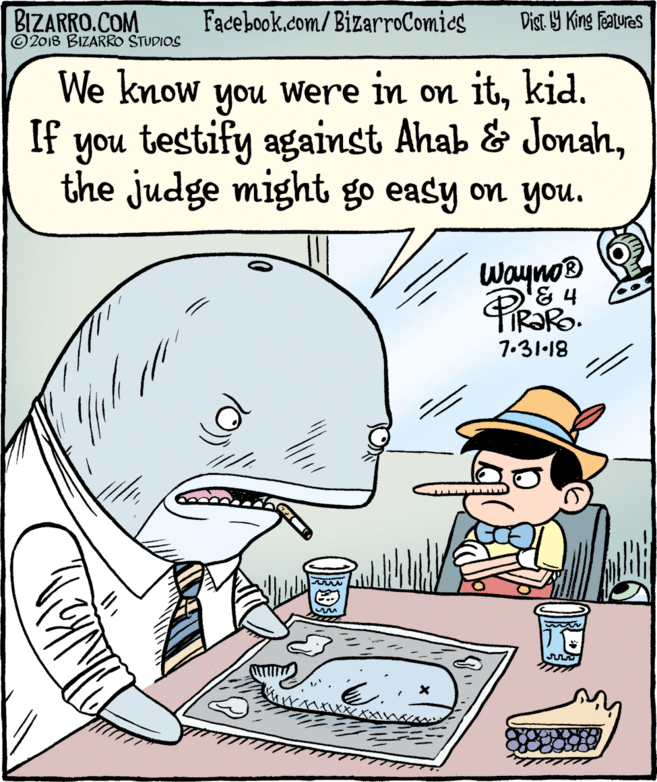
Obviously, Pinocchio, Jonah and Ahab have all had interactions with whales. Less obviously… huh???
Related
58 Comments
There’s a dead whale (as you can see in the picture). They’ve rounded up the usual suspects and are using standard interrogation techniques to make them talk.
Explaining further on “standard interrogation tactics”:
Identify the likely suspects, pick up the weakest, and accuse everybody, and then hope the guy you’ve got spills some useful information. If not, grab someone else. Continue until either you get useful information, or word gets out that you’re rounding up suspects.
All of those encounters involved bad things being done to the whales. Pinocchio and Jonah are the heroes of their stories, and Ahab is a tragic figure, but imagine from the whales’ POV…smashed into rocks, cut open, stabbed with harpoons… They’d be villains.
“All of those encounters involved bad things being done to the whales. ” Do they? Jonah and Pinocchio were vomitted and coughed out and the whales were unharmed. And Moby Dick killed Ahab.
Anyway, it’s pretty clear that a whale has be killed and Pinocchio, Jonah and Ahab are suspects for having encounters with whales. The question is does it work? Pinocchio and Jonah weren’t whale haters but passive victims. And Ahab is nothing at all like either of those.
I would judge it weak but acceptable. Certainly clear what the joke is supposed to be. But it’s a joke that completely breaks down under very slight scrutiny.
Wayno/Piraro missed an excellent (but rather obscure) suspect: Mr. Henry Albert Bivvens, but he was a man of infinite-resource-and-sagacity.
“from the whales’ POV”:
Jonah and the whale weren’t even antagonists: God sent the whale to save Jonah from drowning, and bring him to his assignment.
Basically, the whale was an Uber.
“God sent the whale to save Jonah from drowning, and bring him to his assignment.”
That’s Jonah’s side of the story. What did the whale say? (Leaving aside the question of whether the original text supports translation to “whale”.)
Of course Jonah was swallowed by a *fish*. But comics deal more with what people think is correct.
J.P. types faster than I do.
“That’s Jonah’s side of the story. What did the whale say? ”
“BLARF”
What the bible meant is sketchy.
What Collodi meant is clear. It was a dogfish. Which is not a whale.
Arthur: I’m skeptical that you can know that the sea creature that swallowed Jonah was a “fish,” and not a “whale.” Surely he was swallowed by a entity described by a Jewish word whose mapping into modern scientific terminology is unclear.
I am glad we’re “Leaving aside the question of whether the original text supports translation to ‘whale,'” because that’s a technicality that’s irrelevant to the discussion of the comic.
According to most scholars, the Hebrew actually translates to “Bigass swimming creature that God created with the ability to swallow a human being and then disgorge him later without being harmed.”
Whales were fish until 1758 (10th edition of Systema Naturae).
Pinnochio will just brown nose his way out of this with a little white lie… If you follow what i mean…
Just keeping the fifteen-ringer going! (All fifteen entries in “Recent comments” list at the moment are for this thread!)
They know he’s lying.
Actually, Jonah’s story is that he didn’t want to go preach to the Ninevites, and the large fish was sent to force him. And when his preaching actually worked, and Ninevah repented, he was furious. Since Ahab is already dead, and Pinocchio has no reason for hostility, Jonah is the only real suspect.
The length of Pinocchio’s nose shows that he’s been lying anyway.
I’ve wondered myself if the ‘whale’ was really a ‘whale shark’, which doesn’t eat large things . . . not that I have any belief in the myth of Jonah, et al.
I think Pinocchio did it. Here’s how. He let Monstro swallow him. Once inside, he positioned himself facing directly at Monstro’s heart. Then he started reading the log from Trump’s Twitter account.
I recently re-read MOBY DICK for the first time in fifty years, and was surprised at how often Ishmael kept insisting that, biologists to the contrary, a whale IS a fish, damnit! I’d forgotten that bit from my earlier reading back in college. (And yes, I realize that Melville himself would not have believed this, even though he had his character believe it — or assert it and pretend to believe it for comedic effect.)
Now I’m afraid to re-read THE RETURN OF THE KING, just in case there’s a bit in there I’d forgotten where Frodo and Sam are discussing Shelob and one of them decides to argue that “a spider IS an insect, damnit!”
FWIW, the Mediterranean Sea has a sustaining population of sperm whales, and is at least occasionally visited by humpbacks.
The Hebrew in question is “dag gadol” which certainly can be translated “big fish” or “big-ass swimming thing” or “super fish” or, at in this case, “uber fish.” The ancient Hebrews did not differentiate between fish and whales. The idea that it was a special creature created for this purpose comes reading great significance into the fact that Jonah 1:40 says that God “prepared” (“manah”) the “great fish” to swallow Jonah (KJV “Now the Lord had prepared a great fish to swallow up Jonah…”). However, like many words, the word translated “prepared” (“manah”) can have different meanings. In 1 Chronicles 9:29, it is often translated as “appointed” or “assigned” (“Others were assigned to take care of the furnishings..” NIV), so it could just mean that God appointed the gadol to transport Jonah.
It is interesting (at least to me) that the writer of Jonah did not call the dag gadol a “tannin” or sea monster. “Tannin” seems to be reserved for scary beasts (and not restricted to aquatic monsters– it can also refer to a serpent or dragon).
FWIW, the ancient Greek translation of the Hebrew Bible, the Septuagint, uses the Greek “ketos” for the creature, a word Latinized as “cetus,” “Ketos” can refer to a whale, whale shark, shark, sea monster, etc. In Matthew 12:40, when Jesus refers to the story of Jonah, the original New Testament Greek likewise uses “ketos,” which the translators for the 1611 King James Bible chose to translate as “whale,” and that appears to be what started the whale tradition (even if in the book of Jonah, the KJV uses “great fish”), And about 200 years later, the word “cetacean” for an example of the general class of aquatic mammals that includes whales large and small (dolphins and porpoises), entered the English lexicon.
I should have said :”it could just mean that God appointed the dag gadol to transport Jonah.”
dag = fish, gadol = great
“… that’s a technicality that’s irrelevant to the discussion of the comic.”
You say that as if it was a bad thing. Whereas I think that’s what this blog excels at! :)
ja, since you spoke so knowledgeably about cetaceans, and named dolphins and porpoises separately, I have hopes you could help clear up what is a CIDU for me, from Wrong Hands:
(Below is an edit from the email accompanying my submission of this as CIDU)
I grew up in Miami, where we were rather marine-mammal-conscious. We were taught that “porpoise” was properly the name of a fish, but in casual usage could be applied to a mammal, the one known as bottle-nosed dolphin. (The only way it seemed to matter was in seeing “porpoise” offered as seafood, and remembering not to get outraged over it as the mammal.)
So the distinctions in this table approximately but not precisely correspond to what I grew up believing. I wonder if they match anyone else’s view of the facts. It treats “porpoise” as a marine mammal genuinely and not by linguistic mistake, and furthermore distinguishes it from [bottle-nosed?] dolphin — as ja was doing.
And if not a factual guide, what is this meant as? Is there a joke? Maybe in the idea of “different but can’t tell them apart in practice”?
And why does he write “an porpoise”? Playing off “on purpose” somehow?
Thanks,
Mitch4
‘The Hebrew in question is “dag gadol” which certainly can be translated “big fish”’
Whereas “gal gadot” can be translated as “wonder woman”…
My question about “an porpoise” does not make sense with that (apparently corrected) version of the comic. My July 24 note was accompanied by forwarding the comic as I received it in email subscription, which in the left column had “looks like an porpoise” and “isn’t an porpoise”. So, one mystery removed. …
I’ve never seen porpoise offered as seafood, but I HAVE seen dolphin – imagine my outrage at first, and I still find it startling . . .
Andréa, you may be right and my memory is askew, as a quick search finds no kind of fish referred to as “porpoise” but a fish known as “mahi-mahi” also called “dolphinfish” or just “dolphin”.
And for some reason I now have Cheap Trick’s “Dream Police” running in my head, only it’s “Whale Police”…
You’re welcome.
” the Hebrew actually translates to “Bigass swimming creature that God created with the ability to swallow a human being and then disgorge him later without being harmed.””
That would have been “leviathan” when translated into Modern English.
A dolphin has two eyes on each side of its nose, like Peppa Pig?
Mitch4,
Dolphins and porpoises are two groupings of the smaller toothed whales. Porpoises have a very triangular dorsal fun with a straight back and have spade-shaped teeth; dolphins have a “hooked” dorsal fin that curves in the back and conical teeth. Porpoises trend to have smaller dorsal fins as well (none at all in the case of the finless porpoise) and shorter mouths, and to be more stoutly built. There are only six or seven extant species of porpoises, while there are more than thirty species of dolphins.
I don’t really get the cartoon. Sure, dolphins and porpoises look a lot alike, but it’s not like rabbits and hares, where the snowshoe hare is a rabbit, and the jackrabbit is a hare. With the exception of the critically endangered vaquita, the different porpoises all have “porpoise” in their name, and I don’t know of any dolphin species that is called a porpoise (and most have dolphin in their name). A bottlenose dolphin (like flipper) is a dolphin. I suppose if you ignore the dorsal fin, the plump pilot whale looks like it could be a porpoise, but it is just a big chubby beakless dolphin.
There are two species of dolphinfish, the common dolphinfish or mahi-mahi and pompano dolphinfish, that are sometime referred to as dolphins, but they are fish. I’m not aware of any fish that is called a porpoise.
One slightly confusing thing is this: the act of “porpoising” (swimming in undulating fashion with leaps out of the water) is more likely to be undertaken by a dolphin (or even a penguin) than it is a porpoise, most of whom rarely jump out of the water.
Also, while porpoises tend toward the plumper side, the fastest of all cetaceans is Dall’s porpoise.
MiB: I think a dolphin has its two eyes on one side of its nose, like Dora Maar.
Thank you very much, ja!
Did I mention that a high school buddy of mine, whose interests were folksinging and acting (he later became a New England town Chief of Police), during our senior year appeared as an extra or perhaps small speaking part on flipper?
Was it Officer Obie??
@ Mitch4 – Do you mean the movie or the TV series? If the movie, which year?
It was the TV series. My friend has an IMDB page it turns out, and he was on two episodes – Season 3 Episode 20 Dolphin for Ransom (1967), and Season 2 episode 21 The Lobster Trap (1966). Our HS class year was 1966, but the one that aired in 1967 may have been filmed during the preceding school year, I don’t know.
@ Mitch4 – We have both of the Flipper movies on DVD. My wife watched the 60’s version with the kids, but their reaction was so universally negative that I wouldn’t even consider getting the TV series on DVD, and it’s also soured them on watching the Paul Hogan version. Probably just as well, Rotten Tomatoes gives it 32%.
@Kilby: if you’re looking for movies to watch because they have someone tangentially related to a CIDUr, you could watch the 1962 version of Das Testament des Dr. Mabuse (not to be confused with the classic 1933 version by Fritz Lang), which has my father appearing as an extra in the lecture scene (he’s the blond curly haired one). They basically asked his medical class if they wanted to be extras, and just filmed in their lecture hall, using most of his class. (English title The Terror of Doctor Mabuse — it’s hard to find, but about 10 years ago an academic put out a commercial DVD reissue in the States that I got.)
Even less tenuously, the movie Short Circuit has a scene filmed just down the road from where my house used to be (the house is still there, but it isn’t mine any more.) The film was shot in many locations familiar to Oregon residents, but the part where Number 5 tosses his tracking unit into the back of a pickup truck driven by a pair of older folks was shot at the intersection of NW 185th and Germantown Road.
My favorite “movie shot on a location I know” example was the original THE HEARTBREAK KID. One scene was set on the mall of the east bank of the Minneapolis campus of the U of Minnesota, where Charles Grodin pulled up and parked his car, a neat trick. But not as neat as the scene set in a cabin “in the mountains outside of town.”
Not a movie, but as far as I can tell, the protagonist of James Lileks’ first novel, FALLING UP THE STAIRS, “lives” on my block and possibly even in my house. (Not that I’ve actually seen him in the house, but there *are* a couple of closets I rarely go into. . . .)
Richard Wright’s “Native Son” gives many specific locations on the South Side of Chicago, and in at least one case the full address – – house number and street name. There’s one I used to look for, as it’s on the way to a couple destinations I go to. South Park is now M L King Drive, and once I understood that I was able to find the address given for a crucial setting. But it is no longer a residence….
I like to go TO places mentioned in books or entertainment media: The Village in Wales where ‘The Prisoner’ was filmed; various places in England where ‘The Forsyte Sage’ (the original) was filmed; many areas of Florida that Carl Hiaasen wrote about; Waukegan, Illinois, where several of Ray Bradbury’s stories took place, among others.
We’ve lost track of how many movies we’ve seen with parts filmed at Rye Playland (in New York; the site, btw, of our first date): The amusement park is built using so many styles, it was used as BOTH amusement parks in the film Big (which obviously was a big plus when they were filming).
A while back, a low-budget movie was filmed along Northfield Avenue, a main street a county over from where I live, making use of a supermarket, a Chinese restaurant, and several other locations. I got to watch some of the filming, and interviewed the director and some of the actors. The most surreal part was the entire staff of the Chinese restaurant sitting around watching while a dozen Asian-American actors, dressed identically to them, played “them.”
The funniest part was that they’d paid somebody for the right to film in his home, and never told him his home had been chosen because they wanted the tackiest-looking home they could find.
The movie did not do well. A few years later I spotted the co-star, whom I’d interviewed and I thought was the best part of the film, working behind the counter at McDonald’s. As he handed me my meal, I made a point of not recognizing him.
Um, I’ve been to the Bull and Finch …
Back in 1985 I was in Boston for training at Raytheon. I know the year because the Cardinals were in the stretch run and had a key series with the Mets, so we spent time trying find venues that had WOR showing the game. Not easy in an AL city.
Anyway, during the weekend we were site-seeing and came across a location shoot for “Spenser for Hire”. I joked, “I wonder where Bob is”, referring to Robert Urich. Just then he walked right past us heading to the set. Essentially my only “brush with greatness” as Letterman used to dub the bit on his show.
“Um, I’ve been to the Bull and Finch”
Oh yeah. On that same trip we went in there. For like 10 seconds.
Yep, that’s him . . . and looking back, I’m thinking, WHY would anyone want to borrow his comb, or why would he LET anyone borrow it? But we were more innocent in those days.
We used to wait at the stage door after we saw a Broadway show and met lots of actors. Some were a lot nicer and some went so far as to sneak out the front door so we did not meet them. Richard Burton (who we did not “meet”) had the graciousness to come out the stage door so the crowd could see him, kissed a woman in the crowd and in the confusion jumped in his car and left.
One really good night there had been a NYC subway strike. We had taken the LIRR into Manhattan and walked to the theater district and bought half priced tickets (back when we were upset that the $3 tickets never went on half price sale) for “Betrayal” starring Raul Julia, Roy Scheider, and Blythe Danner. The theater district was rather empty and the theater was also due to the strike (which ended that night). We waited for them and we were the only ones there and they stayed with us quite some time – more than just a thank you and a signature.
We ran into Danny Aiello several times, including while waiting for Lucie Arnez and Robert Klein to come out after a show that they had been in – he was also there to see the show. We ran into several times afterwards waiting after shows and he was always extremely nice.
I won’t list further.
I guess I will – we saw a revue and met Lillian Gish and Cyril Richard after – also Dick Shawn. Again there was no else waiting and we got to talk to them for a while.
 Comics I Don't Understand
There’s a dead whale (as you can see in the picture). They’ve rounded up the usual suspects and are using standard interrogation techniques to make them talk.
Explaining further on “standard interrogation tactics”:
Identify the likely suspects, pick up the weakest, and accuse everybody, and then hope the guy you’ve got spills some useful information. If not, grab someone else. Continue until either you get useful information, or word gets out that you’re rounding up suspects.
All of those encounters involved bad things being done to the whales. Pinocchio and Jonah are the heroes of their stories, and Ahab is a tragic figure, but imagine from the whales’ POV…smashed into rocks, cut open, stabbed with harpoons… They’d be villains.
“All of those encounters involved bad things being done to the whales. ” Do they? Jonah and Pinocchio were vomitted and coughed out and the whales were unharmed. And Moby Dick killed Ahab.
Anyway, it’s pretty clear that a whale has be killed and Pinocchio, Jonah and Ahab are suspects for having encounters with whales. The question is does it work? Pinocchio and Jonah weren’t whale haters but passive victims. And Ahab is nothing at all like either of those.
I would judge it weak but acceptable. Certainly clear what the joke is supposed to be. But it’s a joke that completely breaks down under very slight scrutiny.
Wayno/Piraro missed an excellent (but rather obscure) suspect: Mr. Henry Albert Bivvens, but he was a man of infinite-resource-and-sagacity.
“from the whales’ POV”:
Jonah and the whale weren’t even antagonists: God sent the whale to save Jonah from drowning, and bring him to his assignment.
Basically, the whale was an Uber.
“God sent the whale to save Jonah from drowning, and bring him to his assignment.”
That’s Jonah’s side of the story. What did the whale say? (Leaving aside the question of whether the original text supports translation to “whale”.)
Of course Jonah was swallowed by a *fish*. But comics deal more with what people think is correct.
J.P. types faster than I do.
“That’s Jonah’s side of the story. What did the whale say? ”
“BLARF”
What the bible meant is sketchy.
What Collodi meant is clear. It was a dogfish. Which is not a whale.
Arthur: I’m skeptical that you can know that the sea creature that swallowed Jonah was a “fish,” and not a “whale.” Surely he was swallowed by a entity described by a Jewish word whose mapping into modern scientific terminology is unclear.
I am glad we’re “Leaving aside the question of whether the original text supports translation to ‘whale,'” because that’s a technicality that’s irrelevant to the discussion of the comic.
According to most scholars, the Hebrew actually translates to “Bigass swimming creature that God created with the ability to swallow a human being and then disgorge him later without being harmed.”
Whales were fish until 1758 (10th edition of Systema Naturae).
Pinnochio will just brown nose his way out of this with a little white lie… If you follow what i mean…
Just keeping the fifteen-ringer going! (All fifteen entries in “Recent comments” list at the moment are for this thread!)
They know he’s lying.
Actually, Jonah’s story is that he didn’t want to go preach to the Ninevites, and the large fish was sent to force him. And when his preaching actually worked, and Ninevah repented, he was furious. Since Ahab is already dead, and Pinocchio has no reason for hostility, Jonah is the only real suspect.
The length of Pinocchio’s nose shows that he’s been lying anyway.
I’ve wondered myself if the ‘whale’ was really a ‘whale shark’, which doesn’t eat large things . . . not that I have any belief in the myth of Jonah, et al.
I think Pinocchio did it. Here’s how. He let Monstro swallow him. Once inside, he positioned himself facing directly at Monstro’s heart. Then he started reading the log from Trump’s Twitter account.
I recently re-read MOBY DICK for the first time in fifty years, and was surprised at how often Ishmael kept insisting that, biologists to the contrary, a whale IS a fish, damnit! I’d forgotten that bit from my earlier reading back in college. (And yes, I realize that Melville himself would not have believed this, even though he had his character believe it — or assert it and pretend to believe it for comedic effect.)
Now I’m afraid to re-read THE RETURN OF THE KING, just in case there’s a bit in there I’d forgotten where Frodo and Sam are discussing Shelob and one of them decides to argue that “a spider IS an insect, damnit!”
FWIW, the Mediterranean Sea has a sustaining population of sperm whales, and is at least occasionally visited by humpbacks.
The Hebrew in question is “dag gadol” which certainly can be translated “big fish” or “big-ass swimming thing” or “super fish” or, at in this case, “uber fish.” The ancient Hebrews did not differentiate between fish and whales. The idea that it was a special creature created for this purpose comes reading great significance into the fact that Jonah 1:40 says that God “prepared” (“manah”) the “great fish” to swallow Jonah (KJV “Now the Lord had prepared a great fish to swallow up Jonah…”). However, like many words, the word translated “prepared” (“manah”) can have different meanings. In 1 Chronicles 9:29, it is often translated as “appointed” or “assigned” (“Others were assigned to take care of the furnishings..” NIV), so it could just mean that God appointed the gadol to transport Jonah.
It is interesting (at least to me) that the writer of Jonah did not call the dag gadol a “tannin” or sea monster. “Tannin” seems to be reserved for scary beasts (and not restricted to aquatic monsters– it can also refer to a serpent or dragon).
FWIW, the ancient Greek translation of the Hebrew Bible, the Septuagint, uses the Greek “ketos” for the creature, a word Latinized as “cetus,” “Ketos” can refer to a whale, whale shark, shark, sea monster, etc. In Matthew 12:40, when Jesus refers to the story of Jonah, the original New Testament Greek likewise uses “ketos,” which the translators for the 1611 King James Bible chose to translate as “whale,” and that appears to be what started the whale tradition (even if in the book of Jonah, the KJV uses “great fish”), And about 200 years later, the word “cetacean” for an example of the general class of aquatic mammals that includes whales large and small (dolphins and porpoises), entered the English lexicon.
I should have said :”it could just mean that God appointed the dag gadol to transport Jonah.”
dag = fish, gadol = great
“… that’s a technicality that’s irrelevant to the discussion of the comic.”
You say that as if it was a bad thing. Whereas I think that’s what this blog excels at! :)
ja, since you spoke so knowledgeably about cetaceans, and named dolphins and porpoises separately, I have hopes you could help clear up what is a CIDU for me, from Wrong Hands:
(Below is an edit from the email accompanying my submission of this as CIDU)
I grew up in Miami, where we were rather marine-mammal-conscious. We were taught that “porpoise” was properly the name of a fish, but in casual usage could be applied to a mammal, the one known as bottle-nosed dolphin. (The only way it seemed to matter was in seeing “porpoise” offered as seafood, and remembering not to get outraged over it as the mammal.)
So the distinctions in this table approximately but not precisely correspond to what I grew up believing. I wonder if they match anyone else’s view of the facts. It treats “porpoise” as a marine mammal genuinely and not by linguistic mistake, and furthermore distinguishes it from [bottle-nosed?] dolphin — as ja was doing.
And if not a factual guide, what is this meant as? Is there a joke? Maybe in the idea of “different but can’t tell them apart in practice”?
And why does he write “an porpoise”? Playing off “on purpose” somehow?
Thanks,
Mitch4
‘The Hebrew in question is “dag gadol” which certainly can be translated “big fish”’
Whereas “gal gadot” can be translated as “wonder woman”…
My question about “an porpoise” does not make sense with that (apparently corrected) version of the comic. My July 24 note was accompanied by forwarding the comic as I received it in email subscription, which in the left column had “looks like an porpoise” and “isn’t an porpoise”. So, one mystery removed. …
I’ve never seen porpoise offered as seafood, but I HAVE seen dolphin – imagine my outrage at first, and I still find it startling . . .
Andréa, you may be right and my memory is askew, as a quick search finds no kind of fish referred to as “porpoise” but a fish known as “mahi-mahi” also called “dolphinfish” or just “dolphin”.
Speaking of whales – https://safr.kingfeatures.com/idn/ck3/content.php?file=aHR0cDovL3NhZnIua2luZ2ZlYXR1cmVzLmNvbS9NdXR0cy8yMDE4LzA4L011dHRzLjIwMTgwODAxXzc2MC5naWY=
And for some reason I now have Cheap Trick’s “Dream Police” running in my head, only it’s “Whale Police”…
You’re welcome.
” the Hebrew actually translates to “Bigass swimming creature that God created with the ability to swallow a human being and then disgorge him later without being harmed.””
That would have been “leviathan” when translated into Modern English.
A dolphin has two eyes on each side of its nose, like Peppa Pig?
Mitch4,
Dolphins and porpoises are two groupings of the smaller toothed whales. Porpoises have a very triangular dorsal fun with a straight back and have spade-shaped teeth; dolphins have a “hooked” dorsal fin that curves in the back and conical teeth. Porpoises trend to have smaller dorsal fins as well (none at all in the case of the finless porpoise) and shorter mouths, and to be more stoutly built. There are only six or seven extant species of porpoises, while there are more than thirty species of dolphins.
I don’t really get the cartoon. Sure, dolphins and porpoises look a lot alike, but it’s not like rabbits and hares, where the snowshoe hare is a rabbit, and the jackrabbit is a hare. With the exception of the critically endangered vaquita, the different porpoises all have “porpoise” in their name, and I don’t know of any dolphin species that is called a porpoise (and most have dolphin in their name). A bottlenose dolphin (like flipper) is a dolphin. I suppose if you ignore the dorsal fin, the plump pilot whale looks like it could be a porpoise, but it is just a big chubby beakless dolphin.
There are two species of dolphinfish, the common dolphinfish or mahi-mahi and pompano dolphinfish, that are sometime referred to as dolphins, but they are fish. I’m not aware of any fish that is called a porpoise.
One slightly confusing thing is this: the act of “porpoising” (swimming in undulating fashion with leaps out of the water) is more likely to be undertaken by a dolphin (or even a penguin) than it is a porpoise, most of whom rarely jump out of the water.
Also, while porpoises tend toward the plumper side, the fastest of all cetaceans is Dall’s porpoise.
MiB: I think a dolphin has its two eyes on one side of its nose, like Dora Maar.
Thank you very much, ja!
Did I mention that a high school buddy of mine, whose interests were folksinging and acting (he later became a New England town Chief of Police), during our senior year appeared as an extra or perhaps small speaking part on flipper?
Was it Officer Obie??
@ Mitch4 – Do you mean the movie or the TV series? If the movie, which year?
It was the TV series. My friend has an IMDB page it turns out, and he was on two episodes – Season 3 Episode 20 Dolphin for Ransom (1967), and Season 2 episode 21 The Lobster Trap (1966). Our HS class year was 1966, but the one that aired in 1967 may have been filmed during the preceding school year, I don’t know.
@ Mitch4 – We have both of the Flipper movies on DVD. My wife watched the 60’s version with the kids, but their reaction was so universally negative that I wouldn’t even consider getting the TV series on DVD, and it’s also soured them on watching the Paul Hogan version. Probably just as well, Rotten Tomatoes gives it 32%.
@Kilby: if you’re looking for movies to watch because they have someone tangentially related to a CIDUr, you could watch the 1962 version of Das Testament des Dr. Mabuse (not to be confused with the classic 1933 version by Fritz Lang), which has my father appearing as an extra in the lecture scene (he’s the blond curly haired one). They basically asked his medical class if they wanted to be extras, and just filmed in their lecture hall, using most of his class. (English title The Terror of Doctor Mabuse — it’s hard to find, but about 10 years ago an academic put out a commercial DVD reissue in the States that I got.)
Even less tenuously, the movie Short Circuit has a scene filmed just down the road from where my house used to be (the house is still there, but it isn’t mine any more.) The film was shot in many locations familiar to Oregon residents, but the part where Number 5 tosses his tracking unit into the back of a pickup truck driven by a pair of older folks was shot at the intersection of NW 185th and Germantown Road.
My favorite “movie shot on a location I know” example was the original THE HEARTBREAK KID. One scene was set on the mall of the east bank of the Minneapolis campus of the U of Minnesota, where Charles Grodin pulled up and parked his car, a neat trick. But not as neat as the scene set in a cabin “in the mountains outside of town.”
Not a movie, but as far as I can tell, the protagonist of James Lileks’ first novel, FALLING UP THE STAIRS, “lives” on my block and possibly even in my house. (Not that I’ve actually seen him in the house, but there *are* a couple of closets I rarely go into. . . .)
Richard Wright’s “Native Son” gives many specific locations on the South Side of Chicago, and in at least one case the full address – – house number and street name. There’s one I used to look for, as it’s on the way to a couple destinations I go to. South Park is now M L King Drive, and once I understood that I was able to find the address given for a crucial setting. But it is no longer a residence….
I like to go TO places mentioned in books or entertainment media: The Village in Wales where ‘The Prisoner’ was filmed; various places in England where ‘The Forsyte Sage’ (the original) was filmed; many areas of Florida that Carl Hiaasen wrote about; Waukegan, Illinois, where several of Ray Bradbury’s stories took place, among others.
We’ve lost track of how many movies we’ve seen with parts filmed at Rye Playland (in New York; the site, btw, of our first date): The amusement park is built using so many styles, it was used as BOTH amusement parks in the film Big (which obviously was a big plus when they were filming).
A while back, a low-budget movie was filmed along Northfield Avenue, a main street a county over from where I live, making use of a supermarket, a Chinese restaurant, and several other locations. I got to watch some of the filming, and interviewed the director and some of the actors. The most surreal part was the entire staff of the Chinese restaurant sitting around watching while a dozen Asian-American actors, dressed identically to them, played “them.”
The funniest part was that they’d paid somebody for the right to film in his home, and never told him his home had been chosen because they wanted the tackiest-looking home they could find.
The movie did not do well. A few years later I spotted the co-star, whom I’d interviewed and I thought was the best part of the film, working behind the counter at McDonald’s. As he handed me my meal, I made a point of not recognizing him.
Um, I’ve been to the Bull and Finch …
Back in 1985 I was in Boston for training at Raytheon. I know the year because the Cardinals were in the stretch run and had a key series with the Mets, so we spent time trying find venues that had WOR showing the game. Not easy in an AL city.
Anyway, during the weekend we were site-seeing and came across a location shoot for “Spenser for Hire”. I joked, “I wonder where Bob is”, referring to Robert Urich. Just then he walked right past us heading to the set. Essentially my only “brush with greatness” as Letterman used to dub the bit on his show.
“Um, I’ve been to the Bull and Finch”
Oh yeah. On that same trip we went in there. For like 10 seconds.
I once met Edd “Kookie” Byrnes in Chicago (I’ve no idea where the magazine with his autograph is, 60+ years later), and saw the Beatles’ in their limo in Milwaukee. Oh, for geezers . . . Kookie was in ’77 Sunset Strip’ – https://www.youtube.com/results?search_query=77+sunset+strip+full+episodes
Kookie, Kookie, lend me your comb!
Yep, that’s him . . . and looking back, I’m thinking, WHY would anyone want to borrow his comb, or why would he LET anyone borrow it? But we were more innocent in those days.
We used to wait at the stage door after we saw a Broadway show and met lots of actors. Some were a lot nicer and some went so far as to sneak out the front door so we did not meet them. Richard Burton (who we did not “meet”) had the graciousness to come out the stage door so the crowd could see him, kissed a woman in the crowd and in the confusion jumped in his car and left.
One really good night there had been a NYC subway strike. We had taken the LIRR into Manhattan and walked to the theater district and bought half priced tickets (back when we were upset that the $3 tickets never went on half price sale) for “Betrayal” starring Raul Julia, Roy Scheider, and Blythe Danner. The theater district was rather empty and the theater was also due to the strike (which ended that night). We waited for them and we were the only ones there and they stayed with us quite some time – more than just a thank you and a signature.
We ran into Danny Aiello several times, including while waiting for Lucie Arnez and Robert Klein to come out after a show that they had been in – he was also there to see the show. We ran into several times afterwards waiting after shows and he was always extremely nice.
I won’t list further.
I guess I will – we saw a revue and met Lillian Gish and Cyril Richard after – also Dick Shawn. Again there was no else waiting and we got to talk to them for a while.