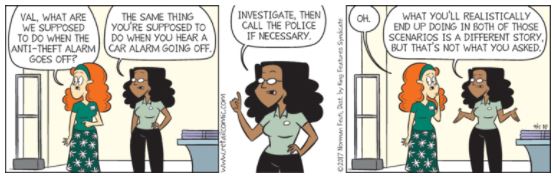
What do people do when a car alarm goes off. It certainly ISN’T rushing to defend somebody’s property. The actual answer is generally “ignore it until it goes away by itself” combined with some degree of “say and/or think extremely unkind things about the owner of the car in question.”
What do retail employees do if the theft alarms at the door go off? Pretty close to nothing. It’s almost always a false alarm, and detaining someone who ISN’T shoplifting carries huge legal costs that likely exceed the value of any shoplifted items. Retail employees, except for LP staff, are almost universally instructed NOT to so much as sternly eye someone leaving after the alarm goes off.
Fact: shoplifters cause higher prices for everyone. BUT “shrinkage” losses by retailers are about 80% goods leaving via the back doors and 20% goods leaving via the front doors.
In “The Monster”, Roberto Benigni plays a man suspected of a being a serial killer. He’s innocent of that, but he delights in shoplifting at a local supermarket, even teaching the undercover policewoman assigned to the case.
His gimmick is to casually pick up small items and drop them into other shoppers’ pockets, purses, etc. In short order everybody is setting off the alarms, and harried clerks are just waving all the customers through — including Benigni and the policewoman, both smiling and wearing bloated overcoats.
Then there’s the ancient story of a worker rolling a wheelbarrow of sand off the site every day. Suspicious guards began searching him and sifting through the sand every day, but found nothing. It turned out the guy was swiping wheelbarrows.
@James Pollock, and “Fact: shoplifters cause higher prices for everyone. BUT “shrinkage” losses by retailers are about 80% goods leaving via the back doors and 20% goods leaving via the front doors.”
While I don’t doubt that employee theft is a problem, that seems rather high, and also does not account for the other sources of shrinkage.
Per the 2017 National Retail Federation (NRF), the distribution is as follows:
Shoplifting/external (including ORC): 36.5%
Employee theft/internal: 30.0%
Administrative and paperwork error: 21.3%
Vendor fraud or error: 5.4%
Unknown loss: 6.8%
So while it may be true that shoplifting represents less than half of shrinkage losses, at least according to the NRF, it is still the leading individual cause, although if you combine employee and vendor losses, I guess the “backdoor” losses approach the front door.
“Per the 2017 National Retail Federation (NRF)” should have read “Per the 2017 report by the National Retail Federation (NRF)”.
“While I don’t doubt that employee theft is a problem, that seems rather high, and also does not account for the other sources of shrinkage.”
So, you’re correcting my overbroad statement by narrowing it to employee theft, and then correcting the correction for being too narrow? Is that what’s happening here?
Back when I was a productive member of society, I was getting ready for work one morning. Then in distance I hear a car alarm start. I looked out the window but nothing obvious was going on. As I got closer to the door into the garage, the alarm started getting louder. And LOUDER. Somehow I had tripped the emergency on the key fob while loading my pockets.
Gotta take those NFR numbers with a grain of salt, since they’re largely speculation and extrapolation: logically, if merchandise is disappearing, then BY DEFINITION nobody really knows where it’s gone.
The LP guys (and gals) do catch some of it, and they extrapolate from that.
And, of course, they have pretty good numbers for the CC fraud/identity fraud, after the fact.
Back when I was learning retail management, CC fraud was trivial. Not sure any more.
@bensondonald = it may have less street credibility, but if I recall correctly Madonna did much the same thing a decade earlier in “Desperately Seeking Susan”, although sh chose to leave while the first alarm was being investigated rather than waiting for complacency to set in.
Grandpa says in his time you could go to the grocery with $2 and come home with milk, steak, onions and bread. “You can’t do that now,” he says, “they’ve got these security cameras all over.”
Most people when a car alarm goes off look to see if it their car. At one client I used to go to – a factory on the third floor in Brooklyn – when a car alarm would go off in the street the bookkeeper would climb up on her desk and look out of the large window to see if her car was okay. She would ask what my car looked like to check it for me, but there was no need, I knew it was not my car – no alarm.
I would figure that like me, honest people who set off the store alarm stop and make eye contact with an employee and check for the dongle that sets it off – since one doesn’t want to schlep back to have it taken off the item purchased.
 Comics I Don't Understand
What do people do when a car alarm goes off. It certainly ISN’T rushing to defend somebody’s property. The actual answer is generally “ignore it until it goes away by itself” combined with some degree of “say and/or think extremely unkind things about the owner of the car in question.”
What do retail employees do if the theft alarms at the door go off? Pretty close to nothing. It’s almost always a false alarm, and detaining someone who ISN’T shoplifting carries huge legal costs that likely exceed the value of any shoplifted items. Retail employees, except for LP staff, are almost universally instructed NOT to so much as sternly eye someone leaving after the alarm goes off.
Fact: shoplifters cause higher prices for everyone. BUT “shrinkage” losses by retailers are about 80% goods leaving via the back doors and 20% goods leaving via the front doors.
In “The Monster”, Roberto Benigni plays a man suspected of a being a serial killer. He’s innocent of that, but he delights in shoplifting at a local supermarket, even teaching the undercover policewoman assigned to the case.
His gimmick is to casually pick up small items and drop them into other shoppers’ pockets, purses, etc. In short order everybody is setting off the alarms, and harried clerks are just waving all the customers through — including Benigni and the policewoman, both smiling and wearing bloated overcoats.
Then there’s the ancient story of a worker rolling a wheelbarrow of sand off the site every day. Suspicious guards began searching him and sifting through the sand every day, but found nothing. It turned out the guy was swiping wheelbarrows.
@James Pollock, and “Fact: shoplifters cause higher prices for everyone. BUT “shrinkage” losses by retailers are about 80% goods leaving via the back doors and 20% goods leaving via the front doors.”
While I don’t doubt that employee theft is a problem, that seems rather high, and also does not account for the other sources of shrinkage.
Per the 2017 National Retail Federation (NRF), the distribution is as follows:
Shoplifting/external (including ORC): 36.5%
Employee theft/internal: 30.0%
Administrative and paperwork error: 21.3%
Vendor fraud or error: 5.4%
Unknown loss: 6.8%
So while it may be true that shoplifting represents less than half of shrinkage losses, at least according to the NRF, it is still the leading individual cause, although if you combine employee and vendor losses, I guess the “backdoor” losses approach the front door.
“Per the 2017 National Retail Federation (NRF)” should have read “Per the 2017 report by the National Retail Federation (NRF)”.
“While I don’t doubt that employee theft is a problem, that seems rather high, and also does not account for the other sources of shrinkage.”
So, you’re correcting my overbroad statement by narrowing it to employee theft, and then correcting the correction for being too narrow? Is that what’s happening here?
Back when I was a productive member of society, I was getting ready for work one morning. Then in distance I hear a car alarm start. I looked out the window but nothing obvious was going on. As I got closer to the door into the garage, the alarm started getting louder. And LOUDER. Somehow I had tripped the emergency on the key fob while loading my pockets.
Gotta take those NFR numbers with a grain of salt, since they’re largely speculation and extrapolation: logically, if merchandise is disappearing, then BY DEFINITION nobody really knows where it’s gone.
The LP guys (and gals) do catch some of it, and they extrapolate from that.
And, of course, they have pretty good numbers for the CC fraud/identity fraud, after the fact.
Back when I was learning retail management, CC fraud was trivial. Not sure any more.
@bensondonald = it may have less street credibility, but if I recall correctly Madonna did much the same thing a decade earlier in “Desperately Seeking Susan”, although sh chose to leave while the first alarm was being investigated rather than waiting for complacency to set in.
Grandpa says in his time you could go to the grocery with $2 and come home with milk, steak, onions and bread. “You can’t do that now,” he says, “they’ve got these security cameras all over.”
Most people when a car alarm goes off look to see if it their car. At one client I used to go to – a factory on the third floor in Brooklyn – when a car alarm would go off in the street the bookkeeper would climb up on her desk and look out of the large window to see if her car was okay. She would ask what my car looked like to check it for me, but there was no need, I knew it was not my car – no alarm.
I would figure that like me, honest people who set off the store alarm stop and make eye contact with an employee and check for the dongle that sets it off – since one doesn’t want to schlep back to have it taken off the item purchased.