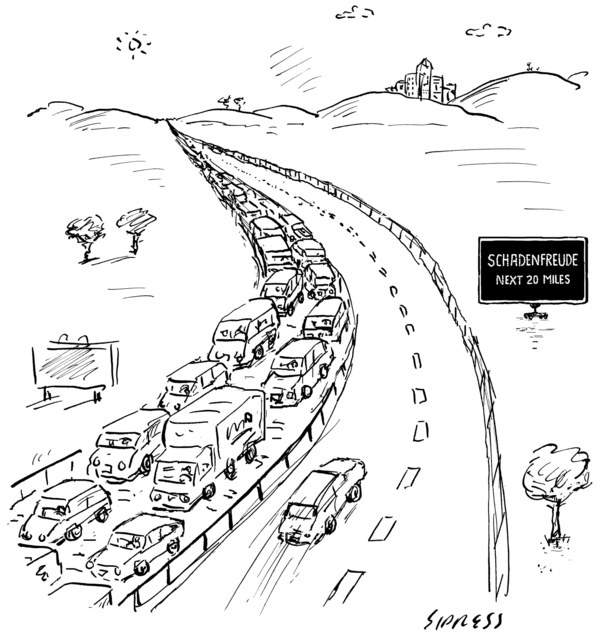
How can my fellow pendants improve on the Schadenfruede cartoon?
Maybe it’s me, but I would think schadenfruede is joy from the misfortunes of a nemesis or a person you have reason to want to see harm fall to (often in the form of bearing a grudge, or resentment or jealousy). Enjoyment in the suffering of random strangers you do not know seems …. sadistic.
Well, gleeful smugness and/or gloating is understandable. But is that actually what Schadenfruede refers to? Maybe it does, but it doesn’t seem fully akilter to me.
Thanks, woozy (@1). I was just about to ask about the percentage of Americans who understand references to “Schadenfreude” or “Weltanschauung” without a dictionary(*). The meaning shown in the comic seems perfectly in line with normal German usage.
Perhaps the distinction is that the term was imported into English by psychologists bent on analyzing patients. Over here, the “Freude” is not really that sadistic, the associated happiness comes from not being affected by the “Schaden” (damage), rather than being mean to those who are.
P.S. (*) – I have the opposite problem here. It’s very hard for me to tell whether a particular English word would be generally understood by most Germans.
P.P.S. Could we get the projectionist to adjust the focus on the first one?
Probably just basic smugness, but years ago I traveled cross country by train. Riding through places where rail crossings stopped rush hour traffic, I enjoyed glancing out the window from a comfortable, elevated seat at the dour commuters waiting for me to pass. If I was in the dining car, all the better.
Woozy, it’s my understanding that Schadenfruede is PRECISELY taking joy at the misfortune of people whom you don’t know and who don’t necessarily deserve it. So yes, it IS mean-spirited.
This very NSFW video explains it well:
These are quite brilliant, particularly the Schadenfreude and the Museum of Yesterday.
Okay. I guess I can see the idea of looking at traffic from a railroad (or better yet a sailboat) and feeling joy that you aren’t in it. But somehow just going the other way in rush hour didn’t resonate with me.
Yes, of course, it’s Schadenfruede. Not sure why it felt so off kilter for me tonight.
I guess because in traffic it’s too close and it’s a “there but for the grace of a decent alternative route go I” (it could so easily have gone the other way). Whereas if I’m further removed I can enjoy a sense of “Ha! I’m so clever to have figured out how to not be in my car at all”.
Here is my (very similar, but not quite) version, which may work a little better:
My subdivision is entered by a RIGHT TURN ONLY lane. Which means that during rush hourS, I can pass by dozens of cars, lined up just like the comic, and never have to actually wait for traffic, not even at the stop light . . . I’m not saying I feel schadenfreude, just satisfaction that we chose this particular subdivision to live in.
And frankly, if I were the car in the empty lane, I’d be more concerned that all that traffic would still be there when I have to come back the other way.
@ Andréa – My initial reaction to the solitary car in the left lane was to verify whether it might be going the wrong way. This is something that happens on the “Autobahn“; not very often, but enough that there is a German word to describe such a person: “Geisterfahrer” (“ghost driver”). It’s almost always either a drunk or mentally deficient driver, there have only been a few rare exceptions where it was on purpose (either a suicide or a colossally stupid dare).
I have never been able to understand the Geisterfahrer thing — OK, you were drunk / stupid / distracted and drove up the wrong ramp… your mistake would be immediately obvious to you, and you would pull over / turn around / stop driving! Who are all these idiots in Germany who get on the highway the wrong way and then keep driving?! Does it even really happen? (I mean beyond someone making a mistake and immediately pulling over / stopping.) Maybe all those warnings on the Blaupunkts are really more along the lines of “there is a car pulled over where you might not expect it due to his having entered on the wrong ramp — be careful until doofus has gotten turned around and cleared”. But the image you get listening to the traffic alerts is that there is a regular epidemic of idiots who are unable to tell that they are driving against the flow of traffic, this in one of the most anally trained driving populations in the world…
(I mean, there’s even a joke getting at the same point I am, where a driver, hearing on the radio that there is one car driving against the flow of traffic, gestures to the traffic and says, “One? There are dozens!”)
“My subdivision is entered by a RIGHT TURN ONLY lane.”
As long as you don’t get that idiot that either doesn’t realize or care that it’s a right-turn lane, then stops to merge back into the main traffic lane.
I felt that same Schadenfruede during a couple of my commutes. One was going home from work at 8:30 am flying down South Shore Drive, enjoying the lake, and watching the line of traffic going north toward the city. Part of the enjoyment was traffic, part was that I was finished working for the day and all those poor slobs were just starting.
I also enjoyed riding the train home from school, and zipping past all the cars on the expressway. It really didn’t matter that I had to stand, since my commute was so short. :-)
Briant: Yes, I ALWAYS watch for that person and never feel completely safe ’til I’m on the other side of the barrier between lanes. Only then do I think to myself, “Nyah nyah nyah.”
Kilby, I think most well-educated Americans are familiar with the word schadenfruede. It may just be me, but I think of it as the “canonical” neat German word: i.e. “German is so cool, they have a compound word for anything you might want to say – for example, . . .”
Schadenfreude is just one of those words that we have to say in German because there’s no English word for it. Like Lebkuchen. (If you ask for “gingerbread” you will get something that is NOT Lebkuchen.) But there really should be two words. One for taking delight at the justice of someone getting the misfortune he thoroughly deserves, and the other for mean-spirited schadenfreude when the misfortune happens to an innocent bystander.
A younger co-worker and I passed by a poster for “An evening of Schubert Lieder” and he asked a couple things that suggested he was taking “Lieder” as maybe a name.
After I said it’s German for “songs” but is used in English-language contexts as a specialized term for songs of a certain sort from a certain range of time and place.
He very reasonably asked “What, isn’t there an English term?”. I thought of “art song” but that has a bunch of problems too.
@ lark – Accidents with “Geisterfahrer” really do happen on the “Autobahn” , and they really do kill a few people (or die, depending). I didn’t think it was that common, but when I looked up the statistics, I discovered that there are approximately 2000 cases reported per year (in comparision to over 40 million registered vehicles in Germany). The number of Geisterfahrer accidents is much lower: about 80 per year (most of them not being fatal). This is about 1.5 per week, but the rate runs to only 5 out of every 10000 accidents on the Autobahn. The offenders are generally either drunk or suffering from dementia (at least a third of the drivers who are caught and/or hurt are over 65).
There are a couple of structural reasons why “Geisterfahrer” are more frequent in Germany than in the USA (this is ignoring any “intentional” incidents):
1) If you are looking at only one side of the Autobahn, there are no immediate color clues on the pavement to say which direction is correct. German lane marking are always white (they do not use yellow for the line separating traffic directions, like in the US). On an American freeway, the left-hand border line is always yellow. Thus, a German Geisterfahrer driving in his own “right” lane is actually in the passing lane for all the cars going the correct way, and could think that they are just returning traffic on a two-lane highway, since those highways always have a white center line in Germany.
2) German “cloverleaf” interchanges and exits are often built to save space, and designs can vary greatly. Traffic entering the Autobahn sometimes shares a short stretch of undivided asphalt with traffic leaving at the same exit. If you take the wrong side of the fork, you end up going the wrong way. Oops.
3) An even easier method is to get confused at a major rest stop, and leave back the way you came. Double oops.
@ Mitch4 – Or to quote Tom Lehrer:
“As someone once remarked to Schubert:
‘Take us to your Lieder!’“
@Kilby re: Geisterfahrer
So my thought had been that really it comes down to a question of over-reporting / under-reporting (ie: it happens at about the same rate in the US and Germany, just you never hear about it in the US, and you hear all the time about it in Germany thanks to the Blaupunkts), but your reply makes seem that it really is a problem in Germany compared to the US. Which then just makes me sad. Because it is clearly a solvable problem, and yet the ultra safety conscious Germans choose not to solve it. (Even if you argue that it results in negligible deaths, the 2000 cases per year, and even more so the 80 accidents per year from it, cause thousands of wasted man hours in the resulting Staus.) All this could be eliminated by the simple expedient of painting a yellow line or the equivalent, and yet they chose not to do this.
Reminds me back in the 80s when the forests were dying from car exhaust, and there was lots of talk of introducing speed limits on the Autobahns, even though the obvious and inevitable solution was to finally put catalytic converters in the cars. What bothered me all through that time was the fact that even though the US had had catalytic converters on all their new cars since 1982 or so, the Germans, in 1989, still did not. This disillusioned me mightily. (And also gave me a swift kick in the rear for my automatic stance that German policy was automatically superior, more rational, more thought-out, to US policy…)
Bill that video makes me laugh for reasons mostly unconnected to the song itself – the censoring of the written lyrics while the sung lyrics are left as they were.
“How can my fellow pendants improve on the Schadenfruede cartoon?”
I’d begin by telling you that I’m a PEDANT, not a PENDANT . . . ‘-)
Not just Lieder. Also “aria” which is an Italian word that we use in English to mean a solo song from an opera. The exact English translation is “air” as in “Londonderry Air”, but “air” means a song like “Londonderry Air”, not an opera song. Then we have “pasta” and “paté” which both literally mean “paste” but if you ask for “paste” in a restaurant you won’t get pasta or paté or anything edible at all, most likely.
Andréa, I’m hanging onto your every word as though you were my schoolteacher. That makes you a pedant and me a pendant.
‘-)
Andrea, do you listen to the Skeptic’s Guide to the Universe? They’re often pendantic.
@ larK – Changing the median line to yellow would not solve the problem(*), because any driver who drives the wrong way for more than a few hundred meters has already demonstrated complete cluelessness.
It’s clearly not possible to rebuild every exit on every Autobahn, but what is needed most of all is a physical barrier between any touching on-ramp/off-ramp lanes. For rest stops, they could install the same gigantic “DO NOT ENTER” signs (facing backward) that are occasionally used in the US (these would also help at those exit lane forks).
P.S. (*) Another reason that they cannot use yellow as a divider is that yellow markings have a completely different meaning in Germany: they are used as “superceding” instructions (and lane borders) for temporary changes (such as at construction sites).
@ Kilby: Turns out my original suspicion was correct: it’s a question of reporting / common knowledge — you hear about it every day in Germany (up to 5 notices per day, according to German Wikipedia), but don’t hear about it in the US, yet there are 265 accidents due to it per year in the US, resulting in an average of 355 deaths. If your figures of 80 per year for Germany are correct (and most of those not fatal), then it is a comparable or worse problem in the US, depending on how you want to compare the numbers.



 Comics I Don't Understand
How can my fellow pendants improve on the Schadenfruede cartoon?
Maybe it’s me, but I would think schadenfruede is joy from the misfortunes of a nemesis or a person you have reason to want to see harm fall to (often in the form of bearing a grudge, or resentment or jealousy). Enjoyment in the suffering of random strangers you do not know seems …. sadistic.
Well, gleeful smugness and/or gloating is understandable. But is that actually what Schadenfruede refers to? Maybe it does, but it doesn’t seem fully akilter to me.
Thanks, woozy (@1). I was just about to ask about the percentage of Americans who understand references to “Schadenfreude” or “Weltanschauung” without a dictionary(*). The meaning shown in the comic seems perfectly in line with normal German usage.
Perhaps the distinction is that the term was imported into English by psychologists bent on analyzing patients. Over here, the “Freude” is not really that sadistic, the associated happiness comes from not being affected by the “Schaden” (damage), rather than being mean to those who are.
P.S. (*) – I have the opposite problem here. It’s very hard for me to tell whether a particular English word would be generally understood by most Germans.
P.P.S. Could we get the projectionist to adjust the focus on the first one?
Probably just basic smugness, but years ago I traveled cross country by train. Riding through places where rail crossings stopped rush hour traffic, I enjoyed glancing out the window from a comfortable, elevated seat at the dour commuters waiting for me to pass. If I was in the dining car, all the better.
Woozy, it’s my understanding that Schadenfruede is PRECISELY taking joy at the misfortune of people whom you don’t know and who don’t necessarily deserve it. So yes, it IS mean-spirited.
This very NSFW video explains it well:
These are quite brilliant, particularly the Schadenfreude and the Museum of Yesterday.
Okay. I guess I can see the idea of looking at traffic from a railroad (or better yet a sailboat) and feeling joy that you aren’t in it. But somehow just going the other way in rush hour didn’t resonate with me.
Yes, of course, it’s Schadenfruede. Not sure why it felt so off kilter for me tonight.
I guess because in traffic it’s too close and it’s a “there but for the grace of a decent alternative route go I” (it could so easily have gone the other way). Whereas if I’m further removed I can enjoy a sense of “Ha! I’m so clever to have figured out how to not be in my car at all”.
Here is my (very similar, but not quite) version, which may work a little better:
My subdivision is entered by a RIGHT TURN ONLY lane. Which means that during rush hourS, I can pass by dozens of cars, lined up just like the comic, and never have to actually wait for traffic, not even at the stop light . . . I’m not saying I feel schadenfreude, just satisfaction that we chose this particular subdivision to live in.
And frankly, if I were the car in the empty lane, I’d be more concerned that all that traffic would still be there when I have to come back the other way.
@ Andréa – My initial reaction to the solitary car in the left lane was to verify whether it might be going the wrong way. This is something that happens on the “Autobahn“; not very often, but enough that there is a German word to describe such a person: “Geisterfahrer” (“ghost driver”). It’s almost always either a drunk or mentally deficient driver, there have only been a few rare exceptions where it was on purpose (either a suicide or a colossally stupid dare).
I have never been able to understand the Geisterfahrer thing — OK, you were drunk / stupid / distracted and drove up the wrong ramp… your mistake would be immediately obvious to you, and you would pull over / turn around / stop driving! Who are all these idiots in Germany who get on the highway the wrong way and then keep driving?! Does it even really happen? (I mean beyond someone making a mistake and immediately pulling over / stopping.) Maybe all those warnings on the Blaupunkts are really more along the lines of “there is a car pulled over where you might not expect it due to his having entered on the wrong ramp — be careful until doofus has gotten turned around and cleared”. But the image you get listening to the traffic alerts is that there is a regular epidemic of idiots who are unable to tell that they are driving against the flow of traffic, this in one of the most anally trained driving populations in the world…
(I mean, there’s even a joke getting at the same point I am, where a driver, hearing on the radio that there is one car driving against the flow of traffic, gestures to the traffic and says, “One? There are dozens!”)
“My subdivision is entered by a RIGHT TURN ONLY lane.”
As long as you don’t get that idiot that either doesn’t realize or care that it’s a right-turn lane, then stops to merge back into the main traffic lane.
I felt that same Schadenfruede during a couple of my commutes. One was going home from work at 8:30 am flying down South Shore Drive, enjoying the lake, and watching the line of traffic going north toward the city. Part of the enjoyment was traffic, part was that I was finished working for the day and all those poor slobs were just starting.
I also enjoyed riding the train home from school, and zipping past all the cars on the expressway. It really didn’t matter that I had to stand, since my commute was so short. :-)
Briant: Yes, I ALWAYS watch for that person and never feel completely safe ’til I’m on the other side of the barrier between lanes. Only then do I think to myself, “Nyah nyah nyah.”
Kilby, I think most well-educated Americans are familiar with the word schadenfruede. It may just be me, but I think of it as the “canonical” neat German word: i.e. “German is so cool, they have a compound word for anything you might want to say – for example, . . .”
Schadenfreude is just one of those words that we have to say in German because there’s no English word for it. Like Lebkuchen. (If you ask for “gingerbread” you will get something that is NOT Lebkuchen.) But there really should be two words. One for taking delight at the justice of someone getting the misfortune he thoroughly deserves, and the other for mean-spirited schadenfreude when the misfortune happens to an innocent bystander.
A younger co-worker and I passed by a poster for “An evening of Schubert Lieder” and he asked a couple things that suggested he was taking “Lieder” as maybe a name.
After I said it’s German for “songs” but is used in English-language contexts as a specialized term for songs of a certain sort from a certain range of time and place.
He very reasonably asked “What, isn’t there an English term?”. I thought of “art song” but that has a bunch of problems too.
@ lark – Accidents with “Geisterfahrer” really do happen on the “Autobahn” , and they really do kill a few people (or die, depending). I didn’t think it was that common, but when I looked up the statistics, I discovered that there are approximately 2000 cases reported per year (in comparision to over 40 million registered vehicles in Germany). The number of Geisterfahrer accidents is much lower: about 80 per year (most of them not being fatal). This is about 1.5 per week, but the rate runs to only 5 out of every 10000 accidents on the Autobahn. The offenders are generally either drunk or suffering from dementia (at least a third of the drivers who are caught and/or hurt are over 65).
There are a couple of structural reasons why “Geisterfahrer” are more frequent in Germany than in the USA (this is ignoring any “intentional” incidents):
1) If you are looking at only one side of the Autobahn, there are no immediate color clues on the pavement to say which direction is correct. German lane marking are always white (they do not use yellow for the line separating traffic directions, like in the US). On an American freeway, the left-hand border line is always yellow. Thus, a German Geisterfahrer driving in his own “right” lane is actually in the passing lane for all the cars going the correct way, and could think that they are just returning traffic on a two-lane highway, since those highways always have a white center line in Germany.
2) German “cloverleaf” interchanges and exits are often built to save space, and designs can vary greatly. Traffic entering the Autobahn sometimes shares a short stretch of undivided asphalt with traffic leaving at the same exit. If you take the wrong side of the fork, you end up going the wrong way. Oops.
3) An even easier method is to get confused at a major rest stop, and leave back the way you came. Double oops.
@ Mitch4 – Or to quote Tom Lehrer:
“As someone once remarked to Schubert:
‘Take us to your Lieder!’“
@Kilby re: Geisterfahrer
So my thought had been that really it comes down to a question of over-reporting / under-reporting (ie: it happens at about the same rate in the US and Germany, just you never hear about it in the US, and you hear all the time about it in Germany thanks to the Blaupunkts), but your reply makes seem that it really is a problem in Germany compared to the US. Which then just makes me sad. Because it is clearly a solvable problem, and yet the ultra safety conscious Germans choose not to solve it. (Even if you argue that it results in negligible deaths, the 2000 cases per year, and even more so the 80 accidents per year from it, cause thousands of wasted man hours in the resulting Staus.) All this could be eliminated by the simple expedient of painting a yellow line or the equivalent, and yet they chose not to do this.
Reminds me back in the 80s when the forests were dying from car exhaust, and there was lots of talk of introducing speed limits on the Autobahns, even though the obvious and inevitable solution was to finally put catalytic converters in the cars. What bothered me all through that time was the fact that even though the US had had catalytic converters on all their new cars since 1982 or so, the Germans, in 1989, still did not. This disillusioned me mightily. (And also gave me a swift kick in the rear for my automatic stance that German policy was automatically superior, more rational, more thought-out, to US policy…)
Bill that video makes me laugh for reasons mostly unconnected to the song itself – the censoring of the written lyrics while the sung lyrics are left as they were.
“How can my fellow pendants improve on the Schadenfruede cartoon?”
I’d begin by telling you that I’m a PEDANT, not a PENDANT . . . ‘-)
Not just Lieder. Also “aria” which is an Italian word that we use in English to mean a solo song from an opera. The exact English translation is “air” as in “Londonderry Air”, but “air” means a song like “Londonderry Air”, not an opera song. Then we have “pasta” and “paté” which both literally mean “paste” but if you ask for “paste” in a restaurant you won’t get pasta or paté or anything edible at all, most likely.
Andréa, I’m hanging onto your every word as though you were my schoolteacher. That makes you a pedant and me a pendant.
‘-)
Andrea, do you listen to the Skeptic’s Guide to the Universe? They’re often pendantic.
@ larK – Changing the median line to yellow would not solve the problem(*), because any driver who drives the wrong way for more than a few hundred meters has already demonstrated complete cluelessness.
It’s clearly not possible to rebuild every exit on every Autobahn, but what is needed most of all is a physical barrier between any touching on-ramp/off-ramp lanes. For rest stops, they could install the same gigantic “DO NOT ENTER” signs (facing backward) that are occasionally used in the US (these would also help at those exit lane forks).
P.S. (*) Another reason that they cannot use yellow as a divider is that yellow markings have a completely different meaning in Germany: they are used as “superceding” instructions (and lane borders) for temporary changes (such as at construction sites).
@ Kilby: Turns out my original suspicion was correct: it’s a question of reporting / common knowledge — you hear about it every day in Germany (up to 5 notices per day, according to German Wikipedia), but don’t hear about it in the US, yet there are 265 accidents due to it per year in the US, resulting in an average of 355 deaths. If your figures of 80 per year for Germany are correct (and most of those not fatal), then it is a comparable or worse problem in the US, depending on how you want to compare the numbers.