Is there some internal logic to this, or was it no more than a hastily-conceived tribute to Stephen Hawking?
Related
41 Comments
As I recall, Hawking’s book gave a brief history of the universe. Maybe it was the only book an alien would not find too anthropocentric. Other than that, I got nothing.
The alien appears to be smiling/smirking, although with “Standard Alien Face 1-B” it’s hard to tell. Maybe it’s amused at how even our geniuses are so far behind the knowledge level of Yer Average Alien Working Stiff Commuter type, and it’s considering this the equivalent of our NATIONAL ENQUIRER or WEEKLY WORLD NEWS or the like as an “undemanding distraction to pass boring time with on the subway”?
My thought was similar to what James Pollock said, that it was a time traveler traveling to a time segment described in the book, the way we’d read a book on travel and go to some of the places. Not terribly funny, but worth a smile to me.
Okay, it was a bonus slap together to honor Stephen Hawking.
In my opinion, this is almost offensive in its utter lack of effort. It shows about 30 seconds of thought “astrophysist = space = alien so alien on the subway reading ‘A Brief History of TIme’.”
Seriously, if that’s the best you are even going to *try* to do, I’d really prefer you not bother.
As far as time-traveling, I recall Dr. Hawking arguing against it, on the basis that people from the future would inevitably travel to the past to invest money and harvest the proceeds in the future, leading to rampant inflation throughout time. Since we don’t see rampant inflation, time travel doesn’t happen (at least not time travel into the past).
Suppose you have a universe in which time travel is possible. At some point in the history of the universe, a functional time-travel machine will be invented. Some time after that, the device will be used to travel into the past, introducing changes to the universe, some large, some small… but whatever they are, these time-travel changes influence future events.
Eventually, some time traveller makes a change which causes one VERY important effect… the time machine is not invented. That leaves us in the universe we now inhabit… one in which time-travel is not known to exist. There is no longer a “second chance” that another time traveller will make changes that offset the first, because with no time-travelling device inventor, no time-travelling device, nothing comes along to change things.
frosteddonut: In the future, the unit of currency is the kreplovar. It’s not interchangeable with modern day dollars, so there’s no point in coming back to invest.
Also, keep in mind that we live in a time preserve. Going back before the year 3070 may be fun, but you could be fined up to 7000 kreplovars (and more, if you prevent yourself from being born).
Yea, I noticed this too and had the same thoughts. However, my guess is that the artist’s purpose was that an alien intelligence superior to ours (he’s here, after all, and we can barely leave the neighborhood) is enjoying the book and this is the intended tribute to Hawking. Still quite weak and confusing. Why the subway? Why incognito in human clothing? Why not just beam the book up to the mothership and enjoy it there?
I’m with woozy. Unless there’s something significant that everyone seems to be missing, the artist shoudn’t have bothered.
…I’m not really sure I follow your argument. It seems like there are a lot of assumptions there. Granted changes would be made if someone/thing did travel back in time, but I don’t think that means there would inevitably be a change that would affect the invention of the time machine. It might, but it might not. A butterfly doesn’t always cause a hurricane.
Even if it did, why would there be no ‘second chance’? Another time-traveller might not be able to offset the actions of first rendering your scenario of the invention of said time machine impossible to replicate, but why could that not produce another timeline in which somebody else invents a time machine completely independent of the first inventor? I can’t see how this is ‘the’ argument against time travel.
Unless of course jumping around in time during the first go completely mucks up the very fabric of space and time as we know it, rendering it impossible to jump around any further, but then that’s another assumption, no?
A more persuasive argument against time travel is that it violates conservation of mass/energy.
That said, there are at least three or four common formulations of what would happen if you travelled to the past and made or tried to make critical changes, and the earlier argument works in at most one of them.
“I’m with woozy. Unless there’s something significant that everyone seems to be missing, the artist shoudn’t have bothered.”
I really don’t think there is. I really think this is a case of the New Yorker assuming it’s in such high regard that a scribbled sketch will be perceived as a great tribute. It isn’t. And I’m … actually kind of pissed.
Too bad we didn’t have a time machine to go back and tell this guy to put his pen down.
Speaking of time machines, sorry JP, but that second paragraph of mine in the post addressed to you reads terribly. Try this:
“Even if it did, why would there be no ‘second chance’? As you say, another time-traveller might not be able to offset the actions of the first one. This could indeed make it impossible to replicate the invention of that time machine in your scenario. However, why couldn’t those actions produce another timeline in which somebody else invents a time machine completely independently of the first inventor? I can’t see how this is ‘the argument’ against time travel.”
@ James Pollock – Isaac Asimov’s novel The End of Eternity has your argument as the point [spoiler alert] of the whole story. For 99%+ of the book, the characters – who come from a whole range of centuries and millennia of human civilisation – shuttle up and down and back and forth in time as part of an outside-time organisation that tries to head off catastrophes and disasters and mass wars and so on. But by tinkering and making changes they keep introducing vastly different and usually much worse conditions and mass swathes of different times with different populations. The time police characters generally have become unmoored from their origins, time streams that no longer exist. Eventually our heroes decide enough is enough, and on about the last page go back right to the start of all this, before WW2, and redirect human endeavour (by means of a letter to Fermi, I think) (it’s decades since I read it*) into atomic power and weapons instead of time research. They thereby wipe out everything that has occurred up to then in the novel before it even happens.
Looking at the plot in https://en.wikipedia.org/wiki/The_End_of_Eternity I remember none of the plot details or characters. But that’s OK… they doubly don’t exist as 1) they are fiction and 2) even if they weren’t, almost all of them at the end of the book are rendered non-existent before they start/ are born.
Still, as Stan points out, all this doesn’t prevent someone else later inventing time machines.
Regarding time travel, we can always assume there’s no free will: if it is written that a time machine is to be invented, then all the changes a time traveler could make also are.
I rather like the version of time that has alternate universes attached at junctures like a series of paper dolls. When you “change the past/present/future”, you are just hopping to a similar nearby rendition of the universe you’ve left! No contradictions, just a seamless move to the next big thing. I guess ‘Abe Lincoln, vampire slayer’ *could* happen :^P
Anyone seen “Timeless”? At the end of the first episode one character’s sister no longer existed. Another character was trying to save (keep alive) his deceased wife. Robert likes it.
Timeless drove me crazy because they had a “history expert’ who knew all the minutiae (the exact design of an 1960 bra) but had no sense of actual historical events.
Or in real-world terms, the writers liked to throw in the occasional bit of trivia, but were too lazy to get the rest of it right.
“why couldn’t those actions produce another timeline in which somebody else invents a time machine completely independently of the first inventor?”
They could. But then that second inventor’s time machine will introduce NEW variations in the flow of time, which causes that second inventor to not invent the time machine, but creates circumstances so that a third one will… which introduces changes in the time stream, etc. There can be any number of inventors whose invention is altered out of the timestream by later meddling by time-travellers. Eventually, you will hit one stream of circumstances in which no time machine is invented, ever, by anyone. Then there are no more changes to the time-stream because there’s nobody with a functional time-machine.
The ultimate time-travel story is “All You Zombies”, by Heinlein.
Preach it, CIDU Bill! The shows doing an era I actually recall (70 and 80s — and I think I saw the first 90 nostalgia movie the other day, Landline), and getting it wrong, despite all the almost autistic attention to minutia, make me question ALL historical dramas: do Merchant and Ivory get it all wrong?
Actually if Robert did not want to watch “Timeless”, I wouldn’t watch it. He has always loved to see time travel movies or shows. Latest one is “The Crossing” which started Monday night.
Separately, I don’t usually look at the online clips as I can’t really watch them on my laptop as it is too slow (and my desktop does not have speakers). But going past “One Minute Time Machine” it occurred to me that the fellow is in NCIS and I ran it to see if it was him – looked like him and she liked familiar once it was running so I checked imdb and it is him – younger I would say than on NCIS and she is the wife from “Kevin can wait” – the one (the character) who died between seasons and they advanced the show a year in time to not bother with dealing with it, other than mentioning that she died.
larK – yes, they get the older time periods wrong also – sometimes laughingly (and I don’t mean the ones that purposely get things wrong for laughs. Reenactors will pick apart shows and movies in discussion groups. Also we only assume that we know what and how things were done/used or people dressed and spoke. I know I don’t write the same as I talk – well in volume I do – so it is entirely possible that people did not speak exactly as they wrote and we guess from the spelling (before it was standardized, especially) as to words were pronounced.
We assume what people wore as underclothes from what still exists, but that does not mean that what is known is all inclusive or that some unusual piece of clothing is just something odd that someone made for their self. As an example of what I mean, women in the 1700s (and other, mostly earlier periods) wore a garment known as “stays”. A French woman would have called hers a corset and that name struck and stayed for later designs (different shapes – 1700s were flat fronted) of similar purpose garments. In the 1700s extant stays have been found in two main designs – ones that tie in front and back (the back set the size and the woman could untie the front to open and close and dress herself) and ones that only tie in back (more formal and require someone to lace and tie the back). None have been found that only tie in the front. Suddenly someone saw online a set of stays at a museum in the UK that only closed in the front. Great excitement. Then someone was able to research further and while the stays dated to the 1700s, they had been remade in the early 1800s – and the change to front only stays made at that time. And yes, I wear stays when reenacting – very comfortable. They are not like Scarlett O’Hara’s corset and should fit comfortably like a gentle hug.
Yes, reenactors are that persnickety. “Outlander” has a terribly inaccurate costume department. As others were arguing in an online group about the 18th century clothing – which are quite inaccurate, I questioned a 1940’s bra that the main character was wearing as it seemed a bit mid 1960s or later to me – based on personal experience with 1950s bras (mom’s). Yes, it is a sort of time travel story also – but only of people from the 20th century going back to the 18th. It is, to me, bodice ripper, ladies type books. I was surprised to find this out as most of the guys in our reenacting unit were reading it, so I thought it would be of a more masculine storyline.
Hollywood has absolutely zero interest in being historically-accurate. What they do want is to SEEM accurate… which means matching up with what viewers are familiar with, which is other Hollywood products.
This is not new with Hollywood, either. Fictionalized history has existed for a long time. “Legends”, they’re called.
Okay, a final comment on “I can’t believe that they put that in that period”. There is a Hallmark series “When calls the Heart”. I am not sure of the exact period – extremely late 1800s or early 1900s. It takes place in Canada. Yes, it is a “fun” movie and not intended to be historically accurate. But sometimes it is just too much of an error –
On the latest show the teacher decides the children should each spend a day at a local business learning about business. She has a meeting with the business owners. When she was done explaining, she took out a clipboard and pen to pass around. Now, this was not even the kind of clipboard that was used in, say the 1950’s with a large generally triangular metal clip with a hole in the clip at the top. This was one of those newer heavy wire clips. And the pen she passed around was a white ballpoint stick pen. Later the same type of clipboard (maybe even the same prop) was used by one of the businessmen in town. I think this is a bit too far – or was Canada that far advanced over the US? :-)

 Comics I Don't Understand
As I recall, Hawking’s book gave a brief history of the universe. Maybe it was the only book an alien would not find too anthropocentric. Other than that, I got nothing.
LikeLike
Or, not an alien, but rather, what people have evolved to look like in the distant future, just after the invention of time travel.
LikeLike
The alien appears to be smiling/smirking, although with “Standard Alien Face 1-B” it’s hard to tell. Maybe it’s amused at how even our geniuses are so far behind the knowledge level of Yer Average Alien Working Stiff Commuter type, and it’s considering this the equivalent of our NATIONAL ENQUIRER or WEEKLY WORLD NEWS or the like as an “undemanding distraction to pass boring time with on the subway”?
LikeLike
My thought was similar to what James Pollock said, that it was a time traveler traveling to a time segment described in the book, the way we’d read a book on travel and go to some of the places. Not terribly funny, but worth a smile to me.
LikeLike
Is there a caption missing? Was this the caption contest?
LikeLike
Okay, it was a bonus slap together to honor Stephen Hawking.
In my opinion, this is almost offensive in its utter lack of effort. It shows about 30 seconds of thought “astrophysist = space = alien so alien on the subway reading ‘A Brief History of TIme’.”
Seriously, if that’s the best you are even going to *try* to do, I’d really prefer you not bother.
LikeLike
As far as time-traveling, I recall Dr. Hawking arguing against it, on the basis that people from the future would inevitably travel to the past to invest money and harvest the proceeds in the future, leading to rampant inflation throughout time. Since we don’t see rampant inflation, time travel doesn’t happen (at least not time travel into the past).
LikeLike
This is the argument against time travel.
Suppose you have a universe in which time travel is possible. At some point in the history of the universe, a functional time-travel machine will be invented. Some time after that, the device will be used to travel into the past, introducing changes to the universe, some large, some small… but whatever they are, these time-travel changes influence future events.
Eventually, some time traveller makes a change which causes one VERY important effect… the time machine is not invented. That leaves us in the universe we now inhabit… one in which time-travel is not known to exist. There is no longer a “second chance” that another time traveller will make changes that offset the first, because with no time-travelling device inventor, no time-travelling device, nothing comes along to change things.
LikeLike
Some time travel theories / devices do not allow for travel further back in time than the initial creation of the time travel device.
LikeLike
frosteddonut: In the future, the unit of currency is the kreplovar. It’s not interchangeable with modern day dollars, so there’s no point in coming back to invest.
Also, keep in mind that we live in a time preserve. Going back before the year 3070 may be fun, but you could be fined up to 7000 kreplovars (and more, if you prevent yourself from being born).
LikeLike
It looks like the guy on the left is speaking. I suspect a caption got stripped out.
LikeLike
Shrug: “The alien appears to be smiling/smirking”
Yea, I noticed this too and had the same thoughts. However, my guess is that the artist’s purpose was that an alien intelligence superior to ours (he’s here, after all, and we can barely leave the neighborhood) is enjoying the book and this is the intended tribute to Hawking. Still quite weak and confusing. Why the subway? Why incognito in human clothing? Why not just beam the book up to the mothership and enjoy it there?
I’m with woozy. Unless there’s something significant that everyone seems to be missing, the artist shoudn’t have bothered.
LikeLike
I don’t think the guy is talking. I think his jaw has dropped
from seeing an alien. He’s probably a visitor rather than an
unflappable New Yorker.
LikeLike
Hey JP,
Just for fun….
…I’m not really sure I follow your argument. It seems like there are a lot of assumptions there. Granted changes would be made if someone/thing did travel back in time, but I don’t think that means there would inevitably be a change that would affect the invention of the time machine. It might, but it might not. A butterfly doesn’t always cause a hurricane.
Even if it did, why would there be no ‘second chance’? Another time-traveller might not be able to offset the actions of first rendering your scenario of the invention of said time machine impossible to replicate, but why could that not produce another timeline in which somebody else invents a time machine completely independent of the first inventor? I can’t see how this is ‘the’ argument against time travel.
Unless of course jumping around in time during the first go completely mucks up the very fabric of space and time as we know it, rendering it impossible to jump around any further, but then that’s another assumption, no?
LikeLike
A more persuasive argument against time travel is that it violates conservation of mass/energy.
That said, there are at least three or four common formulations of what would happen if you travelled to the past and made or tried to make critical changes, and the earlier argument works in at most one of them.
LikeLike
“I’m with woozy. Unless there’s something significant that everyone seems to be missing, the artist shoudn’t have bothered.”
I really don’t think there is. I really think this is a case of the New Yorker assuming it’s in such high regard that a scribbled sketch will be perceived as a great tribute. It isn’t. And I’m … actually kind of pissed.
LikeLike
Too bad we didn’t have a time machine to go back and tell this guy to put his pen down.
Speaking of time machines, sorry JP, but that second paragraph of mine in the post addressed to you reads terribly. Try this:
“Even if it did, why would there be no ‘second chance’? As you say, another time-traveller might not be able to offset the actions of the first one. This could indeed make it impossible to replicate the invention of that time machine in your scenario. However, why couldn’t those actions produce another timeline in which somebody else invents a time machine completely independently of the first inventor? I can’t see how this is ‘the argument’ against time travel.”
Hope that’s more clear.
LikeLike
@ James Pollock – Isaac Asimov’s novel The End of Eternity has your argument as the point [spoiler alert] of the whole story. For 99%+ of the book, the characters – who come from a whole range of centuries and millennia of human civilisation – shuttle up and down and back and forth in time as part of an outside-time organisation that tries to head off catastrophes and disasters and mass wars and so on. But by tinkering and making changes they keep introducing vastly different and usually much worse conditions and mass swathes of different times with different populations. The time police characters generally have become unmoored from their origins, time streams that no longer exist. Eventually our heroes decide enough is enough, and on about the last page go back right to the start of all this, before WW2, and redirect human endeavour (by means of a letter to Fermi, I think) (it’s decades since I read it*) into atomic power and weapons instead of time research. They thereby wipe out everything that has occurred up to then in the novel before it even happens.
Looking at the plot in https://en.wikipedia.org/wiki/The_End_of_Eternity I remember none of the plot details or characters. But that’s OK… they doubly don’t exist as 1) they are fiction and 2) even if they weren’t, almost all of them at the end of the book are rendered non-existent before they start/ are born.
Still, as Stan points out, all this doesn’t prevent someone else later inventing time machines.
LikeLike
Regarding time travel, we can always assume there’s no free will: if it is written that a time machine is to be invented, then all the changes a time traveler could make also are.
LikeLike
I rather like the version of time that has alternate universes attached at junctures like a series of paper dolls. When you “change the past/present/future”, you are just hopping to a similar nearby rendition of the universe you’ve left! No contradictions, just a seamless move to the next big thing. I guess ‘Abe Lincoln, vampire slayer’ *could* happen :^P
LikeLike
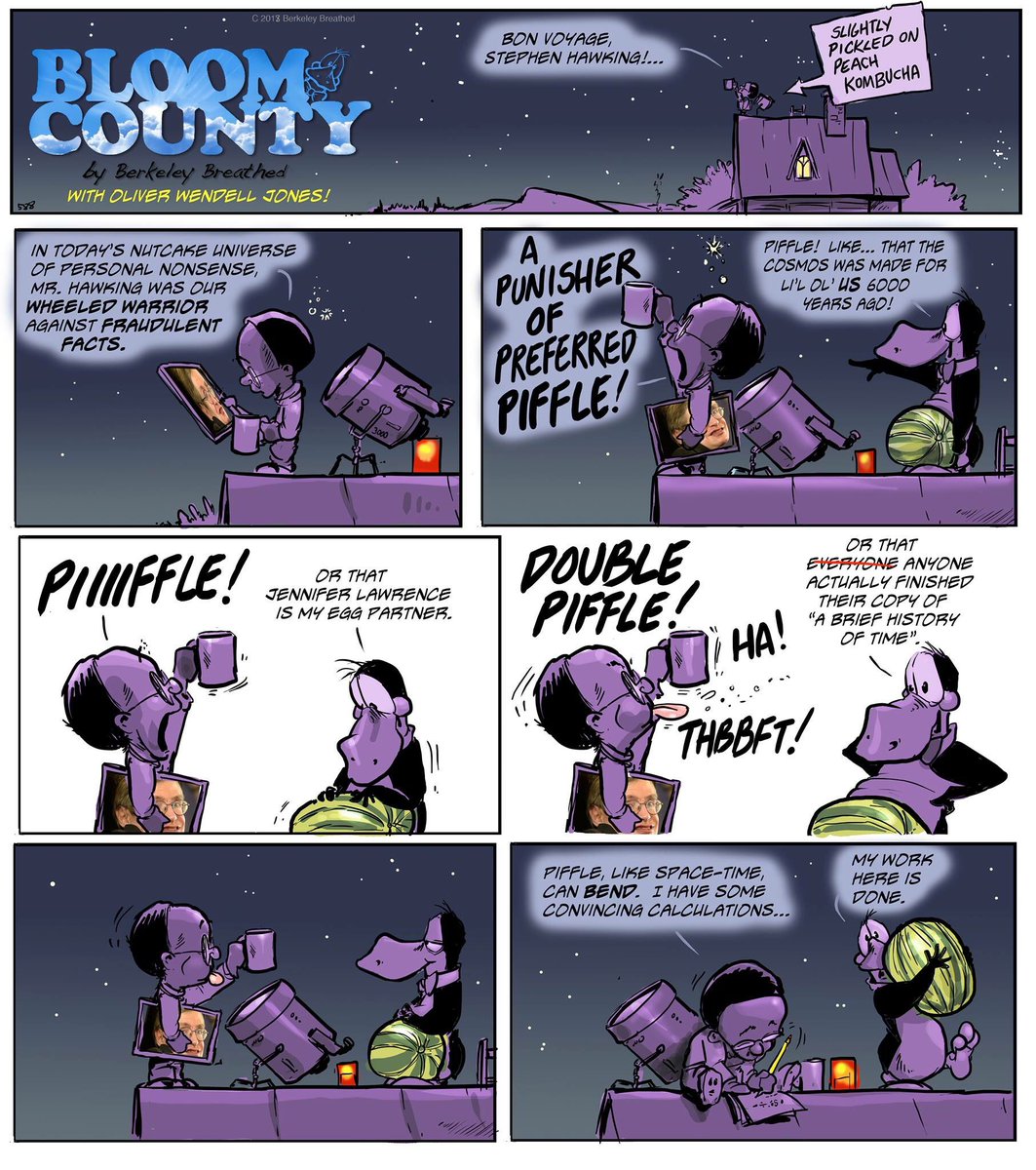
And then there is Bloom County’s tribute to Professor Hawking, which I like much better . . .
LikeLike
Well, how did THAT happen? I thought I was posting a link . . .
LikeLike
… Is Opus trying to hatch a watermelon?
LikeLike
Also, I must admit I haven’t yet finished my copy of “A Brief History of Time”.
LikeLike
There’s a backstory to the Opus & Watermelon story, then Berkeley Breathed combined it w/his tribute to Professor Hawking.
http://www.gocomics.com/bloom-county/2018/03/20
LikeLike
James is discussing “Niven’s Law” as was described in the article “The Theory and Practice of Time Travel” by Larry Niven:
IF THE UNIVERSE OF DISCOURSE PERMITS THE POSSIBILITY OF TIME TRAVEL AND OF CHANGING THE PAST, THEN NO TIME MACHINE WILL BE INVENTED IN THAT UNIVERSE.
LikeLike
Subway “missions” are a favorite of Improv Everywhere. Here’s a time travel one:
https://improveverywhere.com/2016/03/16/time-travel-subway-car/
LikeLike
Re: Berber
Here is an interesting variation of that theory:
One-Minute Time Machine:
LikeLike
Quick heads up about some NSFW words.
LikeLike
RE: Brian is STL
And here is another Improv Everywhere time travel stunt:
LikeLike
Oops! That is the mission report. here is the stunt. Watch it first:
LikeLike
Pinny, thanks! I’d seen One Minute Time Machine before, but the BTTF stunt was new to me and quite cool.
(Flash mobs are kind of played out)
LikeLike
Anyone seen “Timeless”? At the end of the first episode one character’s sister no longer existed. Another character was trying to save (keep alive) his deceased wife. Robert likes it.
LikeLike
Timeless drove me crazy because they had a “history expert’ who knew all the minutiae (the exact design of an 1960 bra) but had no sense of actual historical events.
Or in real-world terms, the writers liked to throw in the occasional bit of trivia, but were too lazy to get the rest of it right.
LikeLike
“why couldn’t those actions produce another timeline in which somebody else invents a time machine completely independently of the first inventor?”
They could. But then that second inventor’s time machine will introduce NEW variations in the flow of time, which causes that second inventor to not invent the time machine, but creates circumstances so that a third one will… which introduces changes in the time stream, etc. There can be any number of inventors whose invention is altered out of the timestream by later meddling by time-travellers. Eventually, you will hit one stream of circumstances in which no time machine is invented, ever, by anyone. Then there are no more changes to the time-stream because there’s nobody with a functional time-machine.
The ultimate time-travel story is “All You Zombies”, by Heinlein.
Click to access Robert-A.-Heinlein-All-You-Zombies.pdf
LikeLike
Preach it, CIDU Bill! The shows doing an era I actually recall (70 and 80s — and I think I saw the first 90 nostalgia movie the other day, Landline), and getting it wrong, despite all the almost autistic attention to minutia, make me question ALL historical dramas: do Merchant and Ivory get it all wrong?
LikeLike
Actually if Robert did not want to watch “Timeless”, I wouldn’t watch it. He has always loved to see time travel movies or shows. Latest one is “The Crossing” which started Monday night.
Separately, I don’t usually look at the online clips as I can’t really watch them on my laptop as it is too slow (and my desktop does not have speakers). But going past “One Minute Time Machine” it occurred to me that the fellow is in NCIS and I ran it to see if it was him – looked like him and she liked familiar once it was running so I checked imdb and it is him – younger I would say than on NCIS and she is the wife from “Kevin can wait” – the one (the character) who died between seasons and they advanced the show a year in time to not bother with dealing with it, other than mentioning that she died.
LikeLike
larK – yes, they get the older time periods wrong also – sometimes laughingly (and I don’t mean the ones that purposely get things wrong for laughs. Reenactors will pick apart shows and movies in discussion groups. Also we only assume that we know what and how things were done/used or people dressed and spoke. I know I don’t write the same as I talk – well in volume I do – so it is entirely possible that people did not speak exactly as they wrote and we guess from the spelling (before it was standardized, especially) as to words were pronounced.
We assume what people wore as underclothes from what still exists, but that does not mean that what is known is all inclusive or that some unusual piece of clothing is just something odd that someone made for their self. As an example of what I mean, women in the 1700s (and other, mostly earlier periods) wore a garment known as “stays”. A French woman would have called hers a corset and that name struck and stayed for later designs (different shapes – 1700s were flat fronted) of similar purpose garments. In the 1700s extant stays have been found in two main designs – ones that tie in front and back (the back set the size and the woman could untie the front to open and close and dress herself) and ones that only tie in back (more formal and require someone to lace and tie the back). None have been found that only tie in the front. Suddenly someone saw online a set of stays at a museum in the UK that only closed in the front. Great excitement. Then someone was able to research further and while the stays dated to the 1700s, they had been remade in the early 1800s – and the change to front only stays made at that time. And yes, I wear stays when reenacting – very comfortable. They are not like Scarlett O’Hara’s corset and should fit comfortably like a gentle hug.
Yes, reenactors are that persnickety. “Outlander” has a terribly inaccurate costume department. As others were arguing in an online group about the 18th century clothing – which are quite inaccurate, I questioned a 1940’s bra that the main character was wearing as it seemed a bit mid 1960s or later to me – based on personal experience with 1950s bras (mom’s). Yes, it is a sort of time travel story also – but only of people from the 20th century going back to the 18th. It is, to me, bodice ripper, ladies type books. I was surprised to find this out as most of the guys in our reenacting unit were reading it, so I thought it would be of a more masculine storyline.
LikeLike
Meant to mention – generally considered the most accurate 1700s movie (especially in clothing) is “Barry Lyndon”
LikeLike
Hollywood has absolutely zero interest in being historically-accurate. What they do want is to SEEM accurate… which means matching up with what viewers are familiar with, which is other Hollywood products.
This is not new with Hollywood, either. Fictionalized history has existed for a long time. “Legends”, they’re called.
LikeLike
Okay, a final comment on “I can’t believe that they put that in that period”. There is a Hallmark series “When calls the Heart”. I am not sure of the exact period – extremely late 1800s or early 1900s. It takes place in Canada. Yes, it is a “fun” movie and not intended to be historically accurate. But sometimes it is just too much of an error –
On the latest show the teacher decides the children should each spend a day at a local business learning about business. She has a meeting with the business owners. When she was done explaining, she took out a clipboard and pen to pass around. Now, this was not even the kind of clipboard that was used in, say the 1950’s with a large generally triangular metal clip with a hole in the clip at the top. This was one of those newer heavy wire clips. And the pen she passed around was a white ballpoint stick pen. Later the same type of clipboard (maybe even the same prop) was used by one of the businessmen in town. I think this is a bit too far – or was Canada that far advanced over the US? :-)
LikeLike