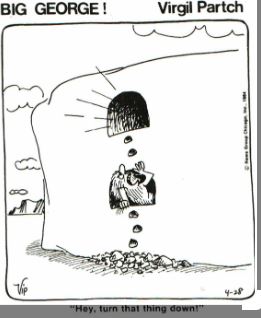
For entertainment, teenage cavemen grooved to the sound of rocks being banged together.
And even then, parental units would complain of the loud noise.
It’s not teens, it’s the upstairs neighbours! Not just banging rocks, but rolling too!
My thought was it looked more like the pueblo adobe housing. And Japanese capsules.
I’m more interested in the source (and publication history) than the comic itself. The gray border (interfering with the caption) seems unusual (perhaps it was from a book). The detail that caught my eye was the handwritten date, which would be unusual for a current rerun (and even more so for a book. Publishers usually remove the dates from reprints.)
P.S. I did not know (until I looked it up) that Partch died in 1984.
Although Partch died in 1984, Toonopedia says that Big George ran from 1960 to 1990. Apparently Partch had built up a very substantial stockpile at the time of his death.
Is the pile of rubble on the ground indicative of what’s going on upstairs?
Is this perhaps a reference to “rock music?”
Music with rocks in. RIP Terry Pratchett.
Just rec’d Marc Burrows’ biography of Sir Terry. Not read it yet, but plan to do so this weekend.
Terrence Feenstra, don’t you mean GNU Terry Pratchett?
Regarding the cartoon, yeah I think it’s supposed to be the neighbors playing loud “rock” music. Sort of a pune, or play on words. Meh.
Usual John, couldn’t they have been running repeats for several years?
B.A., I suppose that’s possible. All I know is what’s in Toonopedia, which says, “Like Henry Boltinoff, Partch worked far in advance, building up a stockpile to last years. Thus, despite the fact that he was killed in a traffic accident in 1984, there was enough material to keep his panel going until 1990. After it ran out, however, Big George ended.”
Okay, Usual John, that does lean toward the “backlog” theory.
I suspect after Joe Martin dies, they’ll find entire comic strips he’d never published.
Zane Grey died in 1939, and had enough unpublished works that a new novel was released every year (or almost every year) through 1959. (After which, and sprinkled in the during-which period, there were also new omnibi and collections of stories culled from magazines and variant editions that added another twenty or so “new” books to his canon.
(There are other cases, but that’s perhaps the most famous.)
Was it a daily strip? If it ran 5 days a week, by my math he would have a stockpile of roughly 1500 when he perished. He must have really really liked doing it.
I thought a horse was pooping in his mouth.
Alex Graham(Fred Basset) and Reg Smythe(Andy Capp) also had big stockpiles of strips running long after their deaths.
Terry Pratchett wrote, “You can’t write books when you are dead, unless your name is L Ron Hubbard.” Someone else wrote something along the lines of, “The good news is that L. Ron Hubbard is dead. The bad news is that he’s still writing books.”
The same can be said of V.C. Andrews (‘Flowers in the Attic’, ad nauseam), altho once s/he died, others were hired to continue the series. These books were the MOST stolen/never returned books in the high school library where I worked for 30 years.
There is a new ‘Agatha Christie’ book out, written by someone who has ‘taken up the mantle’, so to speak.
Andrew Neiderman is the main (possibly only) “new” V.C. Andrews.
Was he picked due to his first name, or did he change his name to this one, I wonder.
Noel Stookey was identified as Paul when the “Peter Paul and Mary” act was put together. Even when they were listed with their full names, he was cited as Paul Stookey. In more recent years, he performs as Noel Paul Stookey.
Big George was one of my favorite comics. I didn’t recognize it by name (George wasn’t in this one). I could only find a few dozen strips on line. (After reading the few dozen, I don’t know that he would be a favorite of mine today; his reactions are a little extreme for me).
I didn’t know that Noel Stookey became Paul only because “Peter, Paul and Mary” sounds better than “Peter, Noel and Mary”. I wonder why Mary Travers didn’t also take a new name so they could be “Peter, Paul and Mounds”.
Mitch, Mark, PP&M never performed as PN&M, thank goodness, nor did they turn Mary into a candy bar, but they did record an album called Peter, Paul, and Mommy. The Beatles called them Pizza, Pooh, and Magpie.
From the can’t-make-it-up department: Noel Paul Stookey’s second solo release was a live album recorded at a Carnegie Hall concert in December of 1971. By the afternoon of the concert just 200 tickets had sold, probably because hardly anyone yet knew who “Noel Stookey” was. So Stookey and his band hit the New York streets, handing out free tickets to anyone who would take them. That evening, the hall was packed.
The album is, remarkably, still in print. The current jacket’s front has the artist’s name and the album title: “Noel Paul Stookey One Night Stand.” But the copy I played on my college radio station, like the copy I bought not long after for my own collection, just said PAUL STOOKEY in large friendly letters on the front, and NOEL on the back. Tucked inside was what looked like a facsimile of the concert program with the date, the 19th of December – less than a week before Christmas. So when I aired it, I gave the album title as NOEL. I didn’t yet know who Noel Stookey was, either.
As a chaser, inside the gatefold was a stage photo of the band. Under Noel was printed “Neil Stokey.” Was that Noel poking fun at his own name tweak? Was it a clueless graphics designer? I can’t say.
Wait now. How on earth did we lurch from Big George to Noel Paul Stookey?
For the record (sorry), I’ll buy the pile of rubble on the ground, but the evenly-spaced dots on the wall don’t look anything like rocks to me.
Returning to the comic as well, I get the implications of ‘rock’ music and the possibility of the upstairs neighbour banging/rolling rocks to make music that people above have suggested, but the caption says, ‘…turn that thing down!’ What ‘thing’ is he referring to? If his neighbour was banging rocks, wouldn’t he just say, “Stop doing that!” or “Put those things (plural) away!” or something?
It seems the guy upstairs has a particular thing, not thingS, which leads me to believe we haven’t got to the bottom of this comic yet. And I’m no help either. I haven’t got a clue.
(Could the ‘evenly-spaced dots’ just be footholds to climb up into the caves?)
@ Andréa – ‘taken up the mantle’, so to speak.
The “new Agatha Christie” is the fourth by Sophie Hannah, a poet and well-regarded psychological thriller writer in her own right. I haven’t read anything by her myself, but I am minorly connected to her in a 6-degrees-of-separation way as her father was Norman Geras, a Marxist lecturer born in then-Rhodesia who ran some of the seminars in my Modern Political Thought course at Manchester University in 1978/79 (when his daughter would have been about eight).
He seemed a rather dour, dry, serious-minded chap but many years later I came across his blog, normblog (still online – on politics, Iraq, films, literature, music, anti-semitisim, various cultural issues and Australian cricket) and he was sometimes surprisingly funny, still in a dry sort of way. I even won a £20 book token in a sweepstake he ran asking his readers to predict the outcome of a Test series (long-form international cricket competition). His last blog post about ten days before he died eight years ago, suitably enough for his daughter’s his wife’s (Adèle Geras, childrens’ author) careers, was a list of 100 works of literature he had enjoyed and thought we might too. (Links to daughter and wife in the wikilink to Norman Geras above).
Thanks for the info on Sophie Hannah; I subscribe to the monthly Book Page, where this new book was recommended but hadn’t mentioned that it was her fourth attempt, altho I do think it mentioned this was her first Poirot book. I’ll see how I like it and then decide whether to try the others.
According to Wikipedia, this would be her fourth Poirot book.
Hercule Poirot
The Monogram Murders (2014)
Closed Casket (2016)
The Mystery of Three Quarters (2018)
The Killings at Kingfisher Hill (2020)
Here’s another 6-degrees link… David Suchet played Poirot in loads of recent TV adaptations. He was a friend of my uncle David, an actor with the Royal Shakespeare Company, and organised and led the operations at my uncle’s memorial service at the Shakespeare Memorial Theatre in Stratford in 1997. Sir Trevor Nunn did the oration, and also wrote my uncle’s obit in The Independent. My aunt Lys, who is mentioned in the obit, died a week ago at age 97 and I am going to her funeral on Friday.
There are weird interconnections in all our lives. “Such is the warp and the weft of the tapestry of your life” as my brother put it in a song he wrote.
The Noel Stookey problem is a failure of Public Relations. Everyone knows that Buster Poindexter is David Johansen and everybody knew that A. A. Fair was Erle Stanley Gardner because their publicists made sure they did.
Some time after Rex Stout died, his estate approved a writer to continue the Nero Wolfe writings. But published under the new writer’s name, not as Stout. With of course a prominent note on the cover that these were approved.
But one of the attractions of the series had been the eccentricities of the Wolfe character, and how they provoked his assistant (and narrator) Archie Goodwin. So fans like me were up in arms when the new writer rode roughshod over the canon, dragging Wolfe into things he never would have done before.
Ellery Queen was a pseudonym for a partnership, and when one of them died the other continued to publish under that name, though (at least at first) not using the Ellery Queen character and milieu they had developed together.
The general feeling was that those solo books stunk in the writing, and that now we knew which partner had been contributing the wordsmith skills.
Something like that was also the plot of a very early (perhaps the premiere) episode of Columbo. With the addition that the deceased partner was murdered, of course.
My memory and the chronology don’t leave it clear if “everybody knew” the Columbo story was commenting on the Queen situation. Or if perhaps it influenced fans and critics and contributed to the trashing of the solo Queen’s work.
Everyone knows that Buster Poindexter is David Johansen and everybody knew that A. A. Fair was Erle Stanley Gardner
Eventually everybody knew that Richard Stark was Donald Westlake, but I don’t know if that was the case from the get-go. There is such a tonal distance between Stark’s quite cold blooded Parker series and Westlake”s cheerful caper comedies .
For what‘s worth, the new “Poirot” books have been published with the blessing of Christie’s estate. Given that the arrangement has lasted this long, it would seem that they approve of what the new author has been doing with the character.
Or, cynically, they approve of the income from the new author.
In all three cases where I read books by approved authors continuing a series of a now-dead originator, I was disappointed, including one where there were at least three additional books. OTOH, I’ve been pleased by some authorized additions to the series of still-living authors (theoretically cowritten) by approved other people.
@ Arthur (& narmitaj) – Sooner or later some TV production company is going to ask for permission to film one or more of those new novels. It would be very interesting to hear David Suchet’s reaction if they ask him to play the lead again.
1) I put all of them on a Reserve at the library;
2) I watched all the Suchet/Poirot episodes available on YouTube a few months ago;
3) I also watched a few interviews with Suchet, and he has stated that he would love to return to playing Poirot;
4) I’ll not be able to read these books without ‘seeing’, in my mind’s eye, Suchet as Poirot.
@ Andréa – Was that interview dated? There are a number of interviews on the various (later) Poirot DVD collections, and I do think I remember him talking about “returning” in one of the earlier ones, with the caveat that it the decision wasn’t his to make. However, on the last DVD set (including “Curtain“), there’s also a clip of him doing the very last scene of the last episode to be filmed (“Dead Man’s Folly“), after which someone (probably the director) declared that that was a “wrap” on Suchet’s entire career as Poirot.
P.S. Suchet has also described how (unexpectedly) difficult it was to “reassume” the mantle of Poirot’s personality for each new series. I would love to see any new episodes that he feels would be appropriate for him to do, but it might be difficult to reconcile the timeline of the new books into the existing canon of films already produced, not to mention with his current appearance.
I didn’t check the dates on the interviews; they are all available on YouTube. I was surprised to find that he’d been doing Poirot for 25 years, off and on. And yes, the scene you describe was shown on one of the interviews I watched.
I doubt they’d be able to gather Miss Lemon, Hastings and Inspector Japp to do more, anyway.
Mitch4: re Ellery Queen — not quite. After THE FINISHING STROKE in 1958, Dannay (who essentially did the plotting) wanted to quit, and I believe Lee (who generally did the bulk of the writing from Dannay’s plots) had developed writer’s block, but wanted the “Ellery Queen” name to continue (I recall reading that Lee felt he needed the continuing income), so Dannay agreed to let him arrange for other people to publish under the authorial name (but not using “Ellery Queen” the character). I think all of the ghostwriters did their own plotting and writing, with only minimal input from Lee and/or Dannay. Most notably, Jack Vance ghosted three pretty good entries (but it’s generally agreed that all of the books by other ghostwriters are indeed bad or at best meh.)
After about five years they decided to bring back EQ the character. Dannay resumed doing the plotting/scenarios, but Lee was still unable to resume his share of the actual writing, so ghost writers were again used — Theodore Sturgeon for the first new novel (THE PLAYER ON THE OTHER SIDE) and Avram Davidson for three others. After which Lee overcame his problems and was able to write again, and Dannay and Lee resumed the original duties for the last three “Ellery Queen the character” novels (and for one gawdawful non-series ‘thriller,’ COP OUT). And then Lee died in 1971, and the series came to an end (although Dannay’s lengthy plot summary for a further unwritten novel, A TRAGEDY OF ERRORS, was later published as a curiosity years after Dannay’s own death in 1982
Thanks, Shrug!
You are more informed on that history than I am! But I did enjoy as well as the novels and stories the critical / editorial / humorous pieces and collections published under EQ authorship or editorship.
Oddly, “The Finishing Stroke” was the *first* EQ book I read, and it did get me into the idea of following a series by an author with continuing characters, and being conscious of the ordering and subcategories. Along with the “Challenge to the Reader” feature, the extensive listing of books by the same author in EQ novels was for me a hallmark of their publishing. The listing would separate out the saga of that upstate town, for instance.
I hope I get back from the dentist in a good mood, to discuss further the New York school with you! I like to use a Queen / Stout comparison to help with weighing arguments about “Can we impose our own time’s standards on works of the past?”.
If I may, I notice you did not discuss the Columbo episode I mentioned. Is it generally thought to be a commentary on the EQ writers?
Not the pilot but Season 1 Episode 1.
“Murder by the Book” is the episode title, but also the title of a Rex Stout novel!
“When one member of a mystery writing team wants to break from his less talented partner, he becomes the victim in a real-life murder mystery.”
Director: Steven Spielberg
Writers: Steven Bochco, Richard Levinson, William Link
Stars: Peter Falk, Jack Cassidy, Rosemary Forsyth See more »
@ Andréa – It wouldn’t be necessary to bring back the others. Except for Hastings’ return in “Curtain”, all three were absent for all of the later series (especially the double-length episodes). In addition, for the new books, the author explicitly stated that she’s not using any of Christie’s “supporting cast”, just Poirot. The books are even scheduled in a carefully selected calendar “gap”, so that their absence does not conflict with the overall “canonical” chronology of the original books.
P.S. The chronology in the TV series is telescoped: other than “The Mysterious Affair at Styles” (set during WWI), and “Curtain” (set in 1949), all of the other episodes were filmed as if they took place during a very short span of years; most of them were set in 1936 or 1937.
Mitch4: “If I may, I notice you did not discuss the Columbo episode I mentioned. Is it generally thought to be a commentary on the EQ writers?”
Don’t know; didn’t comment because I’ve never seen the episode. (I think I did see one episode of COLUMBO once, many years ago — but it wasn’t that one. . . Not a big TV/movie watcher.)
Not the pilot but Season 1 Episode 1.
“Murder by the Book” was available on YouTube several months ago, where I saw it. I see that many, if not most, of the complete episodes have been removed therefrom. Same with the Hercule Poirot episodes. Maybe too many were watching for free whilst staying at home since March? That’s the only reason *I* was watching them. Personally, I find Jack Cassidy creepy, even when he’s NOT a murder suspect.
Which is one of the reasons I liked watching Columbo – all the guests who were famous actors, Patrick McGoohan (who also directed five episodes and wrote two). Donald Pleasance, John Cassavetes, Ben Gazzara, Robert Culp (Mr. Sleazy), George Hamilton, Robert Vaughn, William Shatner, Ray Milland, Leslie Nielson, etc., etc., etc. I bet they all LOVED playing against type.
Columbo/Peter Falk himself was annoying after a few episodes; maybe not so much if you watched an episode a week, but binge-watching . . . annoying, altho I do like to watch the denouément each time..
My father, German as he was, was a fan of American rock and roll music in his youth; he liked Fats Domino, and also liked Chubby Checker, whom he never failed to claim was just a shameless Fats Domino imitator. He never made the connection that Chubby Checker was not hiding this, as even his name is an obvious homage to Fats Domino (Fats = fat -> Chubby; Domino = game piece -> Checker); it was one of my first triumphs of knowing more than my father when as a boy I was able to point this out to him.
Anyway, I bring this up because Mitch has been juxtaposing Rex Stout and Ellery Queen, and I wonder if the Ellery Queen name isn’t an homage to Rex Stout? Rex = King -> Queen. Stout = Sturdy, substantial, firm; Ellery = Alder tree = Hardwood, which is sturdy, firm, substantial… Am I reaching here?
“. . . all three were absent for all of the later series (especially the double-length episodes).”
Which is why I didn’t watch any o’ those.
lark: Can’t see why the EQ authors would have been inspired by Rex Stout in naming their detective and byline — the first Ellery Queen mystery appeared in 1929, and while Stout had published miscellaneous magazine fiction earlier, Stout didn’t publish his first *mystery* until 1934.
I don’t recall if there is any particular reason for their choosing the name “Ellery Queen,” but if they were going to homage any fellow author, “S.S. Van Dine” would have been the likeliest, since there’s a lot of Van Dine’s “Philo Vance” in the early personality of Queen-the-character.
If someone has handy a copy of Francis Nevins’ ROYAL BLOODLINE or hislater ELLERY QUEEN: THE ART OF DETECTION might check; I suspect Nevins would have discussed it. (Incidentally, to further confuse the issue, it’s noted in one or more of the earlier books that “Ellery Queen” is not even the “real” name of the fictional character, who supposedly preferred to remain anonymous or something — though if this were real life, that would be doomed to failure — how many amateur detectives famed for solving many highly-publicized cases and who also happened to be the son of the police commissioner of New York city could there have been running around out there, anyway?)
I’m completely a dilettante here, just a very casual reader, but it surprises me that Ellery Queen dates back that early! I figured it to be a 1950s thing, maybe reaching back to the late 40s, maybe, and dying ignominiously in the early 70s… (None of this based on anything other than how it struck me as a casual reader.)
1929 … wow!
@ Andréa – “Which is why I didn’t watch any o’ those…”
Some of the longer (later) “Poirot” episodes are significantly darker than the earlier (shorter) ones, but the absence of Hastings’ banter or Miss Lemon’s fussiness doesn’t make them any less masterful. I’ve seen fan commentary complaining about their absence, but the fact is that Christie did not put them in every Poirot story, and in many of them they are just not needed.
P.S. Two of the best adaptations with Poirot as a solo operator are the classics “Death on the Nile” (which has plenty of humorous moments, yet still very true to the original), and “Murder on the Orient Express” (which is much darker, and adjusts the focus a little differently from the book). There are many other episodes that I could (and would) recommend, but those two are perhaps the best proof that Suchet does not need a foil to shine brilliantly as Poirot.
A certain writer wrote a book about his experience growing up gay: “The Best Little Boy In The World.” He published it under a pseudonym. It got excellent reviews and became a classic.
The writer went on to become very famous as a financial writer under his real name.
Then he wrote a sequel to “The Best Little Boy” and published it under his real name, revealing that he had been the author of the first one.
Reviews for the sequel were terrible, mostly suggesting that he should stick to financial writing.
Using a pseudonym can often be a better marketing strategy.
Andréa saidColumbo/Peter Falk himself was annoying after a few episodes; maybe not so much if you watched an episode a week, but binge-watching . . . annoying,[…]
And in the original broadcast format, it wasn’t even weekly. Instead, it was in rotation with two other series in the same time slot, under an umbrella label of “NBC Sunday Mystery Movie”. And it was TV-movie length, not “one-hour drama” length. So these were like 90-minute slots or two-hour — which worked because you weren’t getting soaked in any one of them at that length weekly.
From IMDb on “The NBC Mystery Movie” : “The NBC Mystery Movie was the ‘umbrella’ title for one of many mystery series shown on a rotating basis (known as a ‘wheel series’), in the same time slot on Sunday nights on NBC. The original 3 series featured, Columbo (1971), McMillan & Wife (1971) and McCloud (1970). Later, several other (often short-lived) series were added to the rotation including Hec Ramsey (1972), Amy Prentiss (1974), McCoy (1975), Quincy M.E. (1976), and Lanigan’s Rabbi (1976). The “wheel” concept proved so popular that NBC started a second night on Wednesdays, featuring Banacek (1972), Cool Million (1972), Madigan (1972), Faraday and Company (1973), Tenafly (1973), and The Snoop Sisters (1972). Low ratings forced NBC to move the second wheel to Tuesdays, but it was still canceled in 1974. The Sunday wheel ran its course in 1978.”
Some of those are now well-regarded as independent series, and some I don’t think the titles ring a bell at all. I sort of recall “Banaçek” as being in rotation with one I don’t see listed here, where the investigator was a blind guy with a guide dog in New Orleans.
Columbo and one with Dennis Weaver are the only two I recall – but I’d never seen them ’til Columbo was in reruns years later when I lived in my own house.
Yes, I’m sort of pairing the Nero Wolfe and Ellery Queen series, for historical reasons, and frankly because I tend to use Nero Wolfe as a stick to beat Ellery Queen with. They do date from roughly the same era, and fit a very loose schematic for the development of “mystery” (or latterly “detective”) writing —
There was a rich tradition from the UK, going back to Sherlock Holmes and (after some classic writers known for other work more than mystery, such as Chesterton or even Wilkie Collin) taking in figures like Dorothy Sayers before Agatha Christie became the face of the “brand”, which quite unfairly got stereotyped and parodied as “British drawing room mystery novels”. (P D James was a leter entry.)
Later, there were the American West Coast “tough guy” detectives, especially Hammett and Chandler, along with James M Cain and others whose writing was used for the first wave of “film noir”, and not always about crime solving. (See a summary and reply to Edmund Wilson’s negative essays at http://www.dartmouth.edu/~gjdemko/praise.htm )
And I think we can stick a “New York School” in there, fitting in between those on several dimensions. Historical dating (though just very roughly). Geographically, obviously. And on some scale of themes, tone, kind of concern. I am looking at Ellery Queen and Rex Stout primarily here, though oddly the West Coast violent Dashiell Hammett wrote the urbane “Thin Man” stories, set in NYC and upstate NY.
These New York School writers still had the “puzzle solving” aspect from the English tradition, sometimes retaining the “drawing room” big reveal. But also using some elements of “tough guy” stance, though not as much as the West Coast would develop — Ellery Queen and Archie Goodwin (Nero Wolfe’s assistant and legman) could both fight if they needed to, though that did not overshadow their mental detective abilities.
Shrug and larK have noted some of the clever technical innovations in EQ, and I would add that Archie Goodwin also carries forward the John Watson tradition of positing that the published books and stories are roughly true memoirs of cases with some identities disguised. Stout also creates an innovative solution to a technical narrative problem rampant in the mainstream novel as well as these genres — when there is a first-person voice telling the story and also participating in the action, how accurate are the detailed memories supposed to be? Is the dialogue supposed to be verbatim? Well no, and that is not solved for Dickens either. This implausibility was part of what led in the great tradition of Hardy, Conrad, James, and the continentals of the invention of “free indirect style” .
But Rex Stout takes a different apporach, and faces the “verbatim question” head-on. Yes, he says, Archie has trained himself to remember scenes and actions with verbatim accuracy. And besides mentioning this frequently, he gives us a couple times a scene where Mr. Wolfe asks Archie to report on something he participated in, and specifies a verbatim account of what was said. So we have a basis for allowing Archie’s supposed memoir account to stand as fictively accurate.
This even becomes, in a double-self-conscious way a matter of reflection and plot, when [*** WOOPS SPOILER ALERT *** Ä Family Affair”] in “A Family Affair”, the last Nero Wolfe book by Rex Stout, as Wikipedia puts it Ultimately, Wolfe discovers that the killer is one of his closest associates, a character who had been appearing in Nero Wolfe mysteries for over forty years. A Family Affair is an unusual Nero Wolfe mystery in that Archie reveals his (correct) opinion of the killer’s identity well before Wolfe does so in the closing chapters. Archie reflects that maybe his portraits of this long-term associate and even friend have been too kind and overlooked a strain of selfish meanness and violent misogyny he somewhat felt he was seeing but did not place into his earlier memoirs.
larK asks about critical or fan speculation connecting EQ and Rex Stout. Like Shug, I am not aware of any such. However, William S. Baring-Gould ( https://en.wikipedia.org/wiki/William_S._Baring-Gould ) author of the influential 1962 fictional biography,” Sherlock Holmes of Baker Street: A Life of the World’s First Consulting Detective”, also wrote ” Nero Wolfe of West Thirty-fifth Street: The life and times of America’s largest private detective, a fictional biography of Rex Stout’s detective character Nero Wolfe; in this book, Baring-Gould popularised the theory that Wolfe was the son of Sherlock Holmes and Irene Adler. ” As I recall, he also had an even more speculative passage in which he tested a hypothesis that Wolfe could have fathered Archie.
((No, I did not dig up my term paper from around 1974 from John Cawelti’s ( https://en.wikipedia.org/wiki/John_G._Cawelti ) UChicago English Department course on “Popular Culture”. Though I did repeat here some things I must have written about then!))
I just now posted (but is in moderation) “Yes, I’m sort of pairing the Nero Wolfe and Ellery Queen series, for historical reasons, and frankly because I tend to use Nero Wolfe as a stick to beat Ellery Queen with.” I never did quite get to that last part! I was very saddened a couple years ago, looking into some EQ books, to see some shocking racial-stereotype caricatures of Black minor characters. I thought about the sort of “Well, everybody back then and in that position was doing that stuff” defense you sometimes see. Setting aside whether that’s the right sort of contextualization to apply, I thought it worth examining whether the fact claims are themselves even accurate. And for me the natural pairing to compare to EQ would be the Nero Wolfe books of Rex Stout. And what you will find is that Stout emphatically did not do the same. Two of the novels, from different periods, have Black central characters, and foreground issues of racism and later, the Civil Rights movement. Other instances, of minor Black characters, are free of the cliché stereotyping and mocking portraits in EQ.
It was a dual-listed undergrad/grad course. The grad student extra requirement was a term paper in addition to sitting an exam that the undergrads did too. My paper was on narrative in the Nero Wolfe series (as suggested above).
Here’s the exam question! (NB This was probably in 1975.)
Love Story and The Godfather were big hits around the same time. (Love Story novel and movie both 1970, The Godfather novel 1969, movie 1972.) [Indeed, Love Story the novel was #1 bestseller in the U.S. for 1970.]
Why?
Kilby – I am not sure if I have read any Poirots or not – so many books read, mind so aging – but are the murders as easy to solve in the books as they are on the screen? While in the case of “Orient Express” (earlier movie – not the most recent) and “Death on the NIle” it did take me until after the murder to know who did it , but that was longer than “Knives Out” when I figured who did it before it was done. I have not been allowed to say who did it until the movie over for a long time – Robert says it ruins the movies to know.
@ Meryl A – It depends. Christie has a talent for misdirection and surprises, but to paraphrase David Suchet, her mysteries aren’t just “who-dun-it?s”, but rather “how-didde-doo-it?s”. In other words, the mystery is not just about the culprit, but also about the method that was used to commit the crime.
I’ve watched virtually all of the BBC’s “Poirot” episodes more than once, and they are still enjoyable in subsequent viewings, because it is also fun to trace through the action when the “obscured” information is already known. However, I would never inflict a spoiler on anyone who has not seen a particular episode or movie for the first time, because there is a bit of added suspense in that inital experience.
It would be difficult to compare the “solvability” of the mystery in print versus film, since there is no way to experience one without learning the ending of the other. However, I’ve only read a small selection of Christies books (about half of them as German translations), and none of them before I saw the BBC episode. On the whole, I would say that her vocabulary and orthography are starting to show their age, but I still did enjoy reading “Death on the Nile”, in part just to see how closely the BBC’s version was to the original.
@Mitch: one I don’t see listed here, where the investigator was a blind guy with a guide dog in New Orleans.
That was Longstreet, starring James Franciscus. It’s not listed because it was an ABC show.
Just as a side note: YouTube has Nero Wolfe mysteries with Timothy Hutton (of ‘Leverage’ – a show I enjoyed) as Archie. I watched about ten minutes of one and it just ‘sat wrong’ with me, altho I couldn’t say why. Others may enjoy it; there are quite a few episodes available (until they’re not).
Mitch4 mentions Lanigan’s Rabbi (1976) — as I recall, this was based on Harry Kemelman’s [DAY OF THE WEEK] THE RABBI [DID SOMETHING] novels, and is remembered by me solely because (small world department) my then-wife had a small part in a couple of the episodes (as the regular waitress at the cafe where Lanigan and the Rabbi talked and ate).
On Ellery Queen and racial references, I recently reread the first nine novels and noticed and was bothered by such — they were brief and I don’t think there were a lot of them, but they did appear.
(Racial attitudes of the time and place does play a large part in the explanation of the crime in one of them; obviously I’ll say no more to avoidspoilers.)
There’s also a passing reference in ROMAN HAT MYSTERY to an audience member who seems not over-bright being called a “retard” or somesuch slur by one of the authority figures (possibly Inspector Queen himself?) which also caught me up short.
An edition with apparently extensive annotations (by Leslie Klinger) was published in 2018 as part of the omnibus CLASSIC AMERICAN CRIME FICTION OF THE 1920s, and I imagine Klinger will note the racial etc. bits there — I’ve been meaning to try to pry a copy of that omnibus out of the library, but haven’t gotten around to doing so. The book contains annotated texts of:
The house without a key / by Earl Derr Biggers (1925) — The Benson murder case / by S.S. Van Dine (1926) — The Roman hat mystery / by Ellery Queen (1929) — Red harvest / by Dashiell Hammett (1929) — Little Caesar / by W.R. Burnett
@ Andréa – “…watched about ten minutes…and it just ‘sat wrong’…”
I have to say that I’ve never been a fan of crime in fiction or TV: Poirot is a singular exception for me. I just happened to discover one of the early Poirot episodes (decades ago, on PBS), and was captivated by the cinematography, set design, costumes, and props (not to mention the cars). They did such a superb job of staging it to feel like it was shot in the 1930s: it was like being in a time-machine. After that, I just kept watching them.
Shrug, thanks for your replies on EQ. [BTW, it wasn’t me mentioning Lanigan’s Rabbi, tho I do remember that Harry Kemelman series.] I assume it’s clear I’m not out to pillory or “cancel” the Ellery Queen legacy; just noting I was surprised at how far from present-day norms these books I used to read with fascination now look.
Andrea, yes I did see most of that “A Nero Wolfe Mystery” series. https://www.imdb.com/title/tt0283205/reference I agree with you that it felt off, not enough like the books. But I wouldn’t put that onto Hutton, who I thought was fine as Archie. The actor for Wolfe I just didn’t buy, however. And how did they waste Saul Rubinek as lawyer Lon Cohen wen he could have been a perfect Saul Panzer?
At first I saw Hutton and spent a while trying to figure out how he could have also played Ellery Queen in a long-ago series, yet not look any older than how I remembered him in that. Well, a little web search cleared it up: The long-ago Ellery Queen was his father, Timothy Hutton.
An interesting thing about it was their use of a repertory company model for non-recurring characters. This has become less unusual with some TV developers, but still mostly restricted to “anthology shows” where the story and characters are entirely different from episode to episode or season to season. Here they retain the actors for the central and other recurring characters, but for the characters introduced for only one story at a time they re-use actors. So if there is the hot blonde adult daughter of the deceased in one story; then the smart and self-contained blonde suspect Lily Rowan (who in the books becomes Archie’s girlfriend); then the drab mousy blonde older sister of the deceased’s wife in another story; they can all be played by Kari Matchett.
DemetriosX, thanks for the info on Longstreet. I see that it was a 90-minute show, which may be why I wanted to clump it in with the NBC Mystery Movie wheel. If you asked me, today still, to picture a private residence in New Orleans off of a busy or touristy street, I would picture *not* a house front door onto that street but a tall ironwork gate leading to a private enclosure area, from which actual side and back entrances to the house could be accessed. Probably that comes from this show. It also was a step in expanding the kind of job title held by crime-solvers in fiction — M.E.s were already getting started with “Quincy” but Longstreet was probably one of the first Insurance Investigators.
Mitch4: “Longstreet was probably one of the first Insurance Investigators.”
“In 1955 after a yearlong hiatus, the series came back in its best-known incarnation with Bob Bailey starring in “the transcribed adventures of the man with the action-packed expense account – America’s fabulous freelance insurance investigator.” “
Mitch: Timothy’s father was Jim Hutton; you had me going there for a second, thinking Timothy Hutton must clearly be a vampire, every couple of decades reemerging as his own “son”.
(I didn’t realize Hutton was the son in “Ordinary People” (Oscar winning, no less!), a movie I remember hearing a lot about when it was first out, but never seeing it, until very recently, when I was fairly disappointed by it — I guess I had to be there.. wait, I was! My loss, I guess…)
larK, i’m glad you recovered from my slip!
In an episode of his show Leverage, Timothy Hutton’s character once dressed up as a 40s detective with an uncanny resemblance to his father’s Ellery Queen.
My dad was a fan of the mystery wheel shows, so we saw them a lot (the one TV days). I continued after I moved out on my own. I liked Hec Ramsey a lot. It starred Richard Boone. Some people have tried to make the case that Hec was an older Paladin. If so, his sartorial tastes slipped quite a bit over the years.
Yes, the 19302 Art Deco buildings were fantastic, as were the manor houses, and the various hotels he went to (and the cars!). I, too, found that a major attraction of the series, as well as the costumes and makeup. The episodes written by Clive Exton were, I think, the best, albeit they were a bit darker than the others. If you put Being Poirot in the YouTube search block, you’ll get several of the interviews with David Suchet that I found interesting.
That should be 1930’s Art Deco buildings. I wonder where, in England, they found ’em all.
This just arrived in my InBox: ON THIS DAY: In 1860, Wilkie Collins’s The Woman in White was published as a book after a successful serial run in Charles Dickens’s All The Year Round. I subscribe to CRIMEREADS, if anyone is interested. https://crimereads.com/what-we-owe-to-wilkie-collins-the-woman-in-white/
Carl Hiaasen’s new book, Squeeze, came out today. Cause for celebration (to me).
@ Andréa – “the 1930’s Art Deco buildings were fantastic…I wonder where… they found ’em all.”
I certainly agree, although I find it a little irritating when their general fascination with minimalistic white architecture has led them to reuse the same building for multiple episodes. This has happened at least three, or possibly four times, but only one case was really bothersome (in adjacent episodes of the same series).
Another impressive aspect is the depth of acting talent (and casting). Other than the regular characters, there are virtually no instances of an actor returning to play a different role in another episode (I can think of only one, or possibly two exceptions).
“. . . although I find it a little irritating when their general fascination with minimalistic white architecture has led them to reuse the same building for multiple episodes”
Yes, I noticed that BUT was just happy to see the building again ;-). Kind of like all the different British actors in different series (David Jason as Granville in “Open all Hours” and then Jack Frost in “A Touch of Frost” comes to mind, altho there are many many others; I enjoy recognizing and finding out who played whom in what).
And I never tire of seeing Nikki Amuka-Bird show up; nor of saying her name, as though it named a kind of bird.
@ Andréa – “…happy to see the building again…”
In most cases I like that aspect, too. I have the impression that the cinematographers have been careful to select alternative camera angles, so that the duplication of the house would not be patently obvious.
As with recognizing actors in various series, I like the AHA! moment when I remember a building I’d seen before. Of course, watching the episodes out of the order they were broadcast makes a difference in this process.
@ Andréa – I don’t think it matters at all which order you watch the Poirot episodes. In some of the books, Christie did put cross references to events or results of other mysteries, but they are almost never mentioned in the TV versions, which were always produced as independent, stand-alone episodes. This relates to the decision to stage [almost(*)] all of the stories as if they had occurred in the mid-30s, in definite contrast to the books, which are often staged more sequentially (closer to the year in which they were published).
P.S. (*) – I already mentioned two of the three exceptions above (“Styles” & “Curtain”), the only other one that I can think of is “The Chocolate Box” in which the “flashbacks” and “current” scenes seem to form bookends around most of the rest of the episodes.
P.P.S. With regard to recognizing actors, one detail that bothered me while watching Branagh’s eminently forgettable(*) rendition of “Murder on the Orient Express” was the identity of one of the other actors. It wasn’t until I saw the credits that I recognized him by name: Derek Jacobi, who played the narrator (chorus) in Branagh’s “Henry V”.
P.S. I still need to watch him again as Poirot (on DVD, in English), just to make sure that the reason I wasn’t impressed was in fact Branagh’s acting and/or direction, and not just the way the dialog was translated into German.
I didn’t start recognizing Derek Jacobi before my niece gave me a DVD series of Cadfael. Then more recently, under the tutelage of podcasting John Hodgman, I watched the 70s BBC “I, Claudius” in whIch he starred.
Am watching “I, Claudius” for the first time now — saw a credit for Patrick Steward in the last episode, so I had to go back and track him down, because I totally didn’t recognize him (though upon finding him, yeah, that’s him); which led my wife to ask, “what, he’s still alive?” to which I’m like, “They’re all still alive! That’s Brian Blessed, you saw him as Spiros in the older BBC Durrells we watched, that’s Derek Jacobi, he’s everywhere…”
(Augustus’ death scene was fantastic acting on Brian Blessed’s part!)
(That can’t be a spoiler: Augustus is no longer alive, clearly, so obviously he must have died at some point; you can’t claim that a person from 2000 years ago dying is a spoiler!)
larK, if you don’t find John Hodgman, or the idea of a “recap podcast” , too odious, you might want to track down the one he and a sidekick did , under a title something like “I, Podious”. Probably can be found under the Maximum Fun auspices. They had a few celebrity guests, I forget if among them was Patrick Stewart or his son for some reason.
I quite liked Brian Blessed in his role in “Henry V”, although it was a little difficult to take him seriously at the beginning, since I knew him as the king in the first “Blackadder” series.
What I meant was that the buildings may or may not have been recognizable because of random viewing, rather than strictly as they were aired. Assuming that they bothered to keep the episodes using the same buildings far apart.
I watched about five minutes of that and, believe me, you don’t want to bother.
Sir Derek Jacobi was wonderful as Brother Cadfael, and hilarious in one episode of Frasier, where he played a real ‘over the top’ Shakespeare actor, making fun of his own roles.
Jacobi will always be Claudius to me (and, since he was also mentioned here, Brian Blessed will always be Augustus).
Oh come on Bill, Augustus never showed us all 157 of Blessed’s molars as he barks out a laugh that can be heard in the next studio — if we can’t count all of Blessed’s teeth in a role, then it is not a complete Blessed role.
larK, I saw it a long time ago: I think it was being shown on the Romana Broadcasting Network.
@ Andrea – “…recognizing actors … remember a building…”
Last night I watched “Peril at End House” yet again, but this time I recognized (early on) an incidental song “Love is the Sweetest Thing“, which was later used (as a significant theme) in “Death on the Nile“.
@lark: ” you can’t claim that a person from 2000 years ago dying is a spoiler!” Well, maybe, if his name were Issac Lacquedem or Ahasverus or Cartaphilus. . . (but I realize I’m wandering from your point).
Well, by telling me he didn’t die, I guess you’ve given me a spoiler… ;-)
Don’t you love it when you recognize something, and are proven right? ‘Yep, don’t got the damnentia yet!”
Shrug – Will look for your wife when next I see it – and everything comes around in reruns.
You reminded me – When I was in college I had an accident with my car. It was a snowy, icy day and I was not going to work that night due to same. I made it all the way to the subdevelopment my family lived in without an accident and then I had one with someone else (who we did not know) from same. She hit the back of my car when she could not stop at a stop sign (no injuries). We exchanged information – her car was something I had never heard of before – a leased car – and the case went to court. When the lawyer for our insurance company asked me about the car – I knew to say that it was the car owned by father and that I customarily drove – not “my car” from one of the cases in the Rabbi books where that distinction was made in court – car registered/owned in husband’s name not the wife’s who was involved in the accident in the book.
David Suchet is now SIR David Suchet – congrats!!!
 Comics I Don't Understand
For entertainment, teenage cavemen grooved to the sound of rocks being banged together.
And even then, parental units would complain of the loud noise.
It’s not teens, it’s the upstairs neighbours! Not just banging rocks, but rolling too!
My thought was it looked more like the pueblo adobe housing. And Japanese capsules.
I’m more interested in the source (and publication history) than the comic itself. The gray border (interfering with the caption) seems unusual (perhaps it was from a book). The detail that caught my eye was the handwritten date, which would be unusual for a current rerun (and even more so for a book. Publishers usually remove the dates from reprints.)
P.S. I did not know (until I looked it up) that Partch died in 1984.
Although Partch died in 1984, Toonopedia says that Big George ran from 1960 to 1990. Apparently Partch had built up a very substantial stockpile at the time of his death.
Is the pile of rubble on the ground indicative of what’s going on upstairs?
Is this perhaps a reference to “rock music?”
Music with rocks in. RIP Terry Pratchett.
Just rec’d Marc Burrows’ biography of Sir Terry. Not read it yet, but plan to do so this weekend.
Terrence Feenstra, don’t you mean GNU Terry Pratchett?
Regarding the cartoon, yeah I think it’s supposed to be the neighbors playing loud “rock” music. Sort of a pune, or play on words. Meh.
Usual John, couldn’t they have been running repeats for several years?
B.A., I suppose that’s possible. All I know is what’s in Toonopedia, which says, “Like Henry Boltinoff, Partch worked far in advance, building up a stockpile to last years. Thus, despite the fact that he was killed in a traffic accident in 1984, there was enough material to keep his panel going until 1990. After it ran out, however, Big George ended.”
Okay, Usual John, that does lean toward the “backlog” theory.
I suspect after Joe Martin dies, they’ll find entire comic strips he’d never published.
Zane Grey died in 1939, and had enough unpublished works that a new novel was released every year (or almost every year) through 1959. (After which, and sprinkled in the during-which period, there were also new omnibi and collections of stories culled from magazines and variant editions that added another twenty or so “new” books to his canon.
https://en.wikipedia.org/wiki/Zane_Grey#Works
So ViP was (comparatively) a goof-off.
Of course Charles Dickens and other authors communicated new works via mediums even after their deaths, so you can never say never. . .
https://en.wikipedia.org/wiki/T._P._James
(There are other cases, but that’s perhaps the most famous.)
Was it a daily strip? If it ran 5 days a week, by my math he would have a stockpile of roughly 1500 when he perished. He must have really really liked doing it.
I thought a horse was pooping in his mouth.
Alex Graham(Fred Basset) and Reg Smythe(Andy Capp) also had big stockpiles of strips running long after their deaths.
Terry Pratchett wrote, “You can’t write books when you are dead, unless your name is L Ron Hubbard.” Someone else wrote something along the lines of, “The good news is that L. Ron Hubbard is dead. The bad news is that he’s still writing books.”
The same can be said of V.C. Andrews (‘Flowers in the Attic’, ad nauseam), altho once s/he died, others were hired to continue the series. These books were the MOST stolen/never returned books in the high school library where I worked for 30 years.
There is a new ‘Agatha Christie’ book out, written by someone who has ‘taken up the mantle’, so to speak.
Andrew Neiderman is the main (possibly only) “new” V.C. Andrews.
https://en.wikipedia.org/wiki/V._C._Andrews
Was he picked due to his first name, or did he change his name to this one, I wonder.
Noel Stookey was identified as Paul when the “Peter Paul and Mary” act was put together. Even when they were listed with their full names, he was cited as Paul Stookey. In more recent years, he performs as Noel Paul Stookey.
Big George was one of my favorite comics. I didn’t recognize it by name (George wasn’t in this one). I could only find a few dozen strips on line. (After reading the few dozen, I don’t know that he would be a favorite of mine today; his reactions are a little extreme for me).
I didn’t know that Noel Stookey became Paul only because “Peter, Paul and Mary” sounds better than “Peter, Noel and Mary”. I wonder why Mary Travers didn’t also take a new name so they could be “Peter, Paul and Mounds”.
Mitch, Mark, PP&M never performed as PN&M, thank goodness, nor did they turn Mary into a candy bar, but they did record an album called Peter, Paul, and Mommy. The Beatles called them Pizza, Pooh, and Magpie.
From the can’t-make-it-up department: Noel Paul Stookey’s second solo release was a live album recorded at a Carnegie Hall concert in December of 1971. By the afternoon of the concert just 200 tickets had sold, probably because hardly anyone yet knew who “Noel Stookey” was. So Stookey and his band hit the New York streets, handing out free tickets to anyone who would take them. That evening, the hall was packed.
The album is, remarkably, still in print. The current jacket’s front has the artist’s name and the album title: “Noel Paul Stookey One Night Stand.” But the copy I played on my college radio station, like the copy I bought not long after for my own collection, just said PAUL STOOKEY in large friendly letters on the front, and NOEL on the back. Tucked inside was what looked like a facsimile of the concert program with the date, the 19th of December – less than a week before Christmas. So when I aired it, I gave the album title as NOEL. I didn’t yet know who Noel Stookey was, either.
As a chaser, inside the gatefold was a stage photo of the band. Under Noel was printed “Neil Stokey.” Was that Noel poking fun at his own name tweak? Was it a clueless graphics designer? I can’t say.
Wait now. How on earth did we lurch from Big George to Noel Paul Stookey?
For the record (sorry), I’ll buy the pile of rubble on the ground, but the evenly-spaced dots on the wall don’t look anything like rocks to me.
Returning to the comic as well, I get the implications of ‘rock’ music and the possibility of the upstairs neighbour banging/rolling rocks to make music that people above have suggested, but the caption says, ‘…turn that thing down!’ What ‘thing’ is he referring to? If his neighbour was banging rocks, wouldn’t he just say, “Stop doing that!” or “Put those things (plural) away!” or something?
It seems the guy upstairs has a particular thing, not thingS, which leads me to believe we haven’t got to the bottom of this comic yet. And I’m no help either. I haven’t got a clue.
(Could the ‘evenly-spaced dots’ just be footholds to climb up into the caves?)
@ Andréa – ‘taken up the mantle’, so to speak.
The “new Agatha Christie” is the fourth by Sophie Hannah, a poet and well-regarded psychological thriller writer in her own right. I haven’t read anything by her myself, but I am minorly connected to her in a 6-degrees-of-separation way as her father was Norman Geras, a Marxist lecturer born in then-Rhodesia who ran some of the seminars in my Modern Political Thought course at Manchester University in 1978/79 (when his daughter would have been about eight).
He seemed a rather dour, dry, serious-minded chap but many years later I came across his blog, normblog (still online – on politics, Iraq, films, literature, music, anti-semitisim, various cultural issues and Australian cricket) and he was sometimes surprisingly funny, still in a dry sort of way. I even won a £20 book token in a sweepstake he ran asking his readers to predict the outcome of a Test series (long-form international cricket competition). His last blog post about ten days before he died eight years ago, suitably enough for his daughter’s his wife’s (Adèle Geras, childrens’ author) careers, was a list of 100 works of literature he had enjoyed and thought we might too. (Links to daughter and wife in the wikilink to Norman Geras above).
Thanks for the info on Sophie Hannah; I subscribe to the monthly Book Page, where this new book was recommended but hadn’t mentioned that it was her fourth attempt, altho I do think it mentioned this was her first Poirot book. I’ll see how I like it and then decide whether to try the others.
According to Wikipedia, this would be her fourth Poirot book.
Hercule Poirot
The Monogram Murders (2014)
Closed Casket (2016)
The Mystery of Three Quarters (2018)
The Killings at Kingfisher Hill (2020)
Here’s another 6-degrees link… David Suchet played Poirot in loads of recent TV adaptations. He was a friend of my uncle David, an actor with the Royal Shakespeare Company, and organised and led the operations at my uncle’s memorial service at the Shakespeare Memorial Theatre in Stratford in 1997. Sir Trevor Nunn did the oration, and also wrote my uncle’s obit in The Independent. My aunt Lys, who is mentioned in the obit, died a week ago at age 97 and I am going to her funeral on Friday.
There are weird interconnections in all our lives. “Such is the warp and the weft of the tapestry of your life” as my brother put it in a song he wrote.
The Noel Stookey problem is a failure of Public Relations. Everyone knows that Buster Poindexter is David Johansen and everybody knew that A. A. Fair was Erle Stanley Gardner because their publicists made sure they did.
Some time after Rex Stout died, his estate approved a writer to continue the Nero Wolfe writings. But published under the new writer’s name, not as Stout. With of course a prominent note on the cover that these were approved.
But one of the attractions of the series had been the eccentricities of the Wolfe character, and how they provoked his assistant (and narrator) Archie Goodwin. So fans like me were up in arms when the new writer rode roughshod over the canon, dragging Wolfe into things he never would have done before.
Ellery Queen was a pseudonym for a partnership, and when one of them died the other continued to publish under that name, though (at least at first) not using the Ellery Queen character and milieu they had developed together.
The general feeling was that those solo books stunk in the writing, and that now we knew which partner had been contributing the wordsmith skills.
Something like that was also the plot of a very early (perhaps the premiere) episode of Columbo. With the addition that the deceased partner was murdered, of course.
My memory and the chronology don’t leave it clear if “everybody knew” the Columbo story was commenting on the Queen situation. Or if perhaps it influenced fans and critics and contributed to the trashing of the solo Queen’s work.
Everyone knows that Buster Poindexter is David Johansen and everybody knew that A. A. Fair was Erle Stanley Gardner
Eventually everybody knew that Richard Stark was Donald Westlake, but I don’t know if that was the case from the get-go. There is such a tonal distance between Stark’s quite cold blooded Parker series and Westlake”s cheerful caper comedies .
For what‘s worth, the new “Poirot” books have been published with the blessing of Christie’s estate. Given that the arrangement has lasted this long, it would seem that they approve of what the new author has been doing with the character.
Or, cynically, they approve of the income from the new author.
In all three cases where I read books by approved authors continuing a series of a now-dead originator, I was disappointed, including one where there were at least three additional books. OTOH, I’ve been pleased by some authorized additions to the series of still-living authors (theoretically cowritten) by approved other people.
@ Arthur (& narmitaj) – Sooner or later some TV production company is going to ask for permission to film one or more of those new novels. It would be very interesting to hear David Suchet’s reaction if they ask him to play the lead again.
1) I put all of them on a Reserve at the library;
2) I watched all the Suchet/Poirot episodes available on YouTube a few months ago;
3) I also watched a few interviews with Suchet, and he has stated that he would love to return to playing Poirot;
4) I’ll not be able to read these books without ‘seeing’, in my mind’s eye, Suchet as Poirot.
@ Andréa – Was that interview dated? There are a number of interviews on the various (later) Poirot DVD collections, and I do think I remember him talking about “returning” in one of the earlier ones, with the caveat that it the decision wasn’t his to make. However, on the last DVD set (including “Curtain“), there’s also a clip of him doing the very last scene of the last episode to be filmed (“Dead Man’s Folly“), after which someone (probably the director) declared that that was a “wrap” on Suchet’s entire career as Poirot.
P.S. Suchet has also described how (unexpectedly) difficult it was to “reassume” the mantle of Poirot’s personality for each new series. I would love to see any new episodes that he feels would be appropriate for him to do, but it might be difficult to reconcile the timeline of the new books into the existing canon of films already produced, not to mention with his current appearance.
I didn’t check the dates on the interviews; they are all available on YouTube. I was surprised to find that he’d been doing Poirot for 25 years, off and on. And yes, the scene you describe was shown on one of the interviews I watched.
I doubt they’d be able to gather Miss Lemon, Hastings and Inspector Japp to do more, anyway.
Mitch4: re Ellery Queen — not quite. After THE FINISHING STROKE in 1958, Dannay (who essentially did the plotting) wanted to quit, and I believe Lee (who generally did the bulk of the writing from Dannay’s plots) had developed writer’s block, but wanted the “Ellery Queen” name to continue (I recall reading that Lee felt he needed the continuing income), so Dannay agreed to let him arrange for other people to publish under the authorial name (but not using “Ellery Queen” the character). I think all of the ghostwriters did their own plotting and writing, with only minimal input from Lee and/or Dannay. Most notably, Jack Vance ghosted three pretty good entries (but it’s generally agreed that all of the books by other ghostwriters are indeed bad or at best meh.)
After about five years they decided to bring back EQ the character. Dannay resumed doing the plotting/scenarios, but Lee was still unable to resume his share of the actual writing, so ghost writers were again used — Theodore Sturgeon for the first new novel (THE PLAYER ON THE OTHER SIDE) and Avram Davidson for three others. After which Lee overcame his problems and was able to write again, and Dannay and Lee resumed the original duties for the last three “Ellery Queen the character” novels (and for one gawdawful non-series ‘thriller,’ COP OUT). And then Lee died in 1971, and the series came to an end (although Dannay’s lengthy plot summary for a further unwritten novel, A TRAGEDY OF ERRORS, was later published as a curiosity years after Dannay’s own death in 1982
Thanks, Shrug!
You are more informed on that history than I am! But I did enjoy as well as the novels and stories the critical / editorial / humorous pieces and collections published under EQ authorship or editorship.
Oddly, “The Finishing Stroke” was the *first* EQ book I read, and it did get me into the idea of following a series by an author with continuing characters, and being conscious of the ordering and subcategories. Along with the “Challenge to the Reader” feature, the extensive listing of books by the same author in EQ novels was for me a hallmark of their publishing. The listing would separate out the saga of that upstate town, for instance.
I hope I get back from the dentist in a good mood, to discuss further the New York school with you! I like to use a Queen / Stout comparison to help with weighing arguments about “Can we impose our own time’s standards on works of the past?”.
If I may, I notice you did not discuss the Columbo episode I mentioned. Is it generally thought to be a commentary on the EQ writers?
https://www.imdb.com/title/tt0066932/reference
Not the pilot but Season 1 Episode 1.
“Murder by the Book” is the episode title, but also the title of a Rex Stout novel!
“When one member of a mystery writing team wants to break from his less talented partner, he becomes the victim in a real-life murder mystery.”
Director: Steven Spielberg
Writers: Steven Bochco, Richard Levinson, William Link
Stars: Peter Falk, Jack Cassidy, Rosemary Forsyth See more »
@ Andréa – It wouldn’t be necessary to bring back the others. Except for Hastings’ return in “Curtain”, all three were absent for all of the later series (especially the double-length episodes). In addition, for the new books, the author explicitly stated that she’s not using any of Christie’s “supporting cast”, just Poirot. The books are even scheduled in a carefully selected calendar “gap”, so that their absence does not conflict with the overall “canonical” chronology of the original books.
P.S. The chronology in the TV series is telescoped: other than “The Mysterious Affair at Styles” (set during WWI), and “Curtain” (set in 1949), all of the other episodes were filmed as if they took place during a very short span of years; most of them were set in 1936 or 1937.
Mitch4: “If I may, I notice you did not discuss the Columbo episode I mentioned. Is it generally thought to be a commentary on the EQ writers?”
Don’t know; didn’t comment because I’ve never seen the episode. (I think I did see one episode of COLUMBO once, many years ago — but it wasn’t that one. . . Not a big TV/movie watcher.)
Not the pilot but Season 1 Episode 1.
“Murder by the Book” was available on YouTube several months ago, where I saw it. I see that many, if not most, of the complete episodes have been removed therefrom. Same with the Hercule Poirot episodes. Maybe too many were watching for free whilst staying at home since March? That’s the only reason *I* was watching them. Personally, I find Jack Cassidy creepy, even when he’s NOT a murder suspect.
Which is one of the reasons I liked watching Columbo – all the guests who were famous actors, Patrick McGoohan (who also directed five episodes and wrote two). Donald Pleasance, John Cassavetes, Ben Gazzara, Robert Culp (Mr. Sleazy), George Hamilton, Robert Vaughn, William Shatner, Ray Milland, Leslie Nielson, etc., etc., etc. I bet they all LOVED playing against type.
Columbo/Peter Falk himself was annoying after a few episodes; maybe not so much if you watched an episode a week, but binge-watching . . . annoying, altho I do like to watch the denouément each time..
My father, German as he was, was a fan of American rock and roll music in his youth; he liked Fats Domino, and also liked Chubby Checker, whom he never failed to claim was just a shameless Fats Domino imitator. He never made the connection that Chubby Checker was not hiding this, as even his name is an obvious homage to Fats Domino (Fats = fat -> Chubby; Domino = game piece -> Checker); it was one of my first triumphs of knowing more than my father when as a boy I was able to point this out to him.
Anyway, I bring this up because Mitch has been juxtaposing Rex Stout and Ellery Queen, and I wonder if the Ellery Queen name isn’t an homage to Rex Stout? Rex = King -> Queen. Stout = Sturdy, substantial, firm; Ellery = Alder tree = Hardwood, which is sturdy, firm, substantial… Am I reaching here?
“. . . all three were absent for all of the later series (especially the double-length episodes).”
Which is why I didn’t watch any o’ those.
lark: Can’t see why the EQ authors would have been inspired by Rex Stout in naming their detective and byline — the first Ellery Queen mystery appeared in 1929, and while Stout had published miscellaneous magazine fiction earlier, Stout didn’t publish his first *mystery* until 1934.
I don’t recall if there is any particular reason for their choosing the name “Ellery Queen,” but if they were going to homage any fellow author, “S.S. Van Dine” would have been the likeliest, since there’s a lot of Van Dine’s “Philo Vance” in the early personality of Queen-the-character.
If someone has handy a copy of Francis Nevins’ ROYAL BLOODLINE or hislater ELLERY QUEEN: THE ART OF DETECTION might check; I suspect Nevins would have discussed it. (Incidentally, to further confuse the issue, it’s noted in one or more of the earlier books that “Ellery Queen” is not even the “real” name of the fictional character, who supposedly preferred to remain anonymous or something — though if this were real life, that would be doomed to failure — how many amateur detectives famed for solving many highly-publicized cases and who also happened to be the son of the police commissioner of New York city could there have been running around out there, anyway?)
A recommended fun site for All Things Elleryish:
http://queen.spaceports.com/index.html
I’m completely a dilettante here, just a very casual reader, but it surprises me that Ellery Queen dates back that early! I figured it to be a 1950s thing, maybe reaching back to the late 40s, maybe, and dying ignominiously in the early 70s… (None of this based on anything other than how it struck me as a casual reader.)
1929 … wow!
@ Andréa – “Which is why I didn’t watch any o’ those…”
Some of the longer (later) “Poirot” episodes are significantly darker than the earlier (shorter) ones, but the absence of Hastings’ banter or Miss Lemon’s fussiness doesn’t make them any less masterful. I’ve seen fan commentary complaining about their absence, but the fact is that Christie did not put them in every Poirot story, and in many of them they are just not needed.
P.S. Two of the best adaptations with Poirot as a solo operator are the classics “Death on the Nile” (which has plenty of humorous moments, yet still very true to the original), and “Murder on the Orient Express” (which is much darker, and adjusts the focus a little differently from the book). There are many other episodes that I could (and would) recommend, but those two are perhaps the best proof that Suchet does not need a foil to shine brilliantly as Poirot.
A certain writer wrote a book about his experience growing up gay: “The Best Little Boy In The World.” He published it under a pseudonym. It got excellent reviews and became a classic.
The writer went on to become very famous as a financial writer under his real name.
Then he wrote a sequel to “The Best Little Boy” and published it under his real name, revealing that he had been the author of the first one.
Reviews for the sequel were terrible, mostly suggesting that he should stick to financial writing.
Using a pseudonym can often be a better marketing strategy.
Andréa saidColumbo/Peter Falk himself was annoying after a few episodes; maybe not so much if you watched an episode a week, but binge-watching . . . annoying,[…]
And in the original broadcast format, it wasn’t even weekly. Instead, it was in rotation with two other series in the same time slot, under an umbrella label of “NBC Sunday Mystery Movie”. And it was TV-movie length, not “one-hour drama” length. So these were like 90-minute slots or two-hour — which worked because you weren’t getting soaked in any one of them at that length weekly.
From IMDb on “The NBC Mystery Movie” : “The NBC Mystery Movie was the ‘umbrella’ title for one of many mystery series shown on a rotating basis (known as a ‘wheel series’), in the same time slot on Sunday nights on NBC. The original 3 series featured, Columbo (1971), McMillan & Wife (1971) and McCloud (1970). Later, several other (often short-lived) series were added to the rotation including Hec Ramsey (1972), Amy Prentiss (1974), McCoy (1975), Quincy M.E. (1976), and Lanigan’s Rabbi (1976). The “wheel” concept proved so popular that NBC started a second night on Wednesdays, featuring Banacek (1972), Cool Million (1972), Madigan (1972), Faraday and Company (1973), Tenafly (1973), and The Snoop Sisters (1972). Low ratings forced NBC to move the second wheel to Tuesdays, but it was still canceled in 1974. The Sunday wheel ran its course in 1978.”
Some of those are now well-regarded as independent series, and some I don’t think the titles ring a bell at all. I sort of recall “Banaçek” as being in rotation with one I don’t see listed here, where the investigator was a blind guy with a guide dog in New Orleans.
Columbo and one with Dennis Weaver are the only two I recall – but I’d never seen them ’til Columbo was in reruns years later when I lived in my own house.
Yes, I’m sort of pairing the Nero Wolfe and Ellery Queen series, for historical reasons, and frankly because I tend to use Nero Wolfe as a stick to beat Ellery Queen with. They do date from roughly the same era, and fit a very loose schematic for the development of “mystery” (or latterly “detective”) writing —
There was a rich tradition from the UK, going back to Sherlock Holmes and (after some classic writers known for other work more than mystery, such as Chesterton or even Wilkie Collin) taking in figures like Dorothy Sayers before Agatha Christie became the face of the “brand”, which quite unfairly got stereotyped and parodied as “British drawing room mystery novels”. (P D James was a leter entry.)
Later, there were the American West Coast “tough guy” detectives, especially Hammett and Chandler, along with James M Cain and others whose writing was used for the first wave of “film noir”, and not always about crime solving. (See a summary and reply to Edmund Wilson’s negative essays at http://www.dartmouth.edu/~gjdemko/praise.htm )
And I think we can stick a “New York School” in there, fitting in between those on several dimensions. Historical dating (though just very roughly). Geographically, obviously. And on some scale of themes, tone, kind of concern. I am looking at Ellery Queen and Rex Stout primarily here, though oddly the West Coast violent Dashiell Hammett wrote the urbane “Thin Man” stories, set in NYC and upstate NY.
These New York School writers still had the “puzzle solving” aspect from the English tradition, sometimes retaining the “drawing room” big reveal. But also using some elements of “tough guy” stance, though not as much as the West Coast would develop — Ellery Queen and Archie Goodwin (Nero Wolfe’s assistant and legman) could both fight if they needed to, though that did not overshadow their mental detective abilities.
Shrug and larK have noted some of the clever technical innovations in EQ, and I would add that Archie Goodwin also carries forward the John Watson tradition of positing that the published books and stories are roughly true memoirs of cases with some identities disguised. Stout also creates an innovative solution to a technical narrative problem rampant in the mainstream novel as well as these genres — when there is a first-person voice telling the story and also participating in the action, how accurate are the detailed memories supposed to be? Is the dialogue supposed to be verbatim? Well no, and that is not solved for Dickens either. This implausibility was part of what led in the great tradition of Hardy, Conrad, James, and the continentals of the invention of “free indirect style” .
But Rex Stout takes a different apporach, and faces the “verbatim question” head-on. Yes, he says, Archie has trained himself to remember scenes and actions with verbatim accuracy. And besides mentioning this frequently, he gives us a couple times a scene where Mr. Wolfe asks Archie to report on something he participated in, and specifies a verbatim account of what was said. So we have a basis for allowing Archie’s supposed memoir account to stand as fictively accurate.
This even becomes, in a double-self-conscious way a matter of reflection and plot, when [*** WOOPS SPOILER ALERT *** Ä Family Affair”] in “A Family Affair”, the last Nero Wolfe book by Rex Stout, as Wikipedia puts it Ultimately, Wolfe discovers that the killer is one of his closest associates, a character who had been appearing in Nero Wolfe mysteries for over forty years. A Family Affair is an unusual Nero Wolfe mystery in that Archie reveals his (correct) opinion of the killer’s identity well before Wolfe does so in the closing chapters. Archie reflects that maybe his portraits of this long-term associate and even friend have been too kind and overlooked a strain of selfish meanness and violent misogyny he somewhat felt he was seeing but did not place into his earlier memoirs.
larK asks about critical or fan speculation connecting EQ and Rex Stout. Like Shug, I am not aware of any such. However, William S. Baring-Gould ( https://en.wikipedia.org/wiki/William_S._Baring-Gould ) author of the influential 1962 fictional biography,” Sherlock Holmes of Baker Street: A Life of the World’s First Consulting Detective”, also wrote ” Nero Wolfe of West Thirty-fifth Street: The life and times of America’s largest private detective, a fictional biography of Rex Stout’s detective character Nero Wolfe; in this book, Baring-Gould popularised the theory that Wolfe was the son of Sherlock Holmes and Irene Adler. ” As I recall, he also had an even more speculative passage in which he tested a hypothesis that Wolfe could have fathered Archie.
((No, I did not dig up my term paper from around 1974 from John Cawelti’s ( https://en.wikipedia.org/wiki/John_G._Cawelti ) UChicago English Department course on “Popular Culture”. Though I did repeat here some things I must have written about then!))
I just now posted (but is in moderation) “Yes, I’m sort of pairing the Nero Wolfe and Ellery Queen series, for historical reasons, and frankly because I tend to use Nero Wolfe as a stick to beat Ellery Queen with.” I never did quite get to that last part! I was very saddened a couple years ago, looking into some EQ books, to see some shocking racial-stereotype caricatures of Black minor characters. I thought about the sort of “Well, everybody back then and in that position was doing that stuff” defense you sometimes see. Setting aside whether that’s the right sort of contextualization to apply, I thought it worth examining whether the fact claims are themselves even accurate. And for me the natural pairing to compare to EQ would be the Nero Wolfe books of Rex Stout. And what you will find is that Stout emphatically did not do the same. Two of the novels, from different periods, have Black central characters, and foreground issues of racism and later, the Civil Rights movement. Other instances, of minor Black characters, are free of the cliché stereotyping and mocking portraits in EQ.
It was a dual-listed undergrad/grad course. The grad student extra requirement was a term paper in addition to sitting an exam that the undergrads did too. My paper was on narrative in the Nero Wolfe series (as suggested above).
Here’s the exam question! (NB This was probably in 1975.)
Love Story and The Godfather were big hits around the same time. (Love Story novel and movie both 1970, The Godfather novel 1969, movie 1972.) [Indeed, Love Story the novel was #1 bestseller in the U.S. for 1970.]
Why?
Kilby – I am not sure if I have read any Poirots or not – so many books read, mind so aging – but are the murders as easy to solve in the books as they are on the screen? While in the case of “Orient Express” (earlier movie – not the most recent) and “Death on the NIle” it did take me until after the murder to know who did it , but that was longer than “Knives Out” when I figured who did it before it was done. I have not been allowed to say who did it until the movie over for a long time – Robert says it ruins the movies to know.
@ Meryl A – It depends. Christie has a talent for misdirection and surprises, but to paraphrase David Suchet, her mysteries aren’t just “who-dun-it?s”, but rather “how-didde-doo-it?s”. In other words, the mystery is not just about the culprit, but also about the method that was used to commit the crime.
I’ve watched virtually all of the BBC’s “Poirot” episodes more than once, and they are still enjoyable in subsequent viewings, because it is also fun to trace through the action when the “obscured” information is already known. However, I would never inflict a spoiler on anyone who has not seen a particular episode or movie for the first time, because there is a bit of added suspense in that inital experience.
It would be difficult to compare the “solvability” of the mystery in print versus film, since there is no way to experience one without learning the ending of the other. However, I’ve only read a small selection of Christies books (about half of them as German translations), and none of them before I saw the BBC episode. On the whole, I would say that her vocabulary and orthography are starting to show their age, but I still did enjoy reading “Death on the Nile”, in part just to see how closely the BBC’s version was to the original.
@Mitch: one I don’t see listed here, where the investigator was a blind guy with a guide dog in New Orleans.
That was Longstreet, starring James Franciscus. It’s not listed because it was an ABC show.
Just as a side note: YouTube has Nero Wolfe mysteries with Timothy Hutton (of ‘Leverage’ – a show I enjoyed) as Archie. I watched about ten minutes of one and it just ‘sat wrong’ with me, altho I couldn’t say why. Others may enjoy it; there are quite a few episodes available (until they’re not).
Mitch4 mentions Lanigan’s Rabbi (1976) — as I recall, this was based on Harry Kemelman’s [DAY OF THE WEEK] THE RABBI [DID SOMETHING] novels, and is remembered by me solely because (small world department) my then-wife had a small part in a couple of the episodes (as the regular waitress at the cafe where Lanigan and the Rabbi talked and ate).
On Ellery Queen and racial references, I recently reread the first nine novels and noticed and was bothered by such — they were brief and I don’t think there were a lot of them, but they did appear.
(Racial attitudes of the time and place does play a large part in the explanation of the crime in one of them; obviously I’ll say no more to avoidspoilers.)
There’s also a passing reference in ROMAN HAT MYSTERY to an audience member who seems not over-bright being called a “retard” or somesuch slur by one of the authority figures (possibly Inspector Queen himself?) which also caught me up short.
An edition with apparently extensive annotations (by Leslie Klinger) was published in 2018 as part of the omnibus CLASSIC AMERICAN CRIME FICTION OF THE 1920s, and I imagine Klinger will note the racial etc. bits there — I’ve been meaning to try to pry a copy of that omnibus out of the library, but haven’t gotten around to doing so. The book contains annotated texts of:
The house without a key / by Earl Derr Biggers (1925) — The Benson murder case / by S.S. Van Dine (1926) — The Roman hat mystery / by Ellery Queen (1929) — Red harvest / by Dashiell Hammett (1929) — Little Caesar / by W.R. Burnett
@ Andréa – “…watched about ten minutes…and it just ‘sat wrong’…”
I have to say that I’ve never been a fan of crime in fiction or TV: Poirot is a singular exception for me. I just happened to discover one of the early Poirot episodes (decades ago, on PBS), and was captivated by the cinematography, set design, costumes, and props (not to mention the cars). They did such a superb job of staging it to feel like it was shot in the 1930s: it was like being in a time-machine. After that, I just kept watching them.
Shrug, thanks for your replies on EQ. [BTW, it wasn’t me mentioning Lanigan’s Rabbi, tho I do remember that Harry Kemelman series.] I assume it’s clear I’m not out to pillory or “cancel” the Ellery Queen legacy; just noting I was surprised at how far from present-day norms these books I used to read with fascination now look.
Andrea, yes I did see most of that “A Nero Wolfe Mystery” series. https://www.imdb.com/title/tt0283205/reference I agree with you that it felt off, not enough like the books. But I wouldn’t put that onto Hutton, who I thought was fine as Archie. The actor for Wolfe I just didn’t buy, however. And how did they waste Saul Rubinek as lawyer Lon Cohen wen he could have been a perfect Saul Panzer?
At first I saw Hutton and spent a while trying to figure out how he could have also played Ellery Queen in a long-ago series, yet not look any older than how I remembered him in that. Well, a little web search cleared it up: The long-ago Ellery Queen was his father, Timothy Hutton.
An interesting thing about it was their use of a repertory company model for non-recurring characters. This has become less unusual with some TV developers, but still mostly restricted to “anthology shows” where the story and characters are entirely different from episode to episode or season to season. Here they retain the actors for the central and other recurring characters, but for the characters introduced for only one story at a time they re-use actors. So if there is the hot blonde adult daughter of the deceased in one story; then the smart and self-contained blonde suspect Lily Rowan (who in the books becomes Archie’s girlfriend); then the drab mousy blonde older sister of the deceased’s wife in another story; they can all be played by Kari Matchett.
DemetriosX, thanks for the info on Longstreet. I see that it was a 90-minute show, which may be why I wanted to clump it in with the NBC Mystery Movie wheel. If you asked me, today still, to picture a private residence in New Orleans off of a busy or touristy street, I would picture *not* a house front door onto that street but a tall ironwork gate leading to a private enclosure area, from which actual side and back entrances to the house could be accessed. Probably that comes from this show. It also was a step in expanding the kind of job title held by crime-solvers in fiction — M.E.s were already getting started with “Quincy” but Longstreet was probably one of the first Insurance Investigators.
Mitch4: “Longstreet was probably one of the first Insurance Investigators.”
See also old time radio character Johnny Dollar:
https://en.wikipedia.org/wiki/Yours_Truly,_Johnny_Dollar
“In 1955 after a yearlong hiatus, the series came back in its best-known incarnation with Bob Bailey starring in “the transcribed adventures of the man with the action-packed expense account – America’s fabulous freelance insurance investigator.” “
Mitch: Timothy’s father was Jim Hutton; you had me going there for a second, thinking Timothy Hutton must clearly be a vampire, every couple of decades reemerging as his own “son”.
(I didn’t realize Hutton was the son in “Ordinary People” (Oscar winning, no less!), a movie I remember hearing a lot about when it was first out, but never seeing it, until very recently, when I was fairly disappointed by it — I guess I had to be there.. wait, I was! My loss, I guess…)
larK, i’m glad you recovered from my slip!
In an episode of his show Leverage, Timothy Hutton’s character once dressed up as a 40s detective with an uncanny resemblance to his father’s Ellery Queen.
My dad was a fan of the mystery wheel shows, so we saw them a lot (the one TV days). I continued after I moved out on my own. I liked Hec Ramsey a lot. It starred Richard Boone. Some people have tried to make the case that Hec was an older Paladin. If so, his sartorial tastes slipped quite a bit over the years.
Yes, the 19302 Art Deco buildings were fantastic, as were the manor houses, and the various hotels he went to (and the cars!). I, too, found that a major attraction of the series, as well as the costumes and makeup. The episodes written by Clive Exton were, I think, the best, albeit they were a bit darker than the others. If you put Being Poirot in the YouTube search block, you’ll get several of the interviews with David Suchet that I found interesting.
That should be 1930’s Art Deco buildings. I wonder where, in England, they found ’em all.
This just arrived in my InBox: ON THIS DAY: In 1860, Wilkie Collins’s The Woman in White was published as a book after a successful serial run in Charles Dickens’s All The Year Round. I subscribe to CRIMEREADS, if anyone is interested.
https://crimereads.com/what-we-owe-to-wilkie-collins-the-woman-in-white/
Carl Hiaasen’s new book, Squeeze, came out today. Cause for celebration (to me).
@ Andréa – “the 1930’s Art Deco buildings were fantastic…I wonder where… they found ’em all.”
I certainly agree, although I find it a little irritating when their general fascination with minimalistic white architecture has led them to reuse the same building for multiple episodes. This has happened at least three, or possibly four times, but only one case was really bothersome (in adjacent episodes of the same series).
Another impressive aspect is the depth of acting talent (and casting). Other than the regular characters, there are virtually no instances of an actor returning to play a different role in another episode (I can think of only one, or possibly two exceptions).
“. . . although I find it a little irritating when their general fascination with minimalistic white architecture has led them to reuse the same building for multiple episodes”
Yes, I noticed that BUT was just happy to see the building again ;-). Kind of like all the different British actors in different series (David Jason as Granville in “Open all Hours” and then Jack Frost in “A Touch of Frost” comes to mind, altho there are many many others; I enjoy recognizing and finding out who played whom in what).
And I never tire of seeing Nikki Amuka-Bird show up; nor of saying her name, as though it named a kind of bird.
@ Andréa – “…happy to see the building again…”
In most cases I like that aspect, too. I have the impression that the cinematographers have been careful to select alternative camera angles, so that the duplication of the house would not be patently obvious.
As with recognizing actors in various series, I like the AHA! moment when I remember a building I’d seen before. Of course, watching the episodes out of the order they were broadcast makes a difference in this process.
@ Andréa – I don’t think it matters at all which order you watch the Poirot episodes. In some of the books, Christie did put cross references to events or results of other mysteries, but they are almost never mentioned in the TV versions, which were always produced as independent, stand-alone episodes. This relates to the decision to stage [almost(*)] all of the stories as if they had occurred in the mid-30s, in definite contrast to the books, which are often staged more sequentially (closer to the year in which they were published).
P.S. (*) – I already mentioned two of the three exceptions above (“Styles” & “Curtain”), the only other one that I can think of is “The Chocolate Box” in which the “flashbacks” and “current” scenes seem to form bookends around most of the rest of the episodes.
P.P.S. With regard to recognizing actors, one detail that bothered me while watching Branagh’s eminently forgettable(*) rendition of “Murder on the Orient Express” was the identity of one of the other actors. It wasn’t until I saw the credits that I recognized him by name: Derek Jacobi, who played the narrator (chorus) in Branagh’s “Henry V”.
P.S. I still need to watch him again as Poirot (on DVD, in English), just to make sure that the reason I wasn’t impressed was in fact Branagh’s acting and/or direction, and not just the way the dialog was translated into German.
I didn’t start recognizing Derek Jacobi before my niece gave me a DVD series of Cadfael. Then more recently, under the tutelage of podcasting John Hodgman, I watched the 70s BBC “I, Claudius” in whIch he starred.
Am watching “I, Claudius” for the first time now — saw a credit for Patrick Steward in the last episode, so I had to go back and track him down, because I totally didn’t recognize him (though upon finding him, yeah, that’s him); which led my wife to ask, “what, he’s still alive?” to which I’m like, “They’re all still alive! That’s Brian Blessed, you saw him as Spiros in the older BBC Durrells we watched, that’s Derek Jacobi, he’s everywhere…”
(Augustus’ death scene was fantastic acting on Brian Blessed’s part!)
(That can’t be a spoiler: Augustus is no longer alive, clearly, so obviously he must have died at some point; you can’t claim that a person from 2000 years ago dying is a spoiler!)
larK, if you don’t find John Hodgman, or the idea of a “recap podcast” , too odious, you might want to track down the one he and a sidekick did , under a title something like “I, Podious”. Probably can be found under the Maximum Fun auspices. They had a few celebrity guests, I forget if among them was Patrick Stewart or his son for some reason.
I quite liked Brian Blessed in his role in “Henry V”, although it was a little difficult to take him seriously at the beginning, since I knew him as the king in the first “Blackadder” series.
What I meant was that the buildings may or may not have been recognizable because of random viewing, rather than strictly as they were aired. Assuming that they bothered to keep the episodes using the same buildings far apart.
I watched about five minutes of that and, believe me, you don’t want to bother.
Sir Derek Jacobi was wonderful as Brother Cadfael, and hilarious in one episode of Frasier, where he played a real ‘over the top’ Shakespeare actor, making fun of his own roles.
Jacobi will always be Claudius to me (and, since he was also mentioned here, Brian Blessed will always be Augustus).
Oh come on Bill, Augustus never showed us all 157 of Blessed’s molars as he barks out a laugh that can be heard in the next studio — if we can’t count all of Blessed’s teeth in a role, then it is not a complete Blessed role.
larK, I saw it a long time ago: I think it was being shown on the Romana Broadcasting Network.
@ Andrea – “…recognizing actors … remember a building…”
Last night I watched “Peril at End House” yet again, but this time I recognized (early on) an incidental song “Love is the Sweetest Thing“, which was later used (as a significant theme) in “Death on the Nile“.
@lark: ” you can’t claim that a person from 2000 years ago dying is a spoiler!” Well, maybe, if his name were Issac Lacquedem or Ahasverus or Cartaphilus. . . (but I realize I’m wandering from your point).
Well, by telling me he didn’t die, I guess you’ve given me a spoiler… ;-)
Don’t you love it when you recognize something, and are proven right? ‘Yep, don’t got the damnentia yet!”
Shrug – Will look for your wife when next I see it – and everything comes around in reruns.
You reminded me – When I was in college I had an accident with my car. It was a snowy, icy day and I was not going to work that night due to same. I made it all the way to the subdevelopment my family lived in without an accident and then I had one with someone else (who we did not know) from same. She hit the back of my car when she could not stop at a stop sign (no injuries). We exchanged information – her car was something I had never heard of before – a leased car – and the case went to court. When the lawyer for our insurance company asked me about the car – I knew to say that it was the car owned by father and that I customarily drove – not “my car” from one of the cases in the Rabbi books where that distinction was made in court – car registered/owned in husband’s name not the wife’s who was involved in the accident in the book.
David Suchet is now SIR David Suchet – congrats!!!