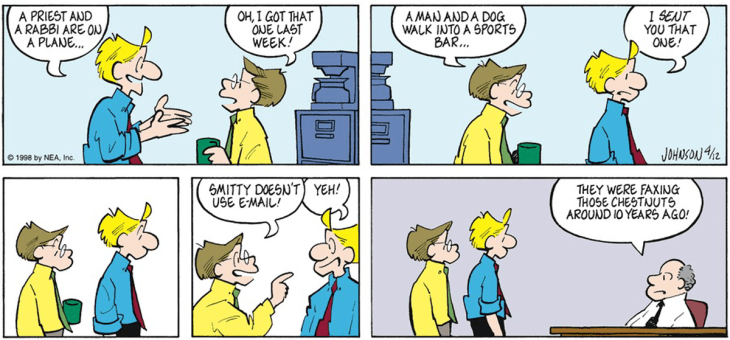
Personal synchronicity: less than half an hour before I saw this, somebody sent me (via Facebook, not by either e-mail or fax) a joke which, because of its political nature, can’t be repeated here.
But it doesn’t have to be, because the point of this post is that I told him I’d been hearing variations of that joke for decades, and my first was
An airplane was going down. On board were Henry Kissinger, a priest and a hippie. The pilot comes back to the passenger area and says “This plane is going down , there are three parachutes, and I’m taking one!” and jumps out of the door.
Henry Kissinger says “I am ze smartest man in ze world und I need to live,” grabs a parachute and jumps out.
The priest says to the hippie, “My son, I have lived a long life and am one with God, please take the last parachute that you may live.”
The hippie turns back to the priest and says “Don’t sweat it, pops, the smartest man in the world just jumped out of an airplane with my backpack.”
Does anybody know of a variation earlier than this one?
 Comics I Don't Understand
Just yesterday somebody on a mailing list sent the oddly specific but funny A priest, a Unitarian minister, and a rabbit walk into a bar. The rabbit says “I must be a typo”.
Totally irrelevant to your question, I realized yesterday that Kissinger is still alive and is still working.
Blinky, I was just about to add that.
The priest, minister and rabbit walked into a blood bank, where the rabbit instead noted he was a “type O”.
I don’t have any history of the parachute joke before “Bill Gates” being the subject. That would only mean predating his retirement in 2006 and move to philanthropist … somewhere between 1983 and 2006.
It probably began with Kissinger. I first heard it with Nixon but I think that could by the classmate I heard it from wasn’t that worldly. I can’t find any earlier version. This probably is the earliest version (unless there was some lifeboat version before that would have been significantly different.)
An Englishman, a Frenchman, an American, and a Mexican are told by the pilot that they are too heavy and may crash.
They pop the hatch and toss out all the luggage, but they’re still too heavy.
They rip out the seats and toss them, but they’re still too heavy.
The Englishman stands up and yells “God save the Queen!” and jumps out, but they’re still too heavy.
The Frenchman stands and yells “Vive la France!” and jumps out, but they’re still too heavy.
The American stands and yells “Remember the Alamo!” and throws out the Mexican.
The earliest version had the Wright Brothers flying a plane with Teddy Roosevelt, William Howard Taft and Woodrow Wilson aboard…
One of those historical fact you almost wish you’d never learned: in Mexican-American conflict, we were the bad guys.
I advise you not to research the war of 1812.
The American position in the War of 1812 seems defensible – not on the side of angels, but not horrible either. We’re much more clearly in the wrong in the Mexican War.
I don’t think wars in which we’re the bad guys are so remarkable, though. Heck, there are countless wars with Native Americans in which we’re the bad guys.
Too late, Pete.
I read a lot of history, and not a shread of my innocence remains.
I think of the War of 1812 as our country going through its adolescence
Not only were we basically just bullies in the Mexican War, the reason the “Texans” wanted the land was do they could expand slavery (the evil Mexicans wouldn’t let them have slaves.
Just recently saw the airplane joke done up as a meme on Facebook, with Hillary Clinton as the one who grabs the backpack. Don’t know if it means anything, but every few weeks or so I come across a certified chestnut that somebody has clumsily recast as political commentary by arbitrarily subbing in current figures. Do they really think these are unknown jokes, or is their familiarity somehow the point? It reminds me of grade school, when a kid would repeat something everybody saw on TV the previous night as if he’d invented it.
The airplane joke may be related to one I heard back in the early 1960s, though I no longer remember which politicians’ names were used (though I think one was Ezra Taft Benson):
Politicians 1, 2, and 3 were being flown over a rural area when one of them noticed a $10 bill on the floor of the plane. “Say,” he said, “I think I’ll throw this out and make some farmer happy.”
But the second politician had a better idea: “I have two fives — give me the ten, you take the two fives and throw them out and make two farmers happy.”
And the third, who had ten one-dollar bills, suggested that he give him the ten in trade for the ones, which he could throw up and make ten farmers happy.
At which point the pilot spoke up: “Give me the money and I’ll throw you three bastids out of the plane and make ALL of the farmers happy!”
Whoops, I forgot we’re not supposed to discuss politics. I retract my opinions on the War of 1812 and the Mexican War.
In 1814 we took a little trip / Along with Colonel Jackson down the mighty Mississip’
This was actually popular on the radio in time to prime us for hearing about the War of 1812 in school.
Found unattributed in my quotes file:
If you aren’t at least a little ashamed of your country’s history, you don’t know your country’s history.
Either of those conflicts pales in comparison to the “Indian Wars”.
Re: first version being with the Wright Brothers – parachutes were a new and untrusted invention late in WWI – only a few pilots carried them. Though the throwing people out version could be earlier.
Mitch4: Thanks. I’d never heard the “typo” joke.
I heard a version of the joke as a child that was ethnic in nature. The punchline was that a person of an ethnicity known to be stupid jumped out with the backpack.
Battle of New Orleans, immortalized in song, happened after the war was over.
Checking the list, “usually on the wrong side” would seem to sum it up.
I’m pretty sure it was Kissinger the first time I heard the joke, too. In the recent incarnation I heard, Hillary was the one ready to make the sacrifice, so you can guess who the smartest man in the world was.
And thanks for the ear worm, Mitch4! You’re a geezer if you started singing the tune (internally, of course) before getting to “…we took a little trip.” You’re definitely a geezer if you instead sang the words to Homer and Jethro’s parody, “The Battle of Camp Kookamonga.”
As far as the battle taking place after the peace treaty, I read one historian who opined that the British had a habit of throwing away treaties if things turned in their favor. Had they decisively won at New Orleans, they might have decided to keep it, or rework some terms to give it back. The US winning the battle helped make sure that the treaty stood as written. Now, I don’t recall who that was nor can I provide any substantiation, so take that for what it’s worth.
I recently read that one of the major results of the Battle of New Orleans was that it inhibited Spain from putting in a claim for the city, which Britain might have backed. As with Brian, I can’t remember exactly where I read it or judge its accuracy.
As for the song, it or the parody will pop into my head on occasion. Alas, in Germany people only know a version done by a group called the Les Humphries Singers. Imagine a version arranged for Mitch Miller or the New Christy Minstrels (and I only recently realized just how incredibly offensive the name of that group was), with the result being drunken crowds of Germans bellowing “Mexicooo! Mexicoo!”.
“Battle of New Orleans, immortalized in song, happened after the war was over.”
Actually, though that’s a fact that people enjoy, it’s not quite true: a treaty had been written, but it hadn’t been officially ratified by both sides do the War was still on. There’s some speculation that if the Battle had gone the other way, the British might have said “oh bugger this, we might still win this war.”
Not likely, granted, since it was already draining them militarily and financially, but one never knows.
Whoops. I began writing that before Brian posted, but by the time I’d finished it, he’d already written much he same thing.
The British DID win the war. I thought you said you had read about it.
I thought the Canadians won the War of 1812. That’s what they told me, at least.
I rather enjoy how this discussion has meandered from old jokes to opinions and factoids on 19th century American wars.
Well, the Canadians won to the extent that they didn’t lose: many Americans thought we should grab us some Canada as long as we were in the area.
The joke we tell in Canada is that the last time the US tried to invade us, we burned down your White House.
@B.A.: I would think the Wright Bris plane would not even get off the ground with Taft aboard.
And now I’m thinking about the Wright Bris plane.
I don’t find the War of 1812 particularly dispiriting. (The Mexican War and the Indian wars are different stories.) My favorite take on it is from Hark, A Vagrant, http://www.harkavagrant.com/index.php?id=340.
Probably not, lazarusjohn. But right now, I’m more intrigued by the concept of a bris plane. It really doesn’t sound safe to me.
There was a car commercial showing how smooth the ride was by having a jeweler in the back seat split a diamond while riding. A parody had a mohel performing a bris.
“Well, the Canadians won to the extent that they didn’t lose: many Americans thought we should grab us some Canada as long as we were in the area.”
Trying to grab Canadian and Indian territory was pretty much the main reason America went to war in the first place. They failed, in Canada at least. Canada and Britain just wanted to hold onto their existing territories. They succeeded. Britain won, America lost.
The idea that Britain might have continued fighting if they had won the Battle of New Orleans is absurd. They got everything they wanted from the peace treaty, which was simply to end the war. Having gained that they had nothing further to fight for. There’s no way in which they would have continued to fight.
I remember that from one of the early seasons of SNL: “Poifect!”
I think “stalemate” or “tie” is a perfectly reasonable way to describe the conclusion of the war. Neither side ended up with any substantial gain or loss. To say that America “lost” because it didn’t gain a bunch of territory that they wanted is to set the bar particularly high for the Americans. It’s like saying that I “lost” at chess because I was hoping to win, and only got a stalemate.
I do agree that it’s unlikely the British would have wanted to continue fighting if they had won the Battle of New Orleans, as they would have had little motivation to do so. And actually, while the US hadn’t ratified the treaty before New Orleans, the British had – so it’s a little strange to say that since “both” sides hadn’t ratified it, the British might have continued. The British had already ratified at a time when, as far as they knew, they had just won a series of military victories.
However, the Americans also had much less motivation to continue fighting by the end of the war. American annexation of Canada was not the only American motivation for the war – I wouldn’t even say that it was the primary motivation. America was also motivated by the British blockade, and British impressment, which strike me as perfectly valid complaints (although the British reasons for doing these things also seem understandable), as well as British arming of Native Americans in the West. By the end of the war, with the defeat of Napolean, British motivations for those activities had ended. So in that sense, the return to the “status quo” was fine for America – the new “status quo” had much of what they had been fighting for anyway.
As a side note, I used to read a lot of antebellum history, and of course, the War of 1812 always figured large in it. It was sort of a shock when I later started reading British history, and saw their take on it. Not because they were pro-Britain/Canada – they generally had a pretty fair view of the war – but because the war was so unimportant for them. Basically, every British history textbook I read had a several large chapters on the Napoleanic war, and just threw in a page or two saying “Oh, yeah, there was a war with the United States too – it’s not that interesting – now back to the main story.”
For a variety of odd reasons, my four years of high school alternated between Canada and California. When I returned to California for my fourth year, they said, “Like, you want to graduate, so we need to make sure you have all the requirements”. One of those was American History. I said, “Is that like the War of 1812?” and they said “Yes”. “Oh, we covered that in 9th grade”. And they checked it off.
I knew enough not to tell them that I learned that Canada won.
(And for the Canadians’ amusement: because the California school was so much better than the Ontario one, I basically covered all of 10th and 11th grade my second year. Then I went back to Canada and did 12th grade my third year. Then I went back to California for my fourth year. So I tell Canadians that “I skipped Grades 11 and 13 and did Grade 12 twice”, which always makes their heads explode.)
” … because the war was so unimportant for them….”
It’s true. I must have been in my thirties before I even remember knowing it existed. I’d heard the song “Battle of New Orleans” and the American National Anthem, but I thought they were about the Revolutionary War. I knew the 1812 Overture was about the Napoleonic Wars. If I’d ever heard the term ‘War of 1812’ I’d have assumed it was also part of the Napoleonic wars. (Which it sort of was)
“Oh, yeah, there was a war with the United States too – it’s not that interesting – now back to the main story.”
I wonder whether we’d feel the same way about it if The Star Spangled Banner hadn’t been written during it.
Speaking of the national anthem, do you know the full name of 20th century American author F. Scott Fitzgerald?
SNL ad for the Royal Deluxe II
“It rides smooth because they’re build right.”
(Smooth enough for a bris in the backseat, at least.)
Here is the great Canadian group The Arrogant Worms: https://youtu.be/WVC677-YmfM
Pinny, thanks for tracking that down!
Mark, that was really good! I particularly noted how they incorporated a section based directly on the “Battle of New Orleans” song.
If you haven’t solved my trivia question, he’s in full Francis Scott Key Fitzgerald.
“I think “stalemate” or “tie” is a perfectly reasonable way to describe the conclusion of the war.”
I didn’t want it anyway! *USA storms off*
Yeah, nice try. When the desired outcome is removing a power entirely from the continent and annexing all its territory is your goal and the end result, after years of war, is that you’re right back where you started, that’s not a tie. That’s a loss.
Possibly a serious loss too. There is a lot of mythologizing around the War of 1812 in Canada, such as lazursjohn’s comment about Canada burning down the White House. That was done by British forces, not Canadian militia. But the war did help coalesce an identity for Canada. A significant number of settlers to Upper Canada (now Ontario) and some in other areas, were United Empire Loyalists who had fled the treasonous uprising in what became the USA. The French in Lower Canada didn’t want much to do with the upstarts either. The Maritimes and Newfoundland probably didn’t really see themselves as part of a whole either. But an attack from an outside enemy helped create a more cohesive identity, one that wasn’t interested in being part of the USA. Without the war, a gradual drift toward unity may have happened as there were still many cross-border connections.
As always, our brave allies among the First Nations were the ones who really lost, getting screwed in the peace deal (the British proposed some benefits for them, but they didn’t happen).
Singapore Bill: As I pointed out before, annexation of Canada was not the primary American motivation for the war. It became a goal after other issues led to conflict. It’s simply factually incorrect to describe Canadian annexation as “the” goal of the war.
If there hadn’t been impressment and blockade issues, and subsequent British support of Indians in the Western territories, it’s highly unlikely that the U.S. would have just gone to war to annex Canada. And all of those issues were resolved to America’s satisfaction (mostly by outside factors) by the end of the war.
It’s rather strange that in a single comment you say that America lost because it was right back where it started, and then (correctly) observe that the First Nations got screwed in the peace deal. That, of course, is what exactly what America wanted, and was one of the three significant ways in which they were not back where they started.
I’ll concede on the First Nations issue. The USA did benefit from the way the treaty went. That aspect was to its benefit. That my home province was invaded and my hometown razed by marauding US home but the war ended with no territorial loss to us, well, I think I’ll still call that a win.
Phil: So that wasn’t Ontario, California?
Boise Ed: Heh, no. Palo Alto.
SingaporeBill: Wow, I guess Kate Beaton (hat tip to Usual John) really called it on the way you guys feel about the war.
DON’T mention the war!
I mentioned it once, but I think I got away with it…
Undoubtedly we, as a country, could learn from the long USA tradition of calm, measured, and proportionate responses to any attack or even perceived slight. Until then, better the jokes that exalt us than a single truth:
Once upon a time in the Kingdom of Heaven, God went missing for six days. Eventually, Michael the archangel found him, resting on the seventh day. He inquired of God, “Where have you been?” God sighed a deep sigh of satisfaction and proudly pointed downwards through the clouds, “Look Michael, look what I’ve made.”
Archangel Michael looked puzzled and said, “What is it?”
“It’s a planet,” replied God, “and I’ve put LIFE on it. I’m going to call it Earth and it’s going to be a place of great balance.”
“Balance?” inquired Michael, still confused.
God explained, pointing to different parts of Earth, “For example, Northern Europe will be a place of great opportunity and wealth while Southern Europe is going to be poor; the Middle East over there will be a hot spot. Over there I’ve placed a continent of white people and over there is a continent of black people,” God continued, pointing to different
countries. “This one will be extremely hot and arid while this one will be very cold and covered in ice.”
The Archangel, impressed by God’s work, then pointed to a large landmass in the top corner and asked, “What’s that one?”
“Ah,” said God. “That’s Canada, the most glorious place on Earth. There are beautiful mountains, lakes, rivers, streams and an exquisite coastline. The people from Canada are going to be modest, intelligent and humorous and they’re going to be found travelling the world. They’ll be extremely sociable, hard working and high achieving, and they will be known throughout the world as diplomats and carriers of peace. I’m also going to give them super-human, unbeatable hockey players who will be admired and feared by all who come across them.”
Michael gasped in wonder and admiration but then proclaimed; “What about balance, God? You said there will be BALANCE!”
God replied wisely. “Wait until you see the loud-mouth bastards I’m putting next to them….”
SB: Great one! Never heard that before, amazingly. Sharing to family back in .ca!
Phil, it would be wrong if we pretended that Canada did not have problems that need fixing. (NSFW due to language, but you’re all at home, so who cares? Also, contains War of 1812 reference)
SB: O my. Just…o my. Sort of in the same vein of Canadiana: https://www.youtube.com/watch?v=F-glHAzXi_M
And if you don’t know about Because News, checkitout.
Phil, oh yeah, Bud. That’s beauty, eh? I just shared it with a USer friend and told her it’s our number 1 song this week.
And of course Because News! And The Debaters!
Geo Washington is discussed as having started the French and Indian War (called Seven years War in other countries). He was 21 and leading Virginia Colonial Militia with British Gen Braddock & his troops. They were trying to take Ft Duquesne (later Ft Pitt and even later Pittsburgh). Braddock was killed in the battle. The Seven Years War is also referred to the first world war also as it involved fighting not only in North American but also in Africa, Asia, South America and Europe.
Never learned this in school.