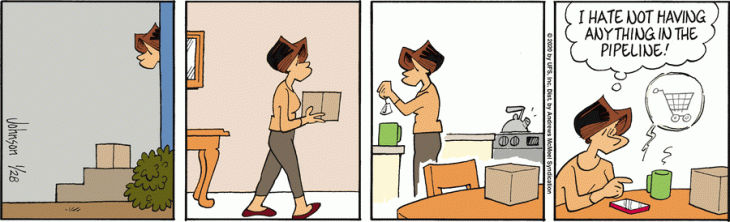
Jimmy did it again: Last night I mentioned to my wife that for the first time in weeks, we had nothing on the way from Amazon. And she said You know, we’re getting really low on those little freezer containers…
Related
37 Comments
I have preorders for DVDs coming out in March (Harry Langdon sound shorts and features by Karel Zeman), and I usually place one for each Pogo volume when it’s announced. Then I have a few months of imagining they might inexplicably show up way early.
It’s a bit like plugging my book and waiting for … (sounds of a scuffle and a door slamming)
A little while back, I accidentally discovered that my sister-in-law had written a novel that is available on Amazon. I asked my sister about it, and she said she had edited if for our SIL (my sister used to be a journal editor for a publishing firm) about ten years ago. I was surprised I hadn’t heard about it. Or I did and didn’t retain it. I’m not sure if I should bring it up and suggest a Kindle version (assuming she still has the electronic copy).
Is this really about shopping on-line? I don’t know…this seems like a true “Arlo” to me.
We try to avoid ordering things online or otherwise as something always goes wrong.
Latest – Robert had bought a smaller (narrower) version of the type he uses – though one from another company at the NYS Sheep and Wool Fair (we schlepped up there just for him to buy same). He uses what is called a rigid heddle loom. (Traditional looms have strings with circles in them and are attached alternately to two or more pieces of wood which runs across the loom – each grouping attached to a piece of wood is a heddle and depending on which ones are raised and lowered in which order determines the pattern woven as they lift and drop the warp threads (the long ones from front to back which are woven through by the weft – the thread that is on a shuttle and moves across through the warp and is what is weaving through the warp – if does not makes sense, I can give more info.) This is a modern loom and the heddle has sections of plastic in it with holes and slots – which is raised and lowered to move the warp up and down for weaving.
Looms are not sold near us or supplies (or even wool on large spools). Due to the fixed nature of the rigid heddles one needs different sizes for different thicknesses of yarn. He had one heddle for this smaller loom as that was what came with the loom. He wanted a different size one to be able to use a different thickness of yarn for a piece he wanted to make. He found one online from a reputable weaving supply company and ordered the heddle he wanted.
It arrived in pretty good time and had been drop shipped from the manufacturer’s US distributor. He was getting ready to warp the loom with it (set up the warp threads to weave a project with it) and had it on the kitchen table. It looked odd to me. I kept looking. One section of the plastic slots/holes had been put in backwards and it was a different color as one side was whiter than the other and one side was flatter than the other! So, he had to contact the company – which insisted this was impossible, then take and send them close up photos of the difference and then they finally agreed to send him a replacement heddle – which when we received it, of course, we had to send the original back.
That put off the project he had in mind for 2 weeks – so 2 weeks of him annoying me looking to do things and not sitting whistling happier while he was weaving.
My God, doesn’t anyone go to the store anymore? The environmental cost of shipping everything direct to your door is enormous, and you’re putting local retailers out of business to boot.
Local retailers don’t have want I want, for the most part. Online shopping is a boon for someone who is agoraphobic and/or cannot walk far. There are few things I buy online that I could purchase locally, and have to search for, both driving from store to store, and then walking thru the store itself. Time is money, even tho I’m retired. This includes everything from furniture to dog food.
Also, there is a high rate of flu here in Florida; the fewer people I meet, the less likely I am to contract this, senkuveddymuch.
Story of my life…
Sorry, make that story of my wife…
Telling folks to stop shopping at amazon.com and instead use ‘local retailers’ is the equivalent of telling folks to stop using Google and use the ol’ World Book Encyclopedia on their shelves or, lacking that, go to the library every time they have questions.
I agree with everything Andréa said. And I’m not convinced that it’s any worse for the environment, given the economies of scale available to Amazon. It’s not like the products just magically appear in the stores – they have to be shipped there.
I always imagine that in fact online shopping and delivery is marginally better for the environment if a van is delivering to 50 or 120 people rather than those people all driving independently to get stuff in shops. Also, some second-hand things you want (like, for instance, a MacBook) just aren’t available locally even in local towns, let alone my village.
On the other hand, the way modern shopping and consumption methods have damaged smaller local businesses in favour of feeding the massive Amazonian maw (and other big maws) is likely socially damaging in terms of lots of smaller businesses and their employees having their range of work and social opportunities savagely reduced. I doubt working in a massive out-of-town warehouse under restrictive work practice conditions is as enjoyable as working in a small retail outlet in a busy high street or market, meeting lots of people/ customers/ random dogs/ coffee shops. Despite feeling that I buy most of my books online!
I hardly ever watch movies on TV or computer at home, though. Not one in the last year or two I don’t think (though I do watch 2-hr long TV episodes from time to time). I go to a cinema to see new films… 32 last year, four so far this year. Each involving a drive of between eight and 25 miles, so not that environmentally friendly – combining petrol, parking and ticket cost, £300-£400 pa no doubt. (A few years ago I went to Bristol 25 miles away to see on the big screen a print of the 1948 Technicolor film The Red Shoes when it was coincidentally on TV at the same time).
My concern is the boxes (wish I’d invested in ULine stock years ago); I do take them to the recycling bin, but I wonder how much of that is really recycled? We can’t re-use boxes for storage here in FL; palmetto bugs (read: cockroaches) love ’em, so everything we store has to be in totes.
Andréa, cardboard is the most recyclable material there is. I have this on the authority of a dumpster diver I made friends with when I was alley picking. He said metal and glass were good, but a bale of cardboard was easier and more profitable.
Chak: Well-separated clean cardboard may well be recyclable, but there’s a good chance it gets mixed in with a bunch of other stuff in the recycling bin that it can’t be easily separated from, making it un-recyclable.
I agree with narmitaj: my main issue with Amazon is the social effects with the closure of small businesses. Environmental impact could go either way.
It’s fairly easy to separate, especially if it’s been flattened as the directions usually. The materials flow by on a belt with employees that grab off large pieces of cardboard and the like.
Recycling is a push and pull between convenience for the consumer and the recycler.
There is no market for much of it; glass is no longer being recycled in our area ’cause China doesn’t want it (that’s the story we get, anyway). Then, the percentage of ‘dirty’ items was reduced to .5% or some amount like that, so many places won’t even take recyclables anymore.
Personally, I think it all goes to landfill – even the bags collected at the grocery stores – and this is all just a ‘feel good’ situation. Especially when I saw our recycles can go in the same truck at the same time as our regular garbage can. I guess they (whoever ‘they’ is – the company that collects it, I suppose) didn’t think anyone would be up and looking out the window that time o’ the morning.
Brian in STL: It’s easy to manually pick up a piece of cardboard. It’s not easily to separate it from other things that may have gotten on it before or after it was put in the recycling bin, such as soda, bits of food, etc. . .
That is a concern, but again that’s the trade-off. A better solution is dual-stream recycling, where paper and cardboard are separated from containers.
Our county provides recyclable stations; what I don’t understand is that it’s all put into the same dumpsters – glass, plastic bottles (but heaven forbid you toss in a plastic bag!), cardboard, paper – which makes me think they just put it all in a landfill somewhere.
Brian in STL: I’m not saying that I have a better solution. I’m just saying that I don’t feel confident that cardboard that I put in the recycling bin actually gets recycled.
F the local retailer. Seriously.
I have some real concerns about shopping with Amazon. They have some real issues I wish would be addressed. So I don’t love them. However, local retailer can kiss my @$$.
Within a one-kilometre radius of my home there are literally hundreds, possibly thousands, of stores. Lord help me if I can actually find anything I want. Said stores don’t carry clothing or footwear in my size. Many carry “designer” brands, which means overpriced items that don’t fit. If I do find an item I need/want, it’s usually the wrong colour or model. Or from a different manufacturer. It may be similar, but it’s not what I want. These places tend to have quite restrictive return policies. Two of my last Amazon returns have been for DVD sets with defective discs that wouldn’t play. If I could have found anyplace around here that sells DVDs (can’t), I’m sure they would have some restriction on returning a set after I opened it. Top it all off with indifferent staff who don’t offer help and/or don’t know anything.
I’ve seen news articles recently where retailers say people come to their stores, take the time of staff looking at products and asking questions, all with no intention of ever buying the item in the store. I wouldn’t do that. I’m always open to the idea of buying it in the store, but, given my complaints in the above paragraph, and the fact that I must spend time on travel and the item likely costs 25-45% more than it does online…nope, not happening.
Glass is recycled because it saves big dollars on the gas consumption at the glass factory: it’s been done long before environmental concerns at the initiative of the manufacturers; adding cullet (broken glass) to the raw materials mix lowers considerably the melting point. The only condition is to separate white / colored glass.
@ Andrea – It doesn’t HAVE to be “landfill”: some processing plants have industrial separators set up that are more reliable than depending on every consumer delivering properly sorted material (such as metal lids on jars, plastics in with the paper, or paper in with the plastic). Using conveyor belts, magnets, and clever air flows, they can turn a mixed stream of incoming material into fairly well-sorted output (see the link below).
P.S. @ Olivier – There are separate recycling boxes in Germany for clear, brown, and green glass (anything doubtful or strange – like “blue” – is supposed to go in with the green). But as I said above, even the most avid recyclers are not always perfectly reliable with their tosses, so there is an automated separator for glass, too, using a optical sensor on each shard, with a blower that flips each shard into the correct bin. I’ve seen one in a mini-documentary (in German, and rather old: 1984). It gets a little silly at the end, but it was made for kids.
My main concern environmentally with Amazon is the number of shipments people get when shipping is free. Before Amazon, you used to save up a shopping list and go buy a bunch of stuff when you made a trip “into town”. Now people are just ordering stuff from Amazon, individually, whenever they think of it, and (as the strip and Bill’s anecdote illustrate) a delivery shows up every 1-2 days.
Yep, when we used to load up the wagons . . . there is no ‘town’ to go to, at least not where I lived in WI nor where I live in FL. Miles and miles of mini-malls and box stores, but no central location, so I’d be driving all day to shop, if I had the energy. AND if I thought I could find what I wanted, which I doubt I would.
It seems all the stuff everybody orders online is never available at a nearby location; it looks like everything is stored in the least efficient way: as far away as possible from potential buyers ;) .
Powers assumes everyone lives a life just like his and therefore feels qualified to dictate how everyone should act. Well, I live in the central part of a major city. I don’t own a car, don’t drive at all. If I go out to shop, it’s using public transit. I live in a multi-unit building and have no children. My carbon footprint is substantially smaller than the suburban dwellers who ‘save up a shopping list and go buy a bunch of stuff when you made a trip “into town”. ‘ I’m fine with ordering my items for delivery as I need them.
Olivier: The items I want might be in a store nearby, but I don’t know it. That’s another huge problem. Retailers–even large ones–tend to have pretty lousy websites and it’s hard to find out if they have items I want.
@SB: don’t tell me, I complain about it constantly. Sometimes also, I order online because I can’t find something in the city (I live in a major (French) city, too) and as soon as I’ve received the item, it shows up in every store window I pass.
Andréa, That’s how it used to be here. Chicago had Blue Bag Recycling, but people just didn’t trust those bags going into the same truck as the trash. The city gave tours of the facilities, where you could see workers pulling out the blue bags, and the whole setup for recycling, but they still couldn’t get much cooperation. So now we have separate cans and separate trucks.
But I’ll bet your city works those recyclables. There’s some (not much) income from selling the recyclables, and there’s less (a lot) to pay for landfill space.
SingaporeBill: Maybe dial it back a bit? Expressing concern about a social change, correctly or incorrectly, is not the same as dictating how everyone should act.
The assumption that everyone lives the same life–“Before Amazon, you used to save up a shopping list and go buy a bunch of stuff when you made a trip “into town”.– and therefore there can be only one solution is irksome and comes up repeatedly in environmental discussions. I’m sure Powers describes a reality (his/hers), but it’s not the sole reality. Powers is probably very nice.
In my city, recycling is “single stream”, so there’s no sorting by the consumer of recyclables. Now, you’re not supposed to put certain things in, like plastic bags and styrofoam, and you’re supposed to put only clean containers in there. Those restrictions are a problem for some people.
And with the problems due to China cutting back, those restrictions are greater. When we first started, the instructions were much more liberal. I recall, “Pizza boxes? Throw them in!” These days I just tear the covers off and recycle those only.
I reuse cardboard boxes to put out our recycling in. We have had 2 of the official plastic recycling boxes and each was destroyed by the sanitation men throwing it in the street after emptying where cars driving much too fast for the road drove into them. Eventually the taped back together boxes were taken by the sanitation men. So I keep our empty boxes in the porch and use them – picking the size of the box to match the amount of recycling for the week (newspapers out separately). Really large ones I cut down and assemble to smaller boxes.
Apropos, except that I keep my credit card number on the computer so all I have to do is copy and paste it in . . .
 Comics I Don't Understand
I have preorders for DVDs coming out in March (Harry Langdon sound shorts and features by Karel Zeman), and I usually place one for each Pogo volume when it’s announced. Then I have a few months of imagining they might inexplicably show up way early.
It’s a bit like plugging my book and waiting for … (sounds of a scuffle and a door slamming)
A little while back, I accidentally discovered that my sister-in-law had written a novel that is available on Amazon. I asked my sister about it, and she said she had edited if for our SIL (my sister used to be a journal editor for a publishing firm) about ten years ago. I was surprised I hadn’t heard about it. Or I did and didn’t retain it. I’m not sure if I should bring it up and suggest a Kindle version (assuming she still has the electronic copy).
Is this really about shopping on-line? I don’t know…this seems like a true “Arlo” to me.
We try to avoid ordering things online or otherwise as something always goes wrong.
Latest – Robert had bought a smaller (narrower) version of the type he uses – though one from another company at the NYS Sheep and Wool Fair (we schlepped up there just for him to buy same). He uses what is called a rigid heddle loom. (Traditional looms have strings with circles in them and are attached alternately to two or more pieces of wood which runs across the loom – each grouping attached to a piece of wood is a heddle and depending on which ones are raised and lowered in which order determines the pattern woven as they lift and drop the warp threads (the long ones from front to back which are woven through by the weft – the thread that is on a shuttle and moves across through the warp and is what is weaving through the warp – if does not makes sense, I can give more info.) This is a modern loom and the heddle has sections of plastic in it with holes and slots – which is raised and lowered to move the warp up and down for weaving.
Looms are not sold near us or supplies (or even wool on large spools). Due to the fixed nature of the rigid heddles one needs different sizes for different thicknesses of yarn. He had one heddle for this smaller loom as that was what came with the loom. He wanted a different size one to be able to use a different thickness of yarn for a piece he wanted to make. He found one online from a reputable weaving supply company and ordered the heddle he wanted.
It arrived in pretty good time and had been drop shipped from the manufacturer’s US distributor. He was getting ready to warp the loom with it (set up the warp threads to weave a project with it) and had it on the kitchen table. It looked odd to me. I kept looking. One section of the plastic slots/holes had been put in backwards and it was a different color as one side was whiter than the other and one side was flatter than the other! So, he had to contact the company – which insisted this was impossible, then take and send them close up photos of the difference and then they finally agreed to send him a replacement heddle – which when we received it, of course, we had to send the original back.
That put off the project he had in mind for 2 weeks – so 2 weeks of him annoying me looking to do things and not sitting whistling happier while he was weaving.
Always a problem when we order things.
I view it as a (sad) comment on modern life, akin to Calvin & Hobbes’s “I feel like I’m in some stockholder’s dream”.
https://southecho.weebly.com/blog/stockholders-dream
My God, doesn’t anyone go to the store anymore? The environmental cost of shipping everything direct to your door is enormous, and you’re putting local retailers out of business to boot.
Local retailers don’t have want I want, for the most part. Online shopping is a boon for someone who is agoraphobic and/or cannot walk far. There are few things I buy online that I could purchase locally, and have to search for, both driving from store to store, and then walking thru the store itself. Time is money, even tho I’m retired. This includes everything from furniture to dog food.
Also, there is a high rate of flu here in Florida; the fewer people I meet, the less likely I am to contract this, senkuveddymuch.
Story of my life…
Sorry, make that story of my wife…
Telling folks to stop shopping at amazon.com and instead use ‘local retailers’ is the equivalent of telling folks to stop using Google and use the ol’ World Book Encyclopedia on their shelves or, lacking that, go to the library every time they have questions.
I agree with everything Andréa said. And I’m not convinced that it’s any worse for the environment, given the economies of scale available to Amazon. It’s not like the products just magically appear in the stores – they have to be shipped there.
It appears that the difference between in-store and online is minimal, in terms of environmental factors: https://ensia.com/features/environmental-cost-online-shopping-delivery/
I always imagine that in fact online shopping and delivery is marginally better for the environment if a van is delivering to 50 or 120 people rather than those people all driving independently to get stuff in shops. Also, some second-hand things you want (like, for instance, a MacBook) just aren’t available locally even in local towns, let alone my village.
On the other hand, the way modern shopping and consumption methods have damaged smaller local businesses in favour of feeding the massive Amazonian maw (and other big maws) is likely socially damaging in terms of lots of smaller businesses and their employees having their range of work and social opportunities savagely reduced. I doubt working in a massive out-of-town warehouse under restrictive work practice conditions is as enjoyable as working in a small retail outlet in a busy high street or market, meeting lots of people/ customers/ random dogs/ coffee shops. Despite feeling that I buy most of my books online!
I hardly ever watch movies on TV or computer at home, though. Not one in the last year or two I don’t think (though I do watch 2-hr long TV episodes from time to time). I go to a cinema to see new films… 32 last year, four so far this year. Each involving a drive of between eight and 25 miles, so not that environmentally friendly – combining petrol, parking and ticket cost, £300-£400 pa no doubt. (A few years ago I went to Bristol 25 miles away to see on the big screen a print of the 1948 Technicolor film The Red Shoes when it was coincidentally on TV at the same time).
My concern is the boxes (wish I’d invested in ULine stock years ago); I do take them to the recycling bin, but I wonder how much of that is really recycled? We can’t re-use boxes for storage here in FL; palmetto bugs (read: cockroaches) love ’em, so everything we store has to be in totes.
Andréa, cardboard is the most recyclable material there is. I have this on the authority of a dumpster diver I made friends with when I was alley picking. He said metal and glass were good, but a bale of cardboard was easier and more profitable.
Chak: Well-separated clean cardboard may well be recyclable, but there’s a good chance it gets mixed in with a bunch of other stuff in the recycling bin that it can’t be easily separated from, making it un-recyclable.
I agree with narmitaj: my main issue with Amazon is the social effects with the closure of small businesses. Environmental impact could go either way.
It’s fairly easy to separate, especially if it’s been flattened as the directions usually. The materials flow by on a belt with employees that grab off large pieces of cardboard and the like.
Recycling is a push and pull between convenience for the consumer and the recycler.
There is no market for much of it; glass is no longer being recycled in our area ’cause China doesn’t want it (that’s the story we get, anyway). Then, the percentage of ‘dirty’ items was reduced to .5% or some amount like that, so many places won’t even take recyclables anymore.
Personally, I think it all goes to landfill – even the bags collected at the grocery stores – and this is all just a ‘feel good’ situation. Especially when I saw our recycles can go in the same truck at the same time as our regular garbage can. I guess they (whoever ‘they’ is – the company that collects it, I suppose) didn’t think anyone would be up and looking out the window that time o’ the morning.
Brian in STL: It’s easy to manually pick up a piece of cardboard. It’s not easily to separate it from other things that may have gotten on it before or after it was put in the recycling bin, such as soda, bits of food, etc. . .
That is a concern, but again that’s the trade-off. A better solution is dual-stream recycling, where paper and cardboard are separated from containers.
Our county provides recyclable stations; what I don’t understand is that it’s all put into the same dumpsters – glass, plastic bottles (but heaven forbid you toss in a plastic bag!), cardboard, paper – which makes me think they just put it all in a landfill somewhere.
Brian in STL: I’m not saying that I have a better solution. I’m just saying that I don’t feel confident that cardboard that I put in the recycling bin actually gets recycled.
F the local retailer. Seriously.
I have some real concerns about shopping with Amazon. They have some real issues I wish would be addressed. So I don’t love them. However, local retailer can kiss my @$$.
Within a one-kilometre radius of my home there are literally hundreds, possibly thousands, of stores. Lord help me if I can actually find anything I want. Said stores don’t carry clothing or footwear in my size. Many carry “designer” brands, which means overpriced items that don’t fit. If I do find an item I need/want, it’s usually the wrong colour or model. Or from a different manufacturer. It may be similar, but it’s not what I want. These places tend to have quite restrictive return policies. Two of my last Amazon returns have been for DVD sets with defective discs that wouldn’t play. If I could have found anyplace around here that sells DVDs (can’t), I’m sure they would have some restriction on returning a set after I opened it. Top it all off with indifferent staff who don’t offer help and/or don’t know anything.
I’ve seen news articles recently where retailers say people come to their stores, take the time of staff looking at products and asking questions, all with no intention of ever buying the item in the store. I wouldn’t do that. I’m always open to the idea of buying it in the store, but, given my complaints in the above paragraph, and the fact that I must spend time on travel and the item likely costs 25-45% more than it does online…nope, not happening.
Glass is recycled because it saves big dollars on the gas consumption at the glass factory: it’s been done long before environmental concerns at the initiative of the manufacturers; adding cullet (broken glass) to the raw materials mix lowers considerably the melting point. The only condition is to separate white / colored glass.
@ Andrea – It doesn’t HAVE to be “landfill”: some processing plants have industrial separators set up that are more reliable than depending on every consumer delivering properly sorted material (such as metal lids on jars, plastics in with the paper, or paper in with the plastic). Using conveyor belts, magnets, and clever air flows, they can turn a mixed stream of incoming material into fairly well-sorted output (see the link below).
P.S. @ Olivier – There are separate recycling boxes in Germany for clear, brown, and green glass (anything doubtful or strange – like “blue” – is supposed to go in with the green). But as I said above, even the most avid recyclers are not always perfectly reliable with their tosses, so there is an automated separator for glass, too, using a optical sensor on each shard, with a blower that flips each shard into the correct bin. I’ve seen one in a mini-documentary (in German, and rather old: 1984). It gets a little silly at the end, but it was made for kids.
My main concern environmentally with Amazon is the number of shipments people get when shipping is free. Before Amazon, you used to save up a shopping list and go buy a bunch of stuff when you made a trip “into town”. Now people are just ordering stuff from Amazon, individually, whenever they think of it, and (as the strip and Bill’s anecdote illustrate) a delivery shows up every 1-2 days.
This is the issue in our area . . .
How Safety Harbor’s recycling challenge affects all of Pinellas County
https://www.tampabay.com/news/environment/2020/01/08/how-safety-harbors-recycling-challenge-affects-all-of-pinellas-county/
“. . . a trip “into town””
Yep, when we used to load up the wagons . . . there is no ‘town’ to go to, at least not where I lived in WI nor where I live in FL. Miles and miles of mini-malls and box stores, but no central location, so I’d be driving all day to shop, if I had the energy. AND if I thought I could find what I wanted, which I doubt I would.
It seems all the stuff everybody orders online is never available at a nearby location; it looks like everything is stored in the least efficient way: as far away as possible from potential buyers ;) .
Powers assumes everyone lives a life just like his and therefore feels qualified to dictate how everyone should act. Well, I live in the central part of a major city. I don’t own a car, don’t drive at all. If I go out to shop, it’s using public transit. I live in a multi-unit building and have no children. My carbon footprint is substantially smaller than the suburban dwellers who ‘save up a shopping list and go buy a bunch of stuff when you made a trip “into town”. ‘ I’m fine with ordering my items for delivery as I need them.
Olivier: The items I want might be in a store nearby, but I don’t know it. That’s another huge problem. Retailers–even large ones–tend to have pretty lousy websites and it’s hard to find out if they have items I want.
@SB: don’t tell me, I complain about it constantly. Sometimes also, I order online because I can’t find something in the city (I live in a major (French) city, too) and as soon as I’ve received the item, it shows up in every store window I pass.
Andréa, That’s how it used to be here. Chicago had Blue Bag Recycling, but people just didn’t trust those bags going into the same truck as the trash. The city gave tours of the facilities, where you could see workers pulling out the blue bags, and the whole setup for recycling, but they still couldn’t get much cooperation. So now we have separate cans and separate trucks.
But I’ll bet your city works those recyclables. There’s some (not much) income from selling the recyclables, and there’s less (a lot) to pay for landfill space.
SingaporeBill: Maybe dial it back a bit? Expressing concern about a social change, correctly or incorrectly, is not the same as dictating how everyone should act.
The assumption that everyone lives the same life–“Before Amazon, you used to save up a shopping list and go buy a bunch of stuff when you made a trip “into town”.– and therefore there can be only one solution is irksome and comes up repeatedly in environmental discussions. I’m sure Powers describes a reality (his/hers), but it’s not the sole reality. Powers is probably very nice.
In my city, recycling is “single stream”, so there’s no sorting by the consumer of recyclables. Now, you’re not supposed to put certain things in, like plastic bags and styrofoam, and you’re supposed to put only clean containers in there. Those restrictions are a problem for some people.
And with the problems due to China cutting back, those restrictions are greater. When we first started, the instructions were much more liberal. I recall, “Pizza boxes? Throw them in!” These days I just tear the covers off and recycle those only.
I reuse cardboard boxes to put out our recycling in. We have had 2 of the official plastic recycling boxes and each was destroyed by the sanitation men throwing it in the street after emptying where cars driving much too fast for the road drove into them. Eventually the taped back together boxes were taken by the sanitation men. So I keep our empty boxes in the porch and use them – picking the size of the box to match the amount of recycling for the week (newspapers out separately). Really large ones I cut down and assemble to smaller boxes.
Apropos, except that I keep my credit card number on the computer so all I have to do is copy and paste it in . . .
