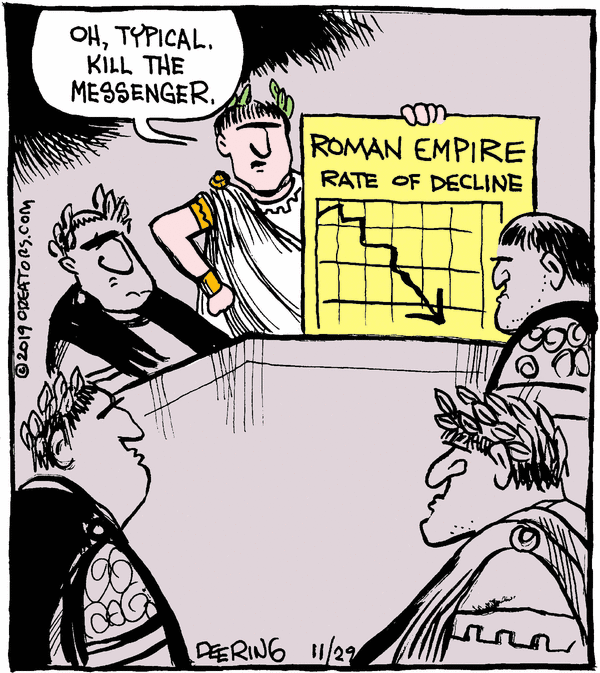
This is another one where knowing there’s supposed to be a joke lets me figure out what the writer had in mind. But that doesn’t make it funny.
*If* you knew in advance that the speaker was Julius Caesar, you might see a joke here.
Not the point I’m sure, but if the rate of decline is decreasing, the situation is improving.
if it’s Julius Caesar, what empire?
(also, in the headline, that should be ‘nuntium’)
Mea culpa. I must have copied it wrong.
Mitch4, good observation.
Yes, as Dave in Boston says, what empire? Julius’ great-nephew (and adopted son) Octavian aka Augustus was the first Emperor.
Although Emperors were known as Caesar in later times – and various emperors since by extension called Kaisers and Czars/Tsars – Julius Caesar, who gave his name to the title, was not one of them (though he was dictator). In fact apparently it was not until 110 years after Julius was killed that the name was solidified into a title. https://en.m.wikipedia.org/wiki/Caesar_(title)
@ Mitch4 -“… the rate of decline is decreasing …”
The title hadn’t been invented back then, but at one point a “spin doctor” in the Nixon administration tried to sugar coat the atrocious state of the economy by claiming that “the rate of increase in the inflation rate was declining”. Someone later observed that this was the first time that a mathematical third-level derivative had made its way into politics.
Perhaps if the cartoonist had added “…under Julius Caesar” to the chart it would be clearer. But, yes, good observation by Mitch4.
Mitch4, nice catch!
I think this is supposed to be literalism – taking a figure of speech back to when it wasn’t a metaphor. Of course, there are so many anachronisms and confusions between Rome, Greece & the 1950s in it that it’s just a mess. As well a that killing a messenger was considered a war crime.
I didn’t realize that was supposed to be Caesar. I thought it was just supposed to be a roman giving a report and they were going to literally kill him by sending him to the lions.
If it is Caesar (and it probably) it doesn’t really fit with my impression of history.
I think “Nuntius” may possibly be correct in one way because it’s the name form, as if “the messenger” was the guys title, such as “Maximus” (the biggest, strongest…) or, my favorite title from Star Trek TOS, “Prefect” ( long ‘e’, from “Praefectus” of way back when, something like the legal enforcer (Google translated it to “Governor”, eh))
“if the rate of decline is decreasing, the situation is improving.”
Not quite true. Things are still getting worse,but not as quickly as it used to.
I believe it needs to be “nuntium” and not the “nuntius” because the noun is acting as the direct object, and thus requires the accusative case form. Since “nuntius” is a second declension noun, the accusative form requires the -um ending. If the noun were being used as the subject of the sentence the “-us” ending would be correct.
“Interficere” means “to kill,” and the form indicates either the infinitive or passive imperative voice. So the translation would be either “To kill the [or a] messenger” or “Let the messenger be killed.”
“Interfice nutium” would be the active imperative for “Kill the messenger.”
Latin class was a long time ago, though.
Pete, I agree, but didn’t come up with a compact way to express the point with full accuracy. My word “situation” unfortunately seems like it might mean the underlying variable of “quality of life and government” whose value we don’t know nor see graphed,we have been taking it. But if we substitute “prospect”, will that convey the point about a future projection? If the trend in the “decline” (negative of first derivative) continues down, eventually there will be a turnaround of the “quality” value. And thus an improving “prospect”.
Pete: “I think the formulation you’re going for is “Things are getting betterly worse.” Or maybe “Betterish, as less worsely.” Or maybe, uh…. OH LOOK! SQUIRREL!” (economist runs offstage while the audience is distracted.)
How good to feel about a decrease in the rate of decline is somewhat subjective. Here’s a fun graph from India’s BJP party touting how gas prices have improved in recent years.
Hmm, I just found that if I respond to ja, i.e. “ja, ..”, I’ve already agreed. Fortunately, I already agree “nuntium” is correct
I went out and found Caesar’s commentary on the Gallic War and opened Book 1, since I had read it as a kid, apparently in some easy reading kid’s edition. Reading Latin is more painful than reading Greek; it’s more painful because it’s obvious that I can’t read Greek, whereas Latin, with its recognizable letters and pronouns drags my mind through the rocks.
So I did a search through Book 1 and found that poor old Lucius Cassius had met a fate similar to our generic Messenger (he’d been interfecerat-ed) and, sure enough, Julias spelled the victim’s name, “L. Cassium”.
Now, I don’t know why, how, or if correctly, Google translated “L. Cassium” to “Lucius Cassius“. I only translated a single sentence from the book. And even the whole of Book 1 doesn’t contain Cassium’s first name in any form different from “L.”. So, maybe it wasn’t actually old Lucius; I didn’t notice the problem before I started writing this.
(I just looked at several published translations and every one expands “L.” to Lucius. I guess I’ve got to find the handwritten original.)
The Romans (especially early on) had only a finite and small number of “first names” (praenomina) and these were even further restricted by family custom. So L. Cassius is uniquely determined. I’m somewhat more surprised that Google could figure this out, though.
I would expect Google to know who L.Cassius was because of the context. Remember, Google Translate doesn’t really translate, it just looks for how other people translated it. That exact sentence is likely easy to find translated.
And the guy at the graph isn’t bald, he can’t be Julius Caesar.
“And the guy at the graph isn’t bald, he can’t be Julius Caesar.”
??
That’s the best known thing about what he looks like, no? I’m sure there’s a whole list of other things that make it very obvious not him, but once you have an obvious one…
Wait, didn’t he have a Caesar Haircut? Short but long enuf to brush, and indeed brushed forward? Are you saying that was just a front combover?
Good point, there would have been a combover, so the picture works.
I wonder if Zach reads CIDU:
Now, if the caption on the chart had been “Roman Republic”, it *would* make sense with Caesar…
 Comics I Don't Understand
This is another one where knowing there’s supposed to be a joke lets me figure out what the writer had in mind. But that doesn’t make it funny.
*If* you knew in advance that the speaker was Julius Caesar, you might see a joke here.
Not the point I’m sure, but if the rate of decline is decreasing, the situation is improving.
if it’s Julius Caesar, what empire?
(also, in the headline, that should be ‘nuntium’)
Mea culpa. I must have copied it wrong.
Mitch4, good observation.
Yes, as Dave in Boston says, what empire? Julius’ great-nephew (and adopted son) Octavian aka Augustus was the first Emperor.
Although Emperors were known as Caesar in later times – and various emperors since by extension called Kaisers and Czars/Tsars – Julius Caesar, who gave his name to the title, was not one of them (though he was dictator). In fact apparently it was not until 110 years after Julius was killed that the name was solidified into a title. https://en.m.wikipedia.org/wiki/Caesar_(title)
@ Mitch4 -“… the rate of decline is decreasing …”
The title hadn’t been invented back then, but at one point a “spin doctor” in the Nixon administration tried to sugar coat the atrocious state of the economy by claiming that “the rate of increase in the inflation rate was declining”. Someone later observed that this was the first time that a mathematical third-level derivative had made its way into politics.
Perhaps if the cartoonist had added “…under Julius Caesar” to the chart it would be clearer. But, yes, good observation by Mitch4.
Mitch4, nice catch!
I think this is supposed to be literalism – taking a figure of speech back to when it wasn’t a metaphor. Of course, there are so many anachronisms and confusions between Rome, Greece & the 1950s in it that it’s just a mess. As well a that killing a messenger was considered a war crime.
I didn’t realize that was supposed to be Caesar. I thought it was just supposed to be a roman giving a report and they were going to literally kill him by sending him to the lions.
If it is Caesar (and it probably) it doesn’t really fit with my impression of history.
I think “Nuntius” may possibly be correct in one way because it’s the name form, as if “the messenger” was the guys title, such as “Maximus” (the biggest, strongest…) or, my favorite title from Star Trek TOS, “Prefect” ( long ‘e’, from “Praefectus” of way back when, something like the legal enforcer (Google translated it to “Governor”, eh))
“if the rate of decline is decreasing, the situation is improving.”
Not quite true. Things are still getting worse,but not as quickly as it used to.
I believe it needs to be “nuntium” and not the “nuntius” because the noun is acting as the direct object, and thus requires the accusative case form. Since “nuntius” is a second declension noun, the accusative form requires the -um ending. If the noun were being used as the subject of the sentence the “-us” ending would be correct.
“Interficere” means “to kill,” and the form indicates either the infinitive or passive imperative voice. So the translation would be either “To kill the [or a] messenger” or “Let the messenger be killed.”
“Interfice nutium” would be the active imperative for “Kill the messenger.”
Latin class was a long time ago, though.
Pete, I agree, but didn’t come up with a compact way to express the point with full accuracy. My word “situation” unfortunately seems like it might mean the underlying variable of “quality of life and government” whose value we don’t know nor see graphed,we have been taking it. But if we substitute “prospect”, will that convey the point about a future projection? If the trend in the “decline” (negative of first derivative) continues down, eventually there will be a turnaround of the “quality” value. And thus an improving “prospect”.
Pete: “I think the formulation you’re going for is “Things are getting betterly worse.” Or maybe “Betterish, as less worsely.” Or maybe, uh…. OH LOOK! SQUIRREL!” (economist runs offstage while the audience is distracted.)
How good to feel about a decrease in the rate of decline is somewhat subjective. Here’s a fun graph from India’s BJP party touting how gas prices have improved in recent years.
Hmm, I just found that if I respond to ja, i.e. “ja, ..”, I’ve already agreed. Fortunately, I already agree “nuntium” is correct
I went out and found Caesar’s commentary on the Gallic War and opened Book 1, since I had read it as a kid, apparently in some easy reading kid’s edition. Reading Latin is more painful than reading Greek; it’s more painful because it’s obvious that I can’t read Greek, whereas Latin, with its recognizable letters and pronouns drags my mind through the rocks.
So I did a search through Book 1 and found that poor old Lucius Cassius had met a fate similar to our generic Messenger (he’d been interfecerat-ed) and, sure enough, Julias spelled the victim’s name, “L. Cassium”.
Now, I don’t know why, how, or if correctly, Google translated “L. Cassium” to “Lucius Cassius“. I only translated a single sentence from the book. And even the whole of Book 1 doesn’t contain Cassium’s first name in any form different from “L.”. So, maybe it wasn’t actually old Lucius; I didn’t notice the problem before I started writing this.
(I just looked at several published translations and every one expands “L.” to Lucius. I guess I’ve got to find the handwritten original.)
The Romans (especially early on) had only a finite and small number of “first names” (praenomina) and these were even further restricted by family custom. So L. Cassius is uniquely determined. I’m somewhat more surprised that Google could figure this out, though.
I would expect Google to know who L.Cassius was because of the context. Remember, Google Translate doesn’t really translate, it just looks for how other people translated it. That exact sentence is likely easy to find translated.
And the guy at the graph isn’t bald, he can’t be Julius Caesar.
“And the guy at the graph isn’t bald, he can’t be Julius Caesar.”
??
That’s the best known thing about what he looks like, no? I’m sure there’s a whole list of other things that make it very obvious not him, but once you have an obvious one…
Wait, didn’t he have a Caesar Haircut? Short but long enuf to brush, and indeed brushed forward? Are you saying that was just a front combover?
Good point, there would have been a combover, so the picture works.
I wonder if Zach reads CIDU:

Now, if the caption on the chart had been “Roman Republic”, it *would* make sense with Caesar…