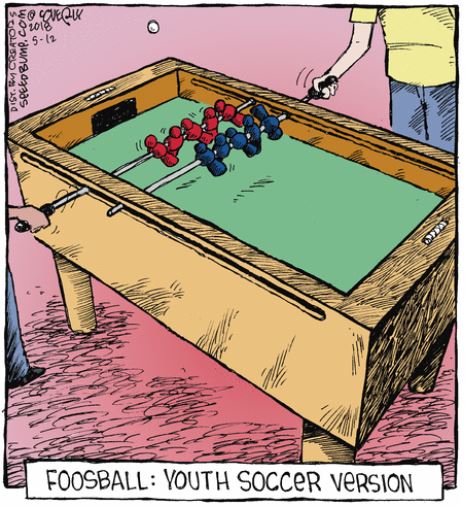
To me, this looks pretty straight-forward. Youth teams often play simplified versions of sports (t-ball, etc.) to build skills, avoid injury, etc., and the artist has taken that idea to the foosball table. Har, har!
In youth soccer leagues all the kids cluster around the ball and try to force it through the scrum to the goal. This is the foosball version of that.
It actually looks kinda fun even if i’d be tempted to spear my opponent in the gut with the rod, but then that would start being youth Battle Royale and that is strictly a spectator sport for me.
@FBS: I’ve seen it in college as well. I remember getting free admission once in Alfred: I had arrived late and asked the guy in the booth if the match was worth the $1 or 2 admission fee. He laughed and waived it for me. I was reminded of the 20-on-20 games of my grade school days: lots of shin-kicking.
Before reading the plausible-sounding comments, I wondered if it was because the hidden other hands of the players were occupied with smartphones, leaving only one hand free for playing.
I am not an expert on kids and their football habits, not having any kids so not forced to watch them do anything, but I suspect here in UK-land their games are more distributed across the pitch as per proper games… after all, kids here will more likely be football-mad and watch plenty of professional games on TV or live and play computer versions of the games as well, all of which I imagine is marginally less common in the USA where I am guessing the kids are more likely to be into and more knowledgeable about other sports.
Here in the UK in just one smallish town (<70,000 pop) Walsall, which has a third-tier professional team (League Two, after the Premier League and the confusingly-named League One, which is the old Second Division), they seem to have a thriving football league setup with youth teams at every single year-group from under-7 to under-18 https://www.wjyl.co.uk/category/players/teams-looking-for-players/ and scroll down for the list.
@ Narmitaj – It depends on what level you are talking about. Germany is no less “football-crazed” than the UK, but I’ve seen first graders playing here, and it is not uncommon entirely normal for all of them to act like little ball bearing players surrounding a superconducting magnetic ball.
P.S. Only after looking at this again, I noticed that the table’s rods are not fixed into holes, allowing the groups to migrate anywhere across the whole field. That is even more evidence for the “junior style of play” theory (as opposed to the “simplification” idea).
P.P.S. @ U.S. readers – The word “pitch” is British technobabble for “field” or “ground”. I had an idiot coach in high school who insisted on using this “authentic” term from the “birthplace” of soccer football, but never bothered to explain to any of us what it meant, nor why he felt obligated to use it.
Yea, on further reflection, I think FBS has it: a gaggle of kids chasing after the ball in no discernible formation.
Question: Do you Yanks really need the term ‘pitch’ explained?
When children first start playing soccer, they get the rules but the actual gameplay is “everybody run to where the ball is and try to kick it towards the goal. No strategy, no “go where the other team isn’t, and one of our guys will kick it to you, and you’ll have a free run toward the goal”, no spacing at all. There’s no notion of team play, nor any kind of tactical or strategic planning.
Americans, even Americans who play soccer, often lack a basic understanding of soccer tactics and strategy well into their U17 or U21 years. (The causes for this are many, but having volunteer coaches in early years who themselves might not have a mastery of soccer tactics is possibly a factor. Also, in Europe a good athlete plays soccer as their first sport. In the USA, Soccer isn’t necessarily drawing the best athletes… some are playing basketball first, or football first, or even hockey first.)
I wouldn’t say pitch was “technobabble”, it’s just the word we use for football and cricket pitches and so on. A football ground is the whole kit and caboodle – the turnstiles, stands, toilets, bars, changing rooms etc (and when they are very big they are stadiums) – but the pitch is always the bit of green grass on which the game is played. http://www.worldwidewords.org/qa/qa-pit1.htm for some history of pitching, connected with hammering in sticks to establish a game was being played (originally, the cricket stumps and widened out to football).
I heard a bit of a gaffe from a BBC radio commentator after the end of the Wales-France World cup rugby quarter final last weekend, when the players mill about and take applause etc: “The French and Welsh rugby players are on the piss …. sorry, pitch!” And here is some confirmation from a twittery listener: https://twitter.com/marathonjamie/status/1185853330880376832 , though I remember only hearing “The Welsh rugby players” were doing this. “On the piss” is UK technobabble for getting drunk, generally out in an organised jovial group manner (you wouldn’t say it about someone getting depressedly smashed alone at home).
@ narmitaj – My apologies for the pejorative: I admit that in British English, “pitch” is a perfectly normal, understandable technical term, but in the U.S. it is simply not a part of the sports vocabulary. In addition, the word has at least a dozen other meanings, so dropping it into a sports context in the U.S. is more likely to cause confusion than communication.
FWIW I have never heard the term pitch used that way. To me, it’s something thrown by a baseball, well, pitcher.
Regarding the comic, I completely relate having coached youth soccer. I actually attempted to assign the kids a designated area as opposed to running after the ball. That way they were available for a pass, defense, etc. But I abandoned the idea when they executed it perfectly and wouldn’t leave their area to go after the ball five feet away with no other kids around it.
I think of pitch as a sort of liquid tar or semisolid petroleum product
“in British English, “pitch” is a perfectly normal, understandable technical term, but in the U.S. it is simply not a part of the sports vocabulary.”
I beg to differ. An American is likely to substitute “field”, but understands in a discussion of soccer, that a pitch is specifically a field marked out for soccer. Soccer isn’t our first choice in team sports, but we’re not COMPLETELY ignorant of the game. We even occasionally have men’s team that is among the world’s top 32, and the American women have had some history of success on the world stage.
A similar thing happens in the introduction to baseball, tee-ball, where the youngest players hit the ball off a tee (instead of trying to hit a moving target). If they manage to hit the ball out of the infield, the outfielder never throws it to an infielder to make the out. Instead, he (or she) runs with the ball, trying to tag the batter out on their own. And all their teammates run in with them, all converging on home plate, which is where the batter is heading by this point.
I would say that a large fraction of Americans are aware of the term since Harry Potter brought them Quidditch pitches. Or at least younger Americans…
Did anybody mention the fact that there’s only one goal?
@ B.A. – The goals are open only to the playing field, so you can‘t see the opening on the near side. I think it‘s drawn correctly.
On looking at this again, the incorrect part is the amount of air the ball’s gotten. You can’t normally do that on a foosball table.
Kilby & Stan – When we first starting eating lunch daily at a local Wendys one TV – the one that faced Robert while we ate had CNN on it. The other TV – the other set had a channel called BeIn (or Bein) that was a European sports channel and mostly ran at lunch time “football” (soccer). I learned a lot about the game from watching the channel for a couple of years – including the term pitch. (I really like how the teams and the children who were picked to be with them shake hands with all the other players and the referees.)
Alas they dropped the sports channel and ran ads for Direct TV movies then a channel I never heard of with a talk show (but no titles to know what they were saying – now they have it shut off.)
 Comics I Don't Understand
To me, this looks pretty straight-forward. Youth teams often play simplified versions of sports (t-ball, etc.) to build skills, avoid injury, etc., and the artist has taken that idea to the foosball table. Har, har!
In youth soccer leagues all the kids cluster around the ball and try to force it through the scrum to the goal. This is the foosball version of that.
It actually looks kinda fun even if i’d be tempted to spear my opponent in the gut with the rod, but then that would start being youth Battle Royale and that is strictly a spectator sport for me.
@FBS: I’ve seen it in college as well. I remember getting free admission once in Alfred: I had arrived late and asked the guy in the booth if the match was worth the $1 or 2 admission fee. He laughed and waived it for me. I was reminded of the 20-on-20 games of my grade school days: lots of shin-kicking.
Before reading the plausible-sounding comments, I wondered if it was because the hidden other hands of the players were occupied with smartphones, leaving only one hand free for playing.
I am not an expert on kids and their football habits, not having any kids so not forced to watch them do anything, but I suspect here in UK-land their games are more distributed across the pitch as per proper games… after all, kids here will more likely be football-mad and watch plenty of professional games on TV or live and play computer versions of the games as well, all of which I imagine is marginally less common in the USA where I am guessing the kids are more likely to be into and more knowledgeable about other sports.
Here in the UK in just one smallish town (<70,000 pop) Walsall, which has a third-tier professional team (League Two, after the Premier League and the confusingly-named League One, which is the old Second Division), they seem to have a thriving football league setup with youth teams at every single year-group from under-7 to under-18
https://www.wjyl.co.uk/category/players/teams-looking-for-players/ and scroll down for the list.
@ Narmitaj – It depends on what level you are talking about. Germany is no less “football-crazed” than the UK, but I’ve seen first graders playing here, and it is
not uncommonentirely normal for all of them to act like little ball bearing players surrounding a superconducting magnetic ball.P.S. Only after looking at this again, I noticed that the table’s rods are not fixed into holes, allowing the groups to migrate anywhere across the whole field. That is even more evidence for the “junior style of play” theory (as opposed to the “simplification” idea).
P.P.S. @ U.S. readers – The word “pitch” is British technobabble for “field” or “ground”. I had an idiot coach in high school who insisted on using this “authentic” term from the “birthplace” of
soccerfootball, but never bothered to explain to any of us what it meant, nor why he felt obligated to use it.Yea, on further reflection, I think FBS has it: a gaggle of kids chasing after the ball in no discernible formation.
Question: Do you Yanks really need the term ‘pitch’ explained?
When children first start playing soccer, they get the rules but the actual gameplay is “everybody run to where the ball is and try to kick it towards the goal. No strategy, no “go where the other team isn’t, and one of our guys will kick it to you, and you’ll have a free run toward the goal”, no spacing at all. There’s no notion of team play, nor any kind of tactical or strategic planning.
Americans, even Americans who play soccer, often lack a basic understanding of soccer tactics and strategy well into their U17 or U21 years. (The causes for this are many, but having volunteer coaches in early years who themselves might not have a mastery of soccer tactics is possibly a factor. Also, in Europe a good athlete plays soccer as their first sport. In the USA, Soccer isn’t necessarily drawing the best athletes… some are playing basketball first, or football first, or even hockey first.)
I wouldn’t say pitch was “technobabble”, it’s just the word we use for football and cricket pitches and so on. A football ground is the whole kit and caboodle – the turnstiles, stands, toilets, bars, changing rooms etc (and when they are very big they are stadiums) – but the pitch is always the bit of green grass on which the game is played. http://www.worldwidewords.org/qa/qa-pit1.htm for some history of pitching, connected with hammering in sticks to establish a game was being played (originally, the cricket stumps and widened out to football).
I heard a bit of a gaffe from a BBC radio commentator after the end of the Wales-France World cup rugby quarter final last weekend, when the players mill about and take applause etc: “The French and Welsh rugby players are on the piss …. sorry, pitch!” And here is some confirmation from a twittery listener: https://twitter.com/marathonjamie/status/1185853330880376832 , though I remember only hearing “The Welsh rugby players” were doing this. “On the piss” is UK technobabble for getting drunk, generally out in an organised jovial group manner (you wouldn’t say it about someone getting depressedly smashed alone at home).
@ narmitaj – My apologies for the pejorative: I admit that in British English, “pitch” is a perfectly normal, understandable technical term, but in the U.S. it is simply not a part of the sports vocabulary. In addition, the word has at least a dozen other meanings, so dropping it into a sports context in the U.S. is more likely to cause confusion than communication.
FWIW I have never heard the term pitch used that way. To me, it’s something thrown by a baseball, well, pitcher.
Regarding the comic, I completely relate having coached youth soccer. I actually attempted to assign the kids a designated area as opposed to running after the ball. That way they were available for a pass, defense, etc. But I abandoned the idea when they executed it perfectly and wouldn’t leave their area to go after the ball five feet away with no other kids around it.
I think of pitch as a sort of liquid tar or semisolid petroleum product
“in British English, “pitch” is a perfectly normal, understandable technical term, but in the U.S. it is simply not a part of the sports vocabulary.”
I beg to differ. An American is likely to substitute “field”, but understands in a discussion of soccer, that a pitch is specifically a field marked out for soccer. Soccer isn’t our first choice in team sports, but we’re not COMPLETELY ignorant of the game. We even occasionally have men’s team that is among the world’s top 32, and the American women have had some history of success on the world stage.
Here is the French pitch ;) :
https://www.pitch-briochepasquier.fr/brioches/classique-chocolat
A similar thing happens in the introduction to baseball, tee-ball, where the youngest players hit the ball off a tee (instead of trying to hit a moving target). If they manage to hit the ball out of the infield, the outfielder never throws it to an infielder to make the out. Instead, he (or she) runs with the ball, trying to tag the batter out on their own. And all their teammates run in with them, all converging on home plate, which is where the batter is heading by this point.
I would say that a large fraction of Americans are aware of the term since Harry Potter brought them Quidditch pitches. Or at least younger Americans…
Did anybody mention the fact that there’s only one goal?
@ B.A. – The goals are open only to the playing field, so you can‘t see the opening on the near side. I think it‘s drawn correctly.
On looking at this again, the incorrect part is the amount of air the ball’s gotten. You can’t normally do that on a foosball table.
Kilby & Stan – When we first starting eating lunch daily at a local Wendys one TV – the one that faced Robert while we ate had CNN on it. The other TV – the other set had a channel called BeIn (or Bein) that was a European sports channel and mostly ran at lunch time “football” (soccer). I learned a lot about the game from watching the channel for a couple of years – including the term pitch. (I really like how the teams and the children who were picked to be with them shake hands with all the other players and the referees.)
Alas they dropped the sports channel and ran ads for Direct TV movies then a channel I never heard of with a talk show (but no titles to know what they were saying – now they have it shut off.)