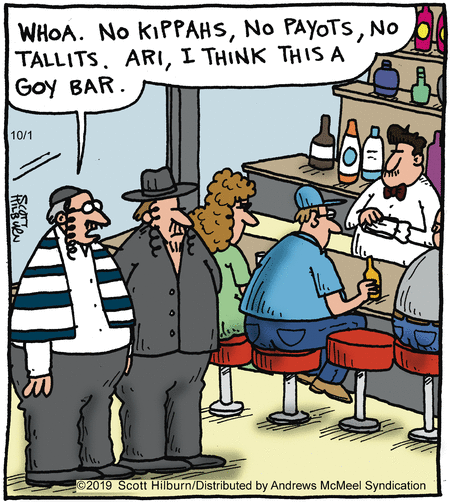
I think this is akin to people wearing clothing or getting tattoos with random words in a language they don’t understand. It looks “cool” or “exotic” to some people, provided they’re on the outside. If you understand the language, it just looks like a word. Here, the pun of “goy” vs. “gay” doesn’t really work if you’re used to hearing the word “goy” in reference to non-Jewish people. If you’re Jewish or have been exposed to Jewish culture, a “goy” bar actually sounds like a regular thing.
@ Boise Ed – A kippa(h) is the little cap that the one on the left is wearing. As a kid, I learned the word “yarmulke“; my first contact with the term “kippa“ was in German.
As Kilby said about kippa, complete with learning yarmulke and only hearing kippa in Germany. Although I have since heard kippa in the US. Payots and tallits are prayer shawls and the little boxes that get tied to the forehead and arms (I think?) for prayer, but I don’t know which is which.
There are “gay bars” and “goy” is a pun on “gay”. There are also “juice bars” that serve fruit juices but no alcohol.
The three people now sitting at the bar just came back from such a bar where the bartender was wearing a yarmulke. “No whiskey, no vodka, the only wine is non-alcoholic Manischewitz. I think this is a Jew’s bar.”
Gary Larson did it better: “Vera looked around the room. Not another chicken anywhere. Then it struck her – this was a hay bar.” Picture a room full of cows eating hay, with one chicken seated at the bar.
Since only some of this was explained above, here is a complete list:
Payot (or payos, to Ashkenazi Jews) (literally “corners” – It is already a plural and does not need the additional “s” at the end) are side curls or sideburns that are the “corners of the head” that the Torah says are not supposed to be cut/shaved off.
A tallit (or, again, tallis as pronounced by Ashkenazi Jews) is a prayer shawl. That large rectangular cloak with tzitzit/tzitzis (fringes) on the four corners that is worn during morning services.
And kippah (literally, “dome” or “covering”) is the Hebrew word for the head covering that observant Jews wear. As mentioned above, it is is known in Yiddish as “yarmulke” or “kappel” (“little cap”).
PS, DemetriosX, the “little boxes that get tied to the forehead and arms…for prayer” are called tefillin (phylacteries, in English).
The challenge in using Jewish humor (differentiated from humorous Jews) is that there are huge swaths of America where there are few of them. In those areas, knowledge of Jewish practices are few, and sources of knowledge of Yiddish are rare.
To land a joke in those areas, you have to aim broad… hitting either stereotypes, or some of the few bits of knowledge that even outsiders are aware of. Which works if the bit of knowledge relied on for the joke actually ARE common knowledge, and miss if they turn out to be less commonly-known than the author/speaker assumed.
I have long maintained that Jewish people produce two kinds of humor which I call “humor for export” and “humor for domestic consumption.”
Humor for export includes Woody Allen, most of Mad Magazine, “The Joy of Yiddish” and other books by Leo Rosten, and the Marx Brothers, the Three Stooges, etc. Either it has no Yiddish or Hebrew references or it has only those a goy would be likely to understand, or else like “The Joy of Yiddish” it explains the jokes.
Humor for domestic consumption is incomprehensible to goys. Here’s a joke that every Jewish person I’ve told it to says it’s funny and every non-Jewish person doesn’t get it.
An old grandfather says to his grandson, “What’s green, hangs on the wall and whistles?”
Grandson: “I don’t know, Zayde. What’s green, hangs on the wall and whistles?”
Grandfather: “A red herring!”
Grandson: “That’s not green.”
Grandfather: “So, you paint it green!”
Grandson: “It doesn’t hang on the wall.”
Grandfather: “There’s a law says you can’t hang it on the wall?”
Grandson: “But it doesn’t whistle.”
Grandfather: “Nu, so it doesn’t whistle.”
@ MiB – I would like to add Mel Brooks to that list. I’ve started to collect his better movies on DVD, because watching exported Yiddish humor that has been dubbed into German just doesn’t work.
MiB, when I’ve heard that joke, it ended ‘Oh, I just put that in to make it hard.’ But the version you know is certainly Jewisher. Also the answer was just ‘a herring’, because that’s more Jewish (gefilte fish is pickled herring).
Kippah is also called in English a skull cap if that helps any.
One of the things (among many) that I like about this list is that one can use many of the more common Yiddish words or expressions and they are understood. It is very hard to explain schlep to my midwestern online needlework friends by trying to find equivalent English terms as words can mean something (as schlep means to carry or pull something, also to drag) which do not actually explain the exact meaning of the term as used generally.
 Comics I Don't Understand
Maybe less “sounds like” than “looks like in print”, but yeah, that’s it. I actually thought this was a fairly decent Oy.
LikeLike
Definitely enough for a joke.
Yeah, print puns vs. oral puns. Perfectly legit.
Also yiddishism, like fruits with Ks in them, an intrinsically funny.
LikeLike
I think this is akin to people wearing clothing or getting tattoos with random words in a language they don’t understand. It looks “cool” or “exotic” to some people, provided they’re on the outside. If you understand the language, it just looks like a word. Here, the pun of “goy” vs. “gay” doesn’t really work if you’re used to hearing the word “goy” in reference to non-Jewish people. If you’re Jewish or have been exposed to Jewish culture, a “goy” bar actually sounds like a regular thing.
LikeLike
Works for this Jew.
LikeLike
I have no idea what kippahs, payots, and tallits are. Goy I know. I learned it from some of Johnny Carson’s frequent guests.
LikeLike
@ Boise Ed – A kippa(h) is the little cap that the one on the left is wearing. As a kid, I learned the word “yarmulke“; my first contact with the term “kippa“ was in German.
LikeLike
As Kilby said about kippa, complete with learning yarmulke and only hearing kippa in Germany. Although I have since heard kippa in the US. Payots and tallits are prayer shawls and the little boxes that get tied to the forehead and arms (I think?) for prayer, but I don’t know which is which.
LikeLike
I thought “kippa” was a little smoked fish from Maine.
LikeLike
Sometimes a pun is just a pun, even with the whole panel drawn to set it up.
LikeLike
Pretty funny, in my opinion.
Trivia: The one thing we know about Jesus’s clothing is that he wore a tallit with tzitzit. No mention of a kipper or payots.
LikeLike
Kippa, not kipper. Thanks, autocorrect.
LikeLike
There are “gay bars” and “goy” is a pun on “gay”. There are also “juice bars” that serve fruit juices but no alcohol.
The three people now sitting at the bar just came back from such a bar where the bartender was wearing a yarmulke. “No whiskey, no vodka, the only wine is non-alcoholic Manischewitz. I think this is a Jew’s bar.”
LikeLike
@ MiB – Despite the belabored setup, that was a very good “Oy (veh)”.
LikeLike
Gary Larson did it better: “Vera looked around the room. Not another chicken anywhere. Then it struck her – this was a hay bar.” Picture a room full of cows eating hay, with one chicken seated at the bar.
LikeLike
Since only some of this was explained above, here is a complete list:
Payot (or payos, to Ashkenazi Jews) (literally “corners” – It is already a plural and does not need the additional “s” at the end) are side curls or sideburns that are the “corners of the head” that the Torah says are not supposed to be cut/shaved off.
A tallit (or, again, tallis as pronounced by Ashkenazi Jews) is a prayer shawl. That large rectangular cloak with tzitzit/tzitzis (fringes) on the four corners that is worn during morning services.
And kippah (literally, “dome” or “covering”) is the Hebrew word for the head covering that observant Jews wear. As mentioned above, it is is known in Yiddish as “yarmulke” or “kappel” (“little cap”).
PS, DemetriosX, the “little boxes that get tied to the forehead and arms…for prayer” are called tefillin (phylacteries, in English).
LikeLike
RE: BR (OCTOBER 2, 2019 AT 5:26 AM)
LikeLike
The challenge in using Jewish humor (differentiated from humorous Jews) is that there are huge swaths of America where there are few of them. In those areas, knowledge of Jewish practices are few, and sources of knowledge of Yiddish are rare.
To land a joke in those areas, you have to aim broad… hitting either stereotypes, or some of the few bits of knowledge that even outsiders are aware of. Which works if the bit of knowledge relied on for the joke actually ARE common knowledge, and miss if they turn out to be less commonly-known than the author/speaker assumed.
LikeLike
Cartoonists work under the assumption that what THEY know, EVERYBODY knows. Jef Mallett assumes that we’re all Michigan bicyclists.
LikeLike
I have long maintained that Jewish people produce two kinds of humor which I call “humor for export” and “humor for domestic consumption.”
Humor for export includes Woody Allen, most of Mad Magazine, “The Joy of Yiddish” and other books by Leo Rosten, and the Marx Brothers, the Three Stooges, etc. Either it has no Yiddish or Hebrew references or it has only those a goy would be likely to understand, or else like “The Joy of Yiddish” it explains the jokes.
Humor for domestic consumption is incomprehensible to goys. Here’s a joke that every Jewish person I’ve told it to says it’s funny and every non-Jewish person doesn’t get it.
An old grandfather says to his grandson, “What’s green, hangs on the wall and whistles?”
Grandson: “I don’t know, Zayde. What’s green, hangs on the wall and whistles?”
Grandfather: “A red herring!”
Grandson: “That’s not green.”
Grandfather: “So, you paint it green!”
Grandson: “It doesn’t hang on the wall.”
Grandfather: “There’s a law says you can’t hang it on the wall?”
Grandson: “But it doesn’t whistle.”
Grandfather: “Nu, so it doesn’t whistle.”
LikeLike
@ MiB – I would like to add Mel Brooks to that list. I’ve started to collect his better movies on DVD, because watching exported Yiddish humor that has been dubbed into German just doesn’t work.
LikeLike
You’re right, Mark. This goy sees no humor there. It’s like saying “What’s a cold, black disk?” … “A football.”
LikeLike
MiB, when I’ve heard that joke, it ended ‘Oh, I just put that in to make it hard.’ But the version you know is certainly Jewisher. Also the answer was just ‘a herring’, because that’s more Jewish (gefilte fish is pickled herring).
LikeLike
Treesong:
Gefilte fish is definitely NOT “pickled herring”. “Pickled herring” is pickled herring.
https://en.wikipedia.org/wiki/Gefilte_fish
LikeLike
It’s Argyle Sweater. It’s not supposed to be funny. :(
LikeLike
Kippah is also called in English a skull cap if that helps any.
One of the things (among many) that I like about this list is that one can use many of the more common Yiddish words or expressions and they are understood. It is very hard to explain schlep to my midwestern online needlework friends by trying to find equivalent English terms as words can mean something (as schlep means to carry or pull something, also to drag) which do not actually explain the exact meaning of the term as used generally.
LikeLike