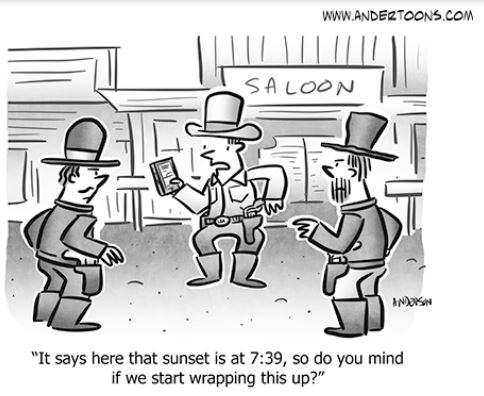
So… either the artist or the sheriff is conflating “High Noon” and “Get out of town by sundown”??
(And yes, I quite predictably scheduled this to go live at 7:39)
Related
30 Comments
No gun fighting on the Sabbath
No need to assume references to either “high noon” or “get out of town by sunset.” You can’t gunfight in the dark, so the speaker is telling them to wrap it up. The humor comes from the incongruity of getting this information from an app.
Initially I took the speaker for the sheriff and was wondering if he shouldn’t instead be trying to break it up, but I guess he’s a referee, or possibly a participant in a three-person gunfight.
I expect Mitch4’s reply is going to be funnier than anything that explains what Anderson had in mind.
“The humor comes from the incongruity of getting this information from an app.” I hope not. With this kind of artwork that could just as easily be an almanac, or so it seems to me.
I figured the humor was the precision of 7:39, rather than when the sun sets or when it gets dark. And if there’s a “get out of town by sundown”, the shoot-out starts near sundown, not at high noon.
My first thought was that either he, or maybe all of them, wanted to go watch the beautiful sunset, maybe with a Margarita in hand.
” if there’s a ‘get out of town by sundown’, the shoot-out starts near sundown, not at high noon.”
If there’s a “get out of town by sundown”, there isn’t a shoot-out. Offering a “get out of town free” is a method of avoiding a shoot out. Getting out of town is what you do to avoid being shot at. Hence, no shooting.
The Quick & the Dead is on GRIT right now
It’s even more boring than I dismember
Actually, there’s plenty of time between sunset and darkness to hold a gunfight.
The bad time, actually, would be the hour BEFORE sundown, when one of the combattants might be blinded (unless he was wearing a pair of Dorian’s sunglasses).
CIDU Bill, if that actually is an almanac he’s holding, it gives the times of civil twilight, nautical twilight and astronomical twilight and explains the differences among them, so he would know exactly when it’s too dark to fight. Assuming that this really IS a gunfight. I don’t know how the logistics of a three-way gunfight work out. Do you concentrate on one opponent and get killed by the other or do you try to shoot both of them at the same time and miss both?
My first thought was that every movie with a shoot-out at high noon has the two combatants staring at each other for an inordinate length of time, seeing who will start to draw first. In some situations they may stare at each other until the sun goes down.
Bill, if they’re dueling near sunset, it’s reasonably fair if they’re facing North/South.
It’s a “sundown town” and the cowboy is black. He may not look very black, but using the “one-drop” rule common in the USA, he is considered such. Having been raised in the black community, he understands that it would be dangerous for him to stay beyond sundown. It’s funny because he is engaging in a gunfight, which is already a dangerous activity.
Because “It says here that noon is at 12:00” would be unnecessary documentation?
Finish the gunfight and then get out of town by sundown. Have it both ways.
I read recently, but am too lazy to track it down, that the actual technique used by one of the few verified old wild west gunfighters was to fire his gun while it was still in the holster — his opponent, hearing the gun discharge, would then be looking to see if he was hit, giving the gunfighter plenty of time to then shoot him at his leisure.
Another actual tactic used by lots of ol’ west gunfighter was to have a hidden confederate with a rifle.
Brian R has it. They got stuck at the “staredown” phase of the confrontation.
There is a mathematical puzzle based on the premise of a round-robin gunfight between people who shoot with differing degrees of accuracy. The participants take turns firing one shot at the opponent of his (or of course her) choice. If you are the weakest shot, you’ll probably get a turn because each of the other two will want to disable the other more than you. On your turn, you want to fire in the air as long as the other two are still standing. Only when one opponent is “out” do you want to shoot.
Being a mathematical / logical puzzle, it does not take into account any conceivable reason that one of your opponents might be motivated to aim at you instead of at the third person.
But it does provide a scenario for three (or more) participants in a well-organized gunfight.
(PS. Overdue kudos to Andréa for her pronunciation of “résumé”.)
In a three-way gunfight, be sure to unload the gun belonging to one of the other guys the night before.
Gunfight at the Kobayashi Corral.
“In a three-way gunfight, be sure to unload the gun belonging to one of the other guys the night before.”
The hidden confederate(s) with a rifle method is particularly effective in this type of scenario.
It need not be a Confederate. A Yankee works too.
No one’s mentioned the famous three-way gunfight in THE GOOD, THE BAD, AND THE UGLY? (Spoiler; Bad lost.)
@Douglas: This seems to merely be prolonging the inevitable for the poor shot, as there seems to be no scenario in which they will emerge alive; since shooting at another will not cause that other to shoot at you for spite, since they are all perfectly rational, I would say you might as well practice your aim if you are the lousy shot, because you might get better (though if you get “lucky” before the ultimate showdown, you have just sped up the inevitable — maybe practice your aim by shooting at something other than an opponent…). I know, I know, these mathematical problems don’t allow for other motivations…
Forgot to mention – the YouTube link is Enrico Morricone music from the various spaghetti westerns of Sergio Leone
More on the mathematical – logic problem: If you let one of the others disable the third, you get the next shot. If, on the other hand, you disable one of the others, the third gets next shot and you’re the target. The highest probability of survival, given the rules of the game, comes with the strategy outlined above.
Yes, it’s better not to get into the situation in the first place.
With regard to other proposed strategies, the western is a genre well-suited to consideration of the tradeoff between honor and life.
@ Douglas: right, so instead of wasting my shot shooting in the air, I practice my aim by shooting at something far away from any opponent — no chance (how bad am I?) of accidentally hitting anyone, but I do get to familiarize myself with the gun and hopefully get slightly better, such that when my chance comes, I will be a better shot…
On a related note, I saw a game theoretic analysis of the Memory game (cards are in pairs, on a player’s turn, they turn over two cards, and if they match, they get the pair and get to go again), assuming perfect play, and players with perfect memory. It turns out there are a lot of position where the best move it to turn over two cards that you know don’t match, because if you “explore” an unknown card, the chance of helping your opponent is better than the chance of getting a lucky match. In that situation, with perfect play the game never ends, since both players just keep turning over two cards that are known not to match.
For the 3-way gunfight, I wonder if there are situations where it’s better to be the worse shot throughout the game (and have it known to your two opponents that you’re a worse shot). e.g. maybe you could demonstrate that you’re a “safer” opponent by publicly only filling half the bullets, and snipping the chamber.
Does anybody else remember “Psychological War”? Basically like standard War, but you can fan and examine as a hand your unplayed cards, and choose what card to play to each battle (trick). Your winnings accumulate in a pile, until you have played all the cards in your hand, and then you scoop up your winnings and turn it into your hand for continued / renewed play. When there is a tie, each player adds two face-down cards to the winnings of a tie-break. Though A is generally high, a 2 beats an A — otherwise A would never change hands.
It’s actually pretty dull. Probably just created as an experiment, to graft Rock-Paper-Scissors ideas onto war cards.
No one’s mentioned the famous three-way gunfight in THE GOOD, THE BAD, AND THE UGLY?
 Comics I Don't Understand
No gun fighting on the Sabbath
No need to assume references to either “high noon” or “get out of town by sunset.” You can’t gunfight in the dark, so the speaker is telling them to wrap it up. The humor comes from the incongruity of getting this information from an app.
Initially I took the speaker for the sheriff and was wondering if he shouldn’t instead be trying to break it up, but I guess he’s a referee, or possibly a participant in a three-person gunfight.
I expect Mitch4’s reply is going to be funnier than anything that explains what Anderson had in mind.
“The humor comes from the incongruity of getting this information from an app.” I hope not. With this kind of artwork that could just as easily be an almanac, or so it seems to me.
I figured the humor was the precision of 7:39, rather than when the sun sets or when it gets dark. And if there’s a “get out of town by sundown”, the shoot-out starts near sundown, not at high noon.
My first thought was that either he, or maybe all of them, wanted to go watch the beautiful sunset, maybe with a Margarita in hand.
” if there’s a ‘get out of town by sundown’, the shoot-out starts near sundown, not at high noon.”
If there’s a “get out of town by sundown”, there isn’t a shoot-out. Offering a “get out of town free” is a method of avoiding a shoot out. Getting out of town is what you do to avoid being shot at. Hence, no shooting.
The Quick & the Dead is on GRIT right now
It’s even more boring than I dismember
Actually, there’s plenty of time between sunset and darkness to hold a gunfight.
The bad time, actually, would be the hour BEFORE sundown, when one of the combattants might be blinded (unless he was wearing a pair of Dorian’s sunglasses).
CIDU Bill, if that actually is an almanac he’s holding, it gives the times of civil twilight, nautical twilight and astronomical twilight and explains the differences among them, so he would know exactly when it’s too dark to fight. Assuming that this really IS a gunfight. I don’t know how the logistics of a three-way gunfight work out. Do you concentrate on one opponent and get killed by the other or do you try to shoot both of them at the same time and miss both?
My first thought was that every movie with a shoot-out at high noon has the two combatants staring at each other for an inordinate length of time, seeing who will start to draw first. In some situations they may stare at each other until the sun goes down.
Bill, if they’re dueling near sunset, it’s reasonably fair if they’re facing North/South.
It’s a “sundown town” and the cowboy is black. He may not look very black, but using the “one-drop” rule common in the USA, he is considered such. Having been raised in the black community, he understands that it would be dangerous for him to stay beyond sundown. It’s funny because he is engaging in a gunfight, which is already a dangerous activity.
https://www.uuworld.org/articles/was-your-town-sundown-town
https://news.harvard.edu/gazette/story/2010/12/one-drop-rule-persists/
Because “It says here that noon is at 12:00” would be unnecessary documentation?
Finish the gunfight and then get out of town by sundown. Have it both ways.
I read recently, but am too lazy to track it down, that the actual technique used by one of the few verified old wild west gunfighters was to fire his gun while it was still in the holster — his opponent, hearing the gun discharge, would then be looking to see if he was hit, giving the gunfighter plenty of time to then shoot him at his leisure.
Another actual tactic used by lots of ol’ west gunfighter was to have a hidden confederate with a rifle.
Brian R has it. They got stuck at the “staredown” phase of the confrontation.
There is a mathematical puzzle based on the premise of a round-robin gunfight between people who shoot with differing degrees of accuracy. The participants take turns firing one shot at the opponent of his (or of course her) choice. If you are the weakest shot, you’ll probably get a turn because each of the other two will want to disable the other more than you. On your turn, you want to fire in the air as long as the other two are still standing. Only when one opponent is “out” do you want to shoot.
Being a mathematical / logical puzzle, it does not take into account any conceivable reason that one of your opponents might be motivated to aim at you instead of at the third person.
But it does provide a scenario for three (or more) participants in a well-organized gunfight.
(PS. Overdue kudos to Andréa for her pronunciation of “résumé”.)
In a three-way gunfight, be sure to unload the gun belonging to one of the other guys the night before.
Gunfight at the Kobayashi Corral.
“In a three-way gunfight, be sure to unload the gun belonging to one of the other guys the night before.”
The hidden confederate(s) with a rifle method is particularly effective in this type of scenario.
It need not be a Confederate. A Yankee works too.
No one’s mentioned the famous three-way gunfight in THE GOOD, THE BAD, AND THE UGLY? (Spoiler; Bad lost.)
@Douglas: This seems to merely be prolonging the inevitable for the poor shot, as there seems to be no scenario in which they will emerge alive; since shooting at another will not cause that other to shoot at you for spite, since they are all perfectly rational, I would say you might as well practice your aim if you are the lousy shot, because you might get better (though if you get “lucky” before the ultimate showdown, you have just sped up the inevitable — maybe practice your aim by shooting at something other than an opponent…). I know, I know, these mathematical problems don’t allow for other motivations…
I have to admit I thought of it . . .
(Lee Van Cleef was sooooo good-lookin’; I worked for several years with his doppelganger.)
(And if you’ve not seen this . . .
https://www.youtube.com/watch?v=enuOArEfqGo&list=RDenuOArEfqGo&start_radio=1 )
Forgot to mention – the YouTube link is Enrico Morricone music from the various spaghetti westerns of Sergio Leone
More on the mathematical – logic problem: If you let one of the others disable the third, you get the next shot. If, on the other hand, you disable one of the others, the third gets next shot and you’re the target. The highest probability of survival, given the rules of the game, comes with the strategy outlined above.
Yes, it’s better not to get into the situation in the first place.
With regard to other proposed strategies, the western is a genre well-suited to consideration of the tradeoff between honor and life.
@ Douglas: right, so instead of wasting my shot shooting in the air, I practice my aim by shooting at something far away from any opponent — no chance (how bad am I?) of accidentally hitting anyone, but I do get to familiarize myself with the gun and hopefully get slightly better, such that when my chance comes, I will be a better shot…
On a related note, I saw a game theoretic analysis of the Memory game (cards are in pairs, on a player’s turn, they turn over two cards, and if they match, they get the pair and get to go again), assuming perfect play, and players with perfect memory. It turns out there are a lot of position where the best move it to turn over two cards that you know don’t match, because if you “explore” an unknown card, the chance of helping your opponent is better than the chance of getting a lucky match. In that situation, with perfect play the game never ends, since both players just keep turning over two cards that are known not to match.
For the 3-way gunfight, I wonder if there are situations where it’s better to be the worse shot throughout the game (and have it known to your two opponents that you’re a worse shot). e.g. maybe you could demonstrate that you’re a “safer” opponent by publicly only filling half the bullets, and snipping the chamber.
Does anybody else remember “Psychological War”? Basically like standard War, but you can fan and examine as a hand your unplayed cards, and choose what card to play to each battle (trick). Your winnings accumulate in a pile, until you have played all the cards in your hand, and then you scoop up your winnings and turn it into your hand for continued / renewed play. When there is a tie, each player adds two face-down cards to the winnings of a tie-break. Though A is generally high, a 2 beats an A — otherwise A would never change hands.
It’s actually pretty dull. Probably just created as an experiment, to graft Rock-Paper-Scissors ideas onto war cards.
No one’s mentioned the famous three-way gunfight in THE GOOD, THE BAD, AND THE UGLY?
I alluded to it.