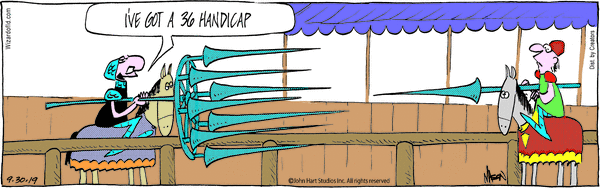
I assume this is somehow analogous to a golf handicap?
Related
32 Comments
Yes. Or perhaps more like racing, where additional weight can directly affect performance, not just the score.
Tho I guess the multiple lances are meant to be an *advantage*.
Yes, a high handicap number means the player is bad, so should get more help. The point of the multiple lances is not that they hurt Rodney by weighing him down too much, but help him by making it easier to his his opponent, despite hit bad aim.
“I assume this is somehow analogous to a golf handicap?”
Well, it analogous in that it alleviates Rodneys incompetence and makes the likely outcome more even.
Not analogous in the golf handicap is purely a numerical score rather than a mechanical advantage.
But expecting the strip to make the logical distinction is a pretty high bar if you ask me. The joke is simply in golf a lesser player is given an advantage called a handicap. So here a lesser jouster is given an advantage an it’s also called a handicap. And the advantage is somewhat comical looking to boot.
(As to why that setup is supposed to be advantageous… surely that is obvious and self evident, isn’t it?)
Woozy, that was what my remark about horse racing was meant to get at — the handicap in golf exerts a levelling effect but thru the score, whereas in horse racing (and perhaps jousting!) there is a levelling by means of actually affecting performance. Here it is a better weapon for the lesser player, in horse racing it is some extra weight literally imposing a handicap on the apparently better horse/jockey.
Mitch. but that’s way overthinking it. Handicap is just a term to level uneven players in sports and this is funny looking. That’s all there is.
Is “36” some kind of magic number?
36 is perfectly cromulent, unlike 42, which would be a ridiculous number to use in a humorous manner.
FYI, 36 is the maximum golf handicap for men.
36 is a beautiful number. Not magical though. It’s the first perfect square with more than one prime factor and is those the first number that can be written a product of two different non trivial squares. I think it’s the first number with as many as 9 factors…. I think.
“36 is perfectly cromulent, unlike 42, which would be a ridiculous number to use in a humorous manner.”
42 is funny in it’s lack interesting features. But its an ironic humor unlike 17 or 43 that are obviously the class clowns. But no-one could possibly laugh at the obvious elegance of 36.
Is it also the highest number of clowns allowed in one car trunk? If so, who made up THAT rule?
The extra weight on the horse in horse racing is not to compensate for a better horse. It is to equalize the weight on all the horses, because jockeys don’t all weigh exactly the same down to the ounce.
Well, MiB, that’s what I thought too — then I read the wikipedia article on handicapping.
A handicap race in horse racing is a race in which horses carry different weights, allocated by the handicapper. A better horse will carry a heavier weight, to give him or her a disadvantage when racing against slower horses. The handicapper’s goal in assigning handicap weights is to enable all the horses to finish together (in a dead heat).
[Emphasis added. Taken from https://en.wikipedia.org/wiki/Handicapping#Horse_racing . See also separate full article https://en.wikipedia.org/wiki/Handicap_(horse_racing) ]
Hunh — my boldface emphases didn’t come thru. Retrying:
A handicap race in horse racing is a race in which horses carry different weights, allocated by the handicapper. A better horse will carry a heavier weight, to give him or her a disadvantage when racing against slower horses.The handicapper’s goal in assigning handicap weights is to enable all the horses to finish together (in a dead heat).
For reasons that I have never understood(*), 36 also happens to be a French expression for “extermely many”.
P.S. (*) – I first heard about this from “Karambolage”, but was later amused to discover it in an episode of “Poirot”. Perhaps Olivier can confirm and/or explain the usage.
@ Mitch4 – Both kinds of weight adjustments exist: handicap races are different from normal races, in which each horse carries the same weight.
There ain’t 36 solutions (just one); it happens every 36th of the month (never); to see 36 candles (when you’re hit on the head): we do like 36. Dictionaries seem to think it goes back to the duodecimal (base 12) system : 36 is beyond what you can count on your knuckles.
We also say that we aren’t going to be 107 years at it (“On ne va pas y passer 107 ans).
Thanks, Kilby. I’m glad there’s a reason we were seeing more than one explanation.
107 years? How intriguing!
I was going to suggest that was the length of “The Hundred Years War”, but apparently that was even a bit longer.
It’s how long it took (supposedly) to build Notre Dame.
Was the handicap race invented by a camera manufacturer, since the goal is to have a situation that can only be decided by a photo finish?
@ MiB – I’m not sure how serious that was meant: handicap races were introduced to facilitate betting, and date back to the mid 19th century, long before the development of photo finish cameras.
Btw, the photo finish is or was a sorta interesting technology. It is *not* simply a photo taken along the finish line at the moment the first horse crosses. That would show the positions at that moment of the other horses, but would not actually determine the place and show horses, since #3 in the photo could overtake #2 by the time they reach the finish.
Instead, the image is a vertical slit, not a full rectangular picture. And the film is pulled thru the back of the camera in a motorized arrangement. So the vertical dimension on the film is the view along the narrow angle of the finish line, while the horizontal dimension of the film is time. The second and third horses will be recorded when each actually crosses the finish line, regardless of their order at the moment the winner goes past.
Mitch4, wouldn’t it be simpler to video the finish line, and then the playback could be advanced one frame at a time?
@ Bill – The advantage of the moving film strip is that it provides a continuous (analog) record of the results. Standard film runs at 24 frames per second, videotape refreshes at 25 fps, meaning that the delay between frames is 4 hundredths of a second. Swimming and skiing events are rounded to the nearest hundredth, but there are many other racing events in which the difference between places can be significantly shorter. Formula 1 reports times down to 1 thousandth of a second. There would be 40 of those “thousandth” ticks between two frames of a videotape monitor.
It’s always fun when tv commenters try to decide whether the tennis ball was in or out : one frame shows the ball before, and the next after, it bounced. Akin to children arguing over the soccer ball glancing off the imaginary goal post, inside or outside the net.
@ Olivier – The Hawkeye system does NOT report where the tennis ball actually bounced. It uses imaging data (from multiple cameras) to make the best possible prediction of where the ball’s impact has landed. There is no 100% guarantee that the computed location is exactly the same as where the ball touched, but the results are good enough that players are willing to accept rulings in which the overlap (or gap) is significantly less than the “fuzz factor” caused by the nap on the ball.
P.S. The French Open does not use the Hawkeye system, because the chair umpire can always climb down to see the spot the ball made on the clay (or as they say in German: “in the sand”).
Thanks, I didn’t know about this system : I’ve stopped following tennis during the Agassi / Sampras era.
@ Olivier – In matches where the Hawkeye is used, players are allowed 3 challenges per set (each player gets one extra challenge if a tiebreak reaches 6:6). Successful challenges are not deducted, only ones in which the player was wrong. Challenges must be made immediately after the bounce (stopping play if necessary), and cannot be made for an intermediate bounce after the point has been played out.
I’ve stopped following tennis because it was not interesting to me any more; this doesn’t make me want to reconsider. Actually, I’ve stopped following any sport because they’re more business than game. Where’s the fun?
@ I didn’t think you would be that interested, but I also did not want to leave you with the impression that the Hawkeye had replaced the line judges. As impressive as the system is, it is not even close to being able to make calls in real time. They even added an animated display of the ball’s path that helps cover up for the computational delay.
Your explanations are ok and this Hawkeye system interesting (I actually checked it on the web); but it implies that tennis (like many (all ?) other sports) is not going in the right direction, as far as I’m concerned.
 Comics I Don't Understand
Yes. Or perhaps more like racing, where additional weight can directly affect performance, not just the score.
Tho I guess the multiple lances are meant to be an *advantage*.
Yes, a high handicap number means the player is bad, so should get more help. The point of the multiple lances is not that they hurt Rodney by weighing him down too much, but help him by making it easier to his his opponent, despite hit bad aim.
“I assume this is somehow analogous to a golf handicap?”
Well, it analogous in that it alleviates Rodneys incompetence and makes the likely outcome more even.
Not analogous in the golf handicap is purely a numerical score rather than a mechanical advantage.
But expecting the strip to make the logical distinction is a pretty high bar if you ask me. The joke is simply in golf a lesser player is given an advantage called a handicap. So here a lesser jouster is given an advantage an it’s also called a handicap. And the advantage is somewhat comical looking to boot.
(As to why that setup is supposed to be advantageous… surely that is obvious and self evident, isn’t it?)
Woozy, that was what my remark about horse racing was meant to get at — the handicap in golf exerts a levelling effect but thru the score, whereas in horse racing (and perhaps jousting!) there is a levelling by means of actually affecting performance. Here it is a better weapon for the lesser player, in horse racing it is some extra weight literally imposing a handicap on the apparently better horse/jockey.
Mitch. but that’s way overthinking it. Handicap is just a term to level uneven players in sports and this is funny looking. That’s all there is.
Is “36” some kind of magic number?

36 is perfectly cromulent, unlike 42, which would be a ridiculous number to use in a humorous manner.
FYI, 36 is the maximum golf handicap for men.
36 is a beautiful number. Not magical though. It’s the first perfect square with more than one prime factor and is those the first number that can be written a product of two different non trivial squares. I think it’s the first number with as many as 9 factors…. I think.
“36 is perfectly cromulent, unlike 42, which would be a ridiculous number to use in a humorous manner.”
42 is funny in it’s lack interesting features. But its an ironic humor unlike 17 or 43 that are obviously the class clowns. But no-one could possibly laugh at the obvious elegance of 36.
Is it also the highest number of clowns allowed in one car trunk? If so, who made up THAT rule?
The extra weight on the horse in horse racing is not to compensate for a better horse. It is to equalize the weight on all the horses, because jockeys don’t all weigh exactly the same down to the ounce.
Well, MiB, that’s what I thought too — then I read the wikipedia article on handicapping.
A handicap race in horse racing is a race in which horses carry different weights, allocated by the handicapper. A better horse will carry a heavier weight, to give him or her a disadvantage when racing against slower horses. The handicapper’s goal in assigning handicap weights is to enable all the horses to finish together (in a dead heat).
[Emphasis added. Taken from https://en.wikipedia.org/wiki/Handicapping#Horse_racing . See also separate full article https://en.wikipedia.org/wiki/Handicap_(horse_racing) ]
Hunh — my boldface emphases didn’t come thru. Retrying:
A handicap race in horse racing is a race in which horses carry different weights, allocated by the handicapper. A better horse will carry a heavier weight, to give him or her a disadvantage when racing against slower horses.The handicapper’s goal in assigning handicap weights is to enable all the horses to finish together (in a dead heat).
For reasons that I have never understood(*), 36 also happens to be a French expression for “extermely many”.
P.S. (*) – I first heard about this from “Karambolage”, but was later amused to discover it in an episode of “Poirot”. Perhaps Olivier can confirm and/or explain the usage.
@ Mitch4 – Both kinds of weight adjustments exist: handicap races are different from normal races, in which each horse carries the same weight.
There ain’t 36 solutions (just one); it happens every 36th of the month (never); to see 36 candles (when you’re hit on the head): we do like 36. Dictionaries seem to think it goes back to the duodecimal (base 12) system : 36 is beyond what you can count on your knuckles.
We also say that we aren’t going to be 107 years at it (“On ne va pas y passer 107 ans).
Thanks, Kilby. I’m glad there’s a reason we were seeing more than one explanation.
107 years? How intriguing!
I was going to suggest that was the length of “The Hundred Years War”, but apparently that was even a bit longer.
It’s how long it took (supposedly) to build Notre Dame.
Was the handicap race invented by a camera manufacturer, since the goal is to have a situation that can only be decided by a photo finish?
@ MiB – I’m not sure how serious that was meant: handicap races were introduced to facilitate betting, and date back to the mid 19th century, long before the development of photo finish cameras.
Btw, the photo finish is or was a sorta interesting technology. It is *not* simply a photo taken along the finish line at the moment the first horse crosses. That would show the positions at that moment of the other horses, but would not actually determine the place and show horses, since #3 in the photo could overtake #2 by the time they reach the finish.
Instead, the image is a vertical slit, not a full rectangular picture. And the film is pulled thru the back of the camera in a motorized arrangement. So the vertical dimension on the film is the view along the narrow angle of the finish line, while the horizontal dimension of the film is time. The second and third horses will be recorded when each actually crosses the finish line, regardless of their order at the moment the winner goes past.
Mitch4, wouldn’t it be simpler to video the finish line, and then the playback could be advanced one frame at a time?
@ Bill – The advantage of the moving film strip is that it provides a continuous (analog) record of the results. Standard film runs at 24 frames per second, videotape refreshes at 25 fps, meaning that the delay between frames is 4 hundredths of a second. Swimming and skiing events are rounded to the nearest hundredth, but there are many other racing events in which the difference between places can be significantly shorter. Formula 1 reports times down to 1 thousandth of a second. There would be 40 of those “thousandth” ticks between two frames of a videotape monitor.
It’s always fun when tv commenters try to decide whether the tennis ball was in or out : one frame shows the ball before, and the next after, it bounced. Akin to children arguing over the soccer ball glancing off the imaginary goal post, inside or outside the net.
@ Olivier – The Hawkeye system does NOT report where the tennis ball actually bounced. It uses imaging data (from multiple cameras) to make the best possible prediction of where the ball’s impact has landed. There is no 100% guarantee that the computed location is exactly the same as where the ball touched, but the results are good enough that players are willing to accept rulings in which the overlap (or gap) is significantly less than the “fuzz factor” caused by the nap on the ball.
P.S. The French Open does not use the Hawkeye system, because the chair umpire can always climb down to see the spot the ball made on the clay (or as they say in German: “in the sand”).
Thanks, I didn’t know about this system : I’ve stopped following tennis during the Agassi / Sampras era.
@ Olivier – In matches where the Hawkeye is used, players are allowed 3 challenges per set (each player gets one extra challenge if a tiebreak reaches 6:6). Successful challenges are not deducted, only ones in which the player was wrong. Challenges must be made immediately after the bounce (stopping play if necessary), and cannot be made for an intermediate bounce after the point has been played out.
I’ve stopped following tennis because it was not interesting to me any more; this doesn’t make me want to reconsider. Actually, I’ve stopped following any sport because they’re more business than game. Where’s the fun?
@ I didn’t think you would be that interested, but I also did not want to leave you with the impression that the Hawkeye had replaced the line judges. As impressive as the system is, it is not even close to being able to make calls in real time. They even added an animated display of the ball’s path that helps cover up for the computational delay.
Your explanations are ok and this Hawkeye system interesting (I actually checked it on the web); but it implies that tennis (like many (all ?) other sports) is not going in the right direction, as far as I’m concerned.