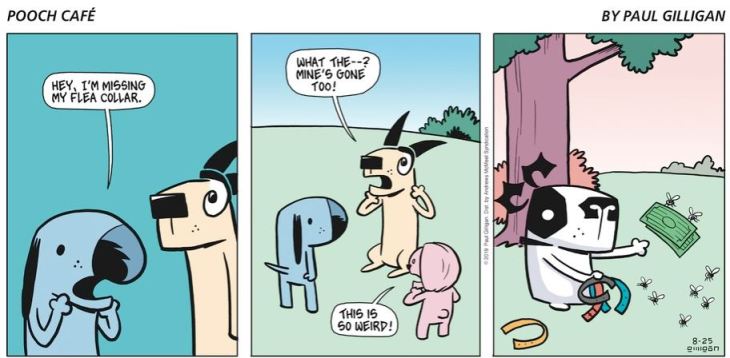
Some explanation for this morning’s post:
I started putting together the post on my phone yesterday, without either the comic or any of the tags, and then put it in hibernation for 24 hours intending to finish it up before it went live.
Something I’d done countless times in the past.
Then I suddenly had to go out of town, and forgot, and the unfinished post went live.
 Comics I Don't Understand
Mosquitoes can fly, and they’re all part of the six-legged blood-suckers union.
It would appear that this dog is a traitor and is selling the flea collars to the fleas, thus making it easier to attack the other dogs.
The real question is where the fleas got their money. Since KEVIN AND KELL had a strip recently where a bat bribed some fireflies to show him the location of other fireflies (that he could eat), my assumption is that the fleas mugged the fireflies and took the money.
Of course, then thst just raises the question of where did the bats get their money.
KEVIN AND KELL is one of those “entire society is made up of sentient animals who work real jobs” strips, so I assume the bat earned it in some respectible profession. (I rarely see the strip, so I don’t know what his job is, though I do know he’s married to a porcupine.) Of couse, POGO was also an all-animals strip and there was some money floating around (Mr. Miggle at the General Store had posted prices, for one thing), but I don’t recall anyone there ever being depicted in a job from which they could have earned money. (There were lots of schemes to make millions with inventions or finding buried treasure or the like, but they never worked out.)
I’m assuming that even in the all-animal society of KEVIN AND KELL that fireflies and comparable small fry are not in the workforce, but I could be wrong. Maybe they’re on welfare?
The point is (and I love Bill’s heading): THOSE ARE NOT FLEAS!! Fleas don’t have wings and fleas don’t fly. So, now it’s a CIDU again . . .
Andréa, so when the flea said to the fly “Let us flee” it was because the flea couldn’t fly?
Maybe the fleas didn’t trust Poncho not to cheat (1. he’s a dog and presumably hates fleas, and 2. he’s depicted in the strip as totally untrustworthy toward anyone/everyone) so they talked some flies into making the exchange for them? (But then that brings up the question of what the fleas paid the flies with. Damn, economic systems are *complicated*!)
RIIIIIGHT!
Oh, and I am very much against flea collars, for the record. It’s VERY difficult to get ’em on the little critters. (ba da bum)
Bill, I hope the out-of-town emergency has been resolved successfully?
I assume that the obvious answer is the accurate one: The cartoonist, unlike Bill, was unaware that fleas cannot fly (although they are incredible jumpers). Flea collars also protect against other pests, notably ticks, but ticks can’t fly either. The bugs in the cartoon might be mosquitoes or flies, but that starts to seem like a bit of a stretch.
“. . . was unaware that fleas cannot fly (although they are incredible jumpers)”
IMAGINE what it’d be like if they could fly!
I keep my dogs flea-free by not allowing them [the dogs] in the yard (also ’cause of fire ants, ticks, armadillo tunnels dug under the fence, poisonous plants and seeds, possible fence-climbing coyotes, bird and squirrel feces, and rat urine, which can carry leptospirosis); I stopped giving them Bravecto a year ago due to over-medication concerns. Because mosquitoes DO fly, I still give Heartgard and have annual heartworm exams on the dogs. I’ve had to become used to not having winter weather cold enough to kill insects, as we had in WI.
I read somewhere that while fleas are astonishing jumpers, it’s not a controlled jump. It’s more a catapult launch with random direction and orientation. I don’t know that is true, but since hearing it I’ve had this image of a fleas screaming as it tumbles wildly through the air and then land with a thud.
Mark M : “It would appear that this dog is a traitor and is selling the flea collars to the fleas”
Why would fleas want a flea collar? Fleas hate flea collars. That’s the whole point of them.
They aren’t buying it, they’re paying him for removing it so they can attack the other dogs.
Bill, I presume you already knew the above, the CIDU part is why the fleas have wings, right? Just put it down to artist’s ignorance.
Pete, my subject line was entirely truthful: Andréa sent this to me as a CIDU and, assuming fleas flew, I thought it was all very clear. She explained my error.
Thanks, Chak; but though sudden, it wasn’t an emergency. I’d been wanting to scan a box of photos and such that my brother found in my mother’s attic (a few hours from where I live), and there was finally a day when I was free, my mother was free, and the weather was nice. So on short notice, off I went.
http://nonadventures.com/2006/09/09/the-torment-of-a-thousand-yesterdays/
Like Wonderella, who while she can’t fly can totally jump hella high.
http://nonadventures.com/2006/09/09/the-torment-of-a-thousand-yesterdays/
PS, her origin story changed significantly later.
Well, I sure goofed my cut and paste on that! The first line was supposed to be:
The cartoonist, unlike Bill, was unaware that fleas cannot fly (although they are incredible jumpers).
@Shrug:
“I’m assuming that even in the all-animal society of KEVIN AND KELL that fireflies and comparable small fry are not in the workforce, but I could be wrong. Maybe they’re on welfare?”
Maybe they just do some…light work?
“I read somewhere that while fleas are astonishing jumpers, it’s not a controlled jump. It’s more a catapult launch with random direction and orientation. ”
Some time ago, I had a cat whose favorite plaything was a grasshopper with one of it’s jumping legs ripped off. The thing jumps, but (similarly) does not land where it it intends. The cat would go fetch it, return to the starting point, and drop it unharmed (except for the catastrophic injury previously inflicted.) The other cat I had at the time liked to go out into the field and return with a wild shoelace. Fortunately for her, they were non-venomous.
lazarusjohn: GROAN, followed by deep bow.
Big fleas have little fleas
Upon their backs to bite ’em
And little fleas have lesser fleas
And so, ad infinitum.
One of the early main characters of Kevin and Kell was firefly who was a programmer.
I quit reading Kevin and Kell in 2001 so I don’t remember what happened to him. He had been working on the Y2K bug and used a dumbifier ray on himself to make him stupid but happy.
There was a long and weird subplot about Y2K being the revealing of conspiracy plot by the birds which gracefully retreated back into a time machine and… the further and further we got past the year 2000 the more weird the plot seemed.
Insect sizes are supremely inconsistent in K&K. The firefly woozy refers to above is bigger than, say, some lions. Other insects are the same size they would be in our world.
The thing about Y2K that bugged me (besides the widespread misunderstanding of what the problem was and what was being done to fix it, I mean) was on the January 1 newscast, when the broadcast news reporter noted that the Y2K problems had been minor, then took credit for that because his news network had gotten onto the Y2K problem “early” and spread lots of awareness. Why, their coverage of the Y2K bug had started all the way back in 1995! Uh, while you’re patting yourself on the back there, newsboy, the IT pros knew about the Y2K bug in 1969. It was covered in programming classes at least as far back as the early 1980’s.
Well, why didn’t they fix it then? Because IT pros don’t make decisions, business managers do. The IT pros would point to the possible problems (no, the problems weren’t all far off in the actual year 2000… they started manifesting in 1970.)
The conversation would go something like this:
IT pro: This is a problem. We should fix it, or at least figure out what it’ll take to fix it.
Business manager: Will it affect profits this quarter? My bonus is based on profits this quarter.
IT pro: No, it probably won’t affect us this quarter.
Business manager: Then it can wait.
So, as time went by, the IT pros started coming up with ever more dire (and improbable) potential problems that could come from not fixing the Y2K bug. By the time they were talking about the entire electric grid shutting down and reverting us to stone ages, the business managers finally allocated some resources to Y2K. Coincidentally, that’s when it started making mainstream news…. except the reporters all took the wild hyperbolic “it could happen!” scenarios as predictions of what WOULD happen.
James Pollock: My dad told me about the original counterpart to the Y2K problem which happened in 1959.
In 1955 a typical computer had 1,000 words, or maybe 16,000 to 36,000 bits, of working memory. Offline storage was generally punched cards. Every bit was a precious resource. Dates were often encoded with a single digit as the year, thus 01156 would be January 15, 1956. Each machine had a different instruction set, and it was generally thought that a program might be in use for only a couple of years; either the business case would change necessitating a new program or a new machine would replace the old one requiring rewriting of the program.
But as it happened, a few machines and programs survived through 1959, and as 1960 approached it became evident to some people at least that programs would start failing as date calculations started to go bad.
But the world survived, somehow.
In 1980 I began using four-digit years in all my designs. I had a pretty high opinion of the quality of my own work, and knew that at least one or two of my programs would be running twenty years later.
“In 1980 I began using four-digit years in all my designs.”
Thus, the Y10K problem.
“I had a pretty high opinion of the quality of my own work, and knew that at least one or two of my programs would be running twenty years later.”
And are they?
@Mark in Boston: Yeah but what about the Y10K bug? Still seems pretty short-sighted to me.
I remember the Y2K “scare”…the Canadian Forces had an operation called “Op ABACUS” (clever name). As part of the operation, reservists who volunteered would be activated to the Regular Force for the “duration” as part of the “aid to the civil power”.
I was duty officer at my base Dec 31 1999: I had a pager (oooh, teck-nolly-gee), so I was able to go to my friend’s New Year’s Eve party. Fairly early on, as midnight crossed the Date Line and it became 2000 in Tonga, Auckland, Sydney, we noted a distinct lack of planes falling out of the sky, rivers of blood, or dogs and cats living together. No teapot, let alone any tempest. I was advised by my superior officer to informally stand down and enjoy my party as it looked like there was not going to be any zombie apocalypse.
Although the arguments over whether the *century* changed that night or had to wait one more year did approach crisis levels…
@ lazarusjohn – Before we get anywhere near Y10K, someone has to solve the Year 2038 problem, which is just one of a long list of similar programming errors.
Kilby, design errors are not the same as programming errors. It’s important to blame the correct people.
Y2K Prep was a great excuse to fund general tech training for teachers here.
@ Arthur – Some system programmer is ultimately responsible for designing how the data is set up and handled.
Kilby, I used to be a system programmer. It’s the mainframe equivalent of a Unix sysadmin. A [systems] analyst does the job you’re describing here. Progammers are the people who look at the specs and make the computer do what the specs say, no matter how silly that is.
If my software is still running in Y10K, I will gladly make myself available to fix the problems, for a sufficient hourly fee.
Arthur, it’s a coding error if recompiling the code with a larger time_t definition doesn’t fix it.
Now, THIS cartoonists knows fleas . . .

Mark in Boston – I first learned to program a computer in high school – Fortran 2 as I recall – and it was all punch cards then. I was in the first class at my high school to learn programming (as opposed to the data processing classes that learned to punch cards and what to do with them on an already programmed computer). The computer was about the size of an office desk back then – big and bulky. The compiler was not software as it is now, but another desk sized computer – both were IBM of course. We would write the program on special paper (lines with the same number of spaces as the cards) and then punch the cards, take the deck of cards and put it into the compiler which would then rewrite the program into code and spit out a new stack of cards. One then took the new stack of cards to the computer (a 600 something) and feed it in. There would be a problem and one would have to go back and find their card(s) with the problem(s), write new ones, and then put them into the compiler…. until the program worked. It being the early 1970s we had no date problems at all.
Now HERE’s someone who knows about fleas . . .

I first learned to program a computer in high school
Fancy modern stuff. I took FORTRAN in college. The “computer” was halfway across the state.You used the keypunch machines to make a stack of cards and hand it to the person at a window who would run the cards at some point. There was a little sign that would tell you the “turnaround time” in minutes, usually around 30. You’d finally get a green fan-fold printout. Once my printout about was about three inches thick. The “window person” told me, “Don’t do that again.” I had to figure out what “that” was.
I hated that experience so much that I swore I’d never do any programming again. Later I became a software engineer with an MSCS.