How are what Unnamed Child said and what Frazz said even part of the same discussion?
And a side question: do kids even know what “counter-clockwise” means anymore? Or if they do know what it means, do they know the derivation?
Related
53 Comments
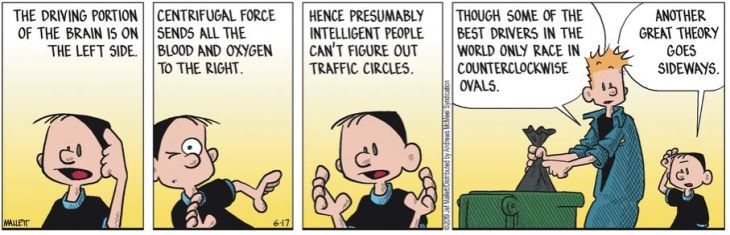
If you drive in clockwise circles, all the blood and oxygen will be pushed to your left side. If you drive in counterclockwise circles, it will be pushed to your right side.
Unnamed Child theorizes that the latter condition (in traffic circles) makes people bad drivers. Frazz is pointing out that the latter condition also occurs with race car drivers, who are good drivers. Unnamed Child acknowledges that this causes a problem for his theory.
1) Good driving has no real correlation to intelligence.
2) Traffic circles are an acquired skill, and driving them has absolutely nothing to do with intelligence (other than “intelligent people who are not comfortable with traffic circles will try to avoid them”).
so kids theory is fallacious and wrong. That doesn’t mean the kids theory is incomprehensible. And Frazz’s comment certainly a reasonable response to it.
What woozy said. I was explaining how “what Unnamed Child said and what Frazz said [are] even part of the same discussion,” not endorsing Unnamed Child’s theory.
Are drivers in the UK notably good at handling roundabouts?
Traffic circles are relatively new in Michigan (I now have half a dozen within a 6-mile radius of me– ten years ago, there weren’t any). Drivers– even experienced drivers– who aren’t used to them upon the first encounters are sometimes rather flummoxed by them– particularly when they show up in a place where they weren’t a few months ago. So unnamed student is trying to explain why these perfectly intelligent drivers seemed to have their brains turn to mush when they enter a traffic circle. Frazz pokes a hole in the theory.
If you grew up in New England (or old England, for that matter), this joke probably doesn’t work. I found it moderately funny.
My very first encounter with a roundabout was in rush hour traffic leaving the airport in Auckland, New Zealand. It was also my first time driving on the other side of the road, sitting on the other side of a car, so my thinking and perspective was totally bass ackwards. I had to zipper into traffic already in the circle. I’m still amazed I didn’t crash.
Counterclockwise means widdershins. Everyone knows that.
and clockwise just means deasil.
The theory is reasonable (if childlike) but the child shows a tremendous adult capacity by accepting it when corrected.
I might dispute Frazz’ correction, though. The best driving occurs in rally, not counterclockwise ovals. (The best drivers can be expected to be found where the best pay for drivers is found, not necessarily where the need for good driving is found.)
As a lifelong pedestrian and former bicyclist, I hate traffic circles. Drivers are all fixated on getting out at their exit (though they can just go around if they miss it, right?) that they’re not paying attention. Furthermore, a commonly stated “benefit” of traffic circles is they don’t slow traffic down like lights and stop signs. Deadly for a pedestrian.
I also hate right-turn-on-red laws as well. The law, as written, here in Ontario is:
“Right turn on a red light
Unless a sign tells you not to, you may make a right turn facing a red light as long as you first come to a complete stop and wait until the way is clear. Remember to signal your turn and yield to pedestrians and others using the road.”
In practice it is:
“Speed up and look continuously to your left to make sure a car isn’t coming and whip around that corner, turning right as fast as you can and you’ve got places to be!”
How bad the circle is depends on the circle. Up until about 5 years ago when one put in a main country road that we travel on in PA, I thought circles were horrible. Up until then I/we had only been on the huge ones with multiple lanes and one can not figure out which lane is going where plus having to cross the lanes to get into or out of the circle. (One near us has a part of the circle which goes into a dog leg and if one makes an error it will be half an hour at least before one can turn around and come back – and the smell of the sea at night – uwwww.)
Once this small circle appeared though – circles made sense. It so was so easy and simple to travel through the intersection – although it does take me reading the signs and figuring out where we are going while Robert drives. No having to switch lanes in and out of the center – no traffic lights controlling who can leave and enter and when.
So it really depends on the circle. (We will be using the nice small one in mid August when we return to the Goshenhoppen Festival through it again.)
“If the kid were so smart, he’d know that centrifugal force isn’t real. . .”
Besides, most people get stupid BEFORE entering the roundabout.
The main purpose of most traffic circles is to let non-locals know they aren’t welcome.
The secondary purpose of most traffic circles is to give locals something to feel smug about.
I don’t think I’ve ever encountered a multi-lane traffic circle here in Germany. They’re an excellent replacement for standard intersections and don’t seem to be deadly for pedestrians (as per Singapore Bill). Pedestrians have the right of way in German traffic circles and nobody is going so fast they can’t see people crossing.
I think a lot of Americans freak out about them, because they see the worst examples the UK has to offer, with multiple lanes and circles appended to circles and whatnot. My daughter who lived in Northern Ireland for a few years said they weren’t really that hard to adjust to. Meanwhile in Spain, up until recently if it isn’t still this way, the traffic circles didn’t have a set direction. Your exit is the first to the left, nobody’s coming and you don’t feel like driving 3/4 of the way around the circle? Go ahead and go clockwise.
@CIDU Bill, actually analog clocks and watches are far more popular than digital readouts at the moment. You’re actually some decades out of date thinking everyone buys numeric-face chronographs.
And as a one-time physics teacher: yes, of course centrifugal force is real. You can measure it easily. How could it be anything but real?
“I think a lot of Americans freak out about them, because they see the worst examples the UK has to offer”
On the other hand, I think a lot of Americans freak out about them because they never see them, so when they’re out of their regular circles (ha!) driving around in unfamiliar terrain, already worried about getting lost, they suddenly get confronted with this construct that they’re unfamiliar with and nobody else is slowing down or stopping. they just know what they’re supposed to do, and how they’re supposed to get to where they want to go. All these stressors land at the same exact time. Meanwhile, the people who do have experience with a traffic circle/rotary/roundabout aren’t stressed about them at all.
Once all the drivers in it are familiar with driving in one, roundabouts are faster than 4-way controlled stops. This is a thing that can be, and is, measured.
I don’t know about schools, but at MegaCorp the wall clocks were still the analog ones.
In my school days, classrooms had clocks with analog faces, but the hands did not move smoothly. The minute hand would jump ahead each minute, on a command sent from a control center in the office.
A traffic circle is not a roundabout.
A traffic circle is a multi-lane monstrosity with exits, intended to handle large volumes of traffic. Example: Carrier Circle in Syracuse, NY: https://goo.gl/maps/BED5a19p2Ko7bF117
Washington has a large number of traffic circles, because the diagonal “state” avenues frequently result in intersections with three or even four streets meeting at the same location. California has virtually no circles, so when some college friends went through D.C. on a road trip, they had a rude awakening at the first circle (with two lanes).
Back then, the lines were painted the way the traffic was “supposed” to move (according to the “rules”), which didn’t really match the way that everyone actually drove. By the time the driver figured out what was happening, he had already missed the exit to continue downtown. He continued around, but before he made it back to the correct exit, he figured, “Hey, this is fun!”, and decided to swing around for a third loop. That’s when a cop decided to stop him and find out what in the world he was doing.
The last time I was at that circle, I discovered that it had been relined to make the incoming and exiting paths along the “main drag” much closer to the way people actually drive that route.
@ Mitch4 – Germany uses that kind of clock for their entire train system. The second hand goes around in about 58 seconds, then waits at the twelve for the signal from the central high command, at which point the minute hand clicks forward by one, and the second hand starts swooping around for another 58-second trip.
@ DemetriosX – Pedestrians do not have right-of-way in German circles unless there is a “zebra” crosswalk specifically marked. However, many (if not most) German drivers will yield to a pedestrian, especially if the circumferential walkway is marked at the edges (but not “striped”).
P.S. There are a number of multi-lane circles in Berlin; the most well-known one is probably the “Großer Stern” that winds around the “Siegessäule” (Victory Column), but otherwise I agree with you, other than downtown Berlin, German circles are all single lane. I have seen ones in which a two-lane road leads into a single-lane circle; in which the right lane is simply a right turn into the next exit from the circle.
Powers, I’ve always heard “traffic circle” and “roundabout” used interchangeably, regardless of what might be technically correct.
What’s really confusing is that we have a “traffic circle” that’s actually a 5-way intersection: they dismantled the circle some 25 years ago when it was obvious the benefits didn’t outweigh the problems, but it kept the name. We moved here a few years later, and I couldn’t understand why people were saying things like “make a right turn at the traffic circle.”
Carlfink, it’s possible that that “analog clocks and watches are far more popular than digital readouts at the moment” is technically true, but that’s very misleading when most people get their time from their cell phones.
Kilby, you mean a human being literally sits in a room and does this manually?
“That’s when a cop decided to stop him and find out what in the world he was doing”
How DOES a cop pull somebody over on a traffic circle?
“How DOES a cop pull somebody over on a traffic circle?”
Lights. Siren. Bullhorn, maybe.
Thank you, James, but I meant where? There is no “side of the road,” and a high-speed chase isn’t practical.
Here’s a nice video of a van in the UK (17 miles from Norwich, it seems) failing to cope with a roundabout properly. Though apparently some people think it is a fake. Not sure why, looks legit to me. https://www.youtube.com/watch?v=xTk_kPeA63c
There was a TV documentary a few months ago, one where the docco crew follows the police through an investigation from the start as it unfolds (ie, not coming round them months or years after the fact just to interview them). In this one a man had left a night-time party to get more drinks or cigarettes, or something, and then disappeared. There was some CCTV footage of him at the off-licence, but instead of going back to the party he left the face of the earth. No other CCTV showing him anywhere else in the county/ country, he didn’t go back to his own home.
Only after a while (a few days I think) did someone report to the police that they had broken down on a large and wooded roundabout and noticed a crashed car in the foliage. Turns out the missing person had not gone back to the party but had headed towards his own home but not on the normal route. He had taken a fast dual carriageway and it was sufficiently uncrowded that no-one saw him deliberately accelerate towards the roundabout, launch into the air like the van above, and crash into a tree and then drop down out of sight into the bushes. Turns out he had various financial and other issues.
This is the above case as reported in the paper when it happened (the police, in the docco, pieced together more facts later on).
There is a difference between roundabouts and rotaries, at least in Massachusetts. Roundabouts are smaller and limited to 15 miles per hour. Rotaries are bigger and limited to 40 miles an hour.
Although I have been driving in Boston for many years, I am not a highly skilled Boston driver. A highly skilled Boston driver is the one who enters the rotary behind me and exits it in front of me. It happens every time.
My experience is that “highly skilled Boston Driver” is an oxymoron.
Re “highly skilled Boston Driver”: “The only way to win is not to play.”
I once cut off a Boston driver in Boston such that he was compelled to angrily honk at me — my proudest moment. Though I wonder if he would have angrily honked had I not had Pennsylvania plates…
And then, there’s this…
If you’re into cutting off, honking and confusing roundabouts (with zero painted lanes), Paris is the place for you!
@ Olivier – I remember driving into downtown Paris on a wide road along the river. The number of lanes varied between two and four, depending solely upon the width of the cars involved (there were no lane markings whatsoever). At the time I thought this was insane (I had not been in Boston before that), but I didn’t realize that it was the “normal” Parisian custom.
You’re talking about “les voies sur berge”(=bank ways); some sections have pavers (instead of tar) and painted lanes fade quickly on those, which is why there are no markings around the Arch of triumph either.
In Sicily, the roads are clearly painted but people drive as if there were none because if there’s enough room for three cars, why put only two? It’s even worse in Algeria: no lanes and if you can drive on it, then it’s a lane (hard shoulders and dividers included).
Naples also ignores lane markings. Plus you have Vespas lane-splitting and cutting across lanes at near right angles to change lanes. It was hair-raising and I was just sitting in a taxi.
The secret is to ignore whatever you can’t see through the windshield and front side windows: if it’s not in front of you, then it’s not your problem. Also, your horn is not used to insult but to warn other drivers: “Hi! I’m here!”
You quickly get used to it and since nobody’s got insurance, people are more careful than it looks.
Don’t try that in Florida – you’ll likely get shot!
The ‘Magic Roundabout’, or, ‘The Roundabout of Death’ . . .
Forget the ‘Roundabout of Death’ title – but the science behind the ‘Magic Roundabout’ is interesting.
Indeed. Looks a bit like Disneyland’s tea party ride. The general view is scary but I suppose that from inside, the shorter horizon makes it easier to negotiate. Solve the big unsolvable problem by parsing it into smaller, easy-to-solve, problems: it’s the finite element method.
And what kind of place is Swindon, in general? The speaker’s eyebrow-lifts when he says “Here in picturesque Swindon” raise the question. :-)
“Thank you, James, but I meant where?”
Well, that depends on where the next available safe place to pull over might be located. There are lots of occasions where a safe place to pull over isn’t available, so the driver is expected to continue on until one presents itself, then pull over. Bridges and construction zones come to mind as examples.
However, many (if not most) German drivers will yield to a pedestrian
In general, I think it’s a decent idea to refrain from running into pedestrians with a vehicle, if only to save on paperwork.
On a trip to Boston in the downtown/historic area we made a wrong turn. We then found no way to escape. Streets were one way or one could otherwise only turn in one direction and we circled back to the same spot twice before it was decided to ignore no turn to the side we needed and just go or we would still be circling there.
Meryl, that reminds me of this (which I had tomove to the Arlo Page).
And I didn’t even mention that we ended up in the red light district when we finally got out of the circling.
 Comics I Don't Understand
If you drive in clockwise circles, all the blood and oxygen will be pushed to your left side. If you drive in counterclockwise circles, it will be pushed to your right side.
Unnamed Child theorizes that the latter condition (in traffic circles) makes people bad drivers. Frazz is pointing out that the latter condition also occurs with race car drivers, who are good drivers. Unnamed Child acknowledges that this causes a problem for his theory.
1) Good driving has no real correlation to intelligence.
2) Traffic circles are an acquired skill, and driving them has absolutely nothing to do with intelligence (other than “intelligent people who are not comfortable with traffic circles will try to avoid them”).
so kids theory is fallacious and wrong. That doesn’t mean the kids theory is incomprehensible. And Frazz’s comment certainly a reasonable response to it.
What woozy said. I was explaining how “what Unnamed Child said and what Frazz said [are] even part of the same discussion,” not endorsing Unnamed Child’s theory.
Are drivers in the UK notably good at handling roundabouts?
Traffic circles are relatively new in Michigan (I now have half a dozen within a 6-mile radius of me– ten years ago, there weren’t any). Drivers– even experienced drivers– who aren’t used to them upon the first encounters are sometimes rather flummoxed by them– particularly when they show up in a place where they weren’t a few months ago. So unnamed student is trying to explain why these perfectly intelligent drivers seemed to have their brains turn to mush when they enter a traffic circle. Frazz pokes a hole in the theory.
If you grew up in New England (or old England, for that matter), this joke probably doesn’t work. I found it moderately funny.
My very first encounter with a roundabout was in rush hour traffic leaving the airport in Auckland, New Zealand. It was also my first time driving on the other side of the road, sitting on the other side of a car, so my thinking and perspective was totally bass ackwards. I had to zipper into traffic already in the circle. I’m still amazed I didn’t crash.
Counterclockwise means widdershins. Everyone knows that.
and clockwise just means deasil.
The theory is reasonable (if childlike) but the child shows a tremendous adult capacity by accepting it when corrected.
I might dispute Frazz’ correction, though. The best driving occurs in rally, not counterclockwise ovals. (The best drivers can be expected to be found where the best pay for drivers is found, not necessarily where the need for good driving is found.)
If the kid were so smart, he’d know that centrifugal force isn’t real and isn’t moving blood at all. It would be inertia the simulates that feeling. https://www.livescience.com/52488-centrifugal-centripetal-forces.html
As a lifelong pedestrian and former bicyclist, I hate traffic circles. Drivers are all fixated on getting out at their exit (though they can just go around if they miss it, right?) that they’re not paying attention. Furthermore, a commonly stated “benefit” of traffic circles is they don’t slow traffic down like lights and stop signs. Deadly for a pedestrian.
I also hate right-turn-on-red laws as well. The law, as written, here in Ontario is:
“Right turn on a red light
Unless a sign tells you not to, you may make a right turn facing a red light as long as you first come to a complete stop and wait until the way is clear. Remember to signal your turn and yield to pedestrians and others using the road.”
In practice it is:
“Speed up and look continuously to your left to make sure a car isn’t coming and whip around that corner, turning right as fast as you can and you’ve got places to be!”
How bad the circle is depends on the circle. Up until about 5 years ago when one put in a main country road that we travel on in PA, I thought circles were horrible. Up until then I/we had only been on the huge ones with multiple lanes and one can not figure out which lane is going where plus having to cross the lanes to get into or out of the circle. (One near us has a part of the circle which goes into a dog leg and if one makes an error it will be half an hour at least before one can turn around and come back – and the smell of the sea at night – uwwww.)
Once this small circle appeared though – circles made sense. It so was so easy and simple to travel through the intersection – although it does take me reading the signs and figuring out where we are going while Robert drives. No having to switch lanes in and out of the center – no traffic lights controlling who can leave and enter and when.
So it really depends on the circle. (We will be using the nice small one in mid August when we return to the Goshenhoppen Festival through it again.)
“If the kid were so smart, he’d know that centrifugal force isn’t real. . .”
Besides, most people get stupid BEFORE entering the roundabout.
The main purpose of most traffic circles is to let non-locals know they aren’t welcome.
The secondary purpose of most traffic circles is to give locals something to feel smug about.
I don’t think I’ve ever encountered a multi-lane traffic circle here in Germany. They’re an excellent replacement for standard intersections and don’t seem to be deadly for pedestrians (as per Singapore Bill). Pedestrians have the right of way in German traffic circles and nobody is going so fast they can’t see people crossing.
I think a lot of Americans freak out about them, because they see the worst examples the UK has to offer, with multiple lanes and circles appended to circles and whatnot. My daughter who lived in Northern Ireland for a few years said they weren’t really that hard to adjust to. Meanwhile in Spain, up until recently if it isn’t still this way, the traffic circles didn’t have a set direction. Your exit is the first to the left, nobody’s coming and you don’t feel like driving 3/4 of the way around the circle? Go ahead and go clockwise.
@CIDU Bill, actually analog clocks and watches are far more popular than digital readouts at the moment. You’re actually some decades out of date thinking everyone buys numeric-face chronographs.
And as a one-time physics teacher: yes, of course centrifugal force is real. You can measure it easily. How could it be anything but real?
“I think a lot of Americans freak out about them, because they see the worst examples the UK has to offer”
On the other hand, I think a lot of Americans freak out about them because they never see them, so when they’re out of their regular circles (ha!) driving around in unfamiliar terrain, already worried about getting lost, they suddenly get confronted with this construct that they’re unfamiliar with and nobody else is slowing down or stopping. they just know what they’re supposed to do, and how they’re supposed to get to where they want to go. All these stressors land at the same exact time. Meanwhile, the people who do have experience with a traffic circle/rotary/roundabout aren’t stressed about them at all.
Once all the drivers in it are familiar with driving in one, roundabouts are faster than 4-way controlled stops. This is a thing that can be, and is, measured.
I don’t know about schools, but at MegaCorp the wall clocks were still the analog ones.
In my school days, classrooms had clocks with analog faces, but the hands did not move smoothly. The minute hand would jump ahead each minute, on a command sent from a control center in the office.
A traffic circle is not a roundabout.
A traffic circle is a multi-lane monstrosity with exits, intended to handle large volumes of traffic. Example: Carrier Circle in Syracuse, NY: https://goo.gl/maps/BED5a19p2Ko7bF117
A roundabout is small, a replacement for a single signalized intersection with low-to-medium traffic volumes: https://flyavp.com/wp-content/uploads/2016/01/ra1.jpg
Washington has a large number of traffic circles, because the diagonal “state” avenues frequently result in intersections with three or even four streets meeting at the same location. California has virtually no circles, so when some college friends went through D.C. on a road trip, they had a rude awakening at the first circle (with two lanes).
Back then, the lines were painted the way the traffic was “supposed” to move (according to the “rules”), which didn’t really match the way that everyone actually drove. By the time the driver figured out what was happening, he had already missed the exit to continue downtown. He continued around, but before he made it back to the correct exit, he figured, “Hey, this is fun!”, and decided to swing around for a third loop. That’s when a cop decided to stop him and find out what in the world he was doing.
The last time I was at that circle, I discovered that it had been relined to make the incoming and exiting paths along the “main drag” much closer to the way people actually drive that route.
@ Mitch4 – Germany uses that kind of clock for their entire train system. The second hand goes around in about 58 seconds, then waits at the twelve for the signal from the central high command, at which point the minute hand clicks forward by one, and the second hand starts swooping around for another 58-second trip.
@ DemetriosX – Pedestrians do not have right-of-way in German circles unless there is a “zebra” crosswalk specifically marked. However, many (if not most) German drivers will yield to a pedestrian, especially if the circumferential walkway is marked at the edges (but not “striped”).
P.S. There are a number of multi-lane circles in Berlin; the most well-known one is probably the “Großer Stern” that winds around the “Siegessäule” (Victory Column), but otherwise I agree with you, other than downtown Berlin, German circles are all single lane. I have seen ones in which a two-lane road leads into a single-lane circle; in which the right lane is simply a right turn into the next exit from the circle.
Powers, I’ve always heard “traffic circle” and “roundabout” used interchangeably, regardless of what might be technically correct.
What’s really confusing is that we have a “traffic circle” that’s actually a 5-way intersection: they dismantled the circle some 25 years ago when it was obvious the benefits didn’t outweigh the problems, but it kept the name. We moved here a few years later, and I couldn’t understand why people were saying things like “make a right turn at the traffic circle.”
Carlfink, it’s possible that that “analog clocks and watches are far more popular than digital readouts at the moment” is technically true, but that’s very misleading when most people get their time from their cell phones.
Kilby, you mean a human being literally sits in a room and does this manually?
“That’s when a cop decided to stop him and find out what in the world he was doing”
How DOES a cop pull somebody over on a traffic circle?
“How DOES a cop pull somebody over on a traffic circle?”
Lights. Siren. Bullhorn, maybe.
Thank you, James, but I meant where? There is no “side of the road,” and a high-speed chase isn’t practical.
Here’s a nice video of a van in the UK (17 miles from Norwich, it seems) failing to cope with a roundabout properly. Though apparently some people think it is a fake. Not sure why, looks legit to me. https://www.youtube.com/watch?v=xTk_kPeA63c
There was a TV documentary a few months ago, one where the docco crew follows the police through an investigation from the start as it unfolds (ie, not coming round them months or years after the fact just to interview them). In this one a man had left a night-time party to get more drinks or cigarettes, or something, and then disappeared. There was some CCTV footage of him at the off-licence, but instead of going back to the party he left the face of the earth. No other CCTV showing him anywhere else in the county/ country, he didn’t go back to his own home.
Only after a while (a few days I think) did someone report to the police that they had broken down on a large and wooded roundabout and noticed a crashed car in the foliage. Turns out the missing person had not gone back to the party but had headed towards his own home but not on the normal route. He had taken a fast dual carriageway and it was sufficiently uncrowded that no-one saw him deliberately accelerate towards the roundabout, launch into the air like the van above, and crash into a tree and then drop down out of sight into the bushes. Turns out he had various financial and other issues.
This is the above case as reported in the paper when it happened (the police, in the docco, pieced together more facts later on).
https://www.mirror.co.uk/news/uk-news/young-dad-lay-dead-car-8772895
There is a difference between roundabouts and rotaries, at least in Massachusetts. Roundabouts are smaller and limited to 15 miles per hour. Rotaries are bigger and limited to 40 miles an hour.
Although I have been driving in Boston for many years, I am not a highly skilled Boston driver. A highly skilled Boston driver is the one who enters the rotary behind me and exits it in front of me. It happens every time.
My experience is that “highly skilled Boston Driver” is an oxymoron.
Re “highly skilled Boston Driver”: “The only way to win is not to play.”
I once cut off a Boston driver in Boston such that he was compelled to angrily honk at me — my proudest moment. Though I wonder if he would have angrily honked had I not had Pennsylvania plates…
And then, there’s this…

If you’re into cutting off, honking and confusing roundabouts (with zero painted lanes), Paris is the place for you!
@ Olivier – I remember driving into downtown Paris on a wide road along the river. The number of lanes varied between two and four, depending solely upon the width of the cars involved (there were no lane markings whatsoever). At the time I thought this was insane (I had not been in Boston before that), but I didn’t realize that it was the “normal” Parisian custom.
You’re talking about “les voies sur berge”(=bank ways); some sections have pavers (instead of tar) and painted lanes fade quickly on those, which is why there are no markings around the Arch of triumph either.
In Sicily, the roads are clearly painted but people drive as if there were none because if there’s enough room for three cars, why put only two? It’s even worse in Algeria: no lanes and if you can drive on it, then it’s a lane (hard shoulders and dividers included).
Naples also ignores lane markings. Plus you have Vespas lane-splitting and cutting across lanes at near right angles to change lanes. It was hair-raising and I was just sitting in a taxi.
The secret is to ignore whatever you can’t see through the windshield and front side windows: if it’s not in front of you, then it’s not your problem. Also, your horn is not used to insult but to warn other drivers: “Hi! I’m here!”
You quickly get used to it and since nobody’s got insurance, people are more careful than it looks.
Don’t try that in Florida – you’ll likely get shot!
The ‘Magic Roundabout’, or, ‘The Roundabout of Death’ . . .
Forget the ‘Roundabout of Death’ title – but the science behind the ‘Magic Roundabout’ is interesting.
Indeed. Looks a bit like Disneyland’s tea party ride. The general view is scary but I suppose that from inside, the shorter horizon makes it easier to negotiate. Solve the big unsolvable problem by parsing it into smaller, easy-to-solve, problems: it’s the finite element method.
And what kind of place is Swindon, in general? The speaker’s eyebrow-lifts when he says “Here in picturesque Swindon” raise the question. :-)
“Thank you, James, but I meant where?”
Well, that depends on where the next available safe place to pull over might be located. There are lots of occasions where a safe place to pull over isn’t available, so the driver is expected to continue on until one presents itself, then pull over. Bridges and construction zones come to mind as examples.
However, many (if not most) German drivers will yield to a pedestrian
In general, I think it’s a decent idea to refrain from running into pedestrians with a vehicle, if only to save on paperwork.
On a trip to Boston in the downtown/historic area we made a wrong turn. We then found no way to escape. Streets were one way or one could otherwise only turn in one direction and we circled back to the same spot twice before it was decided to ignore no turn to the side we needed and just go or we would still be circling there.
Meryl, that reminds me of this (which I had tomove to the Arlo Page).
And I didn’t even mention that we ended up in the red light district when we finally got out of the circling.