Even though (or perhaps “because”) there’s nothing “nosy” about it, I liked the “family tree” joke better than the other two.
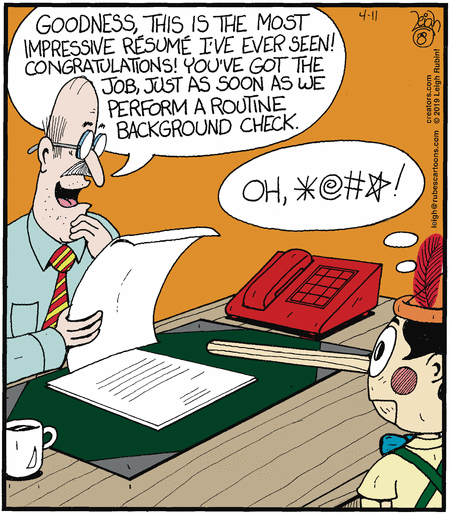
P.S. @ Bill – Did you use the evasive description (“little wooden boy”) to avoid committing a typo in his real name, or was it because you were afraid to arouse ideological spelling arguments along the lines of “(C)Han(n)uk(k)a(h)“?
The name Pinocchio is unambiguous (it has a single, latin-script source, ie. Collodis novel).
It is easy to google and cut-and-paste. So I don’t think Bill avoided the name for those reasons. Perhaps he was afraid to be sued by Disney?
I like how different the visual interpretations of Pinocchio are.
And all the different interpretations are pretty easily recognized as Pinocchio, even without the long nose. Well done by the artists, especially the second, who interprets the Disney version as an adult quite well.
It was just an artistic decision: after all, if I’d been uncertain how to spell his name, it wouldn’t be in the tags.
Soup Dragon, does this look like the web site of somebody who’s paranoid over being sued for copyright violation?
@ Andrèa – Well, if the spelling of his singular name is unquestionable, I sure can’t pass up the chance to exercise some creative orthography when confronted with three of them. How about “Pinocchii“?
Wrong accent, Kilby (accent grave) . . . try the other way (accent acute) . . . and I don’t think I mentioned the spelling of Pinocchio anywhere, did I? BUT I think Pinocchii would be correct.
And frankly, ONE is creepy enough!
@ Andréa – You didn’t mention it explicitly, but the way the sentence was composed, the reference to the name could be interpreted as singular or plural.
P.S. @ Áńdréá – the one time I mess up the accent, I get called out on it. If I used a standard US keyboard, I wouldn’t be able to type any accents at all (other than using cut & paste from another source). The “international” layouts make it fairly easy to “compose” accented letters. I have to keep track of different rules for Windows and Mac, but “acute” and “grave” are separate keys, so it’s hard to mistake them.
What I really dislike is having to pick out the correct character on the iOS keyboard. Tap and hold on the vowel, and you get six or seven alternatives, most of which I will never ever need. I wish there was a way to edit the keyboard, so that it shows only the ones that I want.
For Windows, you’d have to write up a little chart to remember all the combinations, but holding Alt and using the numbers on the keypad, alt-0233 is é and alt-0223 is ß and so on.
@ MiB – I did exactly that for a while back when Windows 95 was still around, but soon discovered that the “US International” layout was much easier to manage and remember.
P.S. The initial “alt” number system had only three digits; I believe that the corresponding encoding for “ß” (originally Greek “beta”) was “Alt+225”.
ß and β are different characters.
ß=U+00DF
β=U+03B2
@ jajizi – That may be true in Unicode, but back in the days of IBM codepages (437 & 850) there was no distinction.
I guess that’s like some old typewriters where if it looks similar, good enough. I can remember being told to type lower-case L for 1 (one), and apostrophe-back space-period for !.
“ß and β are different characters.”
Yes, but which is which? As a German speaker, I would accept either as sz (excuse me, “scharfes S”); in fact, if I didn’t know that the first one was the actual one, I’d pick the second one as sz, because the descender reminds me more of the ligature I see in print and street signs. Of course, I’d also pick that one as beta because clearly the first one where the lines don’t connect can’t be beta… So maybe I’m just a product of the time when beta and sz where indistinguishable on typed text?


 Comics I Don't Understand
Even though (or perhaps “because”) there’s nothing “nosy” about it, I liked the “family tree” joke better than the other two.
P.S. @ Bill – Did you use the evasive description (“little wooden boy”) to avoid committing a typo in his real name, or was it because you were afraid to arouse ideological spelling arguments along the lines of “(C)Han(n)uk(k)a(h)“?
The name Pinocchio is unambiguous (it has a single, latin-script source, ie. Collodis novel).
It is easy to google and cut-and-paste. So I don’t think Bill avoided the name for those reasons. Perhaps he was afraid to be sued by Disney?
I like how different the visual interpretations of Pinocchio are.
And all the different interpretations are pretty easily recognized as Pinocchio, even without the long nose. Well done by the artists, especially the second, who interprets the Disney version as an adult quite well.
It was just an artistic decision: after all, if I’d been uncertain how to spell his name, it wouldn’t be in the tags.
Soup Dragon, does this look like the web site of somebody who’s paranoid over being sued for copyright violation?
@ Andrèa – Well, if the spelling of his singular name is unquestionable, I sure can’t pass up the chance to exercise some creative orthography when confronted with three of them. How about “Pinocchii“?
Wrong accent, Kilby (accent grave) . . . try the other way (accent acute) . . . and I don’t think I mentioned the spelling of Pinocchio anywhere, did I? BUT I think Pinocchii would be correct.
And frankly, ONE is creepy enough!
@ Andréa – You didn’t mention it explicitly, but the way the sentence was composed, the reference to the name could be interpreted as singular or plural.
P.S. @ Áńdréá – the one time I mess up the accent, I get called out on it. If I used a standard US keyboard, I wouldn’t be able to type any accents at all (other than using cut & paste from another source). The “international” layouts make it fairly easy to “compose” accented letters. I have to keep track of different rules for Windows and Mac, but “acute” and “grave” are separate keys, so it’s hard to mistake them.
What I really dislike is having to pick out the correct character on the iOS keyboard. Tap and hold on the vowel, and you get six or seven alternatives, most of which I will never ever need. I wish there was a way to edit the keyboard, so that it shows only the ones that I want.
For Windows, you’d have to write up a little chart to remember all the combinations, but holding Alt and using the numbers on the keypad, alt-0233 is é and alt-0223 is ß and so on.
@ MiB – I did exactly that for a while back when Windows 95 was still around, but soon discovered that the “US International” layout was much easier to manage and remember.
P.S. The initial “alt” number system had only three digits; I believe that the corresponding encoding for “ß” (originally Greek “beta”) was “Alt+225”.
ß and β are different characters.
ß=U+00DF
β=U+03B2
@ jajizi – That may be true in Unicode, but back in the days of IBM codepages (437 & 850) there was no distinction.
I guess that’s like some old typewriters where if it looks similar, good enough. I can remember being told to type lower-case L for 1 (one), and apostrophe-back space-period for !.
“ß and β are different characters.”
Yes, but which is which? As a German speaker, I would accept either as sz (excuse me, “scharfes S”); in fact, if I didn’t know that the first one was the actual one, I’d pick the second one as sz, because the descender reminds me more of the ligature I see in print and street signs. Of course, I’d also pick that one as beta because clearly the first one where the lines don’t connect can’t be beta… So maybe I’m just a product of the time when beta and sz where indistinguishable on typed text?