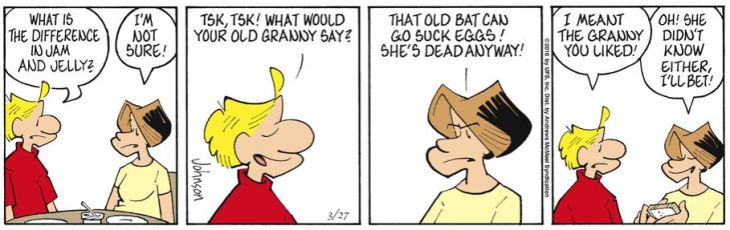
Is this a regionalism, or did Jimmy intend to write “between” and somehow it came out “in”?
Related
29 Comments
I wonder if the size of the word balloon chose for him. Maybe he letters his balloons in a weird way, and suddenly thought “There’s no room for ‘between.’ What else would work?”
Could it just be a Southern quirk?
Yes, it’s Southern. I’ve heard it all my life here in the South.
Interesting. Do you use “in” more generally when non-Southerners would use “between,” e.g. “in a rock and a hard place,” “in you and me,” or specifically with “difference?”
I’ve heard it. I always thought it sounded weird but I’ve heard weirder. “Outside of a dog, a book is a man’s best friend” is very weird when you think of it.
And in a logical diagramming sentences and analysis way it kind of makes sense. “Here is a list of items. Among the items of the list there is a difference, the difference in jam and jelly is…” …. Mmmm, maybe not.
I won’t try to find it, but in one of Theodore Bernstein’s books on language he discusses prepositions. I believe he says that, for the most part, which preposition is used with which other words is much more tradition-based than meaning-based. He goes so far as to list which prepositions are used with various words he’s defining (and defining the usage of).
Also have you noticed one big prepositional difference between America and England? Properly (here) something is different FROM something else, though common usage allows THAN. Brits say something is different TO something else. It used to be jarring to hear that from Brit radio people.
“Interesting. Do you use “in” more generally when non-Southerners would use “between,” e.g. “in a rock and a hard place,” “in you and me,” or specifically with “difference?” ”
Actually I don’t use it. It sounds a bit weird to me, too. But I’ve heard it a lot. It’s only used with difference, I think.
To me it’s like northerners leaving out the preposition in “graduate college”. Just sounds weird.
I haven’t Googled it as I am at work, but I have heard the question “what is the difference between jelly and jam?” as a joke with a very inappropriate (or funny – you judge) response.
My (mostly-California-rasied) spouse always chides me when I say “I need to put gas on the car,” insisting (logically enough) that it should be “in.” But it seems to me I’ve heard other Minnesotans (at least) use “on” int hat instance all my life. Anyone else familiar with that usage or am I just a weirdo?
(And yes, I realized that last sentence should offer the option “and/or”. . . .)
Lots of New York verbal tics I had to edit out of my speech when raising a couple of New Jersey boys (and that wasn’t even counting the suppression of my normal accent).
“Outside of a dog, a book is a man’s best friend”
Inside of a dog, it’s too dark to read. — Groucho Marx
What’s weird about it? “Outside” here meaning ‘other than’, but to make the quote complete with ‘inside of a dog, . . . ‘, ‘outside’ was used. Is that clear as mud?
I think of “in” for “between” as archaic rather than regional, but I have certainly encountered it before.
“What’s weird about it? “Outside” here meaning ‘other than’, ”
And that’s weird. “outside” doesn’t mean “other than”.
woozy: Using “outside” to mean “other than”=”except” seems perfectly cromulent to me.
outside preposition
Definition of outside (Entry 4 of 4)
1…
2…
3 : EXCEPT
@woozy – Not my idiom, but one I’ve heard quite a bit – I’d be more likely to say “aside from”. Aside from chocolate and peanut butter, what are common candy combinations? (I’ve already thought of chocolate and peanut butter, give me some other examples). I can see it being said “Outside chocolate and peanut butter…”
“And that’s weird. ‘outside’ doesn’t mean ‘other than’.”
It does in a Venn diagram.
“My (mostly-California-rasied) spouse always chides me when I say “I need to put gas on the car,” insisting (logically enough) that it should be “in.””
It’s because they’re used to “put on” meaning “load”. Passengers go inside the train, but the train stops at the station to put on passengers AND coal.
Your wife is mad at you for splitting an infinitive.
@James Pollock: Fair enough as an explanation, but I wish to make clear that my wife isn’t “mad” at me, just “amused” at me. (As I often am at myself, myself, for that matter.)
outside of
phrase of outside
North American
apart from.
“outside of his family, nobody cares too much about him”
Growing up in the South, I didn’t even blink at the usage. Perfectly natural, but I will say that I haven’t heard it used that way in quite awhile, (of course, I haven’t spent much time in the South, lately, either.). I’ve also only heard it with difference. And Steve, the joke makes use of the fact that “jam” is also a verb. It doesn’t necessarily have to be a dirty joke, but it certainly is.
I have been surprised to find that many people do not know the difference between jam and jelly, or for that matter among all the other things in those jars like marmalade, preserves, compotes and conserves. (“Among”, right? 3 or more? “The difference between jam and jelly” and “The difference among jam, jelly and preserves”.) For the record, jelly is strained when making it; it has no pulp and you can see a light shine through it. Jam is not strained, has fruit pulp and generally doesn’t let the light through.
“It must be jelly, ’cause jam don’t shake like that.”
As I see it, using “in” means treating what follows as a single unit: “jam and jelly” and referring to possible variances within that single unit. Then, using “between” treats what follows as separate entities: “jam” and “jelly”, referring to possible variances found in one unit but not the other.
For the record, jelly is strained when making it; it has no pulp and you can see a light shine through it. Jam is not strained, has fruit pulp and generally doesn’t let the light through.
In the US, of course. If it has whole or large pieces of fruit, then it’s preserves. In the UK, “jelly” is gelatin dessert, like Jell-o.
“I wish to make clear that my wife isn’t “mad” at me, just “amused” at me. ”
If you say so. I mean no offense to either of you…
Dylan Thomas, from ‘A Child’s Christmas in Wales’: “‘Let’s go in and see if there’s any jelly left,’ Jack said. And we did that.” It’s treated as a dessert.
“It’s treated as a dessert.”
Today, you can go down to the gracery store and buy fruit pretty much any day you want some. But in the olden times, you got fruit in season, and only in season. And ice cream was only for royalty.
One of the things I find hard about learning foreign languages is that in, say, Spanish, ‘en’ is used for on, in, atop, at and probably a bunch of other things I haven’t figured out yet. I never know when to use which one, because it’s fairly idiomatic. If you ask why one is right and another wrong, you get a shrug and, “It just is.”
Mark in Boston – the gocomics comments on this strip go on and on arguing about the difference between jam and jelly, picking up preserves, conserves, etc. in the discussion.
As mentioned (and I posted on the gocomics list) before refrigeration food had to be preserved in some manner or there would be nothing to eat during the winter. The idea that foods are not naturally a year round thing seems totally strange to some people. (Then again – when posting on many lists I have to figure out alternative words for many Yiddish expressions that come to my head automatically – glad that doesn’t happen here.)
I posted about the problems in the preserving foods for the winter – meats smoked or dried. Oh, I did not mention there – no eggs in winter. I was surprised to find this out myself when reading about food in the 1700s. Produce had to be preserved also – no lettuce in January, tomatoes cooked and stored. Potatoes, carrots and apples in the root cellar.
Canning (basically sterilizing food) was not invented until the time of the Napoleonic wars. Before that food was stored in ceramic or glass jars and bottles with a wax seal on the top opening. During the Napoleonic wars someone came up with the idea of boiling the food in old wine bottles to keep it and make it easier to feed the army. Now some foods are put into glass jars which are put in boiling water bath (both before use and to sterilize the food – these foods have to have a high or low PH. Foods on the center of the PH scale needs to be pressure cooked to be safe.
 Comics I Don't Understand
I wonder if the size of the word balloon chose for him. Maybe he letters his balloons in a weird way, and suddenly thought “There’s no room for ‘between.’ What else would work?”
Could it just be a Southern quirk?
Yes, it’s Southern. I’ve heard it all my life here in the South.
Interesting. Do you use “in” more generally when non-Southerners would use “between,” e.g. “in a rock and a hard place,” “in you and me,” or specifically with “difference?”
I’ve heard it. I always thought it sounded weird but I’ve heard weirder. “Outside of a dog, a book is a man’s best friend” is very weird when you think of it.
And in a logical diagramming sentences and analysis way it kind of makes sense. “Here is a list of items. Among the items of the list there is a difference, the difference in jam and jelly is…” …. Mmmm, maybe not.
I won’t try to find it, but in one of Theodore Bernstein’s books on language he discusses prepositions. I believe he says that, for the most part, which preposition is used with which other words is much more tradition-based than meaning-based. He goes so far as to list which prepositions are used with various words he’s defining (and defining the usage of).
Also have you noticed one big prepositional difference between America and England? Properly (here) something is different FROM something else, though common usage allows THAN. Brits say something is different TO something else. It used to be jarring to hear that from Brit radio people.
“Interesting. Do you use “in” more generally when non-Southerners would use “between,” e.g. “in a rock and a hard place,” “in you and me,” or specifically with “difference?” ”
Actually I don’t use it. It sounds a bit weird to me, too. But I’ve heard it a lot. It’s only used with difference, I think.
To me it’s like northerners leaving out the preposition in “graduate college”. Just sounds weird.
I haven’t Googled it as I am at work, but I have heard the question “what is the difference between jelly and jam?” as a joke with a very inappropriate (or funny – you judge) response.
My (mostly-California-rasied) spouse always chides me when I say “I need to put gas on the car,” insisting (logically enough) that it should be “in.” But it seems to me I’ve heard other Minnesotans (at least) use “on” int hat instance all my life. Anyone else familiar with that usage or am I just a weirdo?
(And yes, I realized that last sentence should offer the option “and/or”. . . .)
Lots of New York verbal tics I had to edit out of my speech when raising a couple of New Jersey boys (and that wasn’t even counting the suppression of my normal accent).
“Outside of a dog, a book is a man’s best friend”
Inside of a dog, it’s too dark to read. — Groucho Marx
What’s weird about it? “Outside” here meaning ‘other than’, but to make the quote complete with ‘inside of a dog, . . . ‘, ‘outside’ was used. Is that clear as mud?
I think of “in” for “between” as archaic rather than regional, but I have certainly encountered it before.
“What’s weird about it? “Outside” here meaning ‘other than’, ”
And that’s weird. “outside” doesn’t mean “other than”.
woozy: Using “outside” to mean “other than”=”except” seems perfectly cromulent to me.
https://www.merriam-webster.com/dictionary/outside
outside preposition
Definition of outside (Entry 4 of 4)
1…
2…
3 : EXCEPT
@woozy – Not my idiom, but one I’ve heard quite a bit – I’d be more likely to say “aside from”. Aside from chocolate and peanut butter, what are common candy combinations? (I’ve already thought of chocolate and peanut butter, give me some other examples). I can see it being said “Outside chocolate and peanut butter…”
“And that’s weird. ‘outside’ doesn’t mean ‘other than’.”
It does in a Venn diagram.
“My (mostly-California-rasied) spouse always chides me when I say “I need to put gas on the car,” insisting (logically enough) that it should be “in.””
It’s because they’re used to “put on” meaning “load”. Passengers go inside the train, but the train stops at the station to put on passengers AND coal.
Your wife is mad at you for splitting an infinitive.
@James Pollock: Fair enough as an explanation, but I wish to make clear that my wife isn’t “mad” at me, just “amused” at me. (As I often am at myself, myself, for that matter.)
outside of
phrase of outside
North American
apart from.
“outside of his family, nobody cares too much about him”
Growing up in the South, I didn’t even blink at the usage. Perfectly natural, but I will say that I haven’t heard it used that way in quite awhile, (of course, I haven’t spent much time in the South, lately, either.). I’ve also only heard it with difference. And Steve, the joke makes use of the fact that “jam” is also a verb. It doesn’t necessarily have to be a dirty joke, but it certainly is.
I have been surprised to find that many people do not know the difference between jam and jelly, or for that matter among all the other things in those jars like marmalade, preserves, compotes and conserves. (“Among”, right? 3 or more? “The difference between jam and jelly” and “The difference among jam, jelly and preserves”.) For the record, jelly is strained when making it; it has no pulp and you can see a light shine through it. Jam is not strained, has fruit pulp and generally doesn’t let the light through.
“It must be jelly, ’cause jam don’t shake like that.”
As I see it, using “in” means treating what follows as a single unit: “jam and jelly” and referring to possible variances within that single unit. Then, using “between” treats what follows as separate entities: “jam” and “jelly”, referring to possible variances found in one unit but not the other.
For the record, jelly is strained when making it; it has no pulp and you can see a light shine through it. Jam is not strained, has fruit pulp and generally doesn’t let the light through.
In the US, of course. If it has whole or large pieces of fruit, then it’s preserves. In the UK, “jelly” is gelatin dessert, like Jell-o.
“I wish to make clear that my wife isn’t “mad” at me, just “amused” at me. ”
If you say so. I mean no offense to either of you…
Dylan Thomas, from ‘A Child’s Christmas in Wales’: “‘Let’s go in and see if there’s any jelly left,’ Jack said. And we did that.” It’s treated as a dessert.
“It’s treated as a dessert.”
Today, you can go down to the gracery store and buy fruit pretty much any day you want some. But in the olden times, you got fruit in season, and only in season. And ice cream was only for royalty.
One of the things I find hard about learning foreign languages is that in, say, Spanish, ‘en’ is used for on, in, atop, at and probably a bunch of other things I haven’t figured out yet. I never know when to use which one, because it’s fairly idiomatic. If you ask why one is right and another wrong, you get a shrug and, “It just is.”
Mark in Boston – the gocomics comments on this strip go on and on arguing about the difference between jam and jelly, picking up preserves, conserves, etc. in the discussion.
As mentioned (and I posted on the gocomics list) before refrigeration food had to be preserved in some manner or there would be nothing to eat during the winter. The idea that foods are not naturally a year round thing seems totally strange to some people. (Then again – when posting on many lists I have to figure out alternative words for many Yiddish expressions that come to my head automatically – glad that doesn’t happen here.)
I posted about the problems in the preserving foods for the winter – meats smoked or dried. Oh, I did not mention there – no eggs in winter. I was surprised to find this out myself when reading about food in the 1700s. Produce had to be preserved also – no lettuce in January, tomatoes cooked and stored. Potatoes, carrots and apples in the root cellar.
Canning (basically sterilizing food) was not invented until the time of the Napoleonic wars. Before that food was stored in ceramic or glass jars and bottles with a wax seal on the top opening. During the Napoleonic wars someone came up with the idea of boiling the food in old wine bottles to keep it and make it easier to feed the army. Now some foods are put into glass jars which are put in boiling water bath (both before use and to sterilize the food – these foods have to have a high or low PH. Foods on the center of the PH scale needs to be pressure cooked to be safe.