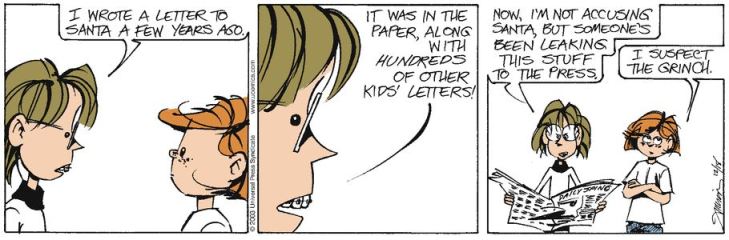
…considering she seems to still believe in Santa Claus:
Related
13 Comments
I think this is a somewhat rhetorical “CIDU,” but the explanation is that newspaper comics don’t want to directly reveal that (spoiler alert) Santa Claus isn’t real. So the treatment of kids old enough to know that he’s not is going to end up being a bit inconsistent, and jokes based on the fact that he’s not are going to be based on things a little more subtle, like an eye roll.
Because she’s so jaded and world-wise that she knows that not everyone is working on Santa’s agenda — she is so sophisticated that she knows that the Grinch tried to steal Christmas; pfft! this leaking of documents is right up his alley.
Kids learn to affect irony and act knowingly long before they actually know much; in fact, I think a lot of adults put on a knowing tough-guy front who still haven’t learned much about how the world really works.
(In 12th grade — senior year! — no one (apart from me and my friend who were both jumped up a grade) knew or could give a definition of a paradox — they kept giving definitions along the lines of “it’s when you say one thing but mean another”; I think these babes-in-the-woods quickly jumped from tentative attempts at sarcasm right into full-blown cynicism when they hit the real world, never getting to delve into the finer shades of irony; all year the teacher had been offering extra credit for anyone who brought in real world examples of irony, though the results were dismal — when the Alanis’ song came out a few years later, it struck me as exactly the kind of extra credit efforts my classmates had been putting in all year — a whole generation great at affecting irony without understanding exactly what it is…)
larK. It’s funny… Every now and then the comes a term that gets bandied around with the general impression its a term from high school english they assumed no really understood very well and we find very surprising because we assumed it was simple and straight forward. 20 years ago it was “irony”. 7 years ago it was “metaphor”. This year it is verb tenses and diagramming sentences.
I think the second strip can be made compatible with the first by the rationale that in the second one, Teena is humoring Stick, the way parents (who know) discuss the matter with children (who don’t). Or, the way older siblings who know pretend not to in order to avoid spoiling the secret for younger sibs.
My own offspring unit worked out the truth on her own, but didn’t let on because she figured it was in her best interest to still be in the “believer” category. I consider this a win in the “teach her critical reasoning” category.
Teena is actually less confusing than Stick, here, to me. It’s been a few years since I’ve read PreTeena, but I remember that Stick is Jewish, which fits with her not actually grasping how Santa works in the second one. So, why was she sending a letter to Santa, again?
Yes, “Stick”, née Sabra Klein, is Jewish.
I remember reading a rant by someone about irony, claiming that it is strictly a literary device. If characters in a novel are getting married in an outdoor wedding and it rains, that’s ironic, but if it happens in real life it’s just a misfortune. So this person would say there are no real world examples of irony.
I like Dr. Johnson’s definition if “irony”: A mode of speech in which the meaning is contrary to the words; as, “Bolingbroke was a holy man.”
I like Baldrick’s definition of “Irony”: It’s like bronzey and goldy .
Perhaps no other critical label has been made to cover more ground than “irony,” and in our time irony has come to have so many meanings that by itself it means almost nothing. In this work, Wayne C. Booth cuts through the resulting confusions by analyzing how we manage to share quite specific…
I agree that about 20 years ago was the heyday for putting the “irony” label on everything. But you still see remarks about wearing something ironically. And meanies who go in for nasty sarcasm still pass it off as simply irony.
irony: the opposite of wrinkly.
Winter Wallaby – Husband still thinks he exists. Husband buys what he wants for Christmas and then Santa has to leave it under the tree for him.
When I was a little kid (before age 5) I would get gifts from Santa, despite being Jewish. We did not have a tree, etc. except I had a small Styrofoam Santa and another of a reindeer. In our apartment we did not have a fireplace or chimney. My parents told me that when this is the case Santa comes out of the (big console with doors) TV. So I would put my two decorations on the TV and in the morning there would be maybe 3 presents.
Years late at one of our weddings my mother was talking to an older gentleman who was thanking her for inviting him and my mom replied to him that he always comes for sad occasions, so how could she not invite for happy ones. I found out that he was one of my Santas. He was the foreman of the factory my grandfather owned and would give grandfather a Christmas gift for me when I was little. The other gifts, I found out at the same time, came from clients of my fathers.
So I actually met Santa and he looked like a normal old man.

 Comics I Don't Understand
I think this is a somewhat rhetorical “CIDU,” but the explanation is that newspaper comics don’t want to directly reveal that (spoiler alert) Santa Claus isn’t real. So the treatment of kids old enough to know that he’s not is going to end up being a bit inconsistent, and jokes based on the fact that he’s not are going to be based on things a little more subtle, like an eye roll.
Because she’s so jaded and world-wise that she knows that not everyone is working on Santa’s agenda — she is so sophisticated that she knows that the Grinch tried to steal Christmas; pfft! this leaking of documents is right up his alley.
Kids learn to affect irony and act knowingly long before they actually know much; in fact, I think a lot of adults put on a knowing tough-guy front who still haven’t learned much about how the world really works.
(In 12th grade — senior year! — no one (apart from me and my friend who were both jumped up a grade) knew or could give a definition of a paradox — they kept giving definitions along the lines of “it’s when you say one thing but mean another”; I think these babes-in-the-woods quickly jumped from tentative attempts at sarcasm right into full-blown cynicism when they hit the real world, never getting to delve into the finer shades of irony; all year the teacher had been offering extra credit for anyone who brought in real world examples of irony, though the results were dismal — when the Alanis’ song came out a few years later, it struck me as exactly the kind of extra credit efforts my classmates had been putting in all year — a whole generation great at affecting irony without understanding exactly what it is…)
larK. It’s funny… Every now and then the comes a term that gets bandied around with the general impression its a term from high school english they assumed no really understood very well and we find very surprising because we assumed it was simple and straight forward. 20 years ago it was “irony”. 7 years ago it was “metaphor”. This year it is verb tenses and diagramming sentences.
I think the second strip can be made compatible with the first by the rationale that in the second one, Teena is humoring Stick, the way parents (who know) discuss the matter with children (who don’t). Or, the way older siblings who know pretend not to in order to avoid spoiling the secret for younger sibs.
My own offspring unit worked out the truth on her own, but didn’t let on because she figured it was in her best interest to still be in the “believer” category. I consider this a win in the “teach her critical reasoning” category.
Teena is actually less confusing than Stick, here, to me. It’s been a few years since I’ve read PreTeena, but I remember that Stick is Jewish, which fits with her not actually grasping how Santa works in the second one. So, why was she sending a letter to Santa, again?
Yes, “Stick”, née Sabra Klein, is Jewish.
I remember reading a rant by someone about irony, claiming that it is strictly a literary device. If characters in a novel are getting married in an outdoor wedding and it rains, that’s ironic, but if it happens in real life it’s just a misfortune. So this person would say there are no real world examples of irony.
I like Dr. Johnson’s definition if “irony”: A mode of speech in which the meaning is contrary to the words; as, “Bolingbroke was a holy man.”
I like Baldrick’s definition of “Irony”: It’s like bronzey and goldy .
https://www.press.uchicago.edu/ucp/books/book/chicago/R/bo3616229.html
Perhaps no other critical label has been made to cover more ground than “irony,” and in our time irony has come to have so many meanings that by itself it means almost nothing. In this work, Wayne C. Booth cuts through the resulting confusions by analyzing how we manage to share quite specific…
I agree that about 20 years ago was the heyday for putting the “irony” label on everything. But you still see remarks about wearing something ironically. And meanies who go in for nasty sarcasm still pass it off as simply irony.
irony: the opposite of wrinkly.
Winter Wallaby – Husband still thinks he exists. Husband buys what he wants for Christmas and then Santa has to leave it under the tree for him.
When I was a little kid (before age 5) I would get gifts from Santa, despite being Jewish. We did not have a tree, etc. except I had a small Styrofoam Santa and another of a reindeer. In our apartment we did not have a fireplace or chimney. My parents told me that when this is the case Santa comes out of the (big console with doors) TV. So I would put my two decorations on the TV and in the morning there would be maybe 3 presents.
Years late at one of our weddings my mother was talking to an older gentleman who was thanking her for inviting him and my mom replied to him that he always comes for sad occasions, so how could she not invite for happy ones. I found out that he was one of my Santas. He was the foreman of the factory my grandfather owned and would give grandfather a Christmas gift for me when I was little. The other gifts, I found out at the same time, came from clients of my fathers.
So I actually met Santa and he looked like a normal old man.