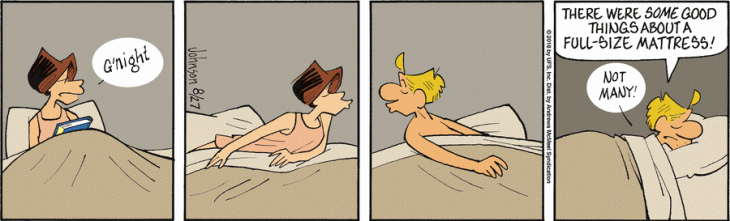
They could sleep next to each other but that makes for a long trip to get out of bed.
She LIKES her space.
In theory I agree with you Bill. But bear in mind that I can’t stand sleeping in a Queen size bed on my own (or at least, I couldn’t before I got married – I have only once decamped for a smaller bed when my husband was away). I can’t comment on how exactly that scales up to a couple in a bed that’s bigger than they need, because we only have a Queen, which is really pushing it for the two of us (he’s huge, and we both sleep sprawled). There’s also the fact that you have to intentionally move to the centre, instead of just staying at the edge, even if you wanted to (Kevin makes a good point)
I still have some trouble recognizing that “full size” is just a point on a scale and not really a description. I know it is not the largest, but still have trouble with the dialogue here — if they don’t have full size, they must have something smaller, no? Then the remarks make no sense.
Size Dimensions
King » 76″ x 80″
Cal King » 72″ x 84″
Queen » 60″ x 80″
Full XL » 53″ x 80″
Full » 53″ x 75″
Twin XL » 38″ x 80″
Twin » 38″ x 75″
“Double” is apparently an obsolete term, equivalent to “full”.
I also remember a “Hollywood” bed size — I don’t think it was like the “Cal King” above.
Yes, they’d have to make the effort to move alllllllll the way to the center… but if sleeping closer to one another is important enough to kvetch about, it’s presumably worth the effort.
And if not, then not.
James – her liking her space would definitely explain why they disagree over whether or not there were advantages.
Bill – I’ve been known to complain when something changes about the fact that I have to make an effort now. It’s not the effort that I mind, it’s that it exists at all when it didn’t before. Totally worth doing, but I used to not have to think about it. (Then again, I’m the kind of person who wears their hair long for convenience. My standards for “easy” and “worth it” are different than other people’s)
@ Mitch4 – Mattress dimensions look very capricious and random when presented in inches. German dimensions are (of course) metric, normally in increments of 10 centimeters. A typical “twin-like” mattress is usually 190 or 200 cm long, and 90 or 100 cm wide (approx. 37″ x 77″, depending).
Another major difference is that “queen” and “king” type mattresses are extremely rare (virtually non-existent). Bedframes in those sizes are normally filled with two separate “twin” type mattresses, each with exactly half the width of the entire frame. Box springs are also close to unknown here. Most beds use a “rack frame” of flexible wooden slats.
There “were” some good things about full size – so now they have a larger size. The good things were being able to kiss and do other arlo-y things more easily. But now they have a lot more space for actually sleeping comfortably, which per Arlo’s “not many” outweighs the benefits of a full sized bed.
“I’m sorry, you have to say ‘dog kennel’ to Mr Lambert, because if you say ‘mattress’ he puts a bag over his head. I should have explained. Otherwise he’s perfectly all right.”
@Kilby – If your small beds are 200 cm long, you have a lot less need for the queen and king mattresses. The only reason we have a queen size is that my husband is 195 cm, which is about the length of the mattress, so a double (which is only 180 cm) doesn’t work, because he has to sleep diagonally to fit on it.
@ Christine – I wasn’t sure before, but all of the beds in our house (even in the kids’ rooms) turn out to be the same length, so it appears 200 cm is “standard”. I know the widths are more variable: the last time we bought a pair of new mattresses we had to back-order the 90 cm width (the floor model was 100 cm wide).
A bigger problem is with the slipcovers for the blankets. The standard length is 180 cm (6 feet), which just isn’t long enough, even if you are “only” 6 feet tall. We use “extra long” (200 cm) covers, to keep our toes warm.
Kilby, may I ask what the purpose of a slipcover for a blanket? That’s not something I’ve ever heard of.
@Chak: Germans don’t do blankets the way Americans understand them. They use duvets of seasonally appropriate thickness (and maybe a quilt when it gets really cold), hence the slipcovers.
I’m surprised Kilby had trouble finding 90cm mattresses. I thought 160, 180 and 200 were all standard widths in Germany. And yes, German double beds all have two mattresses and you have to either put up with the slit in the middle or get an additional mattress overlay that covers the full width.
@ DemetriosX – We didn’t have any trouble at all getting the 90 cm width, it just happened that the model we picked in the store was available immediately (in stock) in 100cm, but not in 90cm. (If I recall correctly, they did have ONE 90cm mattress in that design and firmness level, but we needed two.)
The dual mattress design is also related to the “rack frames” used to support the mattresses. The slats are springy, and there are usually some of them that can be adjusted (for firmness), so you have the option of setting the two sides to slightly different firmness levels.
@Kilby – see, your blanket problem confuses me. They don’t cover your head, so you have an extra 20 -30 cm of effective length in a blanket. (That said, I had, for some reason, thought that, if you moved your head all the way up on the pillow, that a 180cm mattress would be long enough if you’re 180cm yourself, because if you’re on your front your feet stick out that last little bit. So I might be missing something.)
If you don’t tuck the blanket (or duvet/comforter) in at the bottom of the bed, things shift around and pretty soon your feet are hanging out in the cold. So it needs to be just about as long as the mattress, with the space at the top making the part that hangs over and gets tucked in. At least, that’s how it works for me.
I like duvet covers – on duvets, and on a fleece blanket. It’s more comfortable and easier to clean (fleece does a lovely job of incorporating cat (or dog) hair, cotton merely holds it on the surface and the washer and dryer can deal with it).
You make a good point about tucking blankets in. Duvets often don’t/can’t be tucked in like that, but most people either tuck them in or need extra length (see my earlier comments about the tall husband. He fits in our bed because there’s effectively no footboard.)
I think the “not many” is Janis, in response to Arlo’s “some good things” comment.
There’s also depth. Some mattresses are as much as18 inches deep. You have to keep that in mind when you buy fitted sheets.
Christine’s math should work in theory, but it fails in practice. Back when we had standard length (180cm=71″) blankets, I used to wonder why my feet kept freezing. The thickness of the mattress is not the issue, because there’s not nearly enough material to tuck in the end (it’s just “not done” with a duvet).
The issue is simple: even though you “save” 20 cm because you are not covering your head, you still need that much (or more) to hang down over the height of your feet. The best case scenario leaves an open crack at the end of the blanket, and even the slightest movement is likely to expose those toes to the cool night air. This might be a nice thing during the current heat wave, but it’s dreadful in the middle of winter.
@DemetriosX, Okay, thanks. That wasn’t what I was picturing at all.
1 – After we had bed bugs we had to switch to a blanket (2 in winter) as a quilt (which I was taught is the same as duvet or comforter by the way) is hard to heat properly in the dryer. They are short blanket. We have a queen size bed. It is the one we bought almost 40 years ago, so it is not a thick mattress as the mattresses are today. If I want to tuck the bottom, it will be about 2 feet short in usable length as opposed to being about 3/4 of a foot too short normally. My solution was that the bottom blanket of the 2 is not tucked in at foot, but the top one is. This way the bottom one is long enough to snuggle under and the top one keeps the feet warm.
2 – When traveling we have slept in beds from full to king – the full ones are a bit too small and the kings – well, as Arlo thought are too large. In our younger (and much thinner days) could also fit into a twin when parents were away. We have a Queen size at home. When we were buying this house, we had a problem with houses that we saw that would not take a Queen size bed in the master bedroom.
Now, in our RV we have a king sized bed – sort of – but it does not feel huge as the ones in the hotels did. The bed is assembled from what resembles a restaurant booth – when it is not a bed, there is a bench seat on each side, and at the back of the RV/head of the bed(although we leave the one from the back home,as it is not needed to assemble the bed & there is also a table that can be put between the 2 bench seats.). When one makes up the bed (something which can only be done while actually in the bed) the middle of the aisle is filled in with 2 boards. The bench seats push into the center of the bed. The backs to the seats are laid down and fill in between the bench seats and the walls. Yes, the bed goes from wall to wall across, from the headboard at the back door to the “kitchen” on the driver’s side and the “toilet closet” on the other side. It can only be accessed through the aisle opening at the middle of the foot of the bed (about 2 feet across). On the driver’s side the bed is 6’6″ long and on the other side the bed is 6’3″ long. (On my side, the shorter side, my feet are under a low hanging cabinet over the foot of the bed.) I make it up with twin flat sheets as two twin beds, but they are entered on the center line of the bed – so the upper sheets and blankets are not tucked in there and if the upper sheets/blankets are flipped over each other, it is like one bed. (It takes 45 minutes for me to make up the bed – it stays made up between short trips.)
An antique store had a bunch of featherbeds for sale at $10 each so I and my friends bought some.
I remember reading somewhere that although Americans assume you sleep on top of a featherbed, in northern European countries they sleep under the featherbed as if it’s a very heavy blanket. I tried it on a cold winter night and I like it.
But what is the feeling among the group here about featherbeds? Sleep on it or under it?
As someone who used to sleep under a duvet, and currently sleeps on a featherbed, I will say that they work better for sleeping under than on – it’s a lot easier to beat them back into shape on a daily basis if you don’t have to pull sheets off of them. (I’m assuming that the featherbeds people sleep under are lighter than the one I sleep on, because that’s hard to move. I like light duvets, and I’m good with heavy quilts. But my featherbed would need more loft or to be bigger side-to-side – the tuck in problem)
I prefer multiple layers so that if I get too warm I can adjust.
We have a king at home. The best thing about a king size bed is that there is room for each person to roll over into a cool spot on the bed – an important feature in the southern US, or anywhere that doesn’t have air conditioning.
When we travel with the kids, we look for hotels that have 2 Queens, as my husband is 6′, so a double/full is really too short for him to be comfortable. It’s tolerable for 1 night, but not for extended stays. Annoyingly, we’ve occasionally booked rooms that say queen, but certainly aren’t when we get there.
@ MiB – Featherbeds are definitely for sleeping under (as a blanket), not on top. They are more like a quilted comforter than a mattress, and provide no support. With proper care (meaning regular airing out and periodic (but only very seldom) (dry-) cleaning, a feather “bed” can last a long time, but lying on top of them would greatly accelerate the degradation of the feathers. (The same goes for trying to “tuck them in under the mattress”.) Once the feathers are crushed, there’s not much that can be done to save them.
P.S. In German, those “duvet” blankets are actually referred to as “beds” (“Betten“), even if they don’t contain feathers (the ones that do are called “Federbetten“.
 Comics I Don't Understand
They could sleep next to each other but that makes for a long trip to get out of bed.
She LIKES her space.
In theory I agree with you Bill. But bear in mind that I can’t stand sleeping in a Queen size bed on my own (or at least, I couldn’t before I got married – I have only once decamped for a smaller bed when my husband was away). I can’t comment on how exactly that scales up to a couple in a bed that’s bigger than they need, because we only have a Queen, which is really pushing it for the two of us (he’s huge, and we both sleep sprawled). There’s also the fact that you have to intentionally move to the centre, instead of just staying at the edge, even if you wanted to (Kevin makes a good point)
I still have some trouble recognizing that “full size” is just a point on a scale and not really a description. I know it is not the largest, but still have trouble with the dialogue here — if they don’t have full size, they must have something smaller, no? Then the remarks make no sense.
“Double” is apparently an obsolete term, equivalent to “full”.
I also remember a “Hollywood” bed size — I don’t think it was like the “Cal King” above.
Yes, they’d have to make the effort to move alllllllll the way to the center… but if sleeping closer to one another is important enough to kvetch about, it’s presumably worth the effort.
And if not, then not.
James – her liking her space would definitely explain why they disagree over whether or not there were advantages.
Bill – I’ve been known to complain when something changes about the fact that I have to make an effort now. It’s not the effort that I mind, it’s that it exists at all when it didn’t before. Totally worth doing, but I used to not have to think about it. (Then again, I’m the kind of person who wears their hair long for convenience. My standards for “easy” and “worth it” are different than other people’s)
@ Mitch4 – Mattress dimensions look very capricious and random when presented in inches. German dimensions are (of course) metric, normally in increments of 10 centimeters. A typical “twin-like” mattress is usually 190 or 200 cm long, and 90 or 100 cm wide (approx. 37″ x 77″, depending).
Another major difference is that “queen” and “king” type mattresses are extremely rare (virtually non-existent). Bedframes in those sizes are normally filled with two separate “twin” type mattresses, each with exactly half the width of the entire frame. Box springs are also close to unknown here. Most beds use a “rack frame” of flexible wooden slats.
There “were” some good things about full size – so now they have a larger size. The good things were being able to kiss and do other arlo-y things more easily. But now they have a lot more space for actually sleeping comfortably, which per Arlo’s “not many” outweighs the benefits of a full sized bed.
“I’m sorry, you have to say ‘dog kennel’ to Mr Lambert, because if you say ‘mattress’ he puts a bag over his head. I should have explained. Otherwise he’s perfectly all right.”
@Kilby – If your small beds are 200 cm long, you have a lot less need for the queen and king mattresses. The only reason we have a queen size is that my husband is 195 cm, which is about the length of the mattress, so a double (which is only 180 cm) doesn’t work, because he has to sleep diagonally to fit on it.
@ Christine – I wasn’t sure before, but all of the beds in our house (even in the kids’ rooms) turn out to be the same length, so it appears 200 cm is “standard”. I know the widths are more variable: the last time we bought a pair of new mattresses we had to back-order the 90 cm width (the floor model was 100 cm wide).
A bigger problem is with the slipcovers for the blankets. The standard length is 180 cm (6 feet), which just isn’t long enough, even if you are “only” 6 feet tall. We use “extra long” (200 cm) covers, to keep our toes warm.
Kilby, may I ask what the purpose of a slipcover for a blanket? That’s not something I’ve ever heard of.
@Chak: Germans don’t do blankets the way Americans understand them. They use duvets of seasonally appropriate thickness (and maybe a quilt when it gets really cold), hence the slipcovers.
I’m surprised Kilby had trouble finding 90cm mattresses. I thought 160, 180 and 200 were all standard widths in Germany. And yes, German double beds all have two mattresses and you have to either put up with the slit in the middle or get an additional mattress overlay that covers the full width.
@ DemetriosX – We didn’t have any trouble at all getting the 90 cm width, it just happened that the model we picked in the store was available immediately (in stock) in 100cm, but not in 90cm. (If I recall correctly, they did have ONE 90cm mattress in that design and firmness level, but we needed two.)
The dual mattress design is also related to the “rack frames” used to support the mattresses. The slats are springy, and there are usually some of them that can be adjusted (for firmness), so you have the option of setting the two sides to slightly different firmness levels.
@Kilby – see, your blanket problem confuses me. They don’t cover your head, so you have an extra 20 -30 cm of effective length in a blanket. (That said, I had, for some reason, thought that, if you moved your head all the way up on the pillow, that a 180cm mattress would be long enough if you’re 180cm yourself, because if you’re on your front your feet stick out that last little bit. So I might be missing something.)
If you don’t tuck the blanket (or duvet/comforter) in at the bottom of the bed, things shift around and pretty soon your feet are hanging out in the cold. So it needs to be just about as long as the mattress, with the space at the top making the part that hangs over and gets tucked in. At least, that’s how it works for me.
I like duvet covers – on duvets, and on a fleece blanket. It’s more comfortable and easier to clean (fleece does a lovely job of incorporating cat (or dog) hair, cotton merely holds it on the surface and the washer and dryer can deal with it).
You make a good point about tucking blankets in. Duvets often don’t/can’t be tucked in like that, but most people either tuck them in or need extra length (see my earlier comments about the tall husband. He fits in our bed because there’s effectively no footboard.)
I think the “not many” is Janis, in response to Arlo’s “some good things” comment.
There’s also depth. Some mattresses are as much as18 inches deep. You have to keep that in mind when you buy fitted sheets.
Christine’s math should work in theory, but it fails in practice. Back when we had standard length (180cm=71″) blankets, I used to wonder why my feet kept freezing. The thickness of the mattress is not the issue, because there’s not nearly enough material to tuck in the end (it’s just “not done” with a duvet).
The issue is simple: even though you “save” 20 cm because you are not covering your head, you still need that much (or more) to hang down over the height of your feet. The best case scenario leaves an open crack at the end of the blanket, and even the slightest movement is likely to expose those toes to the cool night air. This might be a nice thing during the current heat wave, but it’s dreadful in the middle of winter.
@DemetriosX, Okay, thanks. That wasn’t what I was picturing at all.
1 – After we had bed bugs we had to switch to a blanket (2 in winter) as a quilt (which I was taught is the same as duvet or comforter by the way) is hard to heat properly in the dryer. They are short blanket. We have a queen size bed. It is the one we bought almost 40 years ago, so it is not a thick mattress as the mattresses are today. If I want to tuck the bottom, it will be about 2 feet short in usable length as opposed to being about 3/4 of a foot too short normally. My solution was that the bottom blanket of the 2 is not tucked in at foot, but the top one is. This way the bottom one is long enough to snuggle under and the top one keeps the feet warm.
2 – When traveling we have slept in beds from full to king – the full ones are a bit too small and the kings – well, as Arlo thought are too large. In our younger (and much thinner days) could also fit into a twin when parents were away. We have a Queen size at home. When we were buying this house, we had a problem with houses that we saw that would not take a Queen size bed in the master bedroom.
Now, in our RV we have a king sized bed – sort of – but it does not feel huge as the ones in the hotels did. The bed is assembled from what resembles a restaurant booth – when it is not a bed, there is a bench seat on each side, and at the back of the RV/head of the bed(although we leave the one from the back home,as it is not needed to assemble the bed & there is also a table that can be put between the 2 bench seats.). When one makes up the bed (something which can only be done while actually in the bed) the middle of the aisle is filled in with 2 boards. The bench seats push into the center of the bed. The backs to the seats are laid down and fill in between the bench seats and the walls. Yes, the bed goes from wall to wall across, from the headboard at the back door to the “kitchen” on the driver’s side and the “toilet closet” on the other side. It can only be accessed through the aisle opening at the middle of the foot of the bed (about 2 feet across). On the driver’s side the bed is 6’6″ long and on the other side the bed is 6’3″ long. (On my side, the shorter side, my feet are under a low hanging cabinet over the foot of the bed.) I make it up with twin flat sheets as two twin beds, but they are entered on the center line of the bed – so the upper sheets and blankets are not tucked in there and if the upper sheets/blankets are flipped over each other, it is like one bed. (It takes 45 minutes for me to make up the bed – it stays made up between short trips.)
An antique store had a bunch of featherbeds for sale at $10 each so I and my friends bought some.
I remember reading somewhere that although Americans assume you sleep on top of a featherbed, in northern European countries they sleep under the featherbed as if it’s a very heavy blanket. I tried it on a cold winter night and I like it.
But what is the feeling among the group here about featherbeds? Sleep on it or under it?
As someone who used to sleep under a duvet, and currently sleeps on a featherbed, I will say that they work better for sleeping under than on – it’s a lot easier to beat them back into shape on a daily basis if you don’t have to pull sheets off of them. (I’m assuming that the featherbeds people sleep under are lighter than the one I sleep on, because that’s hard to move. I like light duvets, and I’m good with heavy quilts. But my featherbed would need more loft or to be bigger side-to-side – the tuck in problem)
I prefer multiple layers so that if I get too warm I can adjust.
We have a king at home. The best thing about a king size bed is that there is room for each person to roll over into a cool spot on the bed – an important feature in the southern US, or anywhere that doesn’t have air conditioning.
When we travel with the kids, we look for hotels that have 2 Queens, as my husband is 6′, so a double/full is really too short for him to be comfortable. It’s tolerable for 1 night, but not for extended stays. Annoyingly, we’ve occasionally booked rooms that say queen, but certainly aren’t when we get there.
@ MiB – Featherbeds are definitely for sleeping under (as a blanket), not on top. They are more like a quilted comforter than a mattress, and provide no support. With proper care (meaning regular airing out and periodic (but only very seldom) (dry-) cleaning, a feather “bed” can last a long time, but lying on top of them would greatly accelerate the degradation of the feathers. (The same goes for trying to “tuck them in under the mattress”.) Once the feathers are crushed, there’s not much that can be done to save them.
P.S. In German, those “duvet” blankets are actually referred to as “beds” (“Betten“), even if they don’t contain feathers (the ones that do are called “Federbetten“.