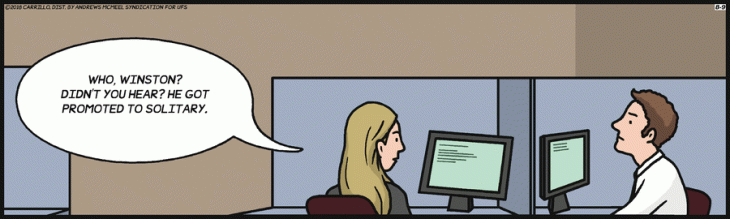
Seems to be gently mocking recent generations of workers, who have come up expecting to work in cubicles or “open” office plans, a closed office is seen as solitary confinement.
There has been much made of younger workers seeming to prefer these types of offices because they improve collaboration, Research is starting to push back on that and will probably all but prove that most of the “open office” movement was not about catering to young workers (who did not, generally, ever really want these types of offices) so much as it was about companies reducing floor space and saving money on rent.
The goal of open office design was to improve collaboration. Turns out, open offices don’t actually foster collaboration.
A secondary goal of open office design is to show status, so that people who do not have their own (closed) offices will work harder to earn one.
(This goes back to at least 1979, when Les Nessman of WKRP insisted that his job required an enclosed office, setting up a running joke for the entire series.)
I’ve worked in open offices that worked well, and open offices that didn’t. I think it had more to do with the people working in them than anything else.
As I was getting ready to leave Megacorp, they were talking about going to the open office concept. Kind of full circle. When I started there in the 80s, we in a “bullpen”, just a sea of desks. Later the big improvement was the “boxcar” model, where the sea was divided up into like 12 desk units. Then various single cube configurations.
billytheskink: I’ve never heard it claimed that any workers, young or old, actually liked the open office model. I always thought it was purely to save money.
The cartoon is drawn as if the characters are trapped in some sort of a grey prison, with the inmates thinking they are at least in a type of shared cell space. Having your own office space is normally an improvement in an office setting, except that in a prison-like workspace that means you are stuck in the same general dull environment but with less personal contact with others.
Winter Wallaby: There has been a recent effort to frame the open office as something desired by “millennials” now that they have begun to enter the workforce en masse. Companies that switch to or have had open floor plans will tout them in an effort to appeal to younger workers and appear modern.
I toured an office brokerage company’s recently renovated office in a skyscraper a few moths back and they glowingly touted their open concept, which had no assigned workspaces for employees at any level and the few closed rooms for private working could only be occupied for short lengths of time. This made them cutting edge and appealing to the young folks, they claimed, before letting the real reason slip… they had cut their SF/employee ration nearly in half and were able to vacate close to half of the office space that they used to occupy in a building. They did not say whether or not they had been successful finding a tenant for the space they had left (they brokered leases for the building as well as occupied space).
Some offices have the employees work at home a good bit of the time and so they just need places to set up the laptop when they happen to be in the office for some reason. That’s different from having this open concept for mostly resident workers.
I don’t believe for a minute that younger people want to be able to move and talk freely. My experience is that they prefer to use email or IM even if they’re sitting within across the aisle from you.
There weren’t enough introverts around to staff all the software engineering jobs so software engineering changed to favor extroverts. I rarely developed an algorithm in my last ten years of software engineering. It became all finding the right components in Apache or Github and wiring them together. It wasn’t fun any more so I retired and went back to college.
Or you needed a different gig. My last venture at Megacorp was writing the control software for test instrumentation. Kind of nice closure to my career, as I had started out as a test engineer.
Here, Here, Mark in Boston. My MegaCorp jump-started my retirement, but I can’t say I wasn’t happy to get out of there. In the end, I was supporting a major HRMS product (which I just discovered is now owned by Oracle, when did that happen?) In previous systems, I could make and test a customer change in a couple of days. With PoS it usually took a week just to find where the relevant module lived. It then took another week communicating with their support staff, because the module didn’t behave the way it was documented..
Ironically, in my first IT job, I was the only programmer in the department, and had my own office. It wasn’t until I joined MegaCorp that I moved into the cube farm.
As for the OP, when I first read it, my mind went to Orwell’s 1984, but that is a little too obscure, and didn’t make total sense.
Having had my own office and “open office,” I find it impossible to believe that workers prefer open office. That has to be something some boss made up.
Mercifully, I got through my career without ever having to deal with an “open office.” And mercifully, I’ve never been in prison, but I’ve always thought that if I did somehow wind up there, I might indeed think of solitary as a “promotion.” (Oh, gee, you mean I will lose the stimulating conversation of hundreds of thugs I would, in the outside world, try to cross the street to avoid interacting with? But, if I am alone in solitary (sort of like the way I spend much of day already all alone in my home office/computer room), who will I find to pay me much-needed human interaction attention such as shivving me for cigarettes (not believing I don’t even smoke) or sexually assaulting me?
(Yes, I know that “solitary” has other problems, notably that one is generally not allowed reading matter or other brain stimulation, and that’s an unpleasant thought, but even so it sounds to me like an upgrade over an “open office” version of a prison environment.)
The only “open” offices I’ve ever seen have been in movies(*), such as Jack Lemmon’s insurance company in “The Apartment”, or the newsroom in “All the President’s Men”. Neither one seemed to be an enjoyable place to work.
P.S. Or cartoons, such as “Paperman” and “Inner Workings“, but in both of those cases the odiousness of the workplace is intentional (for comic and/or narrative purposes).
P.P.S. @ Shrug – The only advantage that I can see in an “open” office (over a “solitary” one) is that you would at least have witnesses in the case of assault.
@ IarK – Twenty Twelve and W1A are different series, though by the same team, and with Hugh “Downton Abbey” Bonneville starring in both. In 2012 he was Head of Deliverance of the Olympic Deliverance Commission in the run-up to the 2012 London Olympics, in W1A (part of the post code of the BBC, which in full is W1A 1AA) he had moved and was Head of Values at the BBC. In both he is caught up in – and one of the generators of – various bits of managerial and marketing chaos and confusion as issues bubble up and get resolved or shelved or cause everyone to tear their hair out.
I think it’s Winston Smith, from Orwell’s novel. “Solitary” is a euphemism for whatever. I guess “promoted” is a euphemism also. Big Brother and all that.
Thanks narmitaj — I guess I should have looked for a wiki or something instead of going off half-cocked. When I couldn’t find the one in my library catalog, and I found the second with the same cast, I just assumed that it was one of those stupid we’ve-changed-the-name-because… well, because, because — I don’t know! Who is being protected by changing Wally to Waldo? “Wally” doesn’t have any negative connotations in the US (see Pixar’s Wall-e), and the British seem to have no problems calling him Wally, and they invented him, so really, what the $%$! is the point??!
I’m often frustrated that so little British content makes its way across the pond to us in the colonies — it’s such low hanging fruit! You don’t have to do much more than package it — no, thank you, I don’t want it “translated”, just make it available! I have said in past I would gladly trade 500 cable channels for the four big British channels, complete with original advertising where applicable. Instead we get “BBCAmerica”, which is so bereft of original programing that at one point they were showing Star Trek reruns, for goodness sake!
Books is another one: the stuff you can’t get here that is bestseller material there (and Australian stuff, same) — boggles the mind!
 Comics I Don't Understand
Me, I thrive in solitary. Some cubicle workers still need social interaction, which is the point of the strip.
LikeLike
Seems to be gently mocking recent generations of workers, who have come up expecting to work in cubicles or “open” office plans, a closed office is seen as solitary confinement.
There has been much made of younger workers seeming to prefer these types of offices because they improve collaboration, Research is starting to push back on that and will probably all but prove that most of the “open office” movement was not about catering to young workers (who did not, generally, ever really want these types of offices) so much as it was about companies reducing floor space and saving money on rent.
LikeLike
The goal of open office design was to improve collaboration. Turns out, open offices don’t actually foster collaboration.
A secondary goal of open office design is to show status, so that people who do not have their own (closed) offices will work harder to earn one.
(This goes back to at least 1979, when Les Nessman of WKRP insisted that his job required an enclosed office, setting up a running joke for the entire series.)
I’ve worked in open offices that worked well, and open offices that didn’t. I think it had more to do with the people working in them than anything else.
LikeLike
As I was getting ready to leave Megacorp, they were talking about going to the open office concept. Kind of full circle. When I started there in the 80s, we in a “bullpen”, just a sea of desks. Later the big improvement was the “boxcar” model, where the sea was divided up into like 12 desk units. Then various single cube configurations.
LikeLike
billytheskink: I’ve never heard it claimed that any workers, young or old, actually liked the open office model. I always thought it was purely to save money.
LikeLike
The cartoon is drawn as if the characters are trapped in some sort of a grey prison, with the inmates thinking they are at least in a type of shared cell space. Having your own office space is normally an improvement in an office setting, except that in a prison-like workspace that means you are stuck in the same general dull environment but with less personal contact with others.
LikeLike
I’ve heard open office (not the desktop software) sold as a way to more interaction among employees.
LikeLike
Winter Wallaby: There has been a recent effort to frame the open office as something desired by “millennials” now that they have begun to enter the workforce en masse. Companies that switch to or have had open floor plans will tout them in an effort to appeal to younger workers and appear modern.
I toured an office brokerage company’s recently renovated office in a skyscraper a few moths back and they glowingly touted their open concept, which had no assigned workspaces for employees at any level and the few closed rooms for private working could only be occupied for short lengths of time. This made them cutting edge and appealing to the young folks, they claimed, before letting the real reason slip… they had cut their SF/employee ration nearly in half and were able to vacate close to half of the office space that they used to occupy in a building. They did not say whether or not they had been successful finding a tenant for the space they had left (they brokered leases for the building as well as occupied space).
LikeLike
Open office and “hot desk” concepts as implemented at the BBC were among the targets of a really funny series called “W1A”.
https://www.imdb.com/title/tt3610926/reference
LikeLike
Some offices have the employees work at home a good bit of the time and so they just need places to set up the laptop when they happen to be in the office for some reason. That’s different from having this open concept for mostly resident workers.
I don’t believe for a minute that younger people want to be able to move and talk freely. My experience is that they prefer to use email or IM even if they’re sitting within across the aisle from you.
LikeLike
There weren’t enough introverts around to staff all the software engineering jobs so software engineering changed to favor extroverts. I rarely developed an algorithm in my last ten years of software engineering. It became all finding the right components in Apache or Github and wiring them together. It wasn’t fun any more so I retired and went back to college.
LikeLike
Or you needed a different gig. My last venture at Megacorp was writing the control software for test instrumentation. Kind of nice closure to my career, as I had started out as a test engineer.
LikeLike
Apparently W1A was renamed Twenty-twelve for American audiences…
LikeLike
Here, Here, Mark in Boston. My MegaCorp jump-started my retirement, but I can’t say I wasn’t happy to get out of there. In the end, I was supporting a major HRMS product (which I just discovered is now owned by Oracle, when did that happen?) In previous systems, I could make and test a customer change in a couple of days. With PoS it usually took a week just to find where the relevant module lived. It then took another week communicating with their support staff, because the module didn’t behave the way it was documented..
Ironically, in my first IT job, I was the only programmer in the department, and had my own office. It wasn’t until I joined MegaCorp that I moved into the cube farm.
As for the OP, when I first read it, my mind went to Orwell’s 1984, but that is a little too obscure, and didn’t make total sense.
LikeLike
Should that have been “Hear, Hear?” I’m getting old.
LikeLike
This discussion about cubicle configurations would not be complete without a link to this classic Dilbert strip.
LikeLike
P.S. For those who dislike clicking on links:

LikeLiked by 1 person
Having had my own office and “open office,” I find it impossible to believe that workers prefer open office. That has to be something some boss made up.
LikeLike
Mercifully, I got through my career without ever having to deal with an “open office.” And mercifully, I’ve never been in prison, but I’ve always thought that if I did somehow wind up there, I might indeed think of solitary as a “promotion.” (Oh, gee, you mean I will lose the stimulating conversation of hundreds of thugs I would, in the outside world, try to cross the street to avoid interacting with? But, if I am alone in solitary (sort of like the way I spend much of day already all alone in my home office/computer room), who will I find to pay me much-needed human interaction attention such as shivving me for cigarettes (not believing I don’t even smoke) or sexually assaulting me?
(Yes, I know that “solitary” has other problems, notably that one is generally not allowed reading matter or other brain stimulation, and that’s an unpleasant thought, but even so it sounds to me like an upgrade over an “open office” version of a prison environment.)
LikeLike
The only “open” offices I’ve ever seen have been in movies(*), such as Jack Lemmon’s insurance company in “The Apartment”, or the newsroom in “All the President’s Men”. Neither one seemed to be an enjoyable place to work.
P.S. Or cartoons, such as “Paperman” and “Inner Workings“, but in both of those cases the odiousness of the workplace is intentional (for comic and/or narrative purposes).
P.P.S. @ Shrug – The only advantage that I can see in an “open” office (over a “solitary” one) is that you would at least have witnesses in the case of assault.
LikeLike
@ IarK – Twenty Twelve and W1A are different series, though by the same team, and with Hugh “Downton Abbey” Bonneville starring in both. In 2012 he was Head of Deliverance of the Olympic Deliverance Commission in the run-up to the 2012 London Olympics, in W1A (part of the post code of the BBC, which in full is W1A 1AA) he had moved and was Head of Values at the BBC. In both he is caught up in – and one of the generators of – various bits of managerial and marketing chaos and confusion as issues bubble up and get resolved or shelved or cause everyone to tear their hair out.
LikeLike
guero, it should have been “There, there, Mark in Boston.”
LikeLike
I think it’s Winston Smith, from Orwell’s novel. “Solitary” is a euphemism for whatever. I guess “promoted” is a euphemism also. Big Brother and all that.
LikeLike
Thanks narmitaj — I guess I should have looked for a wiki or something instead of going off half-cocked. When I couldn’t find the one in my library catalog, and I found the second with the same cast, I just assumed that it was one of those stupid we’ve-changed-the-name-because… well, because, because — I don’t know! Who is being protected by changing Wally to Waldo? “Wally” doesn’t have any negative connotations in the US (see Pixar’s Wall-e), and the British seem to have no problems calling him Wally, and they invented him, so really, what the $%$! is the point??!
I’m often frustrated that so little British content makes its way across the pond to us in the colonies — it’s such low hanging fruit! You don’t have to do much more than package it — no, thank you, I don’t want it “translated”, just make it available! I have said in past I would gladly trade 500 cable channels for the four big British channels, complete with original advertising where applicable. Instead we get “BBCAmerica”, which is so bereft of original programing that at one point they were showing Star Trek reruns, for goodness sake!
Books is another one: the stuff you can’t get here that is bestseller material there (and Australian stuff, same) — boggles the mind!
LikeLike
In a prison, solitary is a punishment; in a cubicle workplace, solitary is a reward.
Hence, a cellmate is better than a colleague ;) .
LikeLike
@ranedeer. I was Thi king Winston Smith too. Promoted to Room 101 of course.
LikeLike