This was queued up hours before guero sent it to me — but his subject line was so much better than mine, I had to quickly change it.
Related
12 Comments
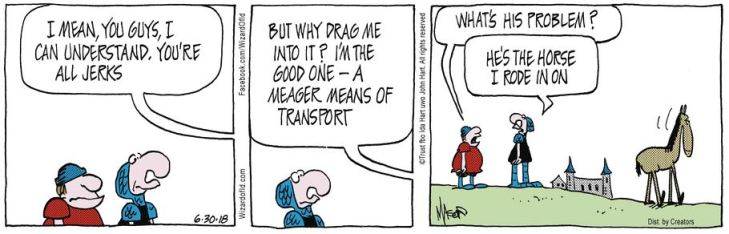
“…. and the horse you rode in on” is such a common place expression, I don’t think it necessarily evokes the obscenity that frequently precedes it.
But do you want to explain the reference to your 7-year-old?
“Curse you and the horse you rode in on” is suitable for 7, yes?
“do you want to explain the reference to your 7-year-old?”
Sure.
They said something mean about you. But it was EXTRA mean, so it was not just about you… they said something mean about you, AND the horse you rode in on.
Explaining things to a 7-year-old isn’t as hard as you think.
It’s not much different than “So’s your old man” and “Yeah, your mama”…. neither of which would I want to explain to a 7-year old. It’s actually not so well known an expression that I read this entire book in my thirties and didn’t get the joke until the last page.
Actually, I had to teach my son that phrase when he was 9.
The backstory was, about 20 years ago, for reasons not worth going into, my brothers and I were having dinner with some well-known actors. At one point, the actress — who might have had a drink or two, which is why I’m not naming names — asked my brother where his wife was and he said she wasn’t feeling well so she stayed home. The actress responded with “Well, then, — her and — the horse she rode in on.”
And my brother just looks at her and says “I would thank you not to insult my wife OR the horse she rode in on.”
So anyway a few weeks later my son and I are flying cross-country. It’s his first flight and suffice it to say it was NOT a good flight. So I decide to tell him stories about that night with the actors, to take his mind off the fact that we were bouncing around. And finally the turbulence had reached the level where I had to break out the Big Gun: the amusing story with the naughty language.
In movies, comics and elsewhere, a character being ejected from some building is almost inevitably followed by a bouncer or guard shouting “And stay out!” It’s understood we just missed hearing the first half of the line “Get out and stay out!”, Yet the complete line is far rarer than the short “And stay out!”, so do younger generations grasp that they’re expected to fill in the complete version?
If someone has been physically ejected, I think that “get out” isn’t needed, and that “and stay out” stands on its own, regardless that it starts with “and”.
Woozy: I was going to mention the Martha Grimes book, too . . . you forgot to mention that this title, as with all Martha Grimes’ Inspector Jury titles, is the name of an actual pub, located in Baltimore, MD, rather than in the UK. (I am an avid fan of this series, can you tell?)
“If someone has been physically ejected, I think that ‘get out’ isn’t needed”
I concur.
Actions speak louder than words, but can also convey exactly the same words.
I don’t know how this happened, but I was ignorant of the phrase, and when I first heard it in a movie assumed the scriptwriters cleverly made it up to give some character a special spark; or if they didn’t invent it, they were among the earliest to notice and make record of it from vernacular speech around them.
I was so set on crediting them, as I later heard it more often, I still tended to think of it as copied (knowingly or not) from that movie.
And now I can’t recall what the movie was! I think it had Paul Newman. I’m tempted to say “Horseman on the Roof” but that’s probably just subconscious linking because of the horse,
 Comics I Don't Understand
“…. and the horse you rode in on” is such a common place expression, I don’t think it necessarily evokes the obscenity that frequently precedes it.
But do you want to explain the reference to your 7-year-old?
“Curse you and the horse you rode in on” is suitable for 7, yes?
“do you want to explain the reference to your 7-year-old?”
Sure.
They said something mean about you. But it was EXTRA mean, so it was not just about you… they said something mean about you, AND the horse you rode in on.
Explaining things to a 7-year-old isn’t as hard as you think.
It’s not much different than “So’s your old man” and “Yeah, your mama”…. neither of which would I want to explain to a 7-year old. It’s actually not so well known an expression that I read this entire book in my thirties and didn’t get the joke until the last page.
Actually, I had to teach my son that phrase when he was 9.
The backstory was, about 20 years ago, for reasons not worth going into, my brothers and I were having dinner with some well-known actors. At one point, the actress — who might have had a drink or two, which is why I’m not naming names — asked my brother where his wife was and he said she wasn’t feeling well so she stayed home. The actress responded with “Well, then, — her and — the horse she rode in on.”
And my brother just looks at her and says “I would thank you not to insult my wife OR the horse she rode in on.”
So anyway a few weeks later my son and I are flying cross-country. It’s his first flight and suffice it to say it was NOT a good flight. So I decide to tell him stories about that night with the actors, to take his mind off the fact that we were bouncing around. And finally the turbulence had reached the level where I had to break out the Big Gun: the amusing story with the naughty language.
In movies, comics and elsewhere, a character being ejected from some building is almost inevitably followed by a bouncer or guard shouting “And stay out!” It’s understood we just missed hearing the first half of the line “Get out and stay out!”, Yet the complete line is far rarer than the short “And stay out!”, so do younger generations grasp that they’re expected to fill in the complete version?
If someone has been physically ejected, I think that “get out” isn’t needed, and that “and stay out” stands on its own, regardless that it starts with “and”.
Woozy: I was going to mention the Martha Grimes book, too . . . you forgot to mention that this title, as with all Martha Grimes’ Inspector Jury titles, is the name of an actual pub, located in Baltimore, MD, rather than in the UK. (I am an avid fan of this series, can you tell?)
“If someone has been physically ejected, I think that ‘get out’ isn’t needed”
I concur.
Actions speak louder than words, but can also convey exactly the same words.
I don’t know how this happened, but I was ignorant of the phrase, and when I first heard it in a movie assumed the scriptwriters cleverly made it up to give some character a special spark; or if they didn’t invent it, they were among the earliest to notice and make record of it from vernacular speech around them.
I was so set on crediting them, as I later heard it more often, I still tended to think of it as copied (knowingly or not) from that movie.
And now I can’t recall what the movie was! I think it had Paul Newman. I’m tempted to say “Horseman on the Roof” but that’s probably just subconscious linking because of the horse,
In case you doubted Woozy et moi . . .
https://www.atlasobscura.com/places/the-horse-you-came-in-on-saloon