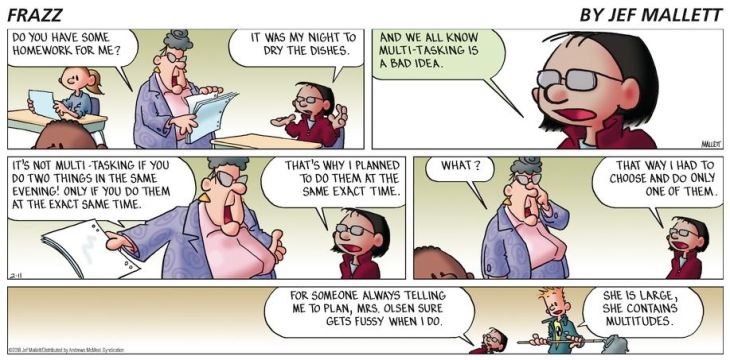
I don’t see a gratuitous insult here. The kid used some silly logic to avoid doing her homework, and Mrs. Olsen, understandably, found it frustrating. The last line is just a funny way for Frazz to (sarcastically) say (with a Whitman reference) that she’s contradicting herself, but not a statement from the cartoonist that she’s actually contradicting herself.
Apparently the last line “She is large, she contains multitudes” is from Walt Whitman, and is supposed to be a comment about her complexity. I’d say what Winter Wallaby says is right: while it appears to the kid that Mrs. Olsen is contradicting herself, we all can see that she’s not really. The kid just twisted the idea to try to get out of work, as all kids seem to do (at least mine do!).
I interpret this as Frazz is saying that there is more to both the situation and Mrs. Olsen than it might seem at first glance.
The Whitman quote (from “Song of Myself”) is:
Do I contradict myself?
Very well then I contradict myself,
(I am large, I contain multitudes.)
To me, the point is that is that any sufficiently complex and interesting person is bound to include some self-contradictory qualities.
Not only do I not see a gratuitous insult, I see the comment as somewhat complementary.
Though Frazz is mostly defending Mrs. Olsen, the “large” may be intended to also suggest her physical appearance, even despite its role in the Whitman allusion.
At one organization where I worked, and often had lunch with people from a different division, who worked more closely with the overall boss of the whole place, they enjoyed [slightly mis-]quoting Hobbes on the “life of man” before civilisation and describing this guy as “nasty, brutish, and short.” He was not tall.
>>Though Frazz is mostly defending Mrs. Olsen, the “large” may be
>>intended to also suggest her physical appearance
I agree that you can certainly read it that way as well (although I think this is a secondary meaning), which is why I considered the comment to be only somewhat complementary.
You can read it as a fat joke, but I assumed that Jef Mallett was too classy for that, and that that interpretation was unintentional.
I agree with the sentiment previously offered that, although it is not the thrust of the comment, it can be taken as a fat joke, and likely would have been by the intended audience (of a school-aged child, I mean, not the meta-ness of the comics readers. At that level, I expect that some Frazz readers, specifically, could be expected to recognize the quote and identify the original context and thus perceive the fullness of the meaning, whereas a substantial portion of comics readership might be expected to recognize it as a poetic quote, and thus not accepting the words on their face, even if they don’t have sufficient familiarity with Whitman’s work to spot it straight out.)
At least it wasn’t, ‘She is legion, for she is many’
Is anyone else bothered by the redundancy of ‘exact same’? I know I am, but then, I’ve been called Ms. Pedant, a name of which I am proud.
An amusing addendum to my previous comment:
(When I told someone I’d watch this, he told me, ‘Watch it? You’d STAR in it!”)
Andréa: I disagree that “exact same” is redundant. The common usage of “same” includes things that aren’t identical, so adding “exact” does add extra information/emphasis/clarity. For example, the following conversation scans fine for me:
Alice: Gosh, I was so embarassed, we were wearing the same outfit!
Bob: Really, exactly the same?
Alice: Well, her skirt was a little longer, but otherwise, yeah.
In the comic, that the two proposed times are exactly the same is implied by the context, so the word “exact” is more for emphasis than for clarify, but it still seems legitimate to me.
“Is anyone else bothered by the redundancy of ‘exact same’?”
No, because it isn’t redundant. Was this the pedantic response you were expecting?
Re: Dr. Whom
This got me thinking that there is something wrong with a title in objective case; a title names something, i.e.: it should be nominative — The Merchant of Venice, The Girl with the Dragon Tattoo, Withnail and I; of course, if you have a preposition in the title, then you can have the objective: Of Mice and Men, For Whom the Bell Tolls, With Nail and Me. But then what of genitive titles? Dr. Caligari’s Cabinet? Ha! It’s The Cabinet of Dr. Caligari! “Jesse’s Girl”? His Dark Materials? Interestingly, the genitive seems more about making an adjective of one noun to modify a second, so, it’s really about the Cabinet, or the Girl, or the Materials — nominative.
Of course, I’m sure there are examples of titles in objective case without prepositions, something like Her, but would those not just be cases of the objective case being used as the nominative, e.g.: “Me and Julio Down by the Schoolyard”?
And I’ll answer myself, because I just thought of the definitive proof against my thesis, Rupert Holmes’ “Him”: No! In the song, the word “him” is used correctly through-out, repeating to emphasize the singer’s paranoia and jealousy, and as the repeated motif of the song, it makes perfect sense for the title; calling the song “He” would be ambiguous and confusing and miss the whole point.
Maybe the Doctor needs his name to be inflected depending on the usage: The Daleks killed Adric and Dr. Whom; Dr. Whose Tardis landed on my foot; Give back Dr. Whom his sonic screwdriver.
I know a linguist whose alias is:
Dr. Whom, Consulting Linguist, Grammarian, Orthoepist, and Philological Busybody
I look out the window and see the people I don’t like headed straight for my front door and I say “Oh no! It’s THEM!” Then I correct my grammar, as “is” takes a predicate nominative: “Oh no! It’s THEY!” Then I correct my grammar so that the subject agrees in number with the predicate nominative. “Oh no! They’s THEY!” Then I correct my grammar so that the verb agrees in number with the subject: “Oh no! They are THEY!”
LarK – you do mean “her” name when referring to Doctor Who/Whom?
“you do mean ‘her’ name when referring to Doctor Who/Whom?”
Sure, and now Lt. Starbuck is girl, too.
@ larK – There are languages that still retain the “vocative” case (such as in Latin), which is (or was) used for “naming” things. I don’t know anywhere near enough about it to say whether this would be appropriate for titles, but there is a parallel oddity in German: the standard form for the salutation of a letter uses the name in “nomitive” case (“Sehr geehrter Herr larK,“), but in the address on the envelope, the name is put in “accusative” case (“An: Herrn larK“). Logical? Not really.
James says: Sure, and now Lt. Starbuck is girl, too.
Oddly enough, within the last week I have received notices from Amazon that new episodes are available for two series I felt sure were completed and closed long ago – – one of them this Battlestar Galactica. (The other was Fringe.) They looked and were phrased just like similar notices for current series.
I figured these were replacements for videos they decided were badly handled, technically. Maybe badly synced or something like that. But on reflection, I think I have gotten notices explicitly saying that. So instead, maybe new promotional montages, long enough to be counted as “bonus episode”?
I know, I know, all I have to do is go find these and watch a little : but I just haven’t gotten around to assuaging my curiosity.
I kneel before my Grammarian overlords. This site should be part of the MENSA eligibility process.
I interpret ‘same’ and ‘exact’ as absolutes, unmodifiable. But that’s just me . . .
There’s no need to change “It is THEY” to “They are THEY”, because the implied antecedent of “It” is not “the people coming down the walk” but “the activity going on outside”.
I’m not a DR. WHO geek, but my understanding was that the lead character did not have a name other than “the Doctor,” and that the “who” part makes it a question. If so, I don’t know why the BBC couldn’t spring for a question mark at the end, though (they’re not all that expensive, unlike things like utterbangs which of course have to be individually hand-crafted).
And as an old English major myslef, I’ve always been irritated by the trope that “whom” is swankier than “who” and using it in ever instance shows you are (a) highly education and/or (b) a prentitious jerk. Sometimes one is correct in a sentence, sometimes the other, but the usual joke assumption is that “whom” is always classier, if you want to depict your character that way. Pfui.
re
Alice: Gosh, I was so embarassed, we were wearing the same outfit!
Bob: Really, exactly the same?
shouldn’t Bob’s reply actually be “How could you both fit in it at once, or did you take turns”?
Dear Mister Language Person: When do you say “who, ” and when do you say “whom”?
A. You say “who” when you want to find out something, like for example if a friend of yours comes up and says, “You will never guess which of your immediate family members just lost a key limb in a freak Skee-Ball accident, ” you would reply: “Who?” You say “whom” when you are in Great Britain or you are angry (as in: “And just WHOM do you think is going to clean up after these otters?”).
Ugh, really? Blockquotes are red?
I take Dave Barry’s advice on EVERYthing! Including buying his books. Just gave one to my therapist – he looked like he needed a laff.
Winter, it was either that or Grasshopper Green.
And nobody wants Grasshopper Green.
Bill: Fair enough. (Surprised they let you choose.)
“I interpret ‘same’ and ‘exact’ as absolutes, unmodifiable. But that’s just me”
In the US tax law, and subsequently the IRS publications, there is the concept of “substantially identical” securities, including mutual funds. This has to do with wash sales, which I won’t go into. There is little explanation of the term or what makes one thing “substantially identical” to another.
There are essentially no cases of the IRS applying the rule to things that are not absolutely identically. Yet the vagueness tends to make some people fearful. Some make up their own interpretations.
“shouldn’t Bob’s reply actually be ‘How could you both fit in it at once, or did you take turns’?”
Maybe the garment in question is one of those Dr. Seuss styles with 8 neckholes and 23 armholes, that two people could wear at the same time.
Winter, pretty much everything is a surprise: basically, I’ve been handed a toy without an instruction manual.
@larK, re: “Me and Julio Down by the Schoolyard”?
In the song, “me” is always the object of the “seeing” (or “seein'” as the case may be).
As far as Rupert Holmes, I tend avoid getting my examples from a guy who thinks adultery is adorable, or that cannibalism makes a good subject for a pop song… ;^)
Ah, I always heard it as “singin’: me and Julio”.
The first search result has it as “see you, me, and Julio…” :-)
Most of the rest agree with you. Hmm….
As for Rupert Holmes, I make no excuses, other than that he got a lot of airplay and I was forced to listen to over an hour of it each day as I was involuntarily bussed to school each day and back (not because of bussing, I just lived at the end of the bus route (for elementary school it was less than 5 minutes, but that changed when I moved up to the middle school, just about coinciding with Rupert’s brief but ubiquitous career); and involuntarily because the state never asked me if I wanted to go to school…) — and not that it was an hour exclusively comprised of Rupert’s greatest hits, though he was represented an awful lot…
And while I’m here, I want to retract my blanket endorsement of Rupert’s grammar in “Him”: the final line of the chorus is: “It’s me or it’s him”, and then deeper in he compounds it with: “It’s goodbye to he and I”.
I had to look up the cannibalism reference, though; apparently my forced indoctrination at a tender age was somewhat remiss…
So ja has made me rethink my whole premise, and now I’m thinking a title must always be in the objective case, as there is always an implied preposition or gerund: A Play about the Merchant of Venice; A Book involving the Girl with the Dragon Tattoo; A Movie of the Adventures of Withnail and Me; A Song about Jesse’s Girl; Tales of his dark Materials; Concerning Him; Singing about Me and Julio down by the Schoolyard; Regarding the King and Me; In which Billy Joel Sings about how Her’s got a Way about She…
And “For Him is a jolly good Fellow”…
Brian in STL – it is a questions of “I know it when I see it” with IRS.
Question, not questions – just had to run up and do paperwork for a sale Robert made and my mind is not back here yet.
“Brian in STL – it is a questions of “I know it when I see it” with IRS.”
Well, they don’t seem to see it. But for some reason people are almost terrified, even though as is often pointed out, wash sales aren’t illegal. It’s also not much of a profit center for the IRS, so I think they’re just satisfied to go with exactly identical on mutual funds and ETFs.
So “wash sales” aren’t money laundering? :-)
Vocative in Latin is for addressing people directly. You could title something “Marce et Quinte” but the English rendering of that would be something like “Hey, Marcus and Quintus”.
“So ‘wash sales’ aren’t money laundering?”
They can be, actually. That’s not what the IRS is looking for, but…
Not in these particular circumstances. This has to do with “tax-loss harvesting” and its benefits.
DiB : “Hey” or “O” ? (as in “O say can you see”, maybe?)
Here’s Rostand’s “Hymn to the Sun”:
“O Sun, I adore thee! Thou fillest with roses the breeze,
With gods the woodland, with flames the brook as it flees;
Thou defiest, O Sun, the humble trees.
The world, without thy beam,
Would only be, not seem. “
Depends on the formality level. Nobody uses O in ordinary speech or even things like titles of novels.
“Nobody uses O in ordinary speech”
O Hell No.
DiB : ok, thanks (although there’s always an exception to prove the rule: “O pioneers !”).
Would “Why” as in “Why you little…!” belong to the same category ?
There’s “O Canada” but “Oh Calcutta!”
“There’s ‘O Canada’ but ‘Oh Calcutta!’”
And there’s O’hio. Or is it OH?
James, that’s “Oh”, not “O”. You’re not addressing hell.
Olivier: kinda. In Latin, vocative is used whenever you address someone (like at the beginning of this line) — the question was how one might render that into English if you had a title that was just (a) name(s) in the vocative. If you had a title like “Tace, Quinte Stulte” you might render it in English as “Shut up, Quintus you fool”, which neither has nor needs anything to mark the case.
James, that’s “Oh”, not “O”. You’re not addressing hell.
I had thought of making a similar claim. But my two most
convenient dictionaries suggest that “o” can be used instead of
“oh” in most cases. One of them is a very old unabridged, so the
confusion of these words is not new.
James Pollock and Brian in STL – jeez guys, Dave in Boston even used the little smiley face guy, and you still got wooshed
“you still got wooshed”
I got what, now?
Hmmm, seem to have dropped an h, after correcting the autocorrect. whooshed, better?
Yeah, that one doesn’t make any sense either.
“Wash sale” – “money laundering”. “It’s a joke, son. You’re supposed to laugh.” – F. Leghorn
Right. And? Was there a point coming? Or is that just the top of your head?
 Comics I Don't Understand
I don’t see a gratuitous insult here. The kid used some silly logic to avoid doing her homework, and Mrs. Olsen, understandably, found it frustrating. The last line is just a funny way for Frazz to (sarcastically) say (with a Whitman reference) that she’s contradicting herself, but not a statement from the cartoonist that she’s actually contradicting herself.
Apparently the last line “She is large, she contains multitudes” is from Walt Whitman, and is supposed to be a comment about her complexity. I’d say what Winter Wallaby says is right: while it appears to the kid that Mrs. Olsen is contradicting herself, we all can see that she’s not really. The kid just twisted the idea to try to get out of work, as all kids seem to do (at least mine do!).
I interpret this as Frazz is saying that there is more to both the situation and Mrs. Olsen than it might seem at first glance.
The Whitman quote (from “Song of Myself”) is:
Do I contradict myself?
Very well then I contradict myself,
(I am large, I contain multitudes.)
To me, the point is that is that any sufficiently complex and interesting person is bound to include some self-contradictory qualities.
Not only do I not see a gratuitous insult, I see the comment as somewhat complementary.
Though Frazz is mostly defending Mrs. Olsen, the “large” may be intended to also suggest her physical appearance, even despite its role in the Whitman allusion.
At one organization where I worked, and often had lunch with people from a different division, who worked more closely with the overall boss of the whole place, they enjoyed [slightly mis-]quoting Hobbes on the “life of man” before civilisation and describing this guy as “nasty, brutish, and short.” He was not tall.
>>Though Frazz is mostly defending Mrs. Olsen, the “large” may be
>>intended to also suggest her physical appearance
I agree that you can certainly read it that way as well (although I think this is a secondary meaning), which is why I considered the comment to be only somewhat complementary.
You can read it as a fat joke, but I assumed that Jef Mallett was too classy for that, and that that interpretation was unintentional.
I agree with the sentiment previously offered that, although it is not the thrust of the comment, it can be taken as a fat joke, and likely would have been by the intended audience (of a school-aged child, I mean, not the meta-ness of the comics readers. At that level, I expect that some Frazz readers, specifically, could be expected to recognize the quote and identify the original context and thus perceive the fullness of the meaning, whereas a substantial portion of comics readership might be expected to recognize it as a poetic quote, and thus not accepting the words on their face, even if they don’t have sufficient familiarity with Whitman’s work to spot it straight out.)
At least it wasn’t, ‘She is legion, for she is many’
Is anyone else bothered by the redundancy of ‘exact same’? I know I am, but then, I’ve been called Ms. Pedant, a name of which I am proud.
An amusing addendum to my previous comment:

(When I told someone I’d watch this, he told me, ‘Watch it? You’d STAR in it!”)
Andréa: I disagree that “exact same” is redundant. The common usage of “same” includes things that aren’t identical, so adding “exact” does add extra information/emphasis/clarity. For example, the following conversation scans fine for me:
Alice: Gosh, I was so embarassed, we were wearing the same outfit!
Bob: Really, exactly the same?
Alice: Well, her skirt was a little longer, but otherwise, yeah.
In the comic, that the two proposed times are exactly the same is implied by the context, so the word “exact” is more for emphasis than for clarify, but it still seems legitimate to me.
“Is anyone else bothered by the redundancy of ‘exact same’?”
No, because it isn’t redundant. Was this the pedantic response you were expecting?
Re: Dr. Whom
This got me thinking that there is something wrong with a title in objective case; a title names something, i.e.: it should be nominative — The Merchant of Venice, The Girl with the Dragon Tattoo, Withnail and I; of course, if you have a preposition in the title, then you can have the objective: Of Mice and Men, For Whom the Bell Tolls, With Nail and Me. But then what of genitive titles? Dr. Caligari’s Cabinet? Ha! It’s The Cabinet of Dr. Caligari! “Jesse’s Girl”? His Dark Materials? Interestingly, the genitive seems more about making an adjective of one noun to modify a second, so, it’s really about the Cabinet, or the Girl, or the Materials — nominative.
Of course, I’m sure there are examples of titles in objective case without prepositions, something like Her, but would those not just be cases of the objective case being used as the nominative, e.g.: “Me and Julio Down by the Schoolyard”?
And I’ll answer myself, because I just thought of the definitive proof against my thesis, Rupert Holmes’ “Him”: No! In the song, the word “him” is used correctly through-out, repeating to emphasize the singer’s paranoia and jealousy, and as the repeated motif of the song, it makes perfect sense for the title; calling the song “He” would be ambiguous and confusing and miss the whole point.
Maybe the Doctor needs his name to be inflected depending on the usage: The Daleks killed Adric and Dr. Whom; Dr. Whose Tardis landed on my foot; Give back Dr. Whom his sonic screwdriver.
I know a linguist whose alias is:
Dr. Whom, Consulting Linguist, Grammarian, Orthoepist, and Philological Busybody
I look out the window and see the people I don’t like headed straight for my front door and I say “Oh no! It’s THEM!” Then I correct my grammar, as “is” takes a predicate nominative: “Oh no! It’s THEY!” Then I correct my grammar so that the subject agrees in number with the predicate nominative. “Oh no! They’s THEY!” Then I correct my grammar so that the verb agrees in number with the subject: “Oh no! They are THEY!”
LarK – you do mean “her” name when referring to Doctor Who/Whom?
“you do mean ‘her’ name when referring to Doctor Who/Whom?”
Sure, and now Lt. Starbuck is girl, too.
@ larK – There are languages that still retain the “vocative” case (such as in Latin), which is (or was) used for “naming” things. I don’t know anywhere near enough about it to say whether this would be appropriate for titles, but there is a parallel oddity in German: the standard form for the salutation of a letter uses the name in “nomitive” case (“Sehr geehrter Herr larK,“), but in the address on the envelope, the name is put in “accusative” case (“An: Herrn larK“). Logical? Not really.
James says: Sure, and now Lt. Starbuck is girl, too.
Oddly enough, within the last week I have received notices from Amazon that new episodes are available for two series I felt sure were completed and closed long ago – – one of them this Battlestar Galactica. (The other was Fringe.) They looked and were phrased just like similar notices for current series.
I figured these were replacements for videos they decided were badly handled, technically. Maybe badly synced or something like that. But on reflection, I think I have gotten notices explicitly saying that. So instead, maybe new promotional montages, long enough to be counted as “bonus episode”?
I know, I know, all I have to do is go find these and watch a little : but I just haven’t gotten around to assuaging my curiosity.
I kneel before my Grammarian overlords. This site should be part of the MENSA eligibility process.
I interpret ‘same’ and ‘exact’ as absolutes, unmodifiable. But that’s just me . . .
There’s no need to change “It is THEY” to “They are THEY”, because the implied antecedent of “It” is not “the people coming down the walk” but “the activity going on outside”.
I’m not a DR. WHO geek, but my understanding was that the lead character did not have a name other than “the Doctor,” and that the “who” part makes it a question. If so, I don’t know why the BBC couldn’t spring for a question mark at the end, though (they’re not all that expensive, unlike things like utterbangs which of course have to be individually hand-crafted).
And as an old English major myslef, I’ve always been irritated by the trope that “whom” is swankier than “who” and using it in ever instance shows you are (a) highly education and/or (b) a prentitious jerk. Sometimes one is correct in a sentence, sometimes the other, but the usual joke assumption is that “whom” is always classier, if you want to depict your character that way. Pfui.
re
Alice: Gosh, I was so embarassed, we were wearing the same outfit!
Bob: Really, exactly the same?
shouldn’t Bob’s reply actually be “How could you both fit in it at once, or did you take turns”?
Shrug: http://www.miamiherald.com/living/liv-columns-blogs/dave-barry/article1936919.html#2
Ugh, really? Blockquotes are red?
I take Dave Barry’s advice on EVERYthing! Including buying his books. Just gave one to my therapist – he looked like he needed a laff.
Winter, it was either that or Grasshopper Green.
And nobody wants Grasshopper Green.
Bill: Fair enough. (Surprised they let you choose.)
“I interpret ‘same’ and ‘exact’ as absolutes, unmodifiable. But that’s just me”
In the US tax law, and subsequently the IRS publications, there is the concept of “substantially identical” securities, including mutual funds. This has to do with wash sales, which I won’t go into. There is little explanation of the term or what makes one thing “substantially identical” to another.
There are essentially no cases of the IRS applying the rule to things that are not absolutely identically. Yet the vagueness tends to make some people fearful. Some make up their own interpretations.
“shouldn’t Bob’s reply actually be ‘How could you both fit in it at once, or did you take turns’?”
Maybe the garment in question is one of those Dr. Seuss styles with 8 neckholes and 23 armholes, that two people could wear at the same time.
Winter, pretty much everything is a surprise: basically, I’ve been handed a toy without an instruction manual.
@larK, re: “Me and Julio Down by the Schoolyard”?
In the song, “me” is always the object of the “seeing” (or “seein'” as the case may be).
As far as Rupert Holmes, I tend avoid getting my examples from a guy who thinks adultery is adorable, or that cannibalism makes a good subject for a pop song… ;^)
Ah, I always heard it as “singin’: me and Julio”.
The first search result has it as “see you, me, and Julio…” :-)
Most of the rest agree with you. Hmm….
As for Rupert Holmes, I make no excuses, other than that he got a lot of airplay and I was forced to listen to over an hour of it each day as I was involuntarily bussed to school each day and back (not because of bussing, I just lived at the end of the bus route (for elementary school it was less than 5 minutes, but that changed when I moved up to the middle school, just about coinciding with Rupert’s brief but ubiquitous career); and involuntarily because the state never asked me if I wanted to go to school…) — and not that it was an hour exclusively comprised of Rupert’s greatest hits, though he was represented an awful lot…
And while I’m here, I want to retract my blanket endorsement of Rupert’s grammar in “Him”: the final line of the chorus is: “It’s me or it’s him”, and then deeper in he compounds it with: “It’s goodbye to he and I”.
I had to look up the cannibalism reference, though; apparently my forced indoctrination at a tender age was somewhat remiss…
So ja has made me rethink my whole premise, and now I’m thinking a title must always be in the objective case, as there is always an implied preposition or gerund: A Play about the Merchant of Venice; A Book involving the Girl with the Dragon Tattoo; A Movie of the Adventures of Withnail and Me; A Song about Jesse’s Girl; Tales of his dark Materials; Concerning Him; Singing about Me and Julio down by the Schoolyard; Regarding the King and Me; In which Billy Joel Sings about how Her’s got a Way about She…
And “For Him is a jolly good Fellow”…
Brian in STL – it is a questions of “I know it when I see it” with IRS.
Question, not questions – just had to run up and do paperwork for a sale Robert made and my mind is not back here yet.
“Brian in STL – it is a questions of “I know it when I see it” with IRS.”
Well, they don’t seem to see it. But for some reason people are almost terrified, even though as is often pointed out, wash sales aren’t illegal. It’s also not much of a profit center for the IRS, so I think they’re just satisfied to go with exactly identical on mutual funds and ETFs.
So “wash sales” aren’t money laundering? :-)
Vocative in Latin is for addressing people directly. You could title something “Marce et Quinte” but the English rendering of that would be something like “Hey, Marcus and Quintus”.
“So ‘wash sales’ aren’t money laundering?”
They can be, actually. That’s not what the IRS is looking for, but…
Not in these particular circumstances. This has to do with “tax-loss harvesting” and its benefits.
DiB : “Hey” or “O” ? (as in “O say can you see”, maybe?)
Here’s Rostand’s “Hymn to the Sun”:
“O Sun, I adore thee! Thou fillest with roses the breeze,
With gods the woodland, with flames the brook as it flees;
Thou defiest, O Sun, the humble trees.
The world, without thy beam,
Would only be, not seem. “
Depends on the formality level. Nobody uses O in ordinary speech or even things like titles of novels.
“Nobody uses O in ordinary speech”
O Hell No.
DiB : ok, thanks (although there’s always an exception to prove the rule: “O pioneers !”).
Would “Why” as in “Why you little…!” belong to the same category ?
There’s “O Canada” but “Oh Calcutta!”
“There’s ‘O Canada’ but ‘Oh Calcutta!’”
And there’s O’hio. Or is it OH?
James, that’s “Oh”, not “O”. You’re not addressing hell.
Olivier: kinda. In Latin, vocative is used whenever you address someone (like at the beginning of this line) — the question was how one might render that into English if you had a title that was just (a) name(s) in the vocative. If you had a title like “Tace, Quinte Stulte” you might render it in English as “Shut up, Quintus you fool”, which neither has nor needs anything to mark the case.
I had thought of making a similar claim. But my two most
convenient dictionaries suggest that “o” can be used instead of
“oh” in most cases. One of them is a very old unabridged, so the
confusion of these words is not new.
James Pollock and Brian in STL – jeez guys, Dave in Boston even used the little smiley face guy, and you still got wooshed
“you still got wooshed”
I got what, now?
Hmmm, seem to have dropped an h, after correcting the autocorrect. whooshed, better?
Yeah, that one doesn’t make any sense either.
“Wash sale” – “money laundering”. “It’s a joke, son. You’re supposed to laugh.” – F. Leghorn
Right. And? Was there a point coming? Or is that just the top of your head?